Showing posts with label basho. Show all posts

Friday, March 16, 2018

Everything We've Loved Comes Back To Find Us - Allan Cooper (Gaspereau Press)

Today's book of poetry:
Everything We've Loved Comes Back To Find Us.  Allan Cooper.  Gaspereau Press.  Kentville, New Brunswick.  2017,
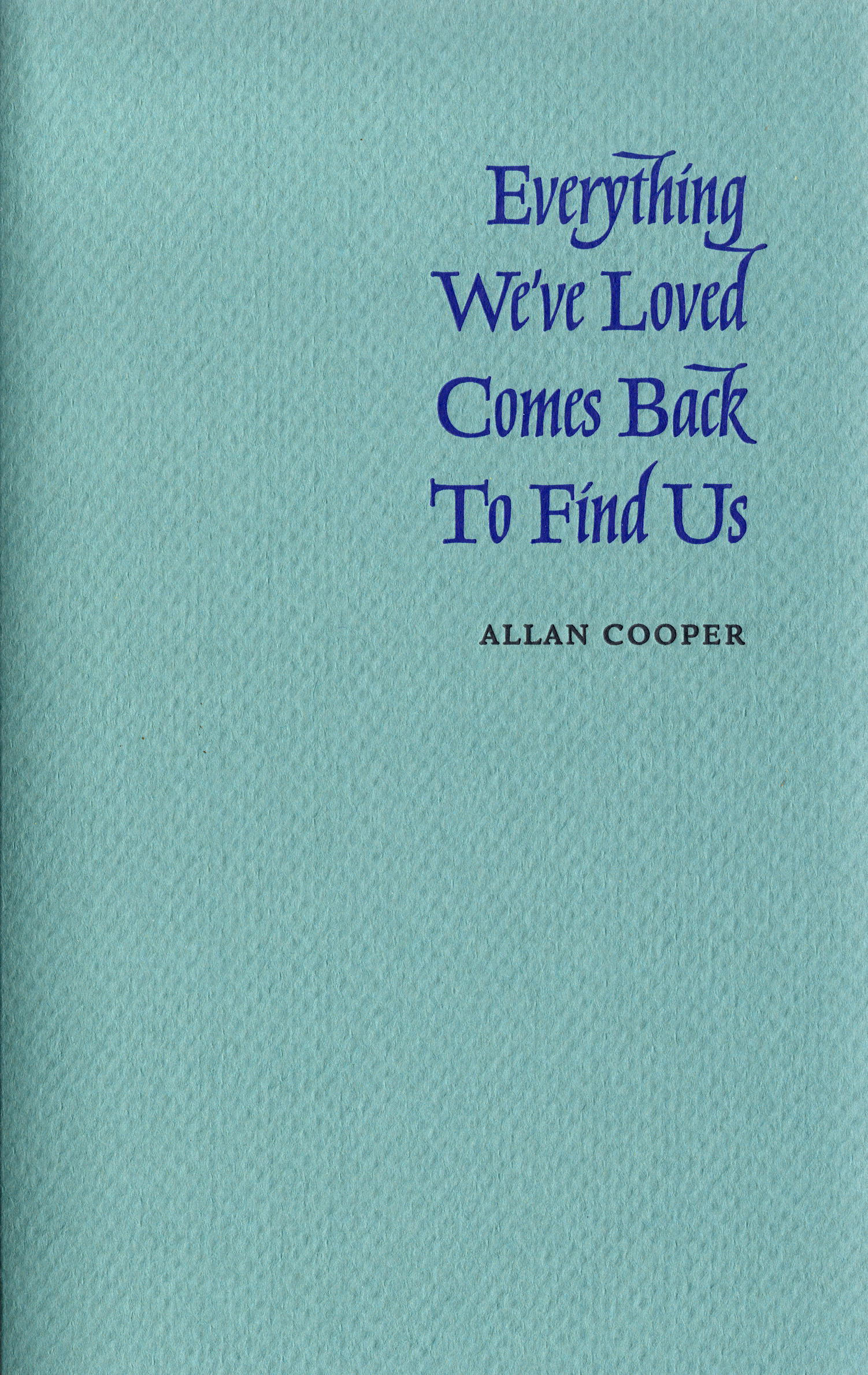

Allan Cooper's Everything We've Loved Comes Back To Find Us is a little like walking into a log-fire warmed home where you know you are welcome.  The opening section of Cooper's thoughtful and tender volume reads like an open letter to his granddaughter and his daughter.  But they could be the children of anyone, these themes are universal.  

Cooper's poem "Standing At The Open Door" is a joyous yawp of observant optimism and we can all use a good dose of that these days.  Allan Cooper would have us believe that there is much more to be celebrated beyond beauty.  Everything We've Loved Comes Back To Find Us will tell you "What the Cricket Said," and "The Young Raccoon," and "The Heron Flying."

They are all saying a different version of the same Walt Whitman grassy thing.  If Allan Cooper had a mantra it might be to take joy in the present and to celebrate the simplest gifts with grace.  Cooper is almost Zen, almost beatific, in his willingness to wait for the quiet moment simply so he can celebrate it with hope carefully disguised as an appreciation.

Hinges and Latches

I stop at the door in the middle of the night
to make sure the old cat is still breathing.
I will do this many times before I sleep.

I like hinges and latches,
the way the key clicks in the lock
before I open the cabin door.

What's this on the table? Someone has
brought me a gift: daisies and vetch,
goldenrod opening the doorways of the fall.

My child, bundle up this love
I have for you. What we carry with us
to the end is enough.

My father was standing at the open door
the moment you were born. Although
he'd been gone a long, still I felt him there.

...

Cooper's "Requiem" for his father stands alone as a tribute and a testament to the power of love and how it seeps through the generations with a great undercurrent.  Cooper muses about heaven but by now we know that Cooper believes heaven is on earth.  Somewhere between youthful promise and the jubilee Cooper sees in the eyes of his granddaughter and the memory of his father's gaze -- Cooper realizes the fleeting nature of chance and the true celebrations are always those of the heart.

This is no big leap for Cooper.  We had Milo, our head tech, head in to the stacks because I knew we had some Cooper gold.  Milo came back with Blood Lines (Fiddlehead Poetry Books, 1979), Poems Released on a Nuclear Wind (Pottersfield Press, 1987) and The Deer Yard (co-written with Harry Thurston, Gaspereau Press, 2013).  I remembered reading Cooper back in my Acme Art & Sailboat days and thinking that I would die to have a book with Fiddlehead.

Take a look at this gem from Poems Released on a Nuclear Wind.  Cooper has been playing with the same carefully considered tool box for a long, long time.

The Bee Leaves The Deep Flower Reluctantly

I think of so many things
contained by this cold:

old berries and poplar catkins
glowing 
beneath the ice

the bones of a mole,

a day in 1965
when I played after school
the red shovel
tunnelling through a drift,

and overhead
the tiny crystals
sounding in every flake of falling snow.

     *              *           *

There is no moment that has more weight
than a child's:

moment of summer filled with the promise
of forever,

the smell of fresh grass, and a cricket singing,

the hand of my grandfather leading me
down to a river, through beech and alder,

a river
flowing always
inside.

         *           *           *

Basho said,

the bee leaves
the deep flower
reluctantly.

Look inside a nest
inside a stone
or tree...

Everything
is inward
and divine.

...

And this, thirty years later, from Everything We've Loved Comes Back To Find Us.

The Wild Clover Plant

There must be some reason why this earth keeps
on breathing. It must be out there somewhere
in the long grass, in the tiniest insect's carapace.

You used to come and get me to show me
the small garter snakes beside the foundation.
In your way, you gave me childhood's second chance.

The yellow mushrooms have gathered in a fairy ring
around the old spruce. When we stand inside it,
I tell you anything can happen.

There are times when I've drunk the dregs of grief.
But I'd rather be the silly man -- arms akimbo --
dancing in the middle of the kitchen floor.

When I say I'm in love with the world, I mean it.
Even the lonely bead of dew on the wild clover
seems enough to feed the world.

...

Everything We've Loved Comes Back To Find Us is like a drink of ice-cold well-water on a sweaty-hot day.  These poems are clear to see through and pure when put to the poetry bullshit barometer.  

[Milo recently insisted we have one installed, to quote Milo's favourite movie character, "Just in cases."]

Everyone chimed in happy on the morning read today.  Our new intern Maggie led with an enthusiastic charge.  Maggie has only recently joined the Today's book of poetry staff.  We found Maggie in the poetry section of Black Squirrel Books here in Ottawa.  Every city needs a Black Squirrel Books and Ottawa is certainly grateful for all they do for the literary community.  Maggie told Today's book of poetry that her current favourite poets were Susan Musgrave, Sue Goyette and Eileen Myles.  We hired her on the spot.

The Invisible Book

     What is the language using us for?
           - W. S. GRAHAM

The invisible book
writes itself
whether we know it or not.
It's in love with the small things we abandon.

     *

I like sentences that begin with rain
and end in silence.
The stones love it too,
and the white rabbit feeding at the edge of the field.

     *

Heaven can wait,
But I seem to find it
in the fox sparrows
kicking up bugs from the leaves.

     *

No one knows when the last word will come.
That's why I talk so much.
Let's spend the rest of the day with a stone Buddha,
who is always silent, always aware.

     *

I can deal with silence, and age,
two or three books on my shelf.
I want to wander with Rilke near the dark roses.
I want to tell Hesse our homesickness will never end.

     *

I'd like to take a little walk
that ends at water.
All the roads inside me
are turning to sand.

     *

The earth breathes evenly,
takes everything inside: the bones
of a vole, the blue shadow hiding
inside an empty snail shell.

     *

The brook sound reminds me
of the earth's hands,
holding everything steady.
What catches the earth when it falls?

     *

I want to be playful with the light,
show it my shadow in late afternoon.
At night I am the lone presence
moving from room to room.

     *

Night comes. The whole field
is soaked with dew.
Lovers don't mind: they spend
the night wrapped in a cocoon of light.

     *

I step outside to take in
the moon, the clouds, a little wind.
Someone keeps changing my name,
and the small things I fall in love with.

     *

Don't worry,
someone looks over us.
It would be a shame if the world
were a garden where nothing ever grew.

     *

I am the voice that never leaves you.
I am the hand that never sleeps.
I am the voice of the wild grass ripening
the shade inside the light.

     *

It's a good thing that the earth
shakes itself now and then, like a giant
waking from sleep. In the earth's cells,
whole pastures of light are waiting to be born.

     *

Let's be playful, then.
It may be the only way to mend the soul.
A woman stitched it by moonlight
from the sorrows of passion and dew.

     *

Call down the black and white angels of the air.
It may be the only hope we have.
Wings keep turning the pages of the invisible book
that we glimpse but may never know.

...

Today's book of poetry reminded everyone on our staff that we had purchased our first Allan Cooper title, Blood Lines, before ANY of them were born.  Now almost forty years later Today's book of poetry is proud to share Allan Cooper's most recent title with all of you.  In truth, not much has changed: Mr. Cooper's poems remain instantly engaging and inspirationally humane.

Allan Cooper has found what he was looking for, it is our great pleasure to share it.  Everything We've Loved Comes Back To Find Us is a book of poetry that soothes where our souls ache.  This is always a welcomed tonic.
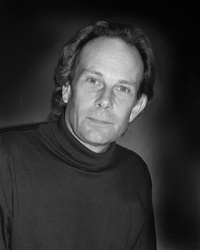

Allan Cooper

ABOUT THE AUTHOR
Allan Cooper has published over a dozen books of poetry, most recently The Deer Yard (with Harry Thurston) and The Alma Elegies. He has twice won the Alfred G. Bailey Award for poetry. He is the founder of Owl's Head Press and has been the editor of the intermittently-published literary journal Germination since 1982. Cooper is also a songwriter and performer. He divides his time between Riverview and Alma, NB.


667

DISCLAIMERS

Poems cited here are assumed to be under copyright by the poet and/or publisher.  They are shown here for publicity and review purposes.  For any other kind of re-use of these poems, please contact the listed publishers for permission.
We here at TBOP are technically deficient and rely on our bashful Milo to fix everything.  We received notice from Google that we were using "cookies"
and that for our readers in Europe there had to be notification of the use of those "cookies.  Please be aware that TBOP may employ the use of some "cookies" (whatever they are) and you should take that into consideration

Wednesday, March 16, 2016

You Can't Be Serious - Ronald Wallace (Parallel Press/University of Wisconsin-Madison Libraries)

Today's book of poetry:
You Can't Be Serious.  Ronald Wallace.  Parallel Press.  University of Wisconsin-Madison Libraries.  Madison, Wisconsin.  2015.

Wallce_cover_front

When I first read You Can't Be Serious back in December I avoided reading the Author's Note at the beginning of the book.  When I'm reading for the blog I always avoid introductions, notes or any other sort of preamble to the poems.  Today's book of poetry is never looking for prior context.  (Of course we always read these notes afterward).

So, I liked these poems a lot before I realized that the poems in You Can't Be Serious are all constructed in such a way that "the last words of each line of each poem, read vertically top to bottom, form a haiku by a classic Japanese master."

It's brilliant stuff.

When I read You Can't Be Serious again last night it was like each poem was a main course, the haiku an illuminating dessert.  This is the cue for Wallace to take a big bow.

The Wisdom of the Old

     after Basho

I thought when I got old that I'd be wise. Wearing
my vast learning lightly I'd find myself a
source of wisdom for others. If you looked in the paper,
you'd find me quoted on most any subject, the robe
of knowledge trailing from my shoulders. Even
my enemies would marvel at my sagacity. If
you had an insoluble problem, I'd solve it. It
would be a no-brainer. I'd be the sage who gets
to explain everything. Turns out, I was all wet.
The older I get the less I know. Here I am picking
through the alleyways of my memory looking for flowers
and finding only trash, a panhandler who, in
better days, had what passed for a brain, but now is the
wacky preacher who won't come in out of the rain.

...

Ronald Wallace is a "Wascally Wabbit" by every stretch of the imagination and as coy as he is clever. These poems roll off the tongue like you'd written them yourself, they go down as naturally as a drink of water.  These poems are ripe with moments that are familiar to us all.

Our morning read was a scream.  Milo, our head tech, read the poems and the Kathryn, our new intern, read the haiku.  The rest of us leisured at their feet as though we were in front of a warming fire in the hearth on a snowy night.  It was morning bliss.

You Can't Be Serious

      after Basho

A writer who can deal with murder, barbarity, horror--with
"tragic elements"--is the greater artist, said the young
Anthony Trollope, than the writer of the mundane. This leaves
me out. "The mild walks of everyday life" are what I
gravitate to. The neighbor's sudden dementia--would
that count as horror? Could barbarity be something like
mistakenly digging up my wife's favorite lemon verbena? To
poison the pesky chipmunks, to do my best to wipe
them out--would that be considered murder? I far and away
prefer the milder walks of the lesser art--the stroll in the
happy diurnal, the observable day-to-day. Tears
are plentiful enough in this life without me putting in
my own two cents. Tragically unambitious, I'm your
chronicler of the commonplace, a ramble in Trollope's eyes.

...

Today's book of poetry admires You Can't Be Serious very much.  As much as Wallace proclaims the anti-Trollope stance and trolls the quiet conventional corners, he has no problem at all taking on the big subjects like abortion, gay rights, politics, sexism, religion and so on.

The fact is You Can't Be Serious can be very serious indeed while remaining entirely Basho/Issa tongue in cheek.  Serious as a heart attack, serious as two grasshoppers can get.  That's when you know there is a master at work.

Bully for You, Mitt Romney

     after Issa

We held the gay boy down and cut his hair. Hey,
it was fifty years ago, and we didn't know, you
know, that he was gay. It was just a prank. There
is nothing more to it. He's dead by now, anyway. do
you think I'd do that today? We'll of course not!
Look at this smile. You can see it wouldn't swat
a flea. Let's have some other questions. Marriage? The
union of one man, one woman. We don't want to fly
in the face of sacred conventions. Abortion? It wrings
my heart to see an innocent fetus murdered, his
teenage mother bereft. Let's leave it in God's hands.
The elderly, the indigent? Give them work! If they're on
the dole, they'll never be useful. The gay boy? On bended
knee he came on to us. We gave him a knee.

...

It's a dreary grey Wednesday here in our nation's capital, spring is trying to come through the clouds and there may even be a bit of sun on the horizon.  It doesn't matter, You Can't Be Serious has already made our day.

Ronald Wallace

ABOUT THE AUTHOR
Ron Wallace is the author of twenty previous books and chapbooks of poetry, fiction and criticism. He co-directs the creative writing program at the UW-Madison, and serves as editor of the UW Press Poetry Series which he founded in 1985.

He is currently Halls-Bascom Professor of English and Felix Pollak Professor of Poetry and the recipient of three distinguished teaching awards, and prizes from his previous poetry collections from The Council for Wisconsin Writers, The Society of Midland Authors, and the Wisconsin Library Association. In 2005 he was awarded the first George Garrett Prize of the Association of Writers and Writing Programs for his service to writers and writing.

Born in Cedar Rapids, Iowa and raised in St. Louis, Missouri, he has been a Wisconsin resident since 1972, dividing his time between Madison and a forty-acre farm in Richland County’s Bear Valley.

parallelpress.library.wisc.edu

448


DISCLAIMERS

Poems cited here are assumed to be under copyright by the poet and/or publisher.  They are shown here for publicity and review purposes.  For any other kind of re-use of these poems, please contact the listed publishers for permission.

We here at TBOP are technically deficient and rely on our bashful Milo to fix everything.  We received notice from Google that we were using "cookies"
and that for our readers in Europe there had to be notification of the use of those "cookies.  Please be aware that TBOP may employ the use of some "cookies" (whatever they are) and you should take that into consideration.

Tuesday, November 17, 2015

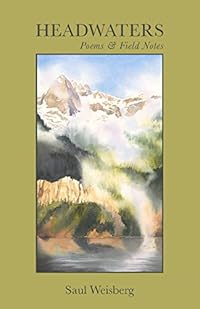
Headwaters, Poems & Field Notes - Saul Weisberg (Pleasure Boat Studio)

Today's book of poetry:
Headwaters, Poems & Field Notes.  Saul Weisberg.  Pleasure Boat Studio.  New York, New York.  2015.


Saul Weisberg's Headwaters, Poems & Field Notes is a master class in exploring the natural world with a tuned and sympathetic ear.  These poems bear a close resemblance to meditations or even prayers.  Weisberg is able to report with such an empathetic voice that you begin to expect that he was the Earth's own lungs given sound.

There is nothing pastoral about these brief accounts although that sentiment is in there, no, Weisberg is closer to Basho with his clipped ease.  These poems are cut to the bone but never terse and never lacking the underlying warmth Weisberg maintains.

What this poetry most certainly is - is celebratory and there is precious little of that these days.  Saul W's Headwaters is marvelously optimistic.

Spring Music

All you need to know
     about my day:

winter wren
     in the morning.

canyon wren
     at dusk.

...

These poems are calming.  When you read these poems the possibility of a kinder world is obvious. There is nothing naive about Weisberg's wisdom or the world he portrays, it is the authentic thing.

Again and again, in the simplest possible terms, these poems announce genuine consideration of the natural world and create wonder.

Paddles

The yellow canoe
tied on top of the red car
next to the frozen lake.

Drifting -
it's all right in a canoe,
in life, another story.

Sometimes
when my wind wanders
only the canoe goes straight.

I point my paddles
where I want to go,
the wind has other ideas.

At the edge of the ice
the canoe hovers,
tasting winter.

...

Weisberg's poems read and sound like things we already know.  At the morning read today everyone had the same reaction to this sublime poetry.  Reverence.

Even Milo was enthusiastic.  He also shaved for the first time since August.  And is wearing a clean shirt.  And is now sitting in the corner with Kathryn, again, and reading Weisberg poems to her.  Her Goth demeanour would seem to be in partial swoon.

Milo isn't just reading to Kathryn, he's giving voice to the Weisberg poems in a quiet but authoritative tone.  He has us all in a short swoon but we know it will lift us up.  Isn't poetry marvelous.

Home Ground

It's good to have a lake close to home,
also rivers, mountains too.
Familiar terrain and the comfort
of well-traveled trails.
In my pocket,
on the torn corner of a map -
directions to a place called home.

...

Headwaters, Poems & Field Notes takes us to a home that is in our better nature, Weisberg reminds us in every poem of who we are and of who we could be.

Splendid.

Saul Weisberg

ABOUT THE AUTHOR
Saul Weisberg is the co-founder and Executive Director of North Cascades Institute, a conservation nonprofit with the mission of conserving and restoring Northwest environments founded in 1986. He serves on the board of directors of the Association of Nature Center Administrators, the Natural History Network and the Environmental Education Association of Washington, and is adjunct faculty at Huxley College of the Environment at Western Washington University. In 2013, Weisberg was given the Environmental Heroes Award by ReSources in Bellingham. He has authored From the Mountains to the Sea, North Cascades: The Story behind the Scenery, Teaching for Wilderness, and Living with Mountains. Saul and his family live near the shores of the Salish Sea in Bellingham, Washington.

BLURBS
Headwaters is a peaceful, joyous book. Its poems open my heart. Yes, every moment is a gift. Every bird, a blessing.
     —Kathleen Dean Moore

Saul Weisberg’s crisp, lyric poems are grounded deeply in his lifelong engagement with the plants and wildlife, rocks and weather of his home ground, Washington’s rugged North Cascades and the Salish Sea. Buoyant, passionate, playful, and precise, these poems echo Basho in capturing mystery within an image and Rexroth in artfully blending themes of nature and love. But the poet’s joyful celebration of family, friendship, community, and place are all his own. This is a clear and welcome poetic voice from one of the West’s most inspiring locales. 
     — Tim McNulty

Headwaters drips with the waters of the wild, sings with the voices of thrush, wren, and owl, dances with the butterflies. How wonderful to have Saul Weisberg’s long-awaited poems together in this handsome book – poems that are worshipful and wry, funny and askance, often sexy, and always perceptive. I am thrilled to have Headwaters at loose in the world at last.
     — Robert Michael Pyle

The sensual poems of Saul Weisberg are powerful connections to the essential elements in nature that enrich and fashion our lives. With economy he fashions an invitation for us to join in the moment and become appreciative witnesses and his companion in nature. With lines such as “The river gathers friends on its way to the sea” and questions likes “What does it mean to become extinct?” we are challenged to expand how we embrace and steward our natural heritage. 
     — Tony Angell

Make room in your backpack for the marvelously condensed wisdom of Headwaters: poems that are intricate as a snowflake, as simple as stone, and the very soul of an educational visionary who has spent his life in the high Cascades. Each of these mountain morsels smiles with gentle truth, and lingers on the mind with honest beauty. 
     — William Dietrich

From the “ecstasy of conifers” and the “infinite ache of wood becoming wood” to rivers that “tremble in their sleep,” Saul Weisberg sees into the heart of the world, revealing all the ways we’re connected to this landscape and to each other. In spare, lyric poems and haiku-like field notes—each one a shining gem—he reminds us how to pay attention, giving us, in poem after poem, “directions to a place called home.”
       – Holly J. Hughes

"Not many people know the spirit of the mountains, rivers, lakes and inland sea of Cascadia like Weisberg does. His reverent attentiveness, subtle humor and deep ecological knowledge are apparent in Headwaters, a volume collecting more than 25 years of his poems and journal entries." 
     — Cascadia Weekly

"Inspired by the landscape around him...Weisberg's work captures the expanse of awe-inspiring wilderness in perfect, distinct moments. Exploring the connection between man and nature, Weisberg's work is is both contemplative and celebratory." 
     — North Sound Life


408

DISCLAIMERS

Poems cited here are assumed to be under copyright by the poet and/or publisher.  They are shown here for publicity and review purposes.  For any other kind of re-use of these poems, please contact the listed publishers for permission.

We here at TBOP are technically deficient and rely on our bashful Milo to fix everything.  We received notice from Google that we were using "cookies"
and that for our readers in Europe there had to be notification of the use of those "cookies.  Please be aware that TBOP may employ the use of some "cookies" (whatever they are) and you should take that into consideration.