Today's book of poetry: Doubter's Hymnal. Laura Cok. Mansfield Press. Toronto, Ontario. 2019.
Doubter's Hymnal is a coming of age song that questions faith, looks at family life, and makes readers sit straight up. If there is a God he is a shadowy creature.
Laura Cok's manifesto is a stern examination of where faith meets practice. The intersection is frantic with electricity and sombre as prayer.
Today's book of poetry was pushed to the edges of our understanding, we were also kept riveted. Cok's poems move across the page with admirable precision. If these poems were cakes - the icing would be perfect.
Needle
I was happy so of course
I looked for something to ruin
some proof that disaster
was already knit too many rows back
to unravel and save
the slipped stitch, the blinked-open gap
to poke a finger through and widen
what comes through is daylight
from another room and the water
running in another kitchen sink
where another pair of soapy hands
are lifting it up,
twisting out the water,
wringing its soft neck.
💥💥💥
Laura Cok bends time in Doubter's Hymnal, she invests time in divesting all the traditional party tricks of their reason, she challenges both faith and fate. When called upon Cok provides a "cure for loneliness" and does reap both an answer and some questions. Today's book of poetry is making Doubter's Hymnal sound far more complicated than it is.
Doubter's Hymnal has Cok making it crystal clear in every poem, these poems have both intention and direction.
Seven Brief Lessons on Physics
with thanks to Carlo Rovelli
THE MOST BEAUTIFUL OF THEORIES
Time passes more quickly in the mountains.
Not a romanticism, but a fact --
the higher you are, the faster it all goes.
Down in the desert there is a fraction of a fraction more.
You could wander out along and see
the curvature of space streaking overhead.
The Milky Way like a veil pulled back.
Behind it, another veil.
💥💥💥
Today's book of poetry found themselves fully engaged, fully completely, as Saint Gordon of Downie suggested to us all. The Today's book of poetry minions sat down to our morning reading and cracked through Doubter's Hymnal with agile reverence.
Today's book of poetry will surpass 800,000 readers sometime later this week, we were sitting at 794,000 earlier today. That is a lot of poetry monsters and every one of you is welcome. Today's book of poetry is currently expanding our offices. We've had a moderate but steady improvement in our office machinery, we've been able to retire our Commodore 16. We're feeling optimistic and plucky.
Laura Cok helped.
Tide Over
I'm thinking all the time what it'd be like,
the belly swollen, tidal turn moon.
One cup a day, then decaf, watching you
brew separate pots, since this is the one thing
I'll have to do alone. Not absentee:
you'd be there for each grainy ultrasound,
each diaper class, the baby CPR.
But when the foot kicks out there's only one
soft bladder it connects with. Flesh distraught,
my breasts unrecognizable to both.
Small alien that's chosen me for host.
Skin taut, now loose, in this, the great exhaling.
Sea-change inside, moon-conjured, amniotic,
first creature that could wash to shore and crawl.
💥💥💥
Laura Cok surprised Today's book of poetry in the best possible poetry way. Doubter's Hymnal is never terse, but these poems have been worked whippet thin. Nothing left but muscle.
Laura Cok
ABOUT THE POET
Laura Cok is a writer and editor based in Toronto, Ontario. Originally from Northern California, she spent time in Grand Rapids, Michigan and Waterloo, Ontario before settling in Toronto. She holds an MA in English Literature from the University of Toronto, winner of the E.J. Pratt Poetry Medal and the University of Toronto Magazine alumni poetry contest. Cok has previously published widely across Canada and works in corporate communications.
Poems cited here are assumed to be under copyright by the poet and/or publisher. They are shown here for publicity and review purposes. For any other kind of re-use of these poems, please contact the listed publishers for permission.
We here at TBOP are technically deficient and rely on our bashful Milo to fix everything. We received notice from Google that we were using "cookies"
and that for our readers in Europe there had to be notification of the use of those "cookies. Please be aware that TBOP may employ the use of some "cookies" (whatever they are) and you should take that into consideration.
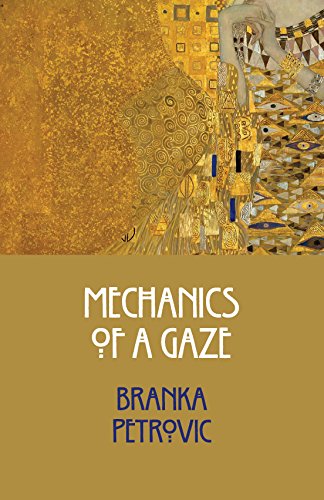
Today's book of poetry: Mechanics of a Gaze. Branka Petrovic. Mansfield Press. Toronto, Ontario. 2017.
Postcard No. 50
Severely hung over—
but hopefully it will be beneficial
💫💫💫
Today's book of poetry has long admired the work of Gustav Klimt, but we've never seen him or his work from quite this delightful perspective. Branka Petrovic's Mechanics of a Gaze does that improbable thing, she makes her writing about the great man's paintings and life as beautiful and interesting as the real thing.
Petrovic moves beyond inhabiting the gaze to directing it's focus.
Disabled Sex
Egon Schiele, Kneeling Girl in Orange Dress (Gertrude Schiele), 1910.
Black chalk and gouache on paper.
Disabled sex: molluscs attempting
foreplay clogging
their shells. Girls in orange dresses
whose hands coil
into rotten cauliflowers;
squirt citruses
from their vulvas.
A circus of cerise boots
& taboo missionary positions.
It's masturbation
with the help of a sex toy,
pumped, then washed
by special friends;
never talked about
with nurses. Limbs looping
into shame.
Fellatio performed
in a wheelchair. Lift
your thigh higher; put your toe
into my mouth; pull
your depression out. Kiss
social constructs goodbye.
My ankle. Press
the inside of my thumb; rub
my left shoulder a little
harder. Yes oh yes
oh yesssssss.
Make sex furniture for me:
enhance this rail,
tantric clamp. Adjust
the mechanics of masculinity;
my right to fuck.
Anxiety that sterilizes
& distorts my thoughts
about myself: a sexy blob-fish
in a sea of deep disgrace.
Revise your kinked
thoughts about me:
a debilitated brute; enable
orgasmic dust, devotism to sparkle.
Talk dirty to me too.
💫💫💫
Mechanics of a Gaze fully examines the pulsating sexuality that most see in Klimt's paintings, she does the same thing with his life. Petrovic, using actual post cards sent by Klimt to his close friend Emilie Flöge, re-imagines time and place until the reader is transported to a Vienna from long ago. Staid and vibrant, repressed and ribald, Klimt's Vienna was a complex culture and as much as artists inhabit/create a culture, artists are always the outsiders looking in.
Branka Petrovic has come correct. She knows the paintings and sketches, the art work of Klimt and his friends and contemporaries. When Petrovic describes a painting to us it grows in every dimension, we see more than Klimt, more than the model, we see Klimt's city, his time, his vision.
Cardinal and Nun A painting by Egon Schiele, 1912.
Oil on canvas.
"Just as a horse in full gallop, blinded by the energy of his own speed,
pays no attention to any post or hole or ditch on the path, so two lovers,
blinded by passion, in the friction of sexual battle, are caught up in
their fierce energy and pay no attention to danger."
—The Kama Sutra (2.7.33)
His red cassock scoffs at the space, unties
like a vulva before us. His cock
knocks against her knee.
The onlooker caught
in a corrupt act.
The pact between God
and man, wrecked in an instant
of scarlet fascia, pectoral crosses,
and a scarlet zucchetto.
Karate hands; punches
we're not sure are him or her, or
the Holy Father. Oops.
The nun's manic glance.
The Cardinal's bare, muscular legs.
This rock-solid burst.
Unearthed erogenous zones; yes, oh
yes; oh no. Not now, not ever.
Paraphrase of Klimt's Kiss?
A reworking of everything mystical
into morbid patches,
black sin. Sunk in sexual gloom.
*
Schiele called the painting Liebkosung,
or The Caress.
*
It has been noted that self-portraits by Schiele from the same peri-
od, match the nun's face. Her beefy legs tip-off a "double-goer," evil
twin.
*
Marie Antoinette's husband, King Louis XVI's penis is
"no bigger than a straw
always limp and always curved
he has no prick, except in his pocket
instead of fucking, he is fucked."
—Les Amours de Charlot et Toinette (1779)
Nymphomaniacal Antoinette sought sexual favours
from her brother-in-law
from various court nobles,
from servants,
even from her own children.
"The Austrian bitch and her Friends in the Royal Orgy" suggests
Antoinette had a string of lovers, including
the Duchess of Polignac and the Count of Artois,
who was also the true father of her children.
The National Enquirer's latest finds:
Catwoman Caged For Clawing at Boy Toy
Carrie Royale's royal insight that Harry's crown jewels
are "average-sized—
but he's a grower, not a shower!"
*
1977:
Margaret Trudeau spent her sixth wedding anniversary
partying with the Rolling Stones
at a Toronto nightclub
and in Mick Jagger's limousine.
💫💫💫
Petrovic wants us to see a more complete picture than simply the amour, the scalding of promise in the paintings, Petrovic wants us to understand more about the man.
There is no greater loss than that of a child. Today's book of poetry has never had children but we've seen that sort of calamity up close. There is no amount of glamour that will shield you from the big hurt. Klimt was voracious in his appetites and fathered many children but Petrovic narrows his gaze and hers to Klimt's sorrow at the death of his son Otto.
Portrait of the Dead Otto Portrait of the Dead Otto Simmerman, 1902.
Chalk on paper.
When death is your baby boy,
his pouted lips, parted hair;
the rest of him; bleached shawl,
bland face; your backdrop is:
a flat beige. The tiny dash of gold
in his hair a hint of life
you wish you saw when you first heard the news, dropped
everything, came running.
Held his lifeless body
tight for the rest of the night.
Two months is too little
to get to know someone. Starting
to bond, only to hold
transience in your hands. The crib,
a temporary casket, until they come,
take him away. Of all the shades
of death, his
is an especially difficult one
to blend: what colour his tiny cheeks,
minute chin, your blues.
The backdrop,
short-lived as unbleached silk,
desert sand, ecru.
*
The universe could have been:
astronomer almond, skyivory,
univeige, cosmic khaki, new-
fangled big bang buff or blush.
They voted for cosmic latte in the end.
*
A study revealed that
the overwhelming majority of stars
formed about 5 billion years ago.
Since these stars would have been
"brighter" in the past
the colour of the universe changes over time,
shifting from blue to red
as more blue stars change to yellow,
becoming eventually
red giants. As light from distant galaxies
reaches the Earth, the average 'colour of the universe'
(as seen from Earth) marginally increases
towards pure white, due to the light
coming from the stars
when they were
much younger and bluer.
*
Much younger and rosy-cheeked,
your baby boy is now
Navajo white. The stars lit in him,
then out. The universe,
a buildup of extraordinary
matter, then ether.
*
Grief is an anti-white flash decanted
from antique white. It's
splashed white, peach puff.
A hint of ivory. Eggshell.
Papaya whipped with
white smoke, ghost white.
It's all the shades of white
you never thought you'd see, wish
you could forget.
💫💫💫
Today's book of poetry would like to dedicate the last poem to the late Arlen Maxwell Kierkegaard.
Branka Petrovic wrings every emotion you have out of you before you get to the end of Mechanics of a Gaze. These poems put you in Vienna, but they also get inside of your internal geography and bang things around. The cobbled streets and secret societies of Vienna become real and breathing. The poems start to feel a little like paintings, exact, and starring back at us.
Petrovic has some serious burn.
Branka Petrovic
ABOUT THE AUTHOR
Branka Petrovic completed an M.A. in English Literature and Creative Writing at Concordia University. She holds a B.A. in English Literature and Philosophy from McGill University. She was co-Editor-in-Chief of Headlight Anthology and her poetry has appeared in Branch, Arc Poetry Magazine, Contemporary Verse 2, The Malahat Review, The Fiddlehead, The Antigonish Review, and The New Quarterly, among others. Her work was long-listed for the 2012 and 2015 CBC Poetry Prize and the 2016-2017 Ralph Gustafson Prize for the Best Poem. It was also shortlisted for the 2013 Gwendolyn MacEwen Poetry Competition. In 2016, she won second prize at the Great Blue Heron Poetry Contest. Born in Belgrade, she lives and writes in Montreal.
BLURBS
Branka Petrovic gets Klimt—she gets inside the gorgeous horror, the lavish violence of his paintings. That she embodies his work and his era in a poetry as ornate, as startling, as boldly sexual, as his art, impresses. That she does so through interrogation, even judgement—particularly of the male gaze—makes this a remarkable, and remarkably mature, first book. Provocative, elegant, and unsettling, Mechanics of a Gaze will leave no reader untouched. —Stephanie Bolster, author of A Page from the Wonders of Life on Earth. Rich in imagery and sound, Branka Petrovic’s Mechanics of a Gaze is a lush, layered, and carefully-curated collection of poems about Gustav Klimt. Animating found material and showing careful attention to the material culture of the Secessionist period in Vienna, Petrovic has written a collection steeped in history and aesthetics, one sharpened by a contemporary, deliciously-ambivalent gaze. Intertwining threads of art, sex, fashion, scandal, and looted works, Branka Petrovic’s Mechanics of a Gaze “blooms / bravura.” —Susan Elmslie—author of Museum of Kindness
Poems cited here are assumed to be under copyright by the poet and/or publisher. They are shown here for publicity and review purposes. For any other kind of re-use of these poems, please contact the listed publishers for permission.
We here at TBOP are technically deficient and rely on our bashful Milo to fix everything. We received notice from Google that we were using "cookies"
and that for our readers in Europe there had to be notification of the use of those "cookies. Please be aware that TBOP may employ the use of some "cookies" (whatever they are) and you should take that into consideration.
Today's book of poetry: The Better Monsters. Puneet Dutt. Mansfield Press. Toronto, Ontario. 2017.
The poems in the first part of Puneet Dutt's bracing and honest The Better Monsters come from the voice of an outsider. Dutt's voice has been in camps, heard gunfire at night. But by the time we are finished Dutt is insider enough that she knows exactly how to reach us.
Whether in Jalalabad or Kabul Dutt's world-weary voice always remembers that:
"to see fighters
from another country with guns
in my local market everyday
not knowing what they were doing
I would hate them"
VIII
Over Cider And Whiskey In Hotel Rooms
Dutt's voice is also inhabited by those same fighters, lost in a world foreign enough to them to allow any extravagance or insanity.
Alien Alien
"he pays cash, that's why he's called Mister."
- Oswald Joseph Mtshali
never had an education
took a talvar to school
and fled the country
records of Saturday Night Fevers
bell bottom stone-washed jeans
played his youth
eyes closed
he reached Queens
doors closed to his
dark room body
doors always closed
no matter the knock
we were toes and whispers
children of his parent's eyes
he left his records behind
walled open to VHS's
CDs
Deep Purple Aerosmith Bon Jovi
another hit
long drives
alone in a white U-Haul
and all the trucks he ever haggled for
that broke down from so many miles
Hey God, I'm just a little man got a wife and family
he knew the songs
the CK jeans
Yankee's cap
they sold him
her and him
two suitcases each
so fast they left us
to get there
Memphis to New Orleans
i asked him
her
what did you see
criss-crossed veins
America
alligators and beads
the giant peach
what did you see
dekhna kyah tah
what was there
we'd long for postcards
textbooks
Mount Rushmore Gettysburg America
highways
highways
5 a.m. and stand
fleamarkets sun under tarp
until now they can't stand anymore
i find them again
on the same street
weary of motels and rest stops
bruised soap souvenirs
of what they've been
back to where they started
97 to 95
from Georgia and back
all along the coast
boxes we'd help make
thought it was a game
hide and seek
perfumes scrunchies barrettes
whatever they could buy
whatever they could sell
always afraid of who was at the door
she kept chipped bottles
Testers without caps
fingered blue RI, America
gifted us Caution: Flammable
and sprayed
stars and stripes
we got through school this way
not being stinky Pakis
go home
we bought
like good greencards
when they asked
we bought
swore allegiance
to clothes and movies
credit card after credit card
found a way to stay
that English
fly tape ensnares flies with appealing colors
Made in USA
so much about
explorers
Manifest Destiny
Christopher Columbus
that America
and when they try to make the rent
next month we have it next month
we scattered
kids and weddings
north and south
they still ask us where
we're really from
implies place
when i slip a hundred in her purse
even when i dye my hair blonde
my tongue lashed by ESL
i can only interpret
a weekend
so many of us
learned
the odds are bet against us
we alien alien
...
Time and distance take new shape when you are on the other side of the world from where you started, the earth your toes remember both too far away to touch and too long ago for warmth.
Punnet Dutt's tender and tragic poems seat the reader in the empty space endured by those who are forced to leave their own terra firma, their own culture, their own countries. Dutt makes it real on the page.
Today's book of poetry thinks that Puneet Dutt talks from both sides of the invisible fence that impedes all our human travails and this encompassing vision serves her well. As harrowing as some of the moments these poems endure, Dutt's voice ultimately never gives up hope and that's the magic.
Coordinates
it's 4 a.m. and clear
13 degrees centigrade
in Jalalabad
Google can't calculate the drive the
walk or how long it will take by TTC
only shows the expanse of impossible
blue
the mouth of the South Pacific
the fingernail of Chile
and Hawaii the crumbs
i type:
"calculate distance between two coordinates"
and receive
the haversine formula
to calculate distance between two points--that is
the shortest distance over the earth's surface
and the bearing between two latitudes
purplemath.com promises
the distance formula its origin its use
the length of hypotenuse is the distance between two
points
another
says to just type your equations and let the calculator do
the rest!
to find the distance between two points
(X1,Y1) and (X2,Y2)
all that you need to do is use the--
but all i want to know is
how far
from daughter
from mother
from herself she will be
from me
when she returns
...
Our morning read was a little more low key than usual. Apparently our entire staff, moi included, decided that we could drink all the red wine we could find in the bar. Amateurs that we are we left three bottles standing at the end of the night but we'd admirably polished off several of their friends. The morning read was subdued intensity tempered by aspirin. But Dutt's voice was clear, despite our fumbling efforts, these poems worked. They have been tempered over hotter flame then any of us will endure.
Reasons To Throw Stones
America begins
this way
48 Trenton St.
where i slowly ask
what i'd thought of for a year--
why did you leave me behind?
she sniffs and
immediately pulls me toward a bath alarmed
by the size of my long loose undergarments
stitched in India elastic frills and ribbons at
each end you can't wear those!
i'll have to take you
shopping!
sluicing me over the head with measuring
cups of soap
immediately America begins with a vigorous
scrubbing immediately i change and please so
immediately i know America is not for big
open questions my mother brandishes card
after card slashing through lines builds my
closed of each auditions next day don't give
them reasons to throw stones this she gives me
now i arrive in Canada i don't know what to
do immediately when i arrive to Canada what
to do immediately?
...
Today's book of poetry thought Puneet Dutt's poems were human in a way that allowed all readers to get to the center of them. But once there Dutt isn't reluctant to insist you see the battles and the battle scars from a new position. Dutt aims for The Better Monsters amongst us human beings and emerges at the end of her harrowing journey still embracing hope.
That's courage.
Punnet Dutt
ABOUT THE AUTHOR
Puneet Dutt received her MA in English from Ryerson University. She is the author of the chapbook PTSD south beach (Grey Borders Books), which was a Finalist for the 2016 Breitling Chapbook Prize (Phantom Books). Her work has been published in a number of journals and in Imaginarium 4: The Best Canadian Speculative Writing. She was born in India and raised in New Jersey. She now resides in Toronto with her husband, where she is an editorial board member at Canthius and a creative writing workshop facilitator with the Toronto Writers Collective. She can be found online at puneetdutt.com.
BLURBS
“Fierce and finely crafted, The Better Monsters distils life’s strangeness in poems that bridge the gap between warning and augury. A tour-de-force from one of Canada’s most promising writers.” —Jim Johnstone, author of The Chemical Life
“In this gripping first collection, Dutt evokes innocence within and despite the cruel enigma of inevitable arrival. She masterfully connotes this ironic centre—the empty solace of truth telling: ‘so fast they left us/to get there.’” —Hal Niedzviecki, Broken Pencil Magazine
“The poems in The Better Monsters teach us how humanity is its own greatest threat but also its greatest salvation. Dutt’s world is one of greater and lesser evils, where the only virtue is the beauty that her language provides. Yes, perhaps her poetry is our best chance to escape our everyday monsters, our monsters within.” —Darrel Alejandro Holnes, Pushcart Prize nominated poet, New York University, United Nations consultant
Poems cited here are assumed to be under copyright by the poet and/or publisher. They are shown here for publicity and review purposes. For any other kind of re-use of these poems, please contact the listed publishers for permission.
We here at TBOP are technically deficient and rely on our bashful Milo to fix everything. We received notice from Google that we were using "cookies"
and that for our readers in Europe there had to be notification of the use of those "cookies. Please be aware that TBOP may employ the use of some "cookies" (whatever they are) and you should take that into consideration
Today's book of poetry: Yes or Nope. Meaghan Strimas. A Stuart Ross Book. Mansfield Press. Toronto, Ontario. 2016. Trillium Book Award Winner
Yes or Nope. Easy question. We say an emphatic yes. So did the Trillium Book Award. Meaghan Strimas made us laugh, smirk, guffaw, chortle and giggle before we finished the enchanting Yes or Nope. She also broke our heart, kicked our shin and left some dishes in the sink.
Today's book of poetry writes these blogs by hand and when I do I jot down the page numbers of the poems I figure you, the audience/reader, can't do without. I like to share as much as I can, all you regular readers know this. The first poem in Yes or Nope arrives on page 11, the last poem is on page 61. Here is today's page list of essential Strimas poems:
Some of her poems stretch to two pages. What Today's book of poetry is clumsily trying to say is that almost every poem in this collection was something we thought you should see. Meaghan Strimas just sets 'em up and knocks 'em down with an endless succession of witty and surprising ruptures of logic until nothing else but her dark and daring sensibility makes sense.
Clean
My neighbour is the King of Clean. He wears his striped sports
socks up to his knees. I like things clean, he says. His wife
agrees: he likes things clean. It's the way he likes it. He likes to
be clean. He drags his power washer across his cement yard,
cursing at it, as if it were an obstinate poodle. But he loves it
the same as his Pekinese. Some days he runs a clean river: a
torrent of hose water streams down his lane and into the sewer.
I can hear the ants screaming, swept up by the current and
taken away. Poor souls. My grandmother, long gone, said she
married her husband because he was a clean man. Clean nails.
Clean pecker. Clean bum. There are so many things I never
wanted to know. And now you know, too. It's much better this
way: we have clarity. We are friends.
...
Yes or Nope is "a Stuart Ross Book" and you all know what we think of Mr. Ross here. He really does have the Midas poetry touch. Strimas and Ross are an excellent match and this book proves it. Strimas isn't exactly strange, the reader grows to know/understand/embrace Strimas logic fairly quickly, but she isn't the least bit shy about being playful.
Today's book of poetry applauds Meaghen Strimas for her rambunctious heart and hard as nails Geiger counter of truth.
You regular readers of Today's book of poetry will remember that we are particularly fond of list poems. Strimas gives us a list poem, a rhymer, thrown into the mix as though she knew we were coming.
Nonsense Poem, or I Like
I like the fact that the light just turned green,
and I like the expression "creamin' in her jeans."
I like the seagull who just shit on my head,
and I like the mongrel who's only playing dead.
I like the secretary who says vanilla, not manila,
and I like the paperweight shaped like a gorilla.
I like the coarseness, the smell of a horse's mane,
I like the careerist who desires a little fame.
I like living, but I don't like feeling lost, and I like
the daffodils--insistent, resilient in the frost.
...
Yes or Nope went over better than the ice-cream truck at this morning's read. Strimas hits just the right temperature to get the engines running.
Strimas has a killer sense of humour but she never lets it intrude on the plot.
Butterfly Unit Two: Goodbye
The mother
brought
a crate
of small
white cartons
to the celebration
of what
should have
been
his first
birthday.
Inside each,
a live butterfly
waiting to be
freed.
We were
to release
each,
but got
talking. Maybe
we forgot,
for a spell,
why we
were there
at all.
Perhaps,
it was
just easier
to pretend
that we
were happy.
When
she finally
opened
the cardboard
flaps,
the monarchs
did not
move.
I poked
one with my
index finger:
it was stiff.
So
we took
each
and lay
then,
one by one,
beneath
the base
of the oldest
tree, where,
from a distance
they looked
like fallen leaves.
...
Today's book of poetry admires Meaghan Strimas's grit. She doesn't seem to have any trouble at all waiting until she sees the whites of our eyes.
Meaghan Strimas
ABOUT THE AUTHOR
Meaghan Strimas is the author of two previous collections of poetry and the editor of The Selected Gwendolyn MacEwen. She teaches writing at Humber College and is a managing editor at The Hunter Literary Review. She lives in Toronto with her family.
BLURBS
“The poetry in Yes or Nope is whip-smart and tenderhearted, funny and alive—Strimas at her brilliant best. I didn’t want it to end.” —Zoe Whittall, author of The Best Kind of People
“Wry and furious, scathing and saucy, Meaghan Strimas tells the stories about us you always feared were true. Stuck through with charming moments, but make no mistake: these poems have no time for the lies we tell ourselves. Yes or Nope is bone-sharp, bang-up, revelatory—a pupil-dilating meditation on growing up and growing old female. This is a book to keep at your bedside, like a flashlight; a book that will keep you safe, and whisper: You are not alone.” —Elisabeth de Mariaffi, author of The Devil You Know
Poems cited here are assumed to be under copyright by the poet and/or publisher. They are shown here for publicity and review purposes. For any other kind of re-use of these poems, please contact the listed publishers for permission.
We here at TBOP are technically deficient and rely on our bashful Milo to fix everything. We received notice from Google that we were using "cookies"
and that for our readers in Europe there had to be notification of the use of those "cookies. Please be aware that TBOP may employ the use of some "cookies" (whatever they are) and you should take that into consideration.
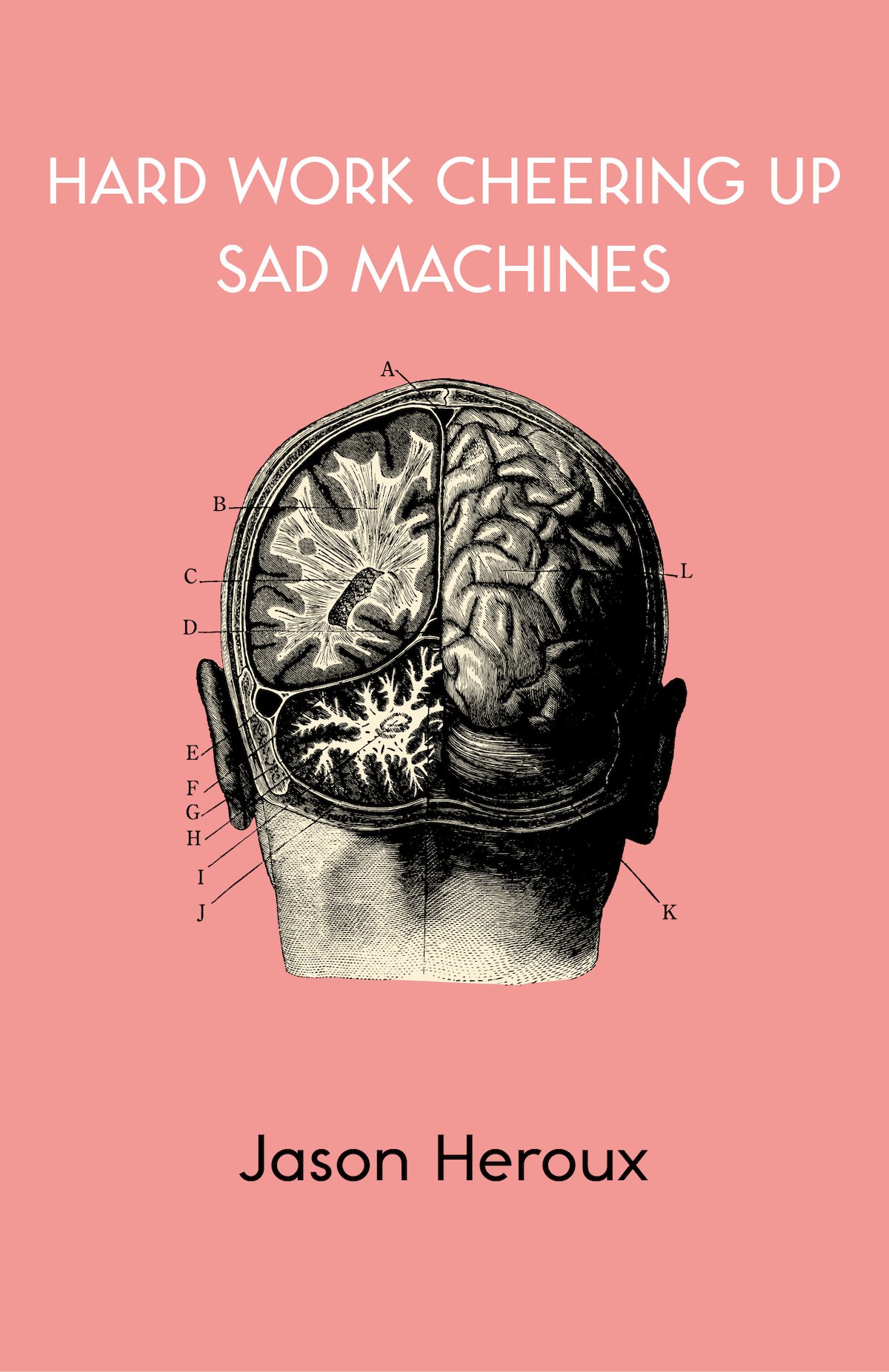
Today's book of poetry: Hard Work Cheering Up Sad Machines. Jason Heroux. A Stuart Ross Book. Mansfield Press. Toronto, Ontario. 2016.
Today's book of poetry might just as well say it and get it out of the way. Jason Heroux has become one of our favourite poets. It's not like we didn't warn you.
Back in September of 2013 Today's book of poetry took a look at Jason Heroux's chapbook In Defense of the Attacked Center Pawn (Puddles of Sky Press, 2013) and thought it was brilliant stuff and ripe with promise. You can see that blog here:
Since then we've read Emergency Hallelujah (Mansfield Press, 2008) and had it scheduled for a blog, the only reason you're not reading about that now is that Hard Work Cheering Up Sad Machines came through the door and we simply couldn't resist.
Heroux's latest volume of poetry is a seriously strong statement of intent. Heroux has discovered a shady planet of surreal shadows where he writes from some dark corner to illuminate everything we know. And boy, oh boy!, does he hammer out some choice humour along the way.
Hard Work Cheering Up Sad Machines
It's easy to breathe if you're breathing
breathe all you want the air is too cold
and weak to run away
your life is a gift with your name on it
a word there's no word for
breathe all you want it's easy to breathe
if you're breathing
the air is an all-you-can-breathe buffet
it's hard work cheering up sad machines
hard work cleaning a number's cage
our heartbeats are staggered staples
holding us together
birds sing like kettles boiling song-water
your life is a gift with your name on it
and your life is a word there's no word for
breath all you want breathe all you want
...
Today's book of poetry could be easily convinced that the poet Jason Heroux is channelling the spirit and voice of the great American novelist, short story writer and cultural guru Kurt Vonnegut Jr. Heroux has a similarly morbid comic stranglehold on reality.
The dilemma for Today's book of poetry is that when it came to picking actual poems for today's blog I was stumped. Hard Work Cheering Up Sad Machines is so ripe with lovely fruit that picking which little piece of wonder to share was beyond me so we resorted to the Odin resolution. Whenever we are blocked we write down the page numbers of every poem we wish to consider, post them on a wall and then have Odin throw darts. The poems we are using today were the first three he hit out of the dozens on offer.
Heroux's epigraph at the beginning of Hard Work Cheering Up Sad Machines is from the French author and anarchist Pierre Antin-Grenier (1947-2014). Antin-Grenier was experimental and a loosely connected member of the "extrême contemporain" - a notion in continuous movement.
It's in the hollow of the ordinary that the marvelous most often makes its nest -- Pierre Autin-Grenier
Today's book of poetry is convinced Heroux has lived up to the challenge; Hard Work Cheering Up Sad Machines rolls over the mundane and ordinary to punch out marvelous poetry from every unknowable landscape he encounters.
Yield
Our yield is now, this moment
is what will eventually
become of us, our only harvest
is the one we're gathering.
Water is drawn by the one
with the well. Whoever has lungs
will breathe in and out. The one
with the horse will ride into town.
Everything is nothing but horns
honking at death, and numbers
attacking numbers, apricot
jam stuck on the table knife.
Everything is nothing but almonds
divided by almonds, and grass blades
savouring our shadow's champagne,
a car without wheels crawling through mud.
Why does everyone seek refuge elsewhere?
Whoever has the orange will peel the skin.
Whoever has a thread will feed the needle.
The one with enough footsteps will walk to the store.
Our only harvest is the one we're gathering, this moment
is what will eventually become of us, our yield is now.
...
The first part of Hard Work Cheering Up Sad Machines is made up of shorter, one or two page poems. Later on in the collection Heroux spreads out a little and writes some longer poems and poem sequences. This all works.
Our morning read was a Heroux buffet. We read from Hard Work Cheering Up Sad Machines of course, but we also opened up Emergency Hallelujah and In Defense of the Attacked Center Pawn. Milo, our head tech, led the charge this morning which should leave him in a good mood. His new task is to now track down and procure the other thirteen titles Heroux has listed.
Today's book of poetry is certain that in the years ahead having Jason Heroux on your shelf will help to prove your smarts.
Blue Yodel of the Broken
What more do I want how many
more feathers would make me happy
on a bird how much extra egg yolk
do I need in an eggshell.
Our death chirps like a cricket
in the quietest corner of the dollar.
Bees are kept where two bones meet
a body develops in the body
where fruit trees are grown
the cows are kept
in the same name as the place
where the hay is kept.
Our death jumps into us the way
the moon leaps into a lake to cool off
swimming in the water that isn't there.
What more of a handshake
can you hold in your hand
how much of this fork
do you need to eat dinner.
The blown-out candle
is kept where the wish is kept.
How much more walnut meat
in the walnut shell would it take
to make us feel safe in the world.
I believe in the barbecue cover
that covers the barbecue I believe
in the same name as the place
where the bird is kept
the cage is kept.
How much more
piggy bank can
the piggy bank hold.
Wherever you are
you are a little rain
that never rained you are
a little hurt that never hurt anything.
Sometimes in the bank I touch
someone else's money and wake up
...
If you read Today's book of poetry more than once you'll realize I am praising a new book of poetry almost every other day. I fear it could all just begin to sound like rain. But the truth is that for every book of poetry Today's book of poetry posts there are three or four that don't make it. I DO like every book that makes it onto the blog. If the blog sometimes lacks a completely fresh veneer or the vocabulary to do these books justice it is entirely on Today's book of poetry.
Books like Jason Heroux's Hard Work Cheering Up Sad Machines are the reason this blog exists, I try to serve up gems every time out but this one is a highly polished jewel.
Jason Heroux
ABOUT THE AUTHOR
Jason Heroux is the author of three previous books of poetry—Memoirs of an Alias, Emergency Hallelujah, and Natural Capital, which was shortlisted for the 2013 ReLit award—and two novels. His work has been published widely in chapbook form and in journals, and has been translated into several languages. Jason lives in Kingston, Ontario.
BLURBS
“Jason Heroux continues to develop his bold style through the delightful fusion of otherwise jarring images.”
—Jonathan Ball, Winnipeg Free Press
“Natural Capital is a helluva good read. I inhaled its 47 poems in one long breath—they left me excited and wondering exactly what it is that makes them so captivating.… Great book. I’d give it several major prizes all at once.”
—Rod Pederson, Arc
“Jason Heroux’s skill as an image-maker recalls Tomas Tranströmer.… In an ideal world, Heroux’s poems would be doled out monthly, one at a time. They would be slotted into the mailbox, or handed to us by some peculiar stranger on the sidewalk.”
—Nick Thran, Event
“At its heart, Heroux’s gift—however existential or surreally humanistic—lies in the transformation of ways of seeing the world, of analyzing it and of language. The poems themselves, in their unique ways of seeing, are humbling at the same time they are refreshing.”
—Cynthia Reeser, Prick of the Spindle
Poems cited here are assumed to be under copyright by the poet and/or publisher. They are shown here for publicity and review purposes. For any other kind of re-use of these poems, please contact the listed publishers for permission.
We here at TBOP are technically deficient and rely on our bashful Milo to fix everything. We received notice from Google that we were using "cookies"
and that for our readers in Europe there had to be notification of the use of those "cookies. Please be aware that TBOP may employ the use of some "cookies" (whatever they are) and you should take that into consideration.
Today's book of poetry: All Of Us Reticent, Here, Together. Stephen Brockwell. Mansfield Press. A Stuart Ross Book. Toronto, Ontario. 2016.
"Dust falls over the ocean too, as I recall."
- The Saline Diminishments
All Of Us Reticent, Here, Together feels like a departure and an arrival for the multi-talented Stephen Brockwell. Today's book of poetry has long admired the work of Brockwell, All Of Us Reticent, Here, Together is his fourteenth or fifteenth poetry title and we have been watching all along.
The departure, if we can call it that, is an emotional one. Brockwell has always had a keenly expressive and fiercely intelligent voice but with All Of Us Reticent, Here, Together Brockwell draws back the curtains to reveal the inner dimensions of a complicated heart. Brockwell has always had an ample tool box of poetic tools to draw from but with this latest book he ups the ante, the closer you get to the heart the sharper the poems become.
This book was edited for press by the omnipresent and galactic Stuart Ross and it shows. It is tight as a drum.
And there are a couple of list poems and you know how much we like those here at Today's book of poetry.
The Location of Culture
At a truckstop counter in Paris.
Over by the Starbucks in Nagoya, I didn't understand a
word. Inside Zanzibar's Coffee Adventure, finest beans in
Iowa, I caught a word I knew.
Curbside near a Philly cheesesteak joint on a sizzling
Friday in August, Brandon insists we take it with
Cheez Whiz.
Under plane trees and palms at the San Diego Zoo, polar
bears soak on wet concrete.
Underneath the oak, a bench has been installed, site for
lapdogs, evening weed, Viola-Cesario soliloquies.
Through the ear canal, the caw of the crow on the street
lamp resonates in the ossicles.
Across Coltrane's reed.
In deer-hide drums I wish I had an ear for.
In neck, fret, and peg, braced spruce and manicured nail.
Through humbucker and valve.
At the Blackburn Arms where Jack McGuire performs
songs no one hears over the off-key accompaniment of
hammered regulars.
Through noise-cancelling Beats, Bluetooth Queen of
the Night.
Notwithstanding my mother's Sinatra, my daughter's
#queenbey.
Throughout the exhausted sleeper's veins. Between
treatment and injection site. In small-print
contraindications.
In bed, in a hammock between trees, in the bath, on moss,
in cold lakes, our bodies pair by prepositions.
On the lips of the toddler smooshing pages with jam. In
the theatre of her hands. She tilts her head to the right,
mimics her father's imitative coos.
Throughout the primary school hallways when the bell
rings on a May scorcher as the shrieks of recessing kids
are at their peak.
At the public library beside the canal, on a table behind
rare-book stacks, volumes open, spread.
Between the pages of my great-uncle Eddie's Leaves of
Grass. In the handshake of his Bajan lover, Colin.
On the handles of my grandfather's paintbrushes:
accidental abstract expressionism.
In the cellar, inside the chest with mould-dusted leather
locking straps; "Man on the Moon" newspapers, a loaded
Inside shelves installed in his dresser drawers, we found
the alphabetized complete works of Edgar Rice Burroughs,
Louis L'Amour and Zane Grey.
Toward Mont Royal's cross, the white spruce, or the fly on
the window at the Montreal General Hospital where my
father's eyes finally settled.
In Parc Jarry bleachers, hot dog in mouth as Bailey singles
Woods home. In the T-shirt's cherished mustard stain.
In Muzak accompanying the Zamboni's peculiar figures.
At Arena Robert Guertin, in locker rooms of broken sticks,
what might Guy Lafleur's poster eyes have seen?
On the court, hoops: in court, hoops.
Around the ditch where the sewer crew shovels through
effluent, hoping to find and close a valve.
Abaft the engine room, reeking of fish and fuel.
From the combine harvester's thousand-watt stereo, barley
field Marley.
Under the boardroom table of the princes of power, bless
their blue silk ties, there's gum. For all their financial
instruments, pick your prepositions; govern them by
sharp verbs.
In my mother's blueprints for Montreal trunks.
Over the copper pair, the glass fibre, between towers:
packets of everything. We like it.
Under the Cisco bridge, trolls creep.
In diodes emitting a radiant moving window of briefest
eternity.
In the palimpsest of typewriter roller and plasma screen,
PINs for accounts of the poorest and richest.
In Homer.
Between rings in birch grain, inside axe and saw cuts,
under initialled bark.
Under the throat of the slaughtered calf, along the blade of
the sakin.
At the cathedral for her funeral, in liturgy and hymn,
unexpected comfort.
In the LAV -- none of us wants to hear it -- when the RPG
renders acronyms disgusting.
@Cranium Central Station, a bat in the attic hangs itself
to sleep.
...
Stephen Brockwell's All Of Us Reticent, Here, Together feels like a clearing of the deck. Parents and grandparents and various other ghosts are ceremoniously debunked into their eternal beds amid the cathartic tumble. Brockwell is searching for a new kind of honesty and it is not an easy purchase, people get hurt, bruises form, seen and unseen.
It's difficult magic to reconcile your heart with your hopes and it is almost impossible not to remember expectations as responsibilities. Brockwell is swimming against some harsh and well established currents but his stroke is strong and true. It's always hard to be who we want when dealing with who we are gets in the way.
Accidental Vegan
My fridge had more food than I needed.
Jane, I asked you to come to my house and cook with me:
onions, garlic, long beans, fish -- no fish!
It was never about the cooking --
you knew that --
it was our way of putting our lips on the same dish.
In the rain, face to face
at the market, we huddled by the fish tank,
watching the slow, sad carp,
gills pulsing, mouth opening, eyes wet, of course.
...
Stephen Brockwell is a disarming poet. In the past his wit and intelligent charm always made for smart, sharp poems worth reading. With All Of Us Reticent, Here, Together Brockwell has added a new level of emotional candor and intensity that is both jarring and exciting.
This sort of honesty, when honed by the articulate hands of an old pro like Brockwell makes for some compelling poetry and rewarding reading.
Today's book of poetry understands that Brockwell had some misgivings about All Of Us Reticent, Here, Together and it is easy to see why. When you put that much on the table the room turns quiet and all eyes focus on the gambler. Brockwell plays the winning hand and doesn't even crack a grin.
Biography Of Mistaken Identities
I was mistaken for Steve Martin at a bar in Montreal.
I was mistaken for someone Richard Simmons could love
by Richard Simmons on a flight to Los Angeles.
I was mistaken for Olympian Ken Read
but I've never needed skis to hurtle downhill.
I was mistaken for a gay man at Swizzles
and played it to my advantage at the slam.
I was such a flirt! Were they mistaken?
I am told I could be mistaken for Henry Rollins.
Soon my dog will mistake me for an old hound
on the porch, bark in my face, and tear my ears.
I hope to be mistaken for soil by seedling pines.
...
We had guest appearances at the Today's book of poetry offices this morning. We had just started our morning read when the doorbell rang. In walked Ayano Omota, Yuka Kashino and Ayaka Nishiwaki. I didn't recognize any of them at first but Ayaka had Pharoah Sanders at the end of her arm and I certainly knew who he was right away. They'd just tumbled out of a rusted old '56 Caddy short that was sitting in the laneway. I almost lost my mind.
But like all other guests Pharoah and the ladies had to take their turn reading a poem. Stephen Brockwell has never sounded better.
Today's book of poetry has been a big Stephen Brockwell fan for a long time and we believe that All Of Us Reticent, Here, Together is his best book.
Stephen Brockwell
ABOUT THE AUTHOR
Stephen Brockwell cut his writing teeth in the ’80s in Montreal, appearing on French and English CBC Radio and in the anthologies Cross/cut: Contemporary English Quebec Poetry and The Insecurity of Art (both Véhicule Press, 1982). George Woodcock described Brockwell’s first book, The Wire in Fences, as having an “extraordinary range of empathies and perceptions.” Harold Bloom wrote that Brockwell’s second book, Cometology, “held rare and authentic promise.” Fruitfly Geographic won the Archibald Lampman award for best book of poetry in Ottawa in 2005. Brockwell currently operates a small IT consulting company from the 7th floor of the Chateau Laurier and lives in a house perpetually under construction.
BLURBS
“In All of Us Reticent, Here, Together, Stephen Brockwell tenders an unsettled confessional: the poet decentring himself to cast light on the shame of being human. Awkward, wry, acerbic, these poems nonetheless find intimacy in all the locations of culture.”
—Soraya Peerbaye, author of Tell: Poems for a Girlhood
“Stephen Brockwell’s poetry, already luminous with intelligence and subtle musical energy, pulses with a new, raw, elegiac edge in his latest collection, All of Us Reticent, Here, Together. Ever curious, ever vigilant, Brockwell’s voice sorts through bruised truths and reverberant detail to deliver these poems of startling tenderness and honesty.” —David O’Meara, author of A Pretty Sight
Poems cited here are assumed to be under copyright by the poet and/or publisher. They are shown here for publicity and review purposes. For any other kind of re-use of these poems, please contact the listed publishers for permission.
We here at TBOP are technically deficient and rely on our bashful Milo to fix everything. We received notice from Google that we were using "cookies"
and that for our readers in Europe there had to be notification of the use of those "cookies. Please be aware that TBOP may employ the use of some "cookies" (whatever they are) and you should take that into consideration.