Showing posts with label michae dennis. Show all posts

Friday, September 6, 2019

A Violent Streak - Stephanie Warner (Fitzhenry & Whiteside)

Today's book of poetry:
A Violent Streak.  Stephanie Warner.  Fitzhenry & Whiteside.  Markham, Ontario. 2018.
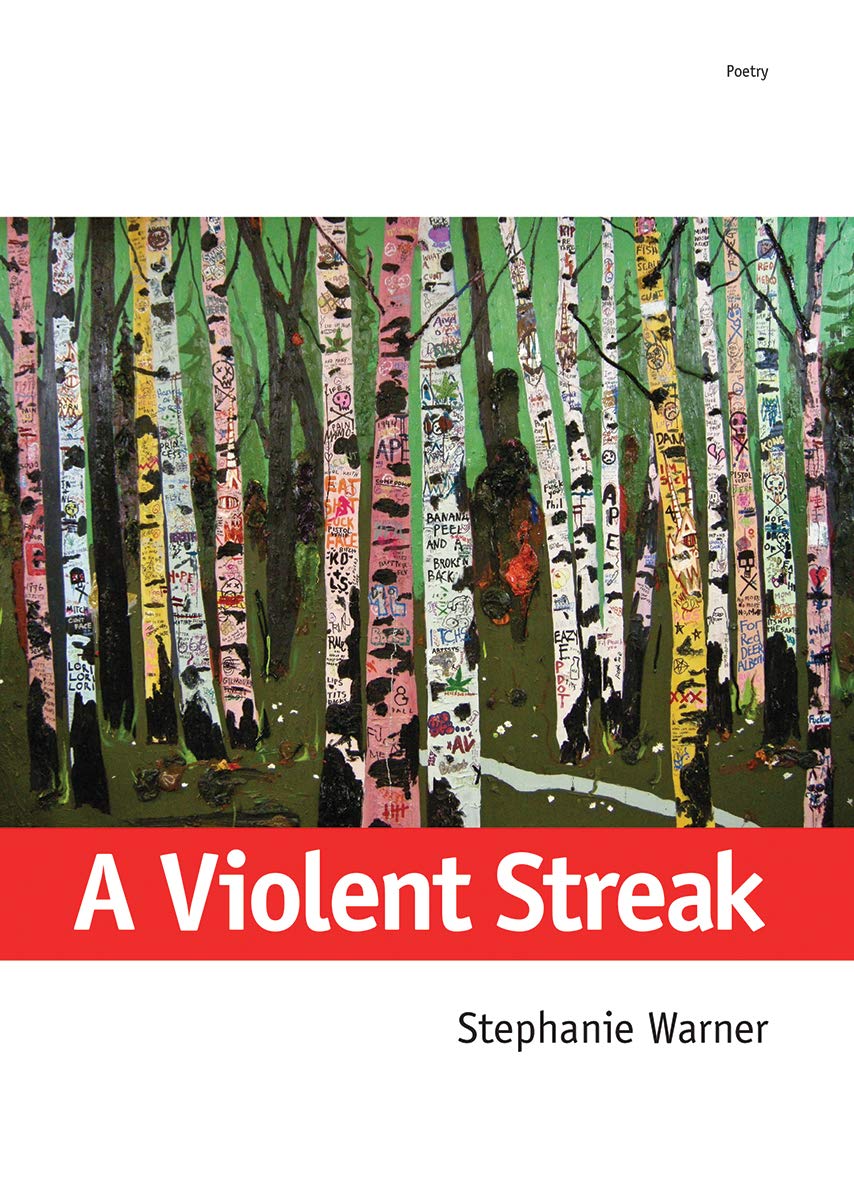

Get in, put on your seat belt and find something to hang onto because this speedy ride might have a bump or two.  Stephanie Warner's A Violent Streak starts off as though you were dropped out of the sky and into the middle of the Olympic 100 metre final, mid race.  You can't even imagine anyone moving that fast or slick or easy.  You can't imagine anyone moving like that.  It's disorienting, but Warner turns it into splendid fun.

Or think of it this way, Stephanie Warner is a machine-gunning poet, and she hits her mark with every bullet.  Today's book of poetry says wow.

Okay, Stephanie Warner explodes out of the gate with serious and humorous intent, she doesn't slow down, does not coast.  A Violent Streak is high beauty running at full speed, foot to the floor.  Warner is a second, third, fourth thought impresario.  We are talking full burn here.  A Violent Streak is such a poetry pleasure to roll your tongue over, you simply don't want the ride to end.

Today's book of poetry doesn't know how Stephanie Warner seems to know everything about everything but we don't doubt her wisdom for one second.  We're now willing disciples.

A Violent Streak

Or is it a seam? Ragged with dropped stitches, a disregard for function
or aesthetics. The way the coulees look hewn from the prairies with a hatchet.
Cows slumbered in their own frozen shit, neon pulsing ALL U CAN EAT,

and a grid of country roads bisecting the landscape like dogma. Not theirs:
Fort McMoney's, where all the best boys go.  Return two years later
with a souped-up Chevy, stereo-surround and oxblood seats, missing a hand.

The flarestacks never leave their minds; the prayer-like rise and fall
of oil wells, or the sunsets, the colours all wrong, through a shimmered film
of pollution. Happy hour (it's always happy hour) and nightly wet t-shirt contests

in bars plucked from Felix the Cat's carpet bag. Formica and movie prop furnishings
heaped like kindling. Perhaps the Coors Light, and casseroles on heirloom cut-glass platters
are small measure against the thirty hectares of drifted snow, crumpled silos, ice-sealed sloughs—

and the oil rigs, like a flock of condors, closing in from the West, so a millionaire
hockey-player, on his last concussion, can wake up to heated tiles. If the whole thing
is a charade, nobody lets on. The men out to buy the annual Christmas gun, and gas

for ATV doughnuts on Lake Gull, which has nothing to do with lakes or gulls.
The women pinch the scalloped edges of pies, doilies draped on every conceivable surface;
Precious Moments angels, 1000-piece puzzles shellacked on the walls.

More babies than anybody knows what to do with. Should've rented a goddamned hall!
Something sinister in the blood, your mother would say. A cousin's bar fight
in Cremona gone pear shaped with blow, Ms. Sam Steele '76, the broken neck

of a bottle of Bud. A nephew mangled in a bailer; others dismantled more elegantly
by drink and the Bashaw casino. But never grandpa, who built this house with his hands,
along with a couple of ex-Hutterite kids, out of their minds on moonshine.

Perhaps he always hankered over a death, quick and clean-like, before another strike
could bend his handsome angles, pry him from the farm, to the home
in Leduc: the petite-morts of bingo nights, shuffle boards, and plastic champagne flutes.

Certain things can't be helped. Are expected, even. The stillborn calves in their mandalas
of slime. A cold-snap and the coyotes plucking kittens from the barn like truffles.
Even the children know not to name them. And, grampa, alone in his Pontiac

the turquoise of a Spanish sea, engine idling in the barn. Folks gone to church,
lingered over coffee, devilled eggs and the week's gossip. Hank on the tape deck,
pining for Chicken Jambalya, and the June bugs thudding against the window glass.

Exhaust strolled into the cornfield maze of his mind, lungs. A two-six of whiskey,
the funny pages and the job done. His rakish smile someplace between charms and spite
flickers on the lips of your cousin, a tom-boyish thing of five-years-old

with a perpetually broken arm. There and gone, like a radio signal. The aunts
try not to see it, or to pick that wayward stitch, as she colours the pantheon of Disney princesses:
black and violet auras grackled around their dresses. Slits where the crayon

was rubbed too hard. She would rather explode cities of Lego with her brother
on the living room floor. The ocean bed that it all once was: Red Deer, Grand Forks,
Gasoline Alley, Black Diamond. The Rocky Mountains a jagged coast. And the oil wells

slumbered, of no monetary value, though beautiful. Oil was always
beautiful. As well, the paramecium, waxing, splitting; the waters seamed
with the gold of their endless couplings. Nothing exchanged, or passed on.

💫💫💫

Reading Stephanie Warner is like shooting adrenalin into your weary eyeballs.  Reading A Violent Streak reminded Today's book of poetry of the very first time we read Hunter S. Thompson.  Today's book of poetry doesn't mean to compare Warner to Thompson in any way.  The comparison is in the feeling generated by the astonishment at the machine-gun quick mind behind this trigger.  A Violent Streak fulfills all of your quotas for excitement.

To tell the honest truth (what other kind is there?), Today's book of poetry is simply not intellectually prepared to follow Stephanie Warner down every path she paves in A Violent Streak.  But we sure enjoyed the tumble.

The Same River Twice

It's not the prospect of impact, per se,
which is individual, not general, as you hem and haw
at the edge of this river of rust, and chrome and gasoline.

Half expecting Hermes to approach: babe, I got this—
and open his trench-coat of paring knives,
astrolabs and taxidermy bats.

On the other side the Temple of Literature, calm eye—
with its beatific statues of turtles, cranes: heads rubbed to mirrors,
lawns clipped to suede, a boy selling baggies of cubed mango

crusted in salt and chilli. How it behaves like water, but isn't.
Bored women draped side-saddle, checking their phones, and tuk-tuks
in an arm's race of Georgian tassel, drapes, and plastic flowers.

Chickens yoked to the back of one, like soap on a rope, shrieking,
and insectal platelets of metal changing hands, shifting claims
and counter-claims, around endless eight-cylinder war lords. A good engine

in Hanoi will cost a month's wages. The rest is incidentals
held together, in some consensus, by the charisma
of oil and velocity. Impossible to step in the same river twice.

Choose your moment, and go. Love your choice.
Self-consciousness means you hesitate, waver. Which means splat.
But how do you forget yourself, ever?  Like the old woman

with her shopping bag of coriander, rickety shoulders, sling-backs,
slipped into the aural equivalent of one million biblical cicadas,
as if into a bath. In Africa, tiny birds forage for morsels of plaque

around an alligator's teeth, but the symbolic is still personal.
Filament of platinum? Better: the poem as a heated block of ice
riding its own melting, and a theory about being subconsciously drawn

to things like your name. The dead and the living poets. But especially
the dead, hovered as a lucky net of coital midges, as your body steps blandly
into the fray. Like being held and loved, but not looked at.

Supposing that a certain level of complexity permits cubist cheats.
Your elbow melts into a hubcap. Mirror-balled and scattered,
your foot, dainty, in a basket of shaved ice and fish.

How it is easy, in the end, to lily-pad the lacuna of non-collisions.
In the Temple of Literature the women in sling-backs
bowed before Confucius, her cupped hands nodding joss-sticks.

The she rises, and steps lightly back into the city's endlessly shuffled
deck of scrap, and you remember how in Spain an olive tree is pruned
to precise colonnades a bird can dart through—and only then does it fruit.

💫💫💫

Our morning read was a quieter affair than usual.  Last night Today's book of poetry said goodbye to the painter Blair Sharpe at a celebration of life ceremony at the Ottawa Art Gallery.  Very bittersweet ground.  Today's book of poetry is a big Blair Sharpe fan and awfully sad to see him go.

The staff in our office could see that Today's book of poetry was blue and driving in low gear, so Kathryn, our Jr. Editor, took over the reins on this morning's read.  The consensus was clear, we were all impressed by Stephanie Warner's scope, range and beauty.

Umami

When he was inside her
she had no organs. His hand
in her belly, the clapper of a bell,
hauling chains of sound
from a tarn of sour water.
She lowed and huffed
and later squeaked and squelched
with the blissful subservience
of a glove.

He washed her after with the tenderness
of a man hosing down his dog,
for she was a straggled and matted
and burr-studded old thing;
despite the buffing with sugar
and olive oil; bra and knickers
that looked spun by spiders—
the raw smack of her incandescent skin.

When he left, she drank straight
from the hotel tap, until her belly cracked
open its sail. Fuck vessels,
she thought, fuck the middle man.
She would drink until she was sluices
and locks; the gold would float to the top.

But for his returning, nightly,
in the stingray's latex cape, inside her
again, his barbed and intractable sex:
bone-comb, fletching of porcupine quills,
stoppering her like his finest vintage.
Bamboozled and bodegoed!
dying for a slash—

She took to watching snarky
food programs, nights she couldn't sleep.
In Japan, a dish of entrails arranged
with tweezers, like tiny bolts of lace—
under a cloud of truffle foam
and a scrimmage of edible flowers,
finished with a shard of crackling:

The intestines are yanked
through the anus of a live duck.
She has been doted on and coddled,
fed figs and chestnuts, has slept
in the crook of the chef's arms,
our little ducky dauphine. The tripe's
pan fried, plated, then paired
with a good sake. Yes, she has to be
alive, folks: dread will spoil the meat—
but that lost bolt from the blue,
the tenderizing of adrenaline,
that's the stuff right there. And the umami,
dear listeners, this is what
you came for.

💫💫💫

Stephanie Warner is one of the few disciples of the more is more school.  Most poets work hard to trim the fat, Warner burns that shit.  These poems are the proverbial brass ring.

Warner burns, these poems are poetry feasts.

Image result for stephanie warner poet photo

Stephanie Warner

ABOUT THE POET
Stephanie Warner was born in Kamloops, and grew up in British Columbia, Alberta and the Yukon. Her poetry has appeared in numerous Canadian literary journals, including the Montreal Poetry Prize Global Anthology, and was awarded second place in the 2015 Prism international poetry contest. She was awarded a faculty studentship at the University of Manchester in 2016, and is working toward a PhD in poetry.

BLURBS
"Read this couplet from "Referents" aloud:
"lexically dekeing: Lake Tullamene, tamarack,
forty clicks til Grand Prairie. Douglas fir, golden larch,
Gasoline Alley."
She is whizzing through hard towns and hard sounds as fast as she can. The beautiful surprise in this work is how dangerously the author zags from image to image to meaning. In my first read I had to throw on the brakes to let danger cross me, as if it were running a light. Internally, I egged her on. A few times she went further and faster than I could have hoped.
The pleasure in A Violent Streak is knowing Warner will push the limit; just short of a game of literary chicken, she is never out of control. Warner's thrill is the intensity of her images and settings. . . Warner's Streak is cutthroat and clever, never pretentious and never hobbled by shame or preciousness, which makes me love it all the more."
     — BC BookLook (See the entire review at bcbooklook.com/2019/03/20/speed-sex-and-                 moonshine/)

"A verbal maximalist, Stephanie Warner explores ideas of reality and escapism, happiness and hurt in poems that unspool with off-balance sentences and mind-bending acts of observation (where the Mars Rover becomes "the world's fanciest / Swiss army knife, trawling a crater / the size of Texas" and lichen is "plashed on the stones like the mother-boards / of steam-punk computers"). A Violent Streak is a fantastic debut: unabashed, virtuosic; a gifted poet 'keening in many tongues.'"
     — Carmine Starnino


781

DISCLAIMERS

Poems cited here are assumed to be under copyright by the poet and/or publisher.  They are shown here for publicity and review purposes.  For any other kind of re-use of these poems, please contact the listed publishers for permission.

We here at TBOP are technically deficient and rely on our bashful Milo to fix everything.  We received notice from Google that we were using "cookies"
and that for our readers in Europe there had to be notification of the use of those "cookies.  Please be aware that TBOP may employ the use of some "cookies" (whatever they are) and you should take that into consideration.


Sunday, August 4, 2019

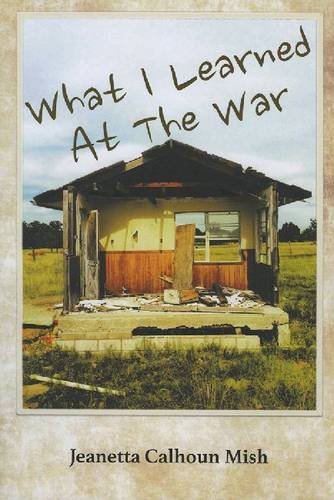
What I Learned at the War — Jeanetta Calhoun Mish. (West End Press)

Today's book of poetry:
What I Learned At The War.  Jeanetta Calhoun Mish.  West End Press.  Albuquerque, New Mexico.  2016.


According to Jeanetta Calhoun Mish "history is a bitch."  That's not a direct quote, more of a spiritual acquiescence to a way of thinking.  Mish doesn't really concern herself with time as we know it.  Time and history just partial information in Mish world.

Mish comes straight at the reader and with considerable velocity.  Mish goes on to tell us that "history resists, tells her story through the mouths of the winners."  But when ever there are winners there are losers as well.  Mist has dirt under her fingernails, her characters do too.  Today's book of poetry thinks Mish has slow-danced us all into submissive/willing audience.  We like what she is cooking.

What I Learned at the War is unsettling because every word reads/feels true and a little dangerous.  Where in the hell does fate fit in with history?  Jeanetta Calhoun Mish lays it all out.

#3 Not Quite Glengarry

At 8am, my friend dropped me off in front
of a nondescript yellowish strip-mall building
at the crumbling edge of Little Rock; the parking

lot almost empty. People with personable voices
needed. No experience necessary. Apply today.
I was trying to go straight, attempting to abandon

an assortment of marginally legal employments.
Hoping to land a job with only a high school
degree, two weeks after a miscarriage, one week

after my boyfriend wrecked my car, hocked all
my furniture, spent the rent money, then ran off
with his ex-wife. I believed I could change

my life by changing jobs. The lead, My Roma,
just back from THE most motivational seminar
EVER, lurched around the room like a speed freak

in a baby blue leisure suit that went out
of style eight years before in 1975. We
would SELL LIKE SAMSON (whoever

the hell that was. Perhaps My Roma thought
he was the guy who invented Samonsite).
The Outbound Telemarketing Specialist

who had been there longest, My Williamson,
handed us our scripts. Hello, my name is Machine
Levene and I'm calling you today because you are

the lucky winner of a set of steak knives. You don't
remember entering a drawing? You didn't —
we've chose you from a long list of deserving

men and women who rarely catch a break
much less win a prize. You only have to pay
for. . .I made it half a day before an old lady

answered with a voice that sounded just like
my granny's and I couldn't bear the shame of lying
to her, of asking her to send only $49.95 in shipping

and handling charges for a set of plastic-handled
steak knives with flimsy aluminum blades, couldn't
tell her that, according to My Blake who flashed

a sample like a switchblade, they came encased
in a red velvet bag with faux silk drawstrings. I 
apologized for disturbing Mrs. Somebody's Granny,

grabbed my coat and walked out. And kept walking
a mile to the nearest bus stop where I waited an hour
for the next bus. Three transfers and two hours after

embarking, I was back where I was staying with a friend
from AA. A new job had not changed my life, but it had
changed my mind about the value of employment

at all costs. The next week, I hitchhiked home
to Tulsa, couch-surfed, read Marx for the first time,
called myself proletarian. Never looked back.

💫💫💫

Sometimes you just like the way someone talks, the way they get to their point, Mish is instantly one of those poets for Today's book of poetry.  If any of my sisters wrote poetry I'd be awfully proud if they wrote these poems.

What I Learned at the War is conversational and confessional.  Today's book of poetry simply enjoyed the ride, cover to cover.  Our assessment is that Jeanetta Calhoun Mish is searching for beauty, but lets us know how much truth is in it's path, and the truth is only occasionally beautiful.

Declaration of a New Poetics

From this day forward
let there be no more abstractions
nor dissembled sighs
I proclaim a new poetics rising up,
flaming out of my body as if
I were the kiln and you the potter
who flung open the door.

From now on I shall speak
only the language of the sensuous,
the sensual, the reality of
taste—touch—smell—
sight is too tricky, too easily seduced
and hearing is reliable only when
applied to the code of ohs and ahs that
cannot be mistaken or misconstructed.

The practice of my new poetics
requires that I run my tongue
along your hip, grasp your stony calves,
inhale deeply at every dark conjunction of limbs.
This poetics demands I ban every pretense,
all talk of love and questions of propriety.
It allows only this primal sacred performance
this paean to need, this clashing of bodies.

In this dangerous intriguing encounter
we open ourselves to the edge
to this honesty the body knows
to our poem of desire.

💫💫💫

Our morning read was holiday-weekend short as most of our loyal minions abandoned ship and headed to the beach.  Still, those of us braving our tepid office and cooking temperatures (83 F at the moment in our offices) gave What I Learned at the War a good bounce around the room

Kathryn, our Jr. Editor, reminded us all that we'd been on a strong woman's roll here at Today's book of poetry and Jeanetta Calhoun Mish raises the bar just that Oklahoma tough gal higher.  Mish does it clean, with full on eyes-wide-open honesty.  What I Learned at the War reads like a bruise, you can feel it now, but you'll feel it more later on, see it more brightly as it sets in.

The Quah Effect
           for The Quah Crew: Faith, Murv, Debbie, & Cassandra

In Tahlequah, time staggers. It halts, leaps, spins, and burrows down
into the rocky soil to remind us that everything that ever happened in
a place is happening still.

Staggers isn't such a pretty idea.
Especially with Indians in the picture.
And Irish. And Scots.

All people who lean into drunkeness
as shadow leans into light.

Say instead: stutter steps.
Dance one forward, two back.
Sideway if you're feeling the
presence of haints and shades.

Or go ahead and live unvarnished.
Admit the ancestral jake leg,
drink until evening has to close
because the moon said so, flip the
bird to sun lurking on horizon,
pissed off and ready to make
your hangover worse.

It is happening. It is all happening.
How can you not feel it?
How can you not puke
with vertigo? History has not been well-
described. She's a bitch. A
Siren. A Medusa.

Don't trust her. You never
know what garments she'll wear
to your funeral.

💫💫💫

Today's book of poetry thinks we understand where Jeanetta Calhoun Mish wanted to take us.  It certainly felt real, felt true.

What I Learned at the War leaves an impression.

Mish can burn.

Jeanetta Calhoun Mish

Jeanetta Calhoun Mish
Photo: John Jernigan

ABOUT THE POET
Jeanetta Calhoun Mish was born in Hobart, Oklahoma. She received a BA and an MFA in English from the University of Texas - Permian Basin and a PhD in English from the University of Oklahoma. Mish is the author of What I Learned at the War (Lamar University Press, 2015) and Work Is Love Made Visible: Collected Family Photographs and Poetry (West End Press/University of New Mexico Press, 2009), winner of the 2010 Oklahoma Book Award for Poetry. In 2019, she was named an Academy of American Poets Laureate Fellow. Mish currently serves as the poet laureate of Oklahoma.

BLURBS
"There's a never-misty nostalgia and sometimes hard edge to these poems of a rough childhood, and an homage to the equally rough environs of Oklahoma. It's the sure hand of the writer that keeps you reading, the propulsive sense of a life happened, lived and recorded, with as much candor and skill as the best poetry offers us"
     --Rusty Barnes, author of Reckoning

"The power in these poems pitches, confessional and kindred like a puck along some pocked seam of red dirt clodded sanity. Grief-drenched, malady-reamed, and clumped up in some rancorous home front fault line ceremoniously split wide open, what proves revelatory, beyond Mish's poetic prowess, is her delivery of synchronicity in place and time--a sweet, sweet surrender."
     --Allison Adelle Hedge Coke author of Streaming


Jeanetta Calhoun Mish
Poet
Video: chatterabq

westendpress.org

776
DISCLAIMERS

Poems cited here are assumed to be under copyright by the poet and/or publisher.  They are shown here for publicity and review purposes.  For any other kind of re-use of these poems, please contact the listed publishers for permission.

We here at TBOP are technically deficient and rely on our bashful Milo to fix everything.  We received notice from Google that we were using "cookies"
and that for our readers in Europe there had to be notification of the use of those "cookies.  Please be aware that TBOP may employ the use of some "cookies" (whatever they are) and you should take that into consideration.


Thursday, February 25, 2016

Blond Boy - Lucia May (Evening Street Poetry)

Today's book of poetry:
Blond Boy.  Lucia May.  Evening Street Poetry.  Dubin, Ohio.  2014.

Picture

"Forgiveness is the answer to the child's dream of a miracle by which what is broken is made whole again, what is soiled is made clean again."
                                                                - Dag Hammarskjold

Lucia May starts Blond Boy with this marvelous quote from Dag Hammarskjold about forgiveness and it is good to keep this in mind when reading through this murky pool of regret and hope.  

Blond Boy is May's poetic attempt to forgive her father and to forgive herself for crimes and misdemeanors large and small.  May's father was a young boy in Poland at the outbreak of World War II and came of age under a Nazi occupied Poland where he suffered great and unforgettable torment at the hands of German soldiers.  May's anecdotes make clear that her father saw things no young boy/man should ever see.

After the war May's father got to the United States and found May's mother, they married, May was conceived and new tragedies and drama unfold.

Luck Runs in My Family

In Poland
during World War II
a certain Nazi
liked to stand my father
against a wall,
walk back
and fire
his pistol
as close as possible
to my father's head
for sport.
My father didn't
feel lucky,
frozen against the wall,
but he'd live
to call it luck.

My brother Billy
died by shooting
himself. He didn't
know that luck
has nothing to do 
with Russian Roulette.

I am lucky
that my daughter is
lucky to be
recovering.
When she burst
into the house
with her eighteen
month medallion
I felt lucky
I didn't feel lucky
driving her
to those first
counseling meetings.
Her scabbed arms,
shaved head,
and scaly warts
made me look away
as if she were a snail
being torn
from its shell.

...

There's no reconciling May's father's tortured past and turning it into a reasonable present.  May's father becomes possessed by a religious furor and his obsessions alienate and eventualy shatter a tattered family.  Clearly haunted, the father is doomed.

There are poems set during wartime Poland, others in an American home in the late fifties, early sixties, and it is falling apart at the seams while May's father tries to fix the cracks with sermons.

These poems are a dysfunctional family's epitaph and it is clouded with ghosts that go unnamed. 
May wants to let go of the past and these poems may be her only shot at redemption, they certainly feel that way.  This is intense and compelling stuff.

For Any Abiding Place on Earth

                                                   after Carl Dennis

All my grandmother needed at her farm in Poland
was time to raise the crops of corn and cousins.

I met my grandmother when I was seven.
As our taxi from Warsaw came to stop in the dust
she sputtered and screamed around this barnyard
with the alarmed chickens. She tugged off her apron
and tucked her hair into her babushka.

I stand at the farm's grave and find only ceramic tile pieces
in the disemboweled earth where the kitchen once stood.

There are no abiding places on earth, unless memory is a place
and I doubt it. Gather all memories and they wouldn't fill
one square inch of this remembered ground.
They are lighter than dust and even less confined.

...

That last verse is gold.  Solid gold.

Luck can cast some pretty dark shadows and the Nazi occupation of Poland left scars beyond what Lucia May's father could rationally endure.  These scars were big enough to scar generations and whether or not May is out from under this horrid history depends on who she forgives.

These poems are, in spite of the father's faults, an apology for her father, to her father, and then to herself.

May is mining some awfully deep torment in Blond Boy.  It makes for some startling poetry.

Blond Boy and the Plan for Eastern Europe
                                  (Generalplan Ost)

Cattle wagons transported
children aged six to ten years
to temporary selection camps.
A sympathetic Nazi guard
could sell a Catholic child back
to its Polish family for 25 zloty.

The blond boy was twelve in 1939
when the Nazis invade Poland.
He is too old for Germanization,
too old to be desirable enough
to undergo racial exams by experts.

Some younger Polish gentiles live
and die as Germans, unsuspecting,
but he is too old to forget Polish
nursery rhymes and his Polish name.

Armed Nazis seize him from the family farm
and he is conscripted as a Zivilarbeiter--
civilian worker--forbidden to swim
in public pools, to ride public transport,
to own a bicycle, or under penalty of death,
to have sex with a German.

By law the blond boy's wages are lower than
German citizens', his nutrition substandard.
He chips stone seven days a week
in a German quarry. He may not attend
church and must wear a purple "P" badge.

His superiors encourage him to sign
the Deutsche Vaolksliste for benefits
like more calories and freedoms.
He refuses to sign and after the war
is spared being tried in Poland for high treason.

...

Blond Boy is full of brave poetry from the wounded heart of a survivor.  Nothing in Blond Boy is going to make you happy - but you are certainly going to glad you spent time with this riveting book of poems.

Picture
Lucia May

ABOUT THE AUTHOR
Lucia May is a poet and longtime arts advocate in St. Paul, MN. Her poems have appeared or are forthcoming in Main Channel Voices, the Evening Street Review, Hot Metal Press, Paperdarts, the Prose-Poem Project, Pemmican, Talking Stick, Tall Grass, Burnt Bridge, The Widow’s Handbook Anthology, The Awakenings Review, The Mom Egg, Verse Wisconsin, Kurier Polski Min-nesota, and the Little Red Tree Inter-national Poetry Prize 2010: Anthology. She has been nominated for a Pushcart Prize by Verse Wisconsin for her poem “Explain in an Essay.”

BLURBS
In Lucia May's inaugural poetry collection, Blond Boy, she records with gracious precision the personal horrors of the boy who would become her father. Taken from his home by the Nazis, the boy's humanity was forever scarred by his experiences. Of his torture, Lucia writes, "...the boys accepted their penalties/like cows on the farm before the knife." Lucia weaves his story into her own through poetry that is brutally honest while being "bathed in the light" of forgiveness. She manages well the difficult task of showing grief and loss unsentimentally, with a glance, a gesture, an image that glows vividly on the page. This slim book offers readers the chance to share in emotions as complex as Bach played with panache on a well-tuned violin. At the end, we are left with memories that are "lighter than dust and even less confined."
     —Linda Back McKay, author of The Next Best Thing and Out of the Shadows: Stories of Adoption and Reunion.

A man who suffered a wretched childhood extended bitterness and perverse misery to his own children. He became a religious fanatic, who in his distorted view deemed the music of Bach and Beethoven wholly unacceptable. Growing up in a nightmarish environment, his daughter, Lucia P. May, did not fall victim to depression, suicide, alcoholism or drug addiction. Miss May escaped the quicksand of her father's cruelty through art, music and literature. She writes exquisite poetry that shines light in the darkness.
     —Robert O Fisch, author of Light from the Yellow Star: A Lesson of Love from the Holocaust and The Sky Is Not the Limit

Lucia Piaskowiak May writes without any sentimentality whatsoever about her father's life in World War II Poland and about the shadow he cast over her own life. She compresses enormous emotion into tense spare lines to create poetry that is fierce and true.
     —Keith Maillard, author of The Clarinet Polka

A memoir in poetry, in Blond Boy Lucia May tells the tragic and amazing story of her father's survival in Nazi-occupied Poland, his marriage to her mother, her visit to Auschwitz, taking violin lessons and attending healing services at a Presbyterian church. This is a story well worth telling and it comes wonderfully alive in all its mesmerizing details. These memories will dance in our minds for a long time. May writes of them as 'lighter than dust and even less confined.' May we all be thankful that she has captured them for a moment.
     —Mary Logue, author of Hand Work and Trees

Lucia May's book, Blond Boy, is a tough, intense collection of poems. It's a book about what luck means. It's a book about a father, that blond boy who survived World War II, and where the luck of surviving led him. It's a collection that offers its readers portraits of a family, of how religion affected them, vignettes that allow us to see a family's suffering, and how pain and discord shaped their lives. We are given stories that cover many years, and we see how the lucky and unlucky in this single family lose or find their strength, their sense of purpose inside a family, inside history. This collection is blunt in its truth-telling, and ambitious in its range. I won't forget these poems.
     —Deborah Keenan, author of From Tiger to Prayer and so she had the world


To see the trailer for Blond Boy please click here:


442


DISCLAIMERS

Poems cited here are assumed to be under copyright by the poet and/or publisher.  They are shown here for publicity and review purposes.  For any other kind of re-use of these poems, please contact the listed publishers for permission.

We here at TBOP are technically deficient and rely on our bashful Milo to fix everything.  We received notice from Google that we were using "cookies"
and that for our readers in Europe there had to be notification of the use of those "cookies.  Please be aware that TBOP may employ the use of some "cookies" (whatever they are) and you should take that into consideration.