Showing posts with label robert pinsky. Show all posts

Tuesday, September 12, 2017

You, Beast - Nick Lantz + The Lightning That Stikes The Neighbors's House - Nick Lantz (The University of Wisconsin Press)

Today's book of poetry:
You, Beast.  Nick Lantz.  University of Wisconsin Press.  Madison, Wisconsin.  2017.

Winner of the BRITTINGHAM PRIZE


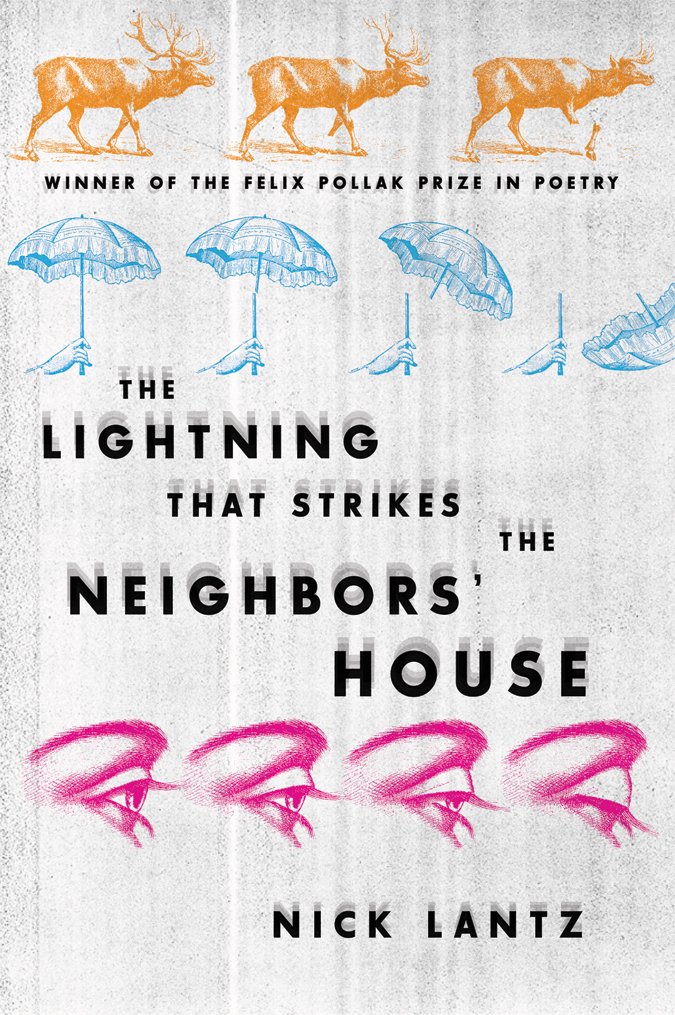
The Lightning That Strikes The Neighbor's House.  Nick Lantz.  University of Wisconsin Press.  Madison, Wisconsin.  2010.

Winner of the 2010 FELIX POLLAK PRIZE IN POETRY selected by Robert Pinsky

Today's book of poetry is throwing two books by Nick Lantz at you today and we're doing it for one reason:  Nick Lantz is a poetry monster.  He's a freaking King Kong Frankenstein Dracula Werewolf monster of the first order.  We are clumsily trying to tell you in the calmest manner that Nick Lantz has range, style and moxie beyond most mortal poets, his poetry is beyond superb.

Lantz is the king of juxtaposition, changing direction with machine gun speed but never missing a step.  The Lightning That Strikes The Neighbor's House and You, Beast are both stunning books of poetry.  Lantz is an encyclopedia, a yin/yang salesman.  Lantz is one of the most exciting poets we have ever read.

Based on True Events

So a dolphin gets caught
in a crab trap, then is rescued
and rehabilitated, but loses
his tail, or just flukes,
and is going to die probably
of heartbreak, but some kid
falls in love with him (or her?),
and the dolphin eats fish
from the kid's hand, music
swells, and the dolphin
is fitted with a prosthetic
tail and learns to do tricks
for the amputated soldiers
returning from a desert
(how can a dolphin
ever imagine a desert?),
and the soldiers say
what a huge inspiration
this dolphin is, so someone
makes a movie in which
all the above occurs
and in which the dolphin
will play itself (God, the name
they've given it: Queenie,
or Felicity or something)
and the movie title is a pun
about the dolphin's tail,
its missing tail that was lost
in some asshole's crab trap,
and everyone is crying
tears of joy as the dolphin
cavorts in the 60 x 60 tank
that will be its home
until it dies, and the dolphin
squeaks and jerks
its head, and who knows
what it's trying to say.

(You, Beast)

...

Conditional

We all have them, the lucky cousins. Feckless, blessed.
               One backed over by a bulldozer, treads

                                                                                          up to his chin.
Not a bone broken, not a bruise. Sunk in the soft mud.

               What can be said about grace
                                                           that does not diminish it?
To play a drunk, the best actors pretend to be sober.
               The street mime ladles water
                                                           from his leaky canoe.

Of the blind dog and the three-legged rabbit he chases, only
               one can be lucky tonight. Our cousins race
                                                                                           every train
to its crossing on principle; it's no surprise they win.

               If you had been born to different parents,
                                                           would your stomach still
be cratered with cigarette burns? Let us believe rain
               follows the plow, that the luck
                                                            we earn is indivisible.

Let me believe that the porch security light recognizes
               my particular shape approaching
                                                             the house at night.
Termites carry our poison back to their many cousins.

               Canoeing under the broken
                                                             train bridge, we looked up
and saw a golden bird spray-painted on the belly
               of the trestle, gaps of sunlight
                                                             punctuating the wings.

(The Lightning That Strikes The Neighbor's House)

...

Today's book of poetry is doubling up on the poems today because this double-decker of Lantz demands it.  The experience of reading the poems in both of these volumes is a little like watching the legendary Arturo Gatti/Micky Ward fights.  30 rounds of beautiful back and forth.  These poems never back up, for every left hook there's a right cross.

For every moment of scathing, blistering sarcasm, there is a moment of sublime tenderness.  Today's book of poetry just ate up Lantz's epic, episodic poem, "Toyland" from You, Beast.  Lantz clearly has a sustain pedal option on his wizardry and when he revs up his big engine sparks fly.

The Lightning That Strikes The Neighbor's House and You, Beast will convince you, dear reader, that Nick Lantz is writing from rarefied air.

This morning's read was twice as long as normal, no one wanted to miss a thing.  Poems this smart, fast and agile don't come along all that often.  The staff sat around trading poems with that look in their eyes, you know that look, the one we save for awe.

Drawing the Bee

The five-year-old's drawing:
distended honeybee,
fuchsia-striped,
striding long-legged
through the tiger grass,
eyes wobbly dots of wax
searching for a flower
to bury his face in.

I could say it signified
the tidy apocalypse
of divorce, the slanted light
of a therapist's office,
but that wouldn't be true.

I always drew the stars as black
knots brooding over bruises
(they might have been bears)
that tilted their heads up to gulp
at greenish air.

When I got a microscope
for my birthday, the first thing I ever trapped
on a slide was a flea
taken from the cat's neck. I drew
its delicate hairs, its needle
mouth, those legs long as a dancer's
and still twitching.

When I walked down a street,
I saw every broken
window first, followed the line
of ants to the car-struck sparrow,
heard in the train's long screech
a voice calling a name that had lost
its shape.

Now my mother sends drawings
she's found in old shoeboxes:
today, a pair of wolves on hind legs,
forepaws on each other's shoulders.
"Dancing," she says, but I know
they're strangling one another.

(You, Beast)

...

The Diving Horses

You know how the old stories go: the peasant's hut
               grows a little smaller every
                                              day, the frog by the window
a little louder. It's a miracle we can sleep at all.

               In the hotel room the night after
                                                           your brother's funeral,
we watched a bad movie about horses trained to jump
               from a platform into a small pool
                                                                          forty feet below.

In the first garden, the fruit didn't know when to drop.
               So what if starvation is the only thing
                                                                           that can make
the young albatross use its wings for the first time?

               Why can't I be more
                              like the hermit crab, strutting
around the sea floor in an empty perfume bottle?

               The news cuts in. The president
                                                                            shrugs. So what
if your brother dies? Without the fox's teeth deep
               in the hen's downy neck,
                                                            we would starve.

After the war, when Sherman took his evening walks,
               the fence posts lay down
                                              in the grass and trembled.
The horses, we're told, required very little prodding.

(The Lightning That Strikes The Neighbor's House)

..

Today's book of poetry started this blog primarily so that I could get my grubby little paws on more poetry.  Discovering new poetry has been a fountain of youth, a literal joyous balm.  But when poets like Nick Lantz walk through the door, well, that's when I love poetry most.

As an audience you Today's book of poetry readers must be getting to know my peccadillo's, tendencies and preferences.  You might even be familiar with my quite brilliant wife K.  K is an extremely polite and voracious reader.  She doesn't usually have much to say about poetry but this is what she said after reading Nick Lantz:

"F**k!  I love this guy!"

and then, as though he were right in the room:

"You've shown me what poetry can be!"

Nick Lantz

ABOUT THE AUTHOR
Nick Lantz is the author of The Lightning That Strikes the Neighbors' House, We Don't Know We Don't Know, and How to Dance as the Roof Caves In. He is the editor of Texas Review, cocurator of thecloudyhouse.com, and an assistant professor of English at Sam Houston State University in Huntsville, Texas. He has been a Jay C. and Ruth Halls Poetry Fellow at the University of Wisconsin–Madison and an Emerging Writer Fellow at Gettysburg College.

BLURBS
“Lantz gives us what we could least have anticipated, then makes it seem the most natural thing in the world.”
     —John Burnside

“Poem by poem, book by book, Nick Lantz is becoming one of our time's best poets. He knows the blades and shrieks and pleasures and sweet sick twists in our human hearts, and this bestiary forces us to look, hard and long, in our own mirrors. 'Polar Bear Attacks Woman ... Horrifying Vid (Click to Watch)' is a poem for this moment in the way Auden and Yeats and Rich and Dickey and Komunyakaa gave us poems for their moments.”
     —Albert Goldbarth


Here on Earth - Off The Mic - Nick Lantz
 Reads "TheYear We Blew Up The Whale"
Video: HereOnEarthShow


607
DISCLAIMERS

Poems cited here are assumed to be under copyright by the poet and/or publisher.  They are shown here for publicity and review purposes.  For any other kind of re-use of these poems, please contact the listed publishers for permission.


We here at TBOP are technically deficient and rely on our bashful Milo to fix everything.  We received notice from Google that we were using "cookies"
and that for our readers in Europe there had to be notification of the use of those "cookies.  Please be aware that TBOP may employ the use of some "cookies" (whatever they are) and you should take that into consideration.

Thursday, September 3, 2015

I Was Building Up To Something - Susan Davis (Moon Tide Press)

Today's book of poetry:
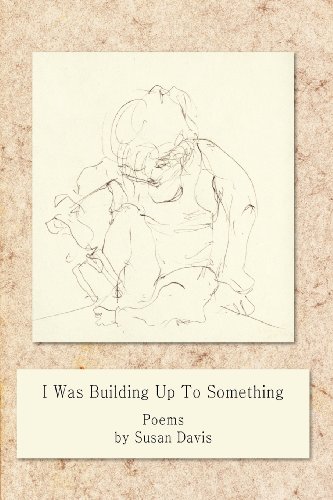
I Was Building Up To Something.  Susan Davis.  Moon Tide Press.  Irvine, California.  2011.


It happened again last night.  I was reading Susan Davis' splendid I Was Building Up To Something and I got to her poem "Undertaking" and I cracked through the silence, alarming Kirsty something fierce.  I whoooooped.  It hadn't been any sort of angry silence or unhappy silence, just the usual, late at night, both of us reading, toes touching, silence.  We'd talked our day over earlier, made our usual little complaints against the universe, solved some problems that weren't ours, laughed a little and then, as usual, read.

As I've said before, it takes a bad poem or a very good one for me to break the silence.

Then I usually read that bad or good poem to K.  She either scowls, laughs and goes back to her The Goldfinch by Donna Tartt or whatever other tome she is reading, or she puts down her book and takes my hand, shares the moment, and then goes back to her book.

K loved this poem.

Undertaking

She had to wash away
the black silt
worked into his pores, into
the wrinkles around his eyes
that made him look older
than his 47 years.
She walked his naked length
on the table at her waist
where she kneaded dough,
where she told the men to place him.
She had given them the children
and made them all leave.
She took her time.
By lantern-light, she washed each finger,
cleaning underneath the nail with
a splinter sheathed in cotton.
She started once to wrap him
in a blanket. He was so cold.
She found a mole on his hip
she never knew was there.
I thought he would have liked
to have her find the mole like this
when he was still alive.
I said to you
when the husband died,

The way it's done now,
they make her leave the room,
leave the body with a stranger
who zips it up in a plastic bag,
tags it like a specimen,
puts this warm sweet body
in a drawer.
They let a stranger handle you
that one last time.
They would have to drug me.
They would have to drag me away.

Remember how I told you that?

...

Today's book of poetry frequently falls victim to romantic shambles and Susan Davis has that voice honed, whet-sharp.  In her poem "Hindsight" when she intones the following I almost fell apart:

What do we want so badly
that we give up those we love to get it?

Lines like these haunt me like a ghost.  So I passed I Was Building Up To Something around the office, like we always do, and was surprised.  Milo read it last, as usual, but today when he finished reading he didn't scowl and throw the book back at me.  Instead he asked, almost politely, if he could keep it until after lunch.  He wanted to give it another go.

This is poetry that reminds the reader of what it is we really struggle with, the basic firmaments of our desire to be good.  Discovering basic goodness is a life long pursuit and Davis provides us with some very illuminating and instructional moments.

Davis writes serious poems that resonate in the reader's ear as though it were common knowledge we were being reminded of, that we are all this wise.  Davis is just reminding us.

Gravity

Ticking marks seconds players use to list words starting with a
  single letter.
It is the end of concentration and a style of thinking.

I have won before. And the smile of summer at table under trees.
Rugs looped on little metal spikes and sheets stiff from sun-drying.

O! the looping car sighs in the suburb summer.
The tire blimp is grinding over like a rainless thunderstorm.

Ten years ago its pilot grabbed a trailing rope to reattach the
  mooring
and it took him off into the small plane space just above the houses

but high enough. He was trying to save it. He was going up with
  the ship
and then he was falling away. What was he thinking? When did he
know

he had misjudged? At the gym we talk fat, muscle, bicep curl,
  lunge.
If he had been stronger. She says work to failure. Exhaust the
  muscle.

And I want to rest. I get tired of holding on. His body whipping
  along like a flag
over the woman strolling her baby and the boy cutting grass for
  his father.

People watching the towers burning and groaned as the bodies
  dropped
a very simple way. There's no help. Then falling is what's left to
  do.

...

Davis kept me riveted from beginning to end of I Was Building Up To Something.  These poems hum with all the right tension.  They are sometimes passion and sometimes pain but always right on target. By the time you get to the end of I Was Building Up To Something you feel completely invested in the poetry of Susan Davis.

I Was Building Up To Something is like a photo album full of strangers who look like you - it is a familiar.  Not because Davis knows you but because she know us  -  because the good stuff is universal.

Progeny

          My conclusions are often wrong, but I don't find out until it's
too late. Then again, who gets to say it's too late? I'm not dead yet.
          That sounds like my daughter. She thinks she'll never die. If
I were sixteen with such fierce grandmothers, I might feel the same.
They'll live to be a hundred. That's a conclusion.
          Endings got heavier with my father's death - the only son,
after my brother - the only son. Now my aunts and their sons are
dying, as if a plague had been designed to stamp out the family.
          I read about the Tutsis and the Hutus in Rwanda. In
Waimanalo, they wait for the day when the north part of Oahu will
be returned to the Kanaka Maoli. I don't know how my Great Aunt
Mattie's land was split up when she died. There are no natives left
to return it to. I don't think Ina Claire will keep up the practice of
stocking the pond and giving each grandchild for birthdays an acre
and a calf to raise.

...

Today's book of poetry simply liked the way Davis talked.  These plain speaking poems are all an open door, their geography welcoming, the weather unpredictable but always instructive.

Susan Davis

ABOUT THE AUTHOR
Susan Davis's poetry reflects a birth in Louisiana, a childhood in upstate New York and stints in the giant states of Texas and Alaska.  She now resides in California with her husband and directs under-graduate creative writing at University of California, Irvine.  Her poem "The Season Begins in a Waiting Room" was chosen for the 2010 Rebecca Lard Poetry Award, and the poem "Farm Days" was installed on wind screens at the Lake June transit station in Dallas in November of 2010.  She is the mother of two daughters.  I Was Building Up To Something is her first book.

BLURBS
There's an ancient Chinese sensibility to Susan Davis' poems, a compression of line and idea, but not of emotion, which I found profoundly moving. While trying to write these lines, I kept replaying her haunting music and rhythms. A first book with the wisdom of several, and I haven't even mentioned that she already owns her own stark, unflinching, original vision or our redoubtable, ever-mysterious world. It's a pleasure to help welcome a new and memorable voice to our literature.
      - Philip Schultz

Susan Davis' poems remind us what reverence is, its sources, why we might quiet ourselves down enough to remember and to hear what brings us to our knees, sometimes with pain, sometimes with joy. Allow the quiet. Kneel down in the garden.  Read these perfect, careful poems.
      - Michelle Latiolais

With an astounding clarity, I Was Building Up To Something looks at the world of family and faith, the vicissitudes of love and longing. The poems explore deeply the fundamental experiences all thinking, feeling people face in a world where spiritual longing is often met with terrifying silence, and the sensation of time passing is both a blessing and a curse. Plainspoken, fresh and unpredictable, they heighten the sense of human attachment. This is a beautiful book. It should be required reading for anyone wishing to live a serious life.
     - Alan Shapiro

Susan Davis' book has the indelible yet understated quality of certain great photographs. Sharp edges of narrative, clarity of emotion, distinct images in declarative sentences, the velvet, gradated shadows of loss, unpredictable rhythms of violence and tenderness in country life and family life: from the precisions of that exacting surface rise the mysteries of life itself, caught in the trigger-slices of these urgent, concentrated poems.
     - Robert Pinsky

Susan Davis
reading from I Was Building Up To Something
at the Muckenthaler Cultural Center
Fullerton, California
18.12.11
video: kmichaelobrien


378

DISCLAIMERS

Poems cited here are assumed to be under copyright by the poet and/or publisher.  They are shown here for publicity and review purposes.  For any other kind of re-use of these poems, please contact the listed publishers for permission.

We here at TBOP are technically deficient and rely on our bashful Milo to fix everything.  We received notice from Google that we were using "cookies"
and that for our readers in Europe there had to be notification of the use of those "cookies.  Please be aware that TBOP may employ the use of some "cookies" (whatever they are) and you should take that into consideration.