Showing posts with label felix pollak prize. Show all posts

Saturday, January 27, 2018

Season of the Second Thought - Lynn Powell (University of Wisconsin Press)

Today's book of poetry:
Season of the Second Thought.  Lynn Powell.  University of Wisconsin Press.  Madison, Wisconsin.  2017.

Winner of the FELIX POLLAK PRIZE in POETRY


Lynn Powell is exactly the tonic that Today's book of poetry needed to get back on track and into gear.  Reading poetry that is this smart and confident reminds us of how the real pros do it.

Season of the Second Thought is audacious.  This is Powell's third book but the first Today's book of poetry has seen.  Reading Season of the Second Thought is like eating that perfect box of chocolates, each one more delicious, every taste a new and exciting experience.  And you can never have enough. Powell calls out the muse, her muse, several times and openly challenges her for higher ground.  Not sure how Powell manages her erudite and sophisticated palette and still comes out speaking in a language we all understand, but it is a true pleasure to read.  And to read again.

Slow Elegy from Afar

     Then the Lord answered Job out of the whirlwind:
      ...Where were you when I laid the foundation of the earth?

What glitch in the genes created shame?
God, the oldest scapegoat, usually gets the rap.

But why would the maker of that granite island--
glacier-polished nub of a Precambrian peak,
with an osprey perched, bellyful of fish, in a wind-bent pine,
the gibbous moon floating up, and the evening star,
on cue, surfacing in a lavender sky--why
would the God of that cold beauty
contrive a hall of mirrors in a human mind?

︷

On our last long walk five springs ago, we sparred, gingerly.
You were a brilliant believer; I had come to believe
that cruelty was the only sin--with the caveat
that cruelty could also be the secret name of subtler sins.
Everything else, I argued, is the blundering of a desire
to be known, loved, or safe. We make mistakes
and know ourselves.

I could see your young, tired face tighten.

So I tried a different tack--
Don't take the perfect so personally.
Don't take shame so much to heart.

︷

Why did you suffer? And why did you leave
your suffering to those you loved?

I can't gird my loins again against my childhood God,
that God with a clipboard and swift red pen.

So I reread Job, and watch the waves wash,
and aim to wash away, the granite shore.
They paraphrase the whirlwind.

As do the oriole that slings her hammock nest
along the path we walked, the doe in the close woods
wary for her fawn, the thunderhead and the downpour,
the firefly galaxies in the blackest field of night,
the forsythia festive once again beside your grave.

...

Lynn Powell's Season of the Second Thought grabbed me by the poetry lapels and shook me senseless.  Powell musing in a blue mood is as good as Miles Davis doing the same.  But somehow I keep hearing W.H. Auden's perfect pitch in these poems.

The thing you learn, early on in Season of the Second Thought, is that you can be confident throwing yourself into each and every poem from the beginning to the end.  Lynn Powell is steady as a metronome with these incandescent poems aglow with "iridescent language."  Powell can burn.  Here's a poet who talks about the weather as though she controlled the sky, like she knows when it is going to rain.

Love Poem from the Wrong Side
of the Rain

What would April do? Tease hidden
meanings from the bulbs, raise the stakes
and double my entendres, and bet
all my roses on the bottom line.

But it's the season of embarrassed trees,
the modest charms of leaf rot and briar
and hawk scat thawing on the muddy path:
skinny March at an earnest latitude.

So tell me, Muse: where around here might a woman
find a little flint and tinder,
some figure of feisty speech, a correlative for kisses
that would make a grown man weep if she put it
all on the table and headed out
for good into the long-stemmed rain?

...

Today's book of poetry is very happy to be back in the saddle, and Lynn Powell is one hell of reminder of why we are in the poetry game.  Today's book of poetry doesn't just love reading great poetry, we aspire to write some of it.  Poets like Powell set the bar to beautiful new heights.

Our morning read was old school.  I made everyone stand up today when they read.  An infinitesimally small gesture of respect in memory of SeƱor Caballero Nicanor Parra who left us this week after more than a century of being a GREAT poet and a beautiful citizen.

Powell's poems held up splendidly.  The grand old man would have seen the bold beauty of Powell's hard truths, her certainties all tinged a little blue.

October Edge

Mapless and skidding again on a backroad
prickly with teasels and sumac and skeletons
of lace, I glimpse a pink non sequitur:
a winged woman on the stoop
of a whitewashed church, glancing up
from an opened book and lifting
her opened hand--

but I will not brake today for grace,
I round the reckless curve, past pumpkins
with no faces forced yet on them, past
bins and barrels of crimson wholesale fruit,
past tombstones disheveled in the drizzle
staggering after their long-lost
ballast of grief--

the blurred signs vanishing
like everything else in the hindsight horizon,
and the black tires taking my incendiary heart
farther, faster, out past the charred trunks of the maples,
those miles of martyrs with feet
held fast to the banked flames
of their own making.

...

Today's book of poetry is here to tell you that Lynn Powell's Season of the Second Thought is worth every second of time you can spend on it.

Today's book of poetry is built on the idea of sharing the best poetry what we can find.  Lynn Powell's Season of the Second Thought is as stone cold solid as any book Today's book of poetry has sent your way.  Lynn Powell is instantly a poet we will have all the time in the world for.

For Lynn Powell we are ready when she asks "Why don't you put your mouth / where your moody heart is?"  Today's book of poetry is speaking up here and now; Lynn Powell IS the next poet you should read.



Lynn Powell

Lynn Powell

ABOUT THE AUTHOR
Lynn Powell teaches in the Creative Writing Program at Oberlin College, where she directs Oberlin's Writers-in-the-Schools Program. She has published two previous collections of poetry: Old & New Testaments, winner of the Brittingham Prize in Poetry, and The Zones of Paradise. Her nonfiction book Framing Innocence won the Studs & Ida Terkel Award.

BLURBS
“Let Powell's images and figures wash over you. They can be deft and unobtrusive, but they will stick with you; they will illuminate what otherwise might be dark. A poet so sure-handed is irresistible. Dazzling.”
     —Robert Wrigley

“Not just written, but wrought. Powell's new poems deftly combine keen observation with perfect pitch, and their rich chiaroscuro renders them vibrant and painterly as the Dutch masters they often reference. The current running through her lines leaves me shivering with excitement and gratitude.”
     —R. T. Smith, author of In the Night Orchard


Kind of Blue
Lynn Powell
Video: Gabriel Jasso


650


DISCLAIMERS

Poems cited here are assumed to be under copyright by the poet and/or publisher.  They are shown here for publicity and review purposes.  For any other kind of re-use of these poems, please contact the listed publishers for permission.


We here at TBOP are technically deficient and rely on our bashful Milo to fix everything.  We received notice from Google that we were using "cookies"
and that for our readers in Europe there had to be notification of the use of those "cookies.  Please be aware that TBOP may employ the use of some "cookies" (whatever they are) and you should take that into consideration


Tuesday, September 12, 2017

You, Beast - Nick Lantz + The Lightning That Stikes The Neighbors's House - Nick Lantz (The University of Wisconsin Press)

Today's book of poetry:
You, Beast.  Nick Lantz.  University of Wisconsin Press.  Madison, Wisconsin.  2017.

Winner of the BRITTINGHAM PRIZE


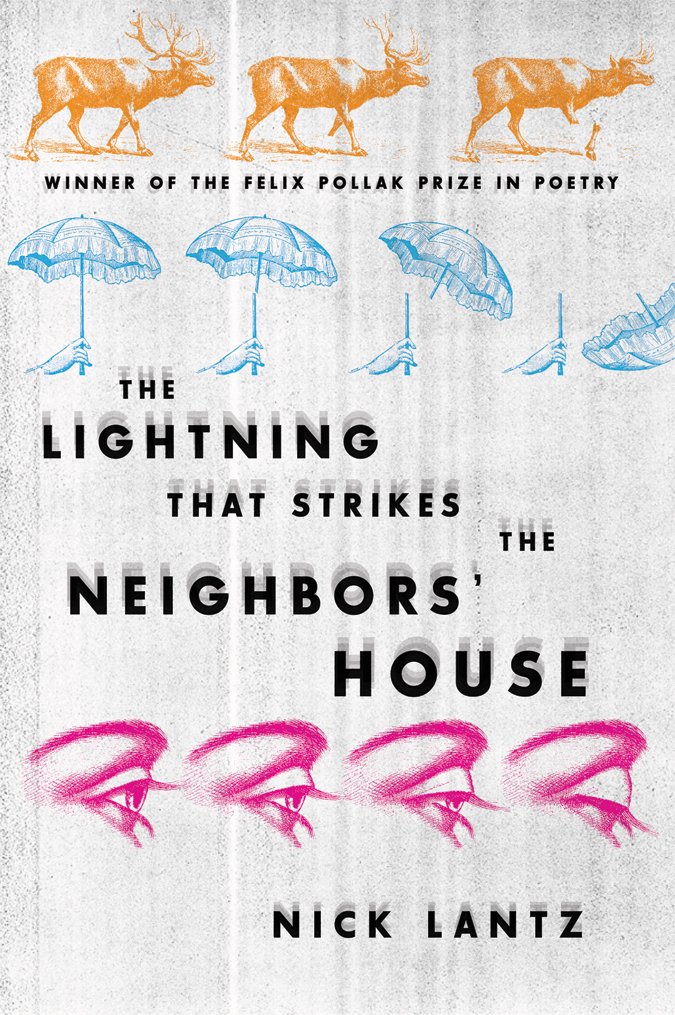
The Lightning That Strikes The Neighbor's House.  Nick Lantz.  University of Wisconsin Press.  Madison, Wisconsin.  2010.

Winner of the 2010 FELIX POLLAK PRIZE IN POETRY selected by Robert Pinsky


Today's book of poetry is throwing two books by Nick Lantz at you today and we're doing it for one reason:  Nick Lantz is a poetry monster.  He's a freaking King Kong Frankenstein Dracula Werewolf monster of the first order.  We are clumsily trying to tell you in the calmest manner that Nick Lantz has range, style and moxie beyond most mortal poets, his poetry is beyond superb.

Lantz is the king of juxtaposition, changing direction with machine gun speed but never missing a step.  The Lightning That Strikes The Neighbor's House and You, Beast are both stunning books of poetry.  Lantz is an encyclopedia, a yin/yang salesman.  Lantz is one of the most exciting poets we have ever read.

Based on True Events

So a dolphin gets caught
in a crab trap, then is rescued
and rehabilitated, but loses
his tail, or just flukes,
and is going to die probably
of heartbreak, but some kid
falls in love with him (or her?),
and the dolphin eats fish
from the kid's hand, music
swells, and the dolphin
is fitted with a prosthetic
tail and learns to do tricks
for the amputated soldiers
returning from a desert
(how can a dolphin
ever imagine a desert?),
and the soldiers say
what a huge inspiration
this dolphin is, so someone
makes a movie in which
all the above occurs
and in which the dolphin
will play itself (God, the name
they've given it: Queenie,
or Felicity or something)
and the movie title is a pun
about the dolphin's tail,
its missing tail that was lost
in some asshole's crab trap,
and everyone is crying
tears of joy as the dolphin
cavorts in the 60 x 60 tank
that will be its home
until it dies, and the dolphin
squeaks and jerks
its head, and who knows
what it's trying to say.

(You, Beast)

...

Conditional

We all have them, the lucky cousins. Feckless, blessed.
               One backed over by a bulldozer, treads

                                                                                          up to his chin.
Not a bone broken, not a bruise. Sunk in the soft mud.

               What can be said about grace
                                                           that does not diminish it?
To play a drunk, the best actors pretend to be sober.
               The street mime ladles water
                                                           from his leaky canoe.

Of the blind dog and the three-legged rabbit he chases, only
               one can be lucky tonight. Our cousins race
                                                                                           every train
to its crossing on principle; it's no surprise they win.

               If you had been born to different parents,
                                                           would your stomach still
be cratered with cigarette burns? Let us believe rain
               follows the plow, that the luck
                                                            we earn is indivisible.

Let me believe that the porch security light recognizes
               my particular shape approaching
                                                             the house at night.
Termites carry our poison back to their many cousins.

               Canoeing under the broken
                                                             train bridge, we looked up
and saw a golden bird spray-painted on the belly
               of the trestle, gaps of sunlight
                                                             punctuating the wings.

(The Lightning That Strikes The Neighbor's House)

...

Today's book of poetry is doubling up on the poems today because this double-decker of Lantz demands it.  The experience of reading the poems in both of these volumes is a little like watching the legendary Arturo Gatti/Micky Ward fights.  30 rounds of beautiful back and forth.  These poems never back up, for every left hook there's a right cross.

For every moment of scathing, blistering sarcasm, there is a moment of sublime tenderness.  Today's book of poetry just ate up Lantz's epic, episodic poem, "Toyland" from You, Beast.  Lantz clearly has a sustain pedal option on his wizardry and when he revs up his big engine sparks fly.

The Lightning That Strikes The Neighbor's House and You, Beast will convince you, dear reader, that Nick Lantz is writing from rarefied air.

This morning's read was twice as long as normal, no one wanted to miss a thing.  Poems this smart, fast and agile don't come along all that often.  The staff sat around trading poems with that look in their eyes, you know that look, the one we save for awe.

Drawing the Bee

The five-year-old's drawing:
distended honeybee,
fuchsia-striped,
striding long-legged
through the tiger grass,
eyes wobbly dots of wax
searching for a flower
to bury his face in.

I could say it signified
the tidy apocalypse
of divorce, the slanted light
of a therapist's office,
but that wouldn't be true.

I always drew the stars as black
knots brooding over bruises
(they might have been bears)
that tilted their heads up to gulp
at greenish air.

When I got a microscope
for my birthday, the first thing I ever trapped
on a slide was a flea
taken from the cat's neck. I drew
its delicate hairs, its needle
mouth, those legs long as a dancer's
and still twitching.

When I walked down a street,
I saw every broken
window first, followed the line
of ants to the car-struck sparrow,
heard in the train's long screech
a voice calling a name that had lost
its shape.

Now my mother sends drawings
she's found in old shoeboxes:
today, a pair of wolves on hind legs,
forepaws on each other's shoulders.
"Dancing," she says, but I know
they're strangling one another.

(You, Beast)

...

The Diving Horses

You know how the old stories go: the peasant's hut
               grows a little smaller every
                                              day, the frog by the window
a little louder. It's a miracle we can sleep at all.

               In the hotel room the night after
                                                           your brother's funeral,
we watched a bad movie about horses trained to jump
               from a platform into a small pool
                                                                          forty feet below.

In the first garden, the fruit didn't know when to drop.
               So what if starvation is the only thing
                                                                           that can make
the young albatross use its wings for the first time?

               Why can't I be more
                              like the hermit crab, strutting
around the sea floor in an empty perfume bottle?

               The news cuts in. The president
                                                                            shrugs. So what
if your brother dies? Without the fox's teeth deep
               in the hen's downy neck,
                                                            we would starve.

After the war, when Sherman took his evening walks,
               the fence posts lay down
                                              in the grass and trembled.
The horses, we're told, required very little prodding.

(The Lightning That Strikes The Neighbor's House)

..

Today's book of poetry started this blog primarily so that I could get my grubby little paws on more poetry.  Discovering new poetry has been a fountain of youth, a literal joyous balm.  But when poets like Nick Lantz walk through the door, well, that's when I love poetry most.

As an audience you Today's book of poetry readers must be getting to know my peccadillo's, tendencies and preferences.  You might even be familiar with my quite brilliant wife K.  K is an extremely polite and voracious reader.  She doesn't usually have much to say about poetry but this is what she said after reading Nick Lantz:

"F**k!  I love this guy!"

and then, as though he were right in the room:

"You've shown me what poetry can be!"

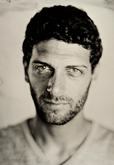
Nick Lantz

ABOUT THE AUTHOR
Nick Lantz is the author of The Lightning That Strikes the Neighbors' House, We Don't Know We Don't Know, and How to Dance as the Roof Caves In. He is the editor of Texas Review, cocurator of thecloudyhouse.com, and an assistant professor of English at Sam Houston State University in Huntsville, Texas. He has been a Jay C. and Ruth Halls Poetry Fellow at the University of Wisconsin–Madison and an Emerging Writer Fellow at Gettysburg College.

BLURBS
“Lantz gives us what we could least have anticipated, then makes it seem the most natural thing in the world.”
     —John Burnside

“Poem by poem, book by book, Nick Lantz is becoming one of our time's best poets. He knows the blades and shrieks and pleasures and sweet sick twists in our human hearts, and this bestiary forces us to look, hard and long, in our own mirrors. 'Polar Bear Attacks Woman ... Horrifying Vid (Click to Watch)' is a poem for this moment in the way Auden and Yeats and Rich and Dickey and Komunyakaa gave us poems for their moments.”
     —Albert Goldbarth


Here on Earth - Off The Mic - Nick Lantz
 Reads "TheYear We Blew Up The Whale"
Video: HereOnEarthShow


607
DISCLAIMERS

Poems cited here are assumed to be under copyright by the poet and/or publisher.  They are shown here for publicity and review purposes.  For any other kind of re-use of these poems, please contact the listed publishers for permission.


We here at TBOP are technically deficient and rely on our bashful Milo to fix everything.  We received notice from Google that we were using "cookies"
and that for our readers in Europe there had to be notification of the use of those "cookies.  Please be aware that TBOP may employ the use of some "cookies" (whatever they are) and you should take that into consideration.


Thursday, August 6, 2015

Blood Work - Matthew Siegel (The University of Wisconsin Press)

Today's book of poetry:
Blood Work.  Matthew Siegel.  The University of Wisconsin Press.  Madison, Wisconsin.  2015.

Winner of The Felix Pollak Prize in Poetry


Matthew Siegel bleeds sad and tragic/romantic all over every page of this fine book.  Sometimes his mother's blood does a Stanley Kubrick moment from The Shining, the walls all glimmering crimson.

Siegel is engaged in a battle with blood and body that he cannot win, only endure.

The poems in Blood Work go in like a quick/smart/sharp prick from an experienced and talented nurse taking blood - but they linger like bruises, both big and bigger.

We here at Today's book of poetry aren't the only admirers of Siegel.  A goodly number of these poems have appeared in journals and magazines of note.  It is no wonder, these poems are tight and often tender, never maudlin and thank our lucky stars, Siegel has a sense of humour.  Poetry without some humour can be a grim ride.

"Fox Goes to the Fox Hospital"

And look there he is back in the hospital
in the easy blue dressing gown, at this facility
with a delicate floral print on the walls.
He'd always had an affinity for flowers.
Healthy yet being repaired, he is back
in this gown and it is like an old costume
pulled out of a locked trunk in the attic
of bad dreams. In the gown he feels naked,
notices his softness, how his sex has never seemed
     less willing
to rise. As if there could be such a cause in this place.
He is healthy but writing a poem.
It is called "going back to the hospital" and written
in lowercase, most notably the first person "I"
which so often had stood properly capitalized
but for some reason today feels diminished.
He's writing a poem called "going back to the hospital"
but really he wishes he could draw a comic
featuring a small mammal version of himself.
His animal would be a fox, he decides, and promptly
changes the title to "fox goes to the fox hospital."

...

Today in our office, here at Today's book of poetry, we are listening to Dexter Gordon's sublime One Flight Up.  In particular we have been listening to the song "Tanya".  Milo is complaining because we will not give him equal time for whatever German-march-techno-blackhead-death-funk he has most recently discovered.  Milo is one strange cat, but he's beautiful and brilliant.  And today even Milo liked the poetry, he called it "sublime, not like Dexter, but subtle in it's own bloody way, so sad, so strong."  Milo is hard to impress.

Blood Work

The white sky presses a gauze pad
over my vein as the needle slips out.

The woman who draws from me smiles, always
remembers me, no matter how skinny I get.

No matter how dark the circles under my eyes,
she remembers me and how easy my veins are,

so visible, so thick, she doesn't even have to tie my arm,
but she does, and takes the smaller vein

the bigger one too easy. I don't tell her
the best to take my blood was a woman

who used to draw blood from animals,
part their fur, find their blue tap and drain.

She lets me play with my filled tubes. Can you feel
how warm they are? That's how warm you are inside

and I nod, think about condoms, tissues,
all the things that contain us but cannot.

...

You don't really hear any fear in the steady voice of Matthew Siegel but you feel the weariness in the bones of these poems.  The reader also learns some lessons in resilience.

This next poem is a stone-cold killer.  Wait for the ending, it falls like a feather, lands like a punch.

[In the Kitchen Mom Stands
With Her Back to Me]

In the kitchen Mom stands with her back to me
facing the window, a joint between her fingers
entranced by Enya. I ask her way she's crying
when I see a single wet trail on her cheek.

She says it is not a tear but I touch it with my finger
and taste it. It tastes like a tear, I say, but she smiles
and passes me the joint. Isn't it beautiful, she says,
it's in Gaelic, her smile as real as her pain.

Her pain that touches my chest with its fingers.
I almost want to hold the fingers but I don't, instead
I puff the joint, look out the window beside her. Rain
all day until now, the sky a dark cream color

almost backlit with orange--mist tumbles
over wet black pavement.  Her eyes, switched-off
depositories for this light, tell a story I cannot bear.
The memory of him rises with this music
and she smiles as if the hurt is the balm.

...

"and she smiles as if the hurt is the balm."

That is my new favourite line of poetry.  It is almost bleak enough to be an outburst from the excellent Canadian poet Eva H.D., or perhaps a line from the ghost of Edith Piaf, even a pouty Judy Garland.

And if you are paying real attention, and I am not mistaken, there might even be a nod to Ezra's Metro.  I had Milo look it up.

Siegel's Blood Work is a dark portal to a world where survive, survivor and survival all take on new meaning, they may even be tinged with hope.

And you all know how much we love any evidence of hope here at TBOP.

Matthew Siegel

ABOUT THE AUTHOR
Matthew Siegel was a Wallace Stegner Fellow at Stanford University. He teaches literature and creative writing at the San Francisco Conservatory of Music.

BLURBS
“This unexpected book—a genuine contribution to the literature of illness—centers on containment: how we contain our blood, how blood is contained in tubes and vials, how sometimes we do not seem contained by our bodies, and sometimes the body seems to contain nothing, and even how in the face of control or self-reliance leaking away, we might manage to contain ourselves, to feel held, to feel held in place. The deceptive directness of Siegel’s debut is remarkable; in his capable hands, illness reveals how barely contained any human being is, and how we reach, alone and together, for whatever will hold us.”
     —Mark Doty, author of Sweet Machine

“Siegel’s poems see the world with an immediacy and compassion that could only come from the decision to be vulnerable. It’s such a simple-seeming principle of poetry—yet it is as rare as hen’s teeth. I honor this young poet for the freshness and skill in these poems, his allegiance to the most unpretentious areas of experience, and his courage-teaching heart.Blood Work is a wonderful first book.”
     —Tony Hoagland, author of Twenty Poems That Could Save America and Sweet Ruin

“These poems resist the dualities of lyric versus narrative, confessional versus impersonal, real against surreal, formal/improvisational, comic/sad. Matthew Siegel manages to tick off all the boxes at once, while remaining compulsively readable. The trick that he’s pulled off is to make a book that simultaneously tickles you and shakes you by the scruff of your neck.”
     —Lucia Perillo, Felix Pollak Prize judge

Matthew Siegel
Reads his poem "On your birthday," featured in the fall 2013 issue of Southern Indiana Review.
video:  SolnRev


371
DISCLAIMERS

Poems cited here are assumed to be under copyright by the poet and/or publisher.  They are shown here for publicity and review purposes.  For any other kind of re-use of these poems, please contact the listed publishers for permission.

We here at TBOP are technically deficient and rely on our bashful Milo to fix everything.  We received notice from Google that we were using "cookies"
and that for our readers in Europe there had to be notification of the use of those "cookies.  Please be aware that TBOP may employ the use of some "cookies" (whatever they are) and you should take that into consideration.