Showing posts with label michael dennis. Show all posts

Monday, October 22, 2018

This Will Be Good - Mallory Tater (Book*hug)

Today's book of poetry:
This Will Be Good.  Mallory Tater.  Book*hug.  Toronto, Ontario.  2018.

This Will Be Good by Mallory Tater

This Will Be Good by Mallory Tater could be a mystery, will our heroine survive the self-loathing of her childhood?  It could easily be a romance because Today's book of poetry dropped his jaw and a little of his heart when we started to see just how Tater navigated.

It is so hard for children to become the children of their parents dreams, or their own, hard for young people period.  It's a complicated world and of course you all know that.  This Will Be Good could be seen as Tater's coming to terms with herself, big deal...
                                                                                        but there's magic in these here poems.

The sheer number of young people, women and men and the rest, who keep journals and write poems, it is entirely overwhelming.  And for the most part justifiably not for public consumption for personal and qualitative reasons.  

But Mallory Tater has panache.  There are moments of pure electric joy in these sad poems.  These are poems of such tender honesty that you will want to reach out to the young people in your lives.

Tater goes bone deep.

All Things Wasted

Point Roberts, WA

Wind blows ocean into our yard
and Grandpa buttons his jacket,
says brennen zaun, let's burn the fence.
That barely remembered German
barnacles his throat. Storm will tear
the pickets down, wood half-rotten
and aren't we cold. Cabin pipes
good and frozen. Globe thistles,
gunmetal blue, die on my shoelaces.

Grandpa sucks a Lucky Strike, exhales
bats and bats. Spiked wings fall
from his lips, thread through
my loosened teeth, snag on my gums,
receded from griding in sleep.
Grandpa unearths our fence,
a simple pulling of teeth. We snap
each post against our knees,
chipped fangs tossed to the pit.
We are ready for the feel of fire.

The horses by the beach are starving.
Grandpa knows the man who aged
and tamed them, let livestock suck life
slowly from him. King tides have flooded
our street, have cured our fallen crabapples.
We feed them to flames, all fence and fruit,
and Grandpa looks so pleased, the scent

of all things wasting. A boy who once hid
in Steinheim fields, stole asparagus shoots
from farmers. The war was over, his mother
widowed, grief turned to endless
hunger. Sparks settle on the corners
of Grandpa's mouth. Fence turns to ash.
Next summer, we'll just build a new one.
Hearing aids off, all sound in his lap.
Neighbour's anxious flag, muted.
Grandpa says we have so much
and aren't we warm.

Later, he falls asleep and I watch
two horses drink hopelessly.
Their tongues push
under rocks for crab meat. Sand fleas
chew their spines as they spit
their wild minds on saw-tooth shells.

πŸ’«πŸ’«πŸ’«

Mallory Tater's fight against her eating disorder adds a particular slant to This Will Be Good.  It is a very intimate inside look, we taste what she does, understand her choices.  But Today's book of poetry is convinced that any subject Tater put her considerable talents to would result in the same intimate and clever tenacity.

What Today's book of poetry is so clumsily trying to express is that we think Tater has it.

"Finding your place in the world," as Book*hug suggests on the cover of This Will Be Good, is a universal struggle and Mallory Tater has turned her voyage into art.

Period

The winter my waist shed six inches,
my period stopped. My breasts depressed,
the skin around them slacked sackish
and loose. I became like burlap and this calmed
my hands. I no longer had a belly to pinch.
My throat withstood the aftermath
of meals. I sucked lemons after losing
to cool and clean cuts from biled food
clawing. All this to say that when it stopped,
I was glad. Tampons at the bottom of my bag
flattened but I kept them on hand
to hand to girlfriends in need before gym class.
I told my mother how sick I must be. She paid so much
attention to me we forgot my sisters, who held pencils
in their hands late into the night, who held hands
in church parking lots, laughing with communion
stuck to the roofs of their mouths. They did not take
the host from the priest, pretend
to swallow, slip it into their pockets. They wrote
nice letters to each other, slipped them under
bedroom doors, borrowed each other's blouses
and blouses forever. They loved Sunday night
strawberries and ice cream in front of the TV.
They did not feed the dog their breakfasts.
Mabel would learn to love French toast, get fat
and sick and her paws would shake from old age
but I would imagine it as all the sugar I gave her
and feel a wave of shameful indulgence. I would
no longer bleed and cramp and share in it. I would say
I hoped to be clean and thin forever like this
but in secret, I felt unabashedly dry,
excluded and light.

πŸ’«πŸ’«πŸ’«

Our morning read was taken over by our new intern, Maggie.  Maggie wears long-sleeved shirts all year long and she told me that she had some experience in the Taterworld of eating disorders and so on.  

The reading, as Maggie organized it, was sharp, crisp and crystal clear, the deeper we went in, the more everyone in the room leaned toward the centre.  Connected.  We were all in line, in tune, like we were singing backup to Laura Nyro, Patti Labelle Sarah Dash Nona Hendryx style.

Good work Tater.  Good work Maggie.

On the Train to Royal Columbian Hospital

We are told Grandpa will sleep his way
to death tonight. The infection in his pancreas
and lungs cannot be fixed with drainage
or prayer from the wandering chaplain.
We are told the father of our mother who built
cabin sheds and showers, drank mugs of ice milk
before bed, bought tickets to community magic
shows, will soon no longer breathe. The last
show he took me to before I became
a teen, a local widow who called herself
the Ta-Da Lady. Grandpa and I both raised our hands
and she asked us onto the stage. She held a sheet
to the crowd and we slipped through a trap door.
Beneath floorboards, Grandpa's heavy breathing
shielded me, thick as a coat. He said we were part
of the illusion, our bodies, thin air. His breath,
cherry cough drops and Dairy Queen cones.
We were beautifully gone together. Tonight I feel
the heat and weight and confusion of my sisters.
They conjure the same memory:
Grandpa swimming between sandbars
near our family cabin, bobbing up for breath
and flashing his teeth, sneering. He would become a shark
and would chase us. In our small blossomed
bathing suits, we used to run towards the shark,
never away, into his oceaned arms.

πŸ’«πŸ’«πŸ’«

A little bit of joy can go a long way.  It doesn't take much to make some people feel alive and worthy.  This Will Be Good stopped Today's book of poetry in our poetry tracks.  

Yesterday we were in Tamworth, Ontario, at the Book Shop, one of the best little book stores in the world, for a poetry reading.  Two men.  Both worth listening to.  But clearly male voices.  Mallory Tater poems come from a young woman's voice - but this old man needed to read these, these poems held this old man's poetry interest from the start to the end.

We will be talking about Mallory Tater's poetry again.  We are sure of it.

Image result for mallory tater photo

Mallory Tater

ABOUT THE AUTHOR
Mallory Tater is a writer from the traditional, unceded territories of the Algonquin Anishnaabeg Nation (Ottawa). Mallory’s poetry and fiction have been published in literary magazines across Canada such as Room Magazine, CV2, The Malahat Review, The Fiddlehead, The New Quarterly, Carousel, Prism International and Arc Magazine. She was shortlisted for Arc Magazine’s 2015 Poem of The Year Contest, The Malahat Review’s 2016 Far Horizon’s Contest and Room Magazine‘s 2016 Fiction and Poetry Prizes. She was the recipient of CV2’s 2016 Young Buck Poetry Prize. She is the Publisher of Rahila’s Ghost Press, a poetry chapbook press. She lives in Vancouver.

BLURBS
This Will Be Good is a prayer, vicious and sweet. Tater’s dexterous language shreds the pink ribbons of nostalgia to remind that girlhood is both ‘sugared with fear’ and ‘diamond-hard.’” 
      —AdΓ¨le Barclay, author of If I Were In a Cage I’d Reach Out For You
This Will Be Good details the truths of girlhood; how young women treat themselves with cruelty and tenderness, fend off and court desire, and brace themselves for a world that both expects too much of them and yet never enough. These poems unfold as stories girls tell each other as they make space to share, cope, grieve, and hopefully, heal.”
      —Dina Del Bucchia, author of Coping with Emotions and Otters, Blind Items and Don’t Tell Me                                             What to Do
“Evocative and tactile as unearthed memory, This Will Be Good follows the history of a family through years, homes, seasons, and bodies. They’re death and grief, sex and religion. A reckoning with womanhood, manhood, and memory, these stories have a feeling of being passed down, kept secret, and slipped in notes and gestures between intimates whose closeness is felt on the skin. Press these words to your breast.” 
      —Sarah Gerard, author of Binary Star and Sunshine State


724


Poems cited here are assumed to be under copyright by the poet and/or publisher.  They are shown here for publicity and review purposes.  For any other kind of re-use of these poems, please contact the listed publishers for permission.

We here at TBOP are technically deficient and rely on our bashful Milo to fix everything.  We received notice from Google that we were using "cookies"
and that for our readers in Europe there had to be notification of the use of those "cookies.  Please be aware that TBOP may employ the use of some "cookies" (whatever they are) and you should take that into consideration.

Tuesday, October 16, 2018

Happinesswise - Jonathan Bennett (ECW Press)

Today's book of poetry:
Happinesswise.  Jonathan Bennett.  ECW Press.  Toronto, Ontario.  2018.

Happinesswise by Jonathan Bennett, ECW Press

Today's book of poetry is quite willing to enter Happinesswise as our next choice for the newest English word.  Why?  Because Jonathan Bennett says so.

Back in January of 2015, Today's book of poetry wrote about Jonathan Bennett's excellent Civil and Civic (ECW, 2011).  You can see that link below.


If Today's book of poetry had been in operation when Mr. Bennett wrote Here is my street, this tree I planted (ECW, 2004), we probably would have had something to say about that as well.  The truth is that Today's book of poetry just likes the way Bennett gets to things and once there, we like what he does.

Happinesswise is several books in one.  The first go round is about all sorts of universal themes, love, death, happiness, sorrow, and is played out among the hardware and antiseptic hallways of hospitals, the low moan of medication.

Bennett hails from Keene, Ontario.  Today's book of poetry has never lived there, but I did play hockey there as a young man.  Today's book of poetry grew up mostly in Peterborough, but, I will reveal that I spent some formative time in the great metropolis of Warsaw, Ontario.  All of that to say that Bennett makes us feel quite at home in the familiar landscape of our youth.

Patient No. 1

Do I? Admit to the neighbour I need help?
She'll offer impatience, weak Earl Grey.

So instead I admit myself, impatiently,
thrown into that timeworn, off-grey ward

whose Hospitalists chart my chest rattle.
I suffer no fear. I am the recipient

of patient-centered, evidence-based care.
This promise made to me all alone,

on a wipe-able poster that's reinforced
by a tenderly chosen stock photo paired

with a font inspired by Cezanne's cursive
I curse the machine drone, the urine sting,

the sour C. diff smell, the pump throb,
the infection control, latex-free signage.

Only last March, the lake icy, gin and tonics,
tinkling wind chimes, your still-beautiful clavicle.


I presented to the ER with severe pain
in my lower, well—does it really matter

where this began? Things have evolved.
Let's keep up, I say. But he taps my gut.

Read the chart, I bark. He does, mumbles
left flank, I am deemed incapacitated.

Last summer I was myself. That recently,
really, independent, with plans in place.

I golfed. Was a snow bird. I hear this,
my diminished life as a chart note,

a biography no one considered worthy—
is it ever too late for morbid thoughts?

                                    ●

You dear, are elsewhere, gone in that
peculiar way—off the wall, in a facility

with advanced dementia. At the lake
last summer your dress removed one

afternoon for no reason and we stared
at each other until we remembered

the way it was done, by us. That was the last
time our bodies knew their lines. The first?

Another century. Same lake. We giggled—
poke, poke, poke. The results

of investigations indicate—no wait for it,
I require a biopsy of the ilium lesion

for a definitive diagnosis, but a working
one: metastatic renal cell carcinoma.

It chisels into me, their grave tones,
but I joke, adding colourful grace notes—

they do not know, I know, the meaning.


Before a doctor dies he becomes a person—
mortality being a pre-requisite for death,

which occurs to me in a postscript thought.
My goals: pain relief, symptom control. Not curative.

I do not speak, but am understood by blinking coyly
at said plan. My son has arrived. He is a doctor too.

He has a new wife. Younger, a prototype
of the previous, more luxurious version.

Their language is useless here because
I still understand it, even if I can no longer—

The resident's mind is so fresh it's still setting.
What are the words for that thing I wish to pray?

I try say to him, and he leans in,
I try to whisper to him: Overdose me.

He looks aghast. Did I manage to make a sound?
He says, what I am about to share is going

to be difficult to hear. My son and the resident
are speaking. I am still, listening. The cancer.

Likely metastatic. Left kidney. Multiple locations.


My next steps are to determine I cannot walk.
My son's first steps—across the lichen at the lake.

Radiation might be an option for symptom control.
It is not a cure. They discuss goals for my care.

My son takes the news hard. He is emotional.
He is relying on his child-wife for comfort,

condolence. I use my eyes to indicate Kleenex
without meaning, it has the tone of reprimand.

Comfort is assured. Remembering questions
can be hard. Try to write them down.

Pain and symptom teams get involved
and former colleagues in Radiation

Oncology and Orthopedics are called upon.
Or maybe they are just visitors. They see

themselves in me. Smile. The first week
my agony begins to modestly improve,

I am told. I walk a length of the hospital
ward with much discomfort, I am told.

Options for care outside of the hospital
are discussed. I am told. I cannot return

home. I will not be cared for at my sons's
home—for a reason never addressed.

I wish to be reunited with my wife,
but I cannot speak. A social worker

I was routinely rude to intuits what
no one else can and applies for spousal

reunification on compassionated grounds.
I apologize to her all night.


The resident finished his rotation today.
Dictated, in all seriousness, into his small

machine final thoughts for his Palliative Care
Reflective Portfolio:

                                  The patient is optimistic
he might be discharged to his demented wife.

πŸ’«πŸ’«πŸ’«

There is nothing like opening a book of poetry and feeling instantly at home.  Today's book of poetry only had to hear the brief mention of an Otonabee hill to be geographically settled.  That and the smell of hot oil and white vinegar that lets you know you are near a chip truck.  Mr. Bennett has that knack of hitting buttons.

Jonathan Bennett is interested, as the title suggests, in our search for happiness, but he is equally curious about the other result.

Bennett isn't afraid to let us in to the personal and a suite of poems about his autistic son is as jarring and sad as it is beautiful, hopeful and wise.  Bennett will find the joy when needed.

In Relief

Lately, he says lemon squares a lot
and at night with his service dog

hard pressed to him, he admits worries:
I don't know what I'm supposed to do.

Where am I supposed to be right now?
Sleep wind. His oscillating fan is Larry.

There is an entire imaginary world
that he develops alongside this one.

It's a logical realm that makes sense,
 a refuge from fluorescent bulb flicker

and persistent AdeleMaroon5Bieber
folded into every wrinkle of existence.

He asks: Do cyclops blink or wink?
We laugh and I ask him to tell me

the riddle of Theseus's ship again
because I can't get enough of him

charting his way through a paradox.
And to hear him argue the case

for Bigfoot is to doubt everything
you thought was true in the universe.

Not a day goes by that I don't ask
what the word he just used means.

Lately, he says lemon squares a lot.
I know why he adores Coltrane and Dali.

Somewhere in his new world a city
is being mapped and named and whole

boroughs intricately sketched,
creatures are homed, or else they war.

All this while he thinks of a video game,
turns over some science he's trying

to solve, and four or five others, unrelated
items in a simultaneous, asynchronous

moment that we partly share, he and I
laughing at the bat of a cyclopean eye.

πŸ’«πŸ’«πŸ’«

Today's book of poetry just wants to remind our dear readers that we are not a service for reviews, exactly.  Today's book of poetry functions as an appreciation society.  Our purpose is not to devine the nuts and bolts of literature, but to share our joy in poetry.

Our morning read was held in the office, as it almost always is, but this morning's poetry office was a quiet place.  All our guests have scattered back to their points of departure.  Hilary and Daemon are back in Toronto, Cranky Eric is back in school.  Erica will undoubtedly be either sleeping, reading or in class.  Stephen, our darling K's father, will be on a plane somewhere over the Atlantic when you are reading this.  Where Freida, Tomas, Thomas, Maggie, Pistol and Lucy are is anyone's guess.

Luckily Kathryn, our Jr. Editor, dependable as ever, was able to check the stacks and bring out the previously mentioned Civil and Civic, and our copy of Here is my street, this tree I planted (just an aside, but Today's book of poetry loves this title so much).  This morning's read became a Bennetthon.

Unassumed Road

That day we lost the hound down the way,
watched it bound tongue-slack, freedom-struck
beyond the yellow wood and lichen-crusted
boulders of pink shield rock and undergrowth.
That day we took chances, pressed on.
That day made no difference, even as you
plunged into a field of bemused heifers,
cursing all dogs, as it rolled in steaming dung.

That day we bushwhacked calling its name,
calling it names, until it returned
with a meaty bone that looked like a rib.
A last laugh that day, when glibly
you said, the person who nailed the sign
This Road is Unassumed, has trust issues.

πŸ’«πŸ’«πŸ’«

Today's book of poetry wanted to send a shout-out to our painter friend Blair Sharpe.  He's been living his own set of poems lately and we appreciate all he's done for us here at Today's book of poetry.

We all need good examples in this life.  Jonathan Bennett's Happinesswise is a fine poetry example.

Our friend Blair, just a fine example.

Image result for jonathan bennett poet photo

Jonathan Bennett

ABOUT THE AUTHOR
Jonathan Bennett is a poet and novelist. He is the author of seven books, the most recent of which is the book of poems Happinesswise (ECW Press, 2018). His previous work includes the critically acclaimed novels, The Colonial Hotel, Entitlement and After Battersea Park, along with two collections of poetry, Civil and Civic, and Here is my street, this tree I planted, and a collection of short stories, Verandah People, which was runner up for the Danuta Gleed Literary Award. Jonathan is a winner of the K.M. Hunter Artists’ Award in Literature.

Jonathan Bennett’s other writing has appeared in many periodicals and journals including: the Globe and Mail, Best Canadian Poetry, The Walrus, Southerly, Cordite, and Antipodes. Born in Vancouver, raised in Sydney, Australia, Jonathan lives near Peterborough, Ontario.

BLURB
“Bennett’s artistry lies in his ability to create poems that shatter complacency with bricks of loaded language.” — Quill & Quire on Civil and Civic

ecwpress.com

722


Poems cited here are assumed to be under copyright by the poet and/or publisher.  They are shown here for publicity and review purposes.  For any other kind of re-use of these poems, please contact the listed publishers for permission.

We here at TBOP are technically deficient and rely on our bashful Milo to fix everything.  We received notice from Google that we were using "cookies"
and that for our readers in Europe there had to be notification of the use of those "cookies.  Please be aware that TBOP may employ the use of some "cookies" (whatever they are) and you should take that into consideration.

Omar


Saturday, January 27, 2018

Season of the Second Thought - Lynn Powell (University of Wisconsin Press)

Today's book of poetry:
Season of the Second Thought.  Lynn Powell.  University of Wisconsin Press.  Madison, Wisconsin.  2017.

Winner of the FELIX POLLAK PRIZE in POETRY


Lynn Powell is exactly the tonic that Today's book of poetry needed to get back on track and into gear.  Reading poetry that is this smart and confident reminds us of how the real pros do it.

Season of the Second Thought is audacious.  This is Powell's third book but the first Today's book of poetry has seen.  Reading Season of the Second Thought is like eating that perfect box of chocolates, each one more delicious, every taste a new and exciting experience.  And you can never have enough. Powell calls out the muse, her muse, several times and openly challenges her for higher ground.  Not sure how Powell manages her erudite and sophisticated palette and still comes out speaking in a language we all understand, but it is a true pleasure to read.  And to read again.

Slow Elegy from Afar

     Then the Lord answered Job out of the whirlwind:
      ...Where were you when I laid the foundation of the earth?

What glitch in the genes created shame?
God, the oldest scapegoat, usually gets the rap.

But why would the maker of that granite island--
glacier-polished nub of a Precambrian peak,
with an osprey perched, bellyful of fish, in a wind-bent pine,
the gibbous moon floating up, and the evening star,
on cue, surfacing in a lavender sky--why
would the God of that cold beauty
contrive a hall of mirrors in a human mind?


On our last long walk five springs ago, we sparred, gingerly.
You were a brilliant believer; I had come to believe
that cruelty was the only sin--with the caveat
that cruelty could also be the secret name of subtler sins.
Everything else, I argued, is the blundering of a desire
to be known, loved, or safe. We make mistakes
and know ourselves.

I could see your young, tired face tighten.

So I tried a different tack--
Don't take the perfect so personally.
Don't take shame so much to heart.


Why did you suffer? And why did you leave
your suffering to those you loved?

I can't gird my loins again against my childhood God,
that God with a clipboard and swift red pen.

So I reread Job, and watch the waves wash,
and aim to wash away, the granite shore.
They paraphrase the whirlwind.

As do the oriole that slings her hammock nest
along the path we walked, the doe in the close woods
wary for her fawn, the thunderhead and the downpour,
the firefly galaxies in the blackest field of night,
the forsythia festive once again beside your grave.

...

Lynn Powell's Season of the Second Thought grabbed me by the poetry lapels and shook me senseless.  Powell musing in a blue mood is as good as Miles Davis doing the same.  But somehow I keep hearing W.H. Auden's perfect pitch in these poems.

The thing you learn, early on in Season of the Second Thought, is that you can be confident throwing yourself into each and every poem from the beginning to the end.  Lynn Powell is steady as a metronome with these incandescent poems aglow with "iridescent language."  Powell can burn.  Here's a poet who talks about the weather as though she controlled the sky, like she knows when it is going to rain.

Love Poem from the Wrong Side
of the Rain

What would April do? Tease hidden
meanings from the bulbs, raise the stakes
and double my entendres, and bet
all my roses on the bottom line.

But it's the season of embarrassed trees,
the modest charms of leaf rot and briar
and hawk scat thawing on the muddy path:
skinny March at an earnest latitude.

So tell me, Muse: where around here might a woman
find a little flint and tinder,
some figure of feisty speech, a correlative for kisses
that would make a grown man weep if she put it
all on the table and headed out
for good into the long-stemmed rain?

...

Today's book of poetry is very happy to be back in the saddle, and Lynn Powell is one hell of reminder of why we are in the poetry game.  Today's book of poetry doesn't just love reading great poetry, we aspire to write some of it.  Poets like Powell set the bar to beautiful new heights.

Our morning read was old school.  I made everyone stand up today when they read.  An infinitesimally small gesture of respect in memory of SeΓ±or Caballero Nicanor Parra who left us this week after more than a century of being a GREAT poet and a beautiful citizen.

Powell's poems held up splendidly.  The grand old man would have seen the bold beauty of Powell's hard truths, her certainties all tinged a little blue.

October Edge

Mapless and skidding again on a backroad
prickly with teasels and sumac and skeletons
of lace, I glimpse a pink non sequitur:
a winged woman on the stoop
of a whitewashed church, glancing up
from an opened book and lifting
her opened hand--

but I will not brake today for grace,
I round the reckless curve, past pumpkins
with no faces forced yet on them, past
bins and barrels of crimson wholesale fruit,
past tombstones disheveled in the drizzle
staggering after their long-lost
ballast of grief--

the blurred signs vanishing
like everything else in the hindsight horizon,
and the black tires taking my incendiary heart
farther, faster, out past the charred trunks of the maples,
those miles of martyrs with feet
held fast to the banked flames
of their own making.

...

Today's book of poetry is here to tell you that Lynn Powell's Season of the Second Thought is worth every second of time you can spend on it.

Today's book of poetry is built on the idea of sharing the best poetry what we can find.  Lynn Powell's Season of the Second Thought is as stone cold solid as any book Today's book of poetry has sent your way.  Lynn Powell is instantly a poet we will have all the time in the world for.

For Lynn Powell we are ready when she asks "Why don't you put your mouth / where your moody heart is?"  Today's book of poetry is speaking up here and now; Lynn Powell IS the next poet you should read.


Lynn Powell

Lynn Powell

ABOUT THE AUTHOR
Lynn Powell teaches in the Creative Writing Program at Oberlin College, where she directs Oberlin's Writers-in-the-Schools Program. She has published two previous collections of poetry: Old & New Testaments, winner of the Brittingham Prize in Poetry, and The Zones of Paradise. Her nonfiction book Framing Innocence won the Studs & Ida Terkel Award.

BLURBS
“Let Powell's images and figures wash over you. They can be deft and unobtrusive, but they will stick with you; they will illuminate what otherwise might be dark. A poet so sure-handed is irresistible. Dazzling.”
     —Robert Wrigley

“Not just written, but wrought. Powell's new poems deftly combine keen observation with perfect pitch, and their rich chiaroscuro renders them vibrant and painterly as the Dutch masters they often reference. The current running through her lines leaves me shivering with excitement and gratitude.”
     —R. T. Smith, author of In the Night Orchard


Kind of Blue
Lynn Powell
Video: Gabriel Jasso


650


DISCLAIMERS

Poems cited here are assumed to be under copyright by the poet and/or publisher.  They are shown here for publicity and review purposes.  For any other kind of re-use of these poems, please contact the listed publishers for permission.


We here at TBOP are technically deficient and rely on our bashful Milo to fix everything.  We received notice from Google that we were using "cookies"
and that for our readers in Europe there had to be notification of the use of those "cookies.  Please be aware that TBOP may employ the use of some "cookies" (whatever they are) and you should take that into consideration


Friday, December 15, 2017

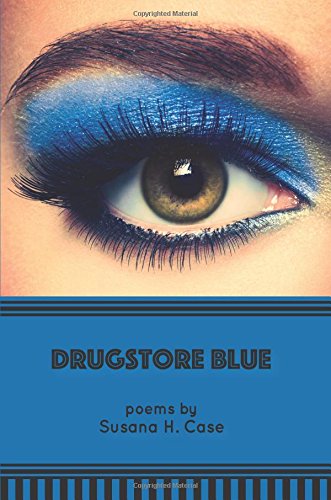
Drugstore Blue - Susana H. Case (Five Oaks Press)

Today's book of poetry:
Drugstore Blue.  Susana H. Case.  Five Oaks Press.  Newburgh, New York.  2017.


Today's book of poetry is a big fan of Susana H. Case.  Milo, our head tech, came out of the stacks with 4Rms w Vu (Mayapple Press, 2014) which Today's book of poetry looked at back in January of 2016.  You can see that here:


Milo also found Case's Manual of Practical Sexual Advice (Kattywampus Press, 2012) and The Scottish Cafe (Slapering Hol Press, 2002).  Today's book of poetry has read and enjoyed all of these Case titles.  Drugstore Blue is the best yet.

Susana H. Case has a beautiful swagger.  In our misogynist world we expect it from certain types of men but we haven't come far enough that this kind of swagger doesn't stand out.  And it's not like male; I'm bigger, better, stronger swagger - it's more of a "I'm smart and I've come out to play" swagger.  An entirely different beast.

Hold Me Like You'll Never Let Me Go

In the street, I find an acoustic guitar,
no name on it, so I decide it's mine
and learn some chords from
a pretty boy ten year younger
whom I retrieve from a SoHo party.

He plays in a garage band. He likes
my long, ironed-straight hair, how I
remove my clothes, their erratic cuts,
easy to toss on to a chair. For a week
we don't leave the apartment.
He makes no plans to go home, but home
is Sweden, so that's understandable.
I strum and roam through rooms,
feeling like a folk goddess.
"I'm leaving on a jet plane," I sing.

You ever spend a whole week naked, talking
about nothing but folk rock? But then
we run out of food and being with him begins
to seem like shoplifting.  You ever do that,
take what you want just to see how it feels?

...

Susana H. Case is all about empowerment in Drugstore Blue and it is a book I want my sisters and my wife to read.  Case isn't asking for anything, bless her cotton socks, she's telling us the new home base like she were the umpire of common sense.

Today's book of poetry enjoyed these poems in part because they remind me of my very favourite women, my wife K, and my sisters, the estimable Luba S, Donna (reigning Queen of The Nasty Grrls) and so on.  None of them are full time poets but they are all this sort of smart, this sort of strong.

I hate when poets are referred to as brave, they are writing poetry not charging the front lines into machine-gun fire and grenades.  But Today's book of poetry sure does have a lot of time for Case and her enthusiastic embrace of a strong woman's mantra.  Only the strong poets are this carnal without sounding licentious.  Case makes a strong case for passion.

Jeanne Moreau, I Love You

In the film, Jeanne Moreau has two lovers,
a rich one on his polo horse and a poor
archaeologist, connoisseur of good bones.
The husband in Dijon is unbearable
in his sarcastic neglect of her.
How can anyone resist her pouty lips,
dismissed by camermen as not photogenic--
I want to kiss those lips.

Her orgasm, shown as a trembling hand
labeled The Lovers pornographic
until Justice Potter Stewart at the Supreme Court
ruled, I know it when I see it, and this is not porn.

I remember, sadly, in an interview, she announced
that sex as an older woman was undignified.
But, in the film she's young, and her existence
as domestic furniture deviates
in unexpected ways: One night of making love

and there she goes with the new lover, in his Citroen,
away into the sunrise, into a revised life,
escaping the death so resident in her old one.
And sex is a little death, sure,
but escape from death too,
done here to the music of Brahms.
Besides, her archaeologist makes her laugh.

I don't want to see her die for not one,
but two indiscretions, this being 1958.
What courage she has driving away
from the Lake of Indifference to Terra Incognita,
as the map drawn at the beginning
of the movie lays out the land of love!
Not even one time does she look back.

...

Today's book of poetry loves Jeanne Moreau, how could you not?  Some of the staff here had to do a quick search for Moreau and got a quick tutorial from Kathryn, our Jr. Editor, on Ms. Moreau and her films.  Our morning read was splendid.  The women on the Today's book of poetry loved Case and Drugstore Blue like it was fresh popcorn drenched with real butter.  The men at Today's book of poetry loved the optimism in these poems.  Susana H. Case even makes men sound redeemable.

When Case goes all dark the lights in the room go out as well.  Case gets you to surrender all your defenses with reason and then she starts swinging her emotional battle-axe and takes no prisoners.

Case is a many sided die, but each side is clearly demarcated.  Drugstore Blue is a velvet hammer.

Torpedo

Hedy Lamarr, runaway trophy wife
of a businessman dealing in shells and grenades,
calls George to ask about glands:
George Antheil, crime writer,
master of pneumatic piano rolls--
his hobby is endocrinology.

She's worried; Louis B. Mayer, studio boss,
doesn't want another flapper,
is dismissive of her flat breasts.
He wants a glamour-puss.

Any girl can be glamorous, she sighs.
All you have to do is stand still
and look stupid.

From breasts, the talk shifts to weapons.
Instead of a torpedo bra,
Hedy and George invent a radio-controlled
guidance system for torpedoes,
an early smart bomb, voluptuous and busty.

They patent it in 1942. Its parts allude to punched
piano rolls, sixteen perfectly synchronized pianolas
in Antheil's Ballet Mecanique
(scored also for airplane propellers).

The Pentagon bosses are as dismissive
of their invention as Louis is of her breasts,
can't grasp a player piano in a torpedo,
refuse to believe
this beautiful woman so nude and orgasmic
running through the woods in the film, Ecstasy,
so glamour-puss,
could also be smart.

...

Susana H. Case is the smart woman who has no fear of shining.  These days when there is so much paste disguised as gem stone, Susana H. Case is mining diamonds.

Susana H Case2b

Susana H. Case

ABOUT THE AUTHOR
Susana H. Case is the author of five books of poetry, most recently, Drugstore Blue, new in 2017 from Five Oaks Press, and 4 Rms w Vu from Mayapple Press, as well as four chapbooks. One of her collections, The Scottish CafΓ©, from Slapering Hol Press, was re-released in a dual-language English-Polish version, Kawiarnia Szkocka by Opole University Press in Poland. Her poems appear widely in magazines and anthologies. Recent poems can be found in: The Cortland Review, Fourteen Hills, Portland Review, Potomac Review, and Rattle, among others. Dr. Case is a Professor and Program Coordinator at the New York Institute of Technology in New York City.

BLURBS
“In Drugstore Blue, Susana H. Case’s speaker is a femme fatale in serious eyeshadow: ‘You need me / like a tongue needs a second / mouth.’ That’s the sound of her craft, one of her dart-like declarations, hitting its mark. Rarely has makeup, and the color blue, in particular, come alive on the page like this: ‘Blue all the way to the brow, an eyelid / tin-glazed, / underglazed, / sancai lead glazed, / oxide blue glazed, / a glaze of blue not born of the blues, but the antidote, / spring blue, felice blue, / green dragon constellation blue, / occult knowledge blue, / the eye of God.’ Need I say more? Her poetry reads like a graphic novel, a romp, a road-trip in a borrowed car, speeding with a wild child at the wheel. Vivid, direct, episodic, and utterly believable, Case’s tropes make excellent landings. From Morandi to Velvet Elvis, from Marrakech to Cartagena, eros is never far off, and her text glitters on the page in a poetry of great precision.”
     — Elaine Sexton, author of Causeway and Prospect/Refuge
“Susana H. Case’s Drugstore Blue offers the edgy yet compassionate and sometimes racy odyssey of a woman coming of age. The poems, wonderfully complex both in their craft as well as their emotional depth, often widen into larger mythological and historical realms. Case’s fine ear and wit are deeply satisfying.”
     — Sally Bliumis-Dunn, author of Second Skin and Echolocation

“Susana H. Case dedicates Drugstore Blue to her maternal grandmother who, ‘In her youth, having never seen a ship… considered crossing an ocean and thought, Yes, I can do that.’ Case clearly inherited her grandmother’s courage and curiosity. The speaker in these poems explores terrain both internal and external—from callow youth to vibrant maturity, from Bushwick to Zimbabwe. More seeker than tourist, she keeps her eyes wide open and invites her reader along for the adventure, forcing us to see what goes on in the world we inhabit, even if it does ‘cause inconveniences, / like thinking.’”
      — Grace Bauer, author of The Women at the Well and MEAN/TIME


"CopiapΓ²" by Susana H Case, from the poetry anthology "Rabbit Ears"
Video:  Rabbit Ears TV


642

DISCLAIMERS

Poems cited here are assumed to be under copyright by the poet and/or publisher.  They are shown here for publicity and review purposes.  For any other kind of re-use of these poems, please contact the listed publishers for permission.

We here at TBOP are technically deficient and rely on our bashful Milo to fix everything.  We received notice from Google that we were using "cookies"
and that for our readers in Europe there had to be notification of the use of those "cookies.  Please be aware that TBOP may employ the use of some "cookies" (whatever they are) and you should take that into consideration

Saturday, November 4, 2017

Shape of Faith - John Phillips (Shearsman Books)

Today's book of poetry:
Shape of Faith.  John Phillips.  Shearsman Books.  Bristol, U.K.  2017.

John Phillips - Shape of Faith

Paradise

Because words reveal
the separation

of what is
from what is said to be:

in Paradise
language would be a sin

...

British poet John Phillips employs many of the same tactics as our own beloved Nelson Ball.  Phillips never overstates anything.  Shape of Faith is spartan, just as David Miller says.  There is no fat.  Phillips gets to it.

And what he gets to are the basic questions that end in faith.

You could write most of these astute and pristine poems on a post-it note and carry it in your pocket for later use.

Letter

for Theodore Enslin

The daffodils are
just
      coming into
bloom
              Still
a number of
                   croci
& a kind of blue
scilla
          I found
          years ago
in an
          abandoned garden
       a swallow just
                  fluttered in

...

John Phillips captures the everyday and is willing to show the whimsy of it.  Again and again when reading Shape of Faith Today's book of poetry had to pause and let these short bursts of concentrated sage and savvy wisdom sink in.

Phillips is willing to go long when necessary and his poem "Lateword" marches over several pages before ending in the matrimonial bliss of a child sleeping under the parents touching embrace.  It seems Phillips is aware of the bad but deeply concerned with finding the best of us, the good.

Reading

Reading Jean Daive on his friend Paul Celan:  struck by this
sentence:  a stranger to nothing in this world.  Looking back
through the book, I can't find those words anywhere.  Yet
swear I read it this afternoon, sitting on the bench in the
garden, while my daughter Lana slept upstairs and the house
was otherwise empty.  It was a line that pierced me.  Perhaps
because my first reaction to it, however brief, was positive.
Then the shock, the revulsion:  that someone could say that
about another person;  that it could be true.

...

John Phillips' Shape of Faith is the first British poet/book Today's book of poetry has had the pleasure of posting.  His terse and ticklish voice one we haven't heard before but we recognize it as a kindred immediately.

Our morning read was a little submarined today.  The read followed a feed.  The day started with a feast of French Toast smothered in butter and Maple Syrup, and BACON, along with a glass of Mickey D.  We wanted proper orange juice but all Chez Charlot had this morning was Mickey.

The morning itself was a happy square-dance of readers in various prone positions littered around the office like tired octopuses out of the water all bacon and French Toast lethargic.  Our crowed enjoyed the poems and their breakfast then sauntered slowly and sloth-like back to their individual poetry burrows and I haven't heard a peep from any of them since.

I looked in on Milo, our head tech, he was dead to the world but I could still hear The Cure beautifully moaning through his headphones.

Lost

Still looking
for the piece

of the word
that fell off

the last time
I used it --

thinking it
might explain

what happened
next or say

what didn't

...

John Phillips' Shape of Faith is a clean machine.  These poems have no extraneous cargo, they are tight as a duck's butt.  And smart.

Any of you regular Today's book of poetry minions will know how much we admire smart.

Picture of author John Phillips
John Phillips


ABOUT THE AUTHOR
John Phillips was born in St. Ives, Cornwall — where he still lives — and is the author of Heretic (Longhouse, 2016), What Shape Sound (Skysill Press, 2011) and Language Is (Sardines Press, 2005), as well as a number of chapbooks.

BLURBS
"Phillips would have us look no further than the poem itself for the primary matter of its own accordant recognition as fact. So that to write is to read ourselves into being alive in forms we have no further proof of than the act of the poem's own declaration."
     —Patrick James Dunagan 
 
"Many speak to me in that place that is beyond speech; that transcends the tyranny of words, which is the taste of true poetry.  Some carry that resonance that results from the retrieval, retrospectively, of a moment of precognitive awareness of an object or event which perceives it revealed unadorned, prior to the arising of the conditioning, serial moments of conceptual, dualistic thought.  Poems where the ego-self of the poet is absent.  Those moments of true ‘poetry’ before what we call poetry."
      — Malcolm Ritchie 
 
"At its best this is highly unusual, Spartan, thought-provoking, intelligent and subtly, quietly moving work."  
     —David Miller 
 
"I love the book… And you lead me to places I recognise but have never been able to name – as you do! "
      —John Berger 

JOHN PHILLIPS | 29 May 2012
Video: damnthecaesars


624
DISCLAIMERS

Poems cited here are assumed to be under copyright by the poet and/or publisher.  They are shown here for publicity and review purposes.  For any other kind of re-use of these poems, please contact the listed publishers for permission.


We here at TBOP are technically deficient and rely on our bashful Milo to fix everything.  We received notice from Google that we were using "cookies"
and that for our readers in Europe there had to be notification of the use of those "cookies.  Please be aware that TBOP may employ the use of some "cookies" (whatever they are) and you should take that into consideration