Showing posts with label brittingham poetry prize. Show all posts

Tuesday, September 12, 2017

You, Beast - Nick Lantz + The Lightning That Stikes The Neighbors's House - Nick Lantz (The University of Wisconsin Press)

Today's book of poetry:
You, Beast.  Nick Lantz.  University of Wisconsin Press.  Madison, Wisconsin.  2017.

Winner of the BRITTINGHAM PRIZE


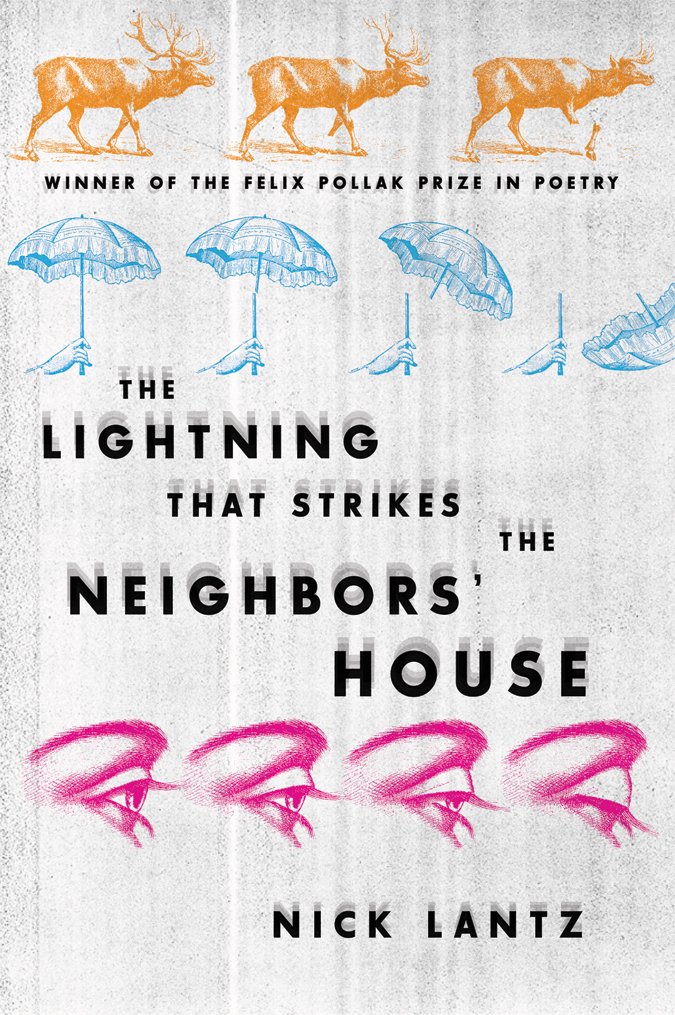
The Lightning That Strikes The Neighbor's House.  Nick Lantz.  University of Wisconsin Press.  Madison, Wisconsin.  2010.

Winner of the 2010 FELIX POLLAK PRIZE IN POETRY selected by Robert Pinsky

Today's book of poetry is throwing two books by Nick Lantz at you today and we're doing it for one reason:  Nick Lantz is a poetry monster.  He's a freaking King Kong Frankenstein Dracula Werewolf monster of the first order.  We are clumsily trying to tell you in the calmest manner that Nick Lantz has range, style and moxie beyond most mortal poets, his poetry is beyond superb.

Lantz is the king of juxtaposition, changing direction with machine gun speed but never missing a step.  The Lightning That Strikes The Neighbor's House and You, Beast are both stunning books of poetry.  Lantz is an encyclopedia, a yin/yang salesman.  Lantz is one of the most exciting poets we have ever read.

Based on True Events

So a dolphin gets caught
in a crab trap, then is rescued
and rehabilitated, but loses
his tail, or just flukes,
and is going to die probably
of heartbreak, but some kid
falls in love with him (or her?),
and the dolphin eats fish
from the kid's hand, music
swells, and the dolphin
is fitted with a prosthetic
tail and learns to do tricks
for the amputated soldiers
returning from a desert
(how can a dolphin
ever imagine a desert?),
and the soldiers say
what a huge inspiration
this dolphin is, so someone
makes a movie in which
all the above occurs
and in which the dolphin
will play itself (God, the name
they've given it: Queenie,
or Felicity or something)
and the movie title is a pun
about the dolphin's tail,
its missing tail that was lost
in some asshole's crab trap,
and everyone is crying
tears of joy as the dolphin
cavorts in the 60 x 60 tank
that will be its home
until it dies, and the dolphin
squeaks and jerks
its head, and who knows
what it's trying to say.

(You, Beast)

...

Conditional

We all have them, the lucky cousins. Feckless, blessed.
               One backed over by a bulldozer, treads

                                                                                          up to his chin.
Not a bone broken, not a bruise. Sunk in the soft mud.

               What can be said about grace
                                                           that does not diminish it?
To play a drunk, the best actors pretend to be sober.
               The street mime ladles water
                                                           from his leaky canoe.

Of the blind dog and the three-legged rabbit he chases, only
               one can be lucky tonight. Our cousins race
                                                                                           every train
to its crossing on principle; it's no surprise they win.

               If you had been born to different parents,
                                                           would your stomach still
be cratered with cigarette burns? Let us believe rain
               follows the plow, that the luck
                                                            we earn is indivisible.

Let me believe that the porch security light recognizes
               my particular shape approaching
                                                             the house at night.
Termites carry our poison back to their many cousins.

               Canoeing under the broken
                                                             train bridge, we looked up
and saw a golden bird spray-painted on the belly
               of the trestle, gaps of sunlight
                                                             punctuating the wings.

(The Lightning That Strikes The Neighbor's House)

...

Today's book of poetry is doubling up on the poems today because this double-decker of Lantz demands it.  The experience of reading the poems in both of these volumes is a little like watching the legendary Arturo Gatti/Micky Ward fights.  30 rounds of beautiful back and forth.  These poems never back up, for every left hook there's a right cross.

For every moment of scathing, blistering sarcasm, there is a moment of sublime tenderness.  Today's book of poetry just ate up Lantz's epic, episodic poem, "Toyland" from You, Beast.  Lantz clearly has a sustain pedal option on his wizardry and when he revs up his big engine sparks fly.

The Lightning That Strikes The Neighbor's House and You, Beast will convince you, dear reader, that Nick Lantz is writing from rarefied air.

This morning's read was twice as long as normal, no one wanted to miss a thing.  Poems this smart, fast and agile don't come along all that often.  The staff sat around trading poems with that look in their eyes, you know that look, the one we save for awe.

Drawing the Bee

The five-year-old's drawing:
distended honeybee,
fuchsia-striped,
striding long-legged
through the tiger grass,
eyes wobbly dots of wax
searching for a flower
to bury his face in.

I could say it signified
the tidy apocalypse
of divorce, the slanted light
of a therapist's office,
but that wouldn't be true.

I always drew the stars as black
knots brooding over bruises
(they might have been bears)
that tilted their heads up to gulp
at greenish air.

When I got a microscope
for my birthday, the first thing I ever trapped
on a slide was a flea
taken from the cat's neck. I drew
its delicate hairs, its needle
mouth, those legs long as a dancer's
and still twitching.

When I walked down a street,
I saw every broken
window first, followed the line
of ants to the car-struck sparrow,
heard in the train's long screech
a voice calling a name that had lost
its shape.

Now my mother sends drawings
she's found in old shoeboxes:
today, a pair of wolves on hind legs,
forepaws on each other's shoulders.
"Dancing," she says, but I know
they're strangling one another.

(You, Beast)

...

The Diving Horses

You know how the old stories go: the peasant's hut
               grows a little smaller every
                                              day, the frog by the window
a little louder. It's a miracle we can sleep at all.

               In the hotel room the night after
                                                           your brother's funeral,
we watched a bad movie about horses trained to jump
               from a platform into a small pool
                                                                          forty feet below.

In the first garden, the fruit didn't know when to drop.
               So what if starvation is the only thing
                                                                           that can make
the young albatross use its wings for the first time?

               Why can't I be more
                              like the hermit crab, strutting
around the sea floor in an empty perfume bottle?

               The news cuts in. The president
                                                                            shrugs. So what
if your brother dies? Without the fox's teeth deep
               in the hen's downy neck,
                                                            we would starve.

After the war, when Sherman took his evening walks,
               the fence posts lay down
                                              in the grass and trembled.
The horses, we're told, required very little prodding.

(The Lightning That Strikes The Neighbor's House)

..

Today's book of poetry started this blog primarily so that I could get my grubby little paws on more poetry.  Discovering new poetry has been a fountain of youth, a literal joyous balm.  But when poets like Nick Lantz walk through the door, well, that's when I love poetry most.

As an audience you Today's book of poetry readers must be getting to know my peccadillo's, tendencies and preferences.  You might even be familiar with my quite brilliant wife K.  K is an extremely polite and voracious reader.  She doesn't usually have much to say about poetry but this is what she said after reading Nick Lantz:

"F**k!  I love this guy!"

and then, as though he were right in the room:

"You've shown me what poetry can be!"

Nick Lantz

ABOUT THE AUTHOR
Nick Lantz is the author of The Lightning That Strikes the Neighbors' House, We Don't Know We Don't Know, and How to Dance as the Roof Caves In. He is the editor of Texas Review, cocurator of thecloudyhouse.com, and an assistant professor of English at Sam Houston State University in Huntsville, Texas. He has been a Jay C. and Ruth Halls Poetry Fellow at the University of Wisconsin–Madison and an Emerging Writer Fellow at Gettysburg College.

BLURBS
“Lantz gives us what we could least have anticipated, then makes it seem the most natural thing in the world.”
     —John Burnside

“Poem by poem, book by book, Nick Lantz is becoming one of our time's best poets. He knows the blades and shrieks and pleasures and sweet sick twists in our human hearts, and this bestiary forces us to look, hard and long, in our own mirrors. 'Polar Bear Attacks Woman ... Horrifying Vid (Click to Watch)' is a poem for this moment in the way Auden and Yeats and Rich and Dickey and Komunyakaa gave us poems for their moments.”
     —Albert Goldbarth


Here on Earth - Off The Mic - Nick Lantz
 Reads "TheYear We Blew Up The Whale"
Video: HereOnEarthShow


607
DISCLAIMERS

Poems cited here are assumed to be under copyright by the poet and/or publisher.  They are shown here for publicity and review purposes.  For any other kind of re-use of these poems, please contact the listed publishers for permission.


We here at TBOP are technically deficient and rely on our bashful Milo to fix everything.  We received notice from Google that we were using "cookies"
and that for our readers in Europe there had to be notification of the use of those "cookies.  Please be aware that TBOP may employ the use of some "cookies" (whatever they are) and you should take that into consideration.

Monday, April 17, 2017

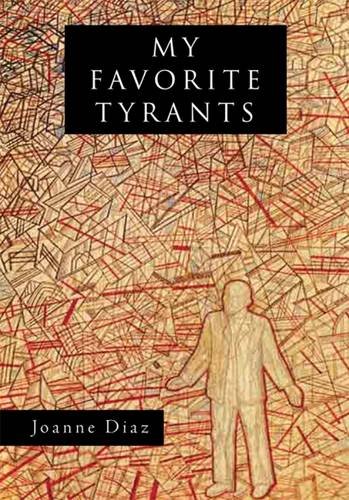
My Favorite Tyrants - Joanne Diaz (The University of Wisconsin Press)

Today's book of poetry:
My Favorite Tyrants.  Joanne Diaz.  The University of Wisconsin Press.  Madison, Wisconsin.  2014.

Winner of the Brittingham Prize in Poetry


American poet Joanne Diaz is as solid as a rock.  My Favorite Tyrants is a second book of poetry from Diaz, following The Lessons.  The Lessons is now at the top of Milo's, our head tech, search list. My Favorite Tyrants has made a deep impression here.

In the past few weeks Today's book of poetry has been in narrative poetry hog heaven.  You'll remember that we recently wrote about B.H. Fairchild and his The Art of the Lathe and were seriously gob-smacked.  I've already warned you readers that a David Lee feature was in the offing, as well as a double-header from the indefatigable David Clewell.  And now Joanne Diaz.

Diaz is no drop in veracity or tenacity from these monsters.  My Favorite Tyrants is outstanding.   Diaz spends no time on false drama or proselytizing, instead she spins such exacting and true sounding tales we are forced to remember how good poetry can be.

Barbershop

To get there, drive past Hajjar Elemenatry School,
named after the child of Lebanese immigrants
who lived here his whole life and died as the much-loved war hero
and town physician. Coast past the ditch where the now-filled
Middlesex Canal once transversed the town lines of Billerica,
Burlington, Winchester, Cambridge, and Boston, transporting
raw cotton in one direction and colorful textiles
in the other. Take a left at the corner of Call and Pollard,
there at the house of Asa Pollard, the first man to give his life
in the Battle of Bunker Hill, twenty miles southeast of here.
Follow the necklace of shabby little ranches on Pollard
until you get to the town center, then drive around the rotary,
built around the tree beneath which George Washington
allegedly sat -- is there any town in the former colonies
that doesn't have such a tree? -- and keep turning
past the old town hall, which is the new library, then
the old library, which is now the senior center
where she got her flu shot the day before, then past
Sweeney's funeral home where she is now, in the basement,
beneath the hands of the mortician who injects her veins
with the formaldehyde that will preserve her until the next day,
when the hearse will drive her coffin to a plot that is being dug,
past Taylor Florist, where they will charge four hundred dollars
for a spray of lavender wrapped with cheap ribbons that say
Mother and Wife, to Jim's where you can see my father
getting his first barbershop haircut in forty-eight years.
The sideburns, already, are not to his liking, and the razor's edge
feels a size off from her Oster home barbershop razor,
and the plastic sheet that covers him now is so uncomfortable
compared with the flowered bed sheet that she used, stained
purple-brown as it was from years of her own home coloring treatments.
If you listen, you'll hear him tell the barber that he hasn't been
to a barbershop since 1961, but now that she is gone, he guesses
that this is what he'll have to do. In these first days, he's relieved
to be with strangers. With them it is almost easy to say,
My wife has died in this, his new language.

...

Joanne Diaz digests this bitter earth and then voices, in songs we recognize, songs we'll remember, the necessary journeys we take to make a family.  My Favorite Tyrants is much bigger than just family, Diaz also manages to work in some geo-political fanning of the flames.

Death is a big Diaz theme but she looks beyond the simple dark mystery and talks to us with reasoned empathy, tearful sympathy and breathless curiosity.  Diaz does all that without ever raising any maudlin excess.

The poems where Diaz talks about the death of her mother resonate with a clean and vibrant hum.   Remorse, respect, loss, wonder.  Diaz works all of them into narratives that play out so true you might think you already know the story.  You don't, but the real truth always sounds familiar.

Demeter's Last Stand

Last night, I alluded to my years as a Camp Fire Girl
and Averill revealed that she had been one, too,
and after she made the sign of a fire rising from her hand,

we chanted the promise that every Camp Fire Girl knows:
WoHeLo means work; I light the candle of work. WoHeLo means
health; I light the candle of health. WoHeLo means love;

I light the candle of love. How many times
did Lori Dembkoski and I giggle
during those camping expeditions in the backyard

of Mrs. D'Angelo, a kind woman who seemed to have invented
recycling when she filled her old knee-highs with soap chips
and knotted the ends to tree branches; when she poked

holes in gallon jugs and forced twigs into them
so that we could start and stop the water
as the jugs swung, unwieldy, from low branches;

when she told ghost stories that originated in her own house.
After a few years, Mrs. D'Angelo left us for a job
in Pennsylvania, and our new troop had to meet

in the low-ceilinged cafeteria at the middle school
where we resigned ourselves to cutting ochre-colored felt
amidst the stench of Tatter Tots. I don't know how long

it took for a janitor named Connie Rock to find us,
but our encounters with him in the hallway
did offer surprises. One week he'd kneel down

to compliment our felt handiwork and knee-socks;
another time he'd ask us to sit on his lap just for a little while;
and eventually we kissed him on his sallow cheeks

that were soured and lined with decades of hard drink
and smoke. One night, when all the parents
came to the cafeteria for an event

not worth the remembering, Connie found me
and called my name, and I went to him as I had
in the weeks before, I imagine now that my mother

saw then: the red sash full of badges that she had hand-sewn,
the blue hat that featured a small bright bird;
my smile at an old janitor as he cradled me on his lap

and smiled back, as if I were Persephone and he were Hades,
just after he had pushed through a cleft in the soil to steal me.
It took only a moment for my mother to seize my wrist

and hurry to the car. Mother, if I thanked you too little,
know that tonight I remember your besting of Demeter's speed,
and that you saved me from a lifetime of winters.

...


Our morning read was a stunner.  Earlier this morning Kathryn, our Jr. Editor, made every one of us listen to/watch the P.J. Harvey/Bjork video of the old Rolling Stones tune "Satisfaction."  Everyone in the room was on the edge of their seat.  Kathryn was convinced the video would be the perfect opener to a reading of My Favorite Tyrants and she was right.  Diaz brought down the house.

Diaz has a fascination for the American producer/actor/writer Larry David.  Larry David was the head writer for Seinfeld and then was the primary attention getter in Curb Your Enthusiasm.  I expect you readers are like me and reside in the love/hate faction for Larry David sentiment.  Diaz doesn't skip a beat as she culturally appropriates his skinny ass for a meeting with Antonin Artaud. In the real world I would pay anything to see that meeting.

On the Meeting of Larry David and Antonin Artaud

      after Philip Levine

In my dream, Antonin Artaud is a patient
at Bellevue, receiving electroshock treatments
for the schizophrenia that shattered him
for all of his adult life, and Larry David
has come to see him during visiting hours.
Antonin's eyes reveal a man who on most days
is frantic beyond reason, but today, Larry's
the one who's at the end of his rope.
He's just starred in his first feature-length film
and it's a flop. He knows he should never
have taken a role written thirty-five years ago
and intended for Zero Mostel, that great
heaving sweat machine who died too soon
to play the part. Larry's a writer, a comedian,
but no actor, and now he's stinking up
an already terrible movie. Even worse,
Larry's wife has left him -- not just
in the TV show, but in real life too, and all
because he probably complained too much
about the environmentally sound toilet paper.

At first, it might seem unlikely that Larry
should meet this great French surrealist.
But Antonin had a soul that could find the meaning
and fulfillment of its perfection only in its own disaster,
and in this regard, he and Larry are twins
born of the same seed. So when Antonin
sees Larry insult a nurse, trip on the foot
of a demented patient, and swear out loud
three times as he crosses the floor of the ward,
Antonin feels delight, perhaps for the first time
in years. Finally, a man who might slice
the veneer of bourgeois reality in two!
Larry is also having a good time. Blind
to socioeconomic distinctions, oblivious
to mental illness or wellness, Larry is pleased
with Antonin's frenetically spun moustache
and pulls on it in the hope that it's a fake.

In a few minutes, visiting hours will end,
and Larry will return to the lonely world
outside, the one that Antonin abandoned
years ago. The men look out the window,
first to the East River and the barges floating
downstream, and then, beyond the water
to the length of Long Island City, the old
PepsiCo sign a halo of bright red curves.
To Antonin, the sign is an interminable Rorschach test,
the answers to which he will never know.
To Larry, it is a reminder that he is thirsty.
When he goes to the vending machine
he loses his change after he pushes the button.
He walks away in disgust, and just as he
is about to leave the ward, he hears
the rubbery footfall of the nurse
whom he had insulted only minutes earlier.
She pushes the same button and gets two Pepsis,
but will not give one to Larry, who takes out
his small notebook to resume his endless work.

...

Today's book of poetry cannot say that the Brittingham Prize in Poetry winning My Favorite Tyrants is the best book of poetry we've ever seen but it is excellent.  We've been awfully lucky here at Today's book of poetry in recent months with the quality of the books we've received and Joanne Diaz can hold water with the very best of 'em.  

My Favorite Tyrants is a pleasure to push.  All you poetry junkies need this fix.

Image result for joanne diaz photo
Joanne Diaz

ABOUT THE AUTHOR
Joanne Diaz is the author of My Favorite Tyrants (University of Wisconsin Press, 2014) and The Lessons (Silverfish Review Press, 2011). She teaches at Illinois Wesleyan University.


BLURB
Forged of equal parts brains and brass, these poems bleed and shine and all but blind us. How wild they are, how beautiful! I love the way Joanne Diaz uses light and noise to tell us more than any history book can of the tyrants who distort yet give meaning to our lives: Castro, Stalin, Our teachers, our parents, ourselves."
     -  David Kirby


572

DISCLAIMERS

Poems cited here are assumed to be under copyright by the poet and/or publisher.  They are shown here for publicity and review purposes.  For any other kind of re-use of these poems, please contact the listed publishers for permission.

We here at TBOP are technically deficient and rely on our bashful Milo to fix everything.  We received notice from Google that we were using "cookies"
and that for our readers in Europe there had to be notification of the use of those "cookies.  Please be aware that TBOP may employ the use of some "cookies" (whatever they are) and you should take that into consideration.


Tuesday, October 11, 2016

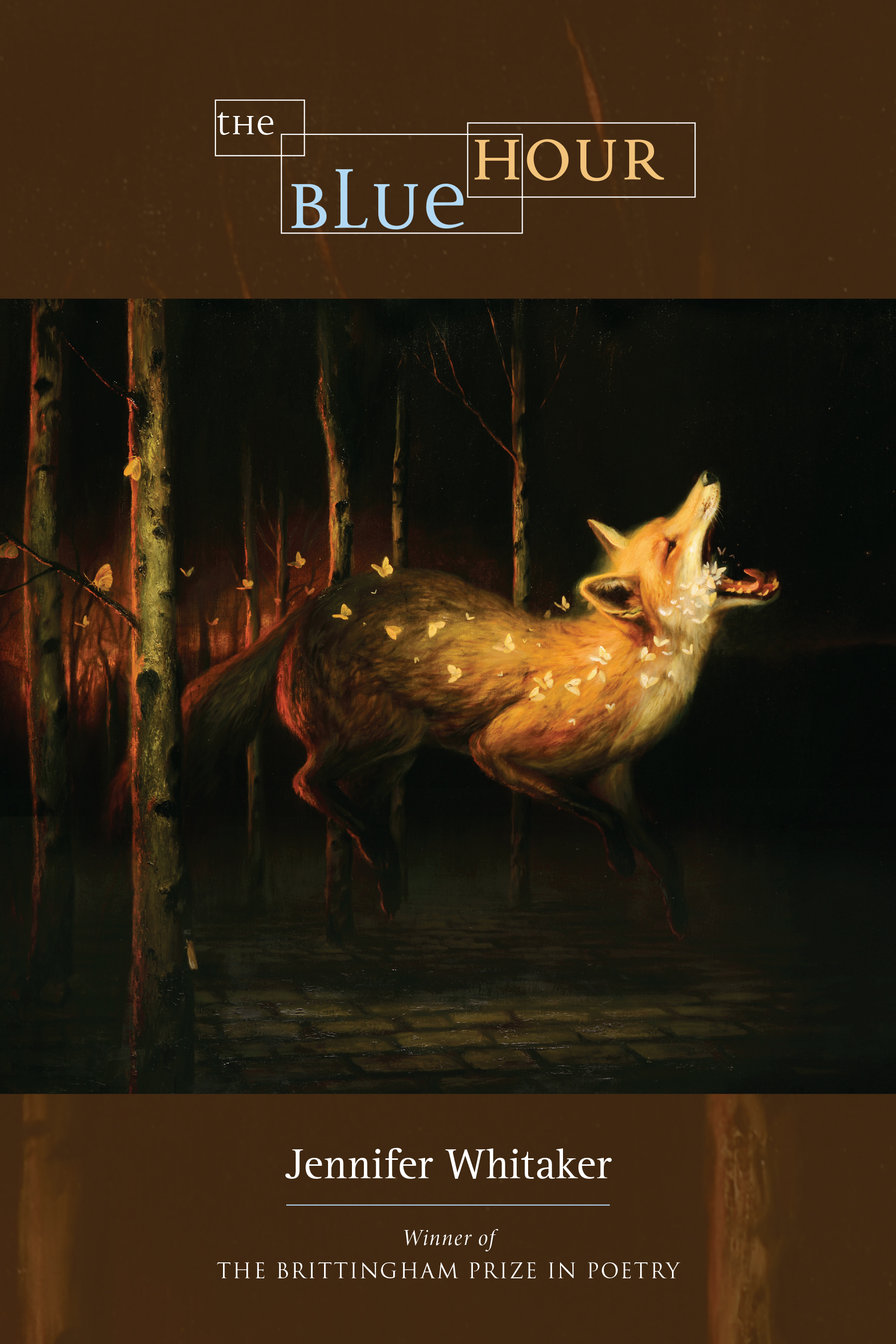
The Blue Hour - Jennifer Whitaker (University of Wisconsin Press)

Today's book of poetry:
The Blue Hour.  Jennifer Whitaker.  University of Wisconsin Press.  Madison, Wisconsin.  2016.

Winner of the Brittingham Prize in Poetry


Jennifer Whitaker credits the seventeenth century poet Gianbattista Basile's Pentamerone as a big influence on these poems.  She doffs her hat to Frannie Lindsay, Christine Garren, Karyna McGlynn and Brian Teare's collection The Room Where I Was Born.

Jennifer Whitaker may have been influenced by these writers, we will take her word for it, she might want to include the poetry Gods though, they have shone down on her.  Whitaker makes it all her own despite whatever influence trails in these vapours.

The Blue Hour is incendiary, these poems are white hot and unless handled with care - they will burn you.

Habit

When I followed him to the river, I narrowed myself
to a needle's point -- the morning clear,

the cicadas' swelling hum a comfort.
Lures spread out carnival-bright on newspaper,

those feathers trembling. The day's catch usual:
fish too tiny left on the banks, a snake flayed open to the light.

The field beyond the river: the cattails bending
with the wind, those daffodils' pursed lips.

When rocks bit the backs of my knees,
the haze of insects crowding around us,

my skirt pushed back like a gasp and the water
the water a stagnant slash across the land

I didn't fight. I was older then. I wasn't scared;
I was tired. -- Back at home, I brushed my hair,
put on my clean dress.

...

Brutish and wickedly candid, Whitaker makes us believe these are fairy tales, and they are, of the grimiest sort.  The Blue Hours pour gasoline over a number of sad ballets and Jennifer Whitaker keeps throwing in the match.  

These are horrifying poems laced with chilling beauty and delicately tender observation.  Whitaker infuses these poems with a weary sense of danger and foreboding.  Not even death will reconcile or console the demons left by this litany of orchestrated sexual violence.

Blue Hour

The whole world swells
underneath the house;
old newspapers bloat
in their plastic skins,
a black heat damps
like the inside of a mouth.

I quit the whine that sent me here,
I crouch in the bright six o'clock dark
like a cave cricket, in its fear
and ricochet frenzy blind
and springing toward that which frightens,

that which could easily be you --

...

Today's book of poetry didn't know where to scream when I read some of these poems but I couldn't turn away either.  Poems this highly charged should come with an early warning system.  Poems this highly charged are as rare as hen's teeth.

Kathryn, our Jr. Editor, was stranded on the distraught/angry/seething train after reading The Blue Hour so she excused herself from the morning read.  She sat beside Milo and didn't say a word. There were no smiles in our office as we solemnly read through Whitaker's violations.  I think the men felt guilty for being men, the women, some sort of kindred and justified outrage.  Everyone agreed the poems were Sterling.

I let things cool for a while after the reading, filled the office with some quiet Chet Baker on the box, later on some Billie.  There's a reverent quiet now, except for the music.  

Jennifer Whitaker's The Blue Hours left marks.

Father as Distant Boat

Far across the lake, on the other shore, the family takes off their hats,
loosens their neckties, unbraids their hair. There is a man and a woman,
a girl and small dog with soft ears. They board you
through the mist and stink of weeds. You pitch wildly.

Not until the shore's too far gone will they realize
the wood underfoot is rotten soft. Delicately,
like a slowly flooding room, it will dawn
on them: no one ever survives you. At sunset
they'll leap from your edges like flames.

...

Today's book of poetry wants to celebrate The Blue Room because this book is an achievement.  What a horrible, horrible world we inhabit that these evil fairy tales might be true.  Jennifer Whitaker takes us where no one wants to go and tries to bring us out clean on the other side, but great books leave a residue that stays with you forever.

Sublime and violent, and oh, what a cost to be wise.

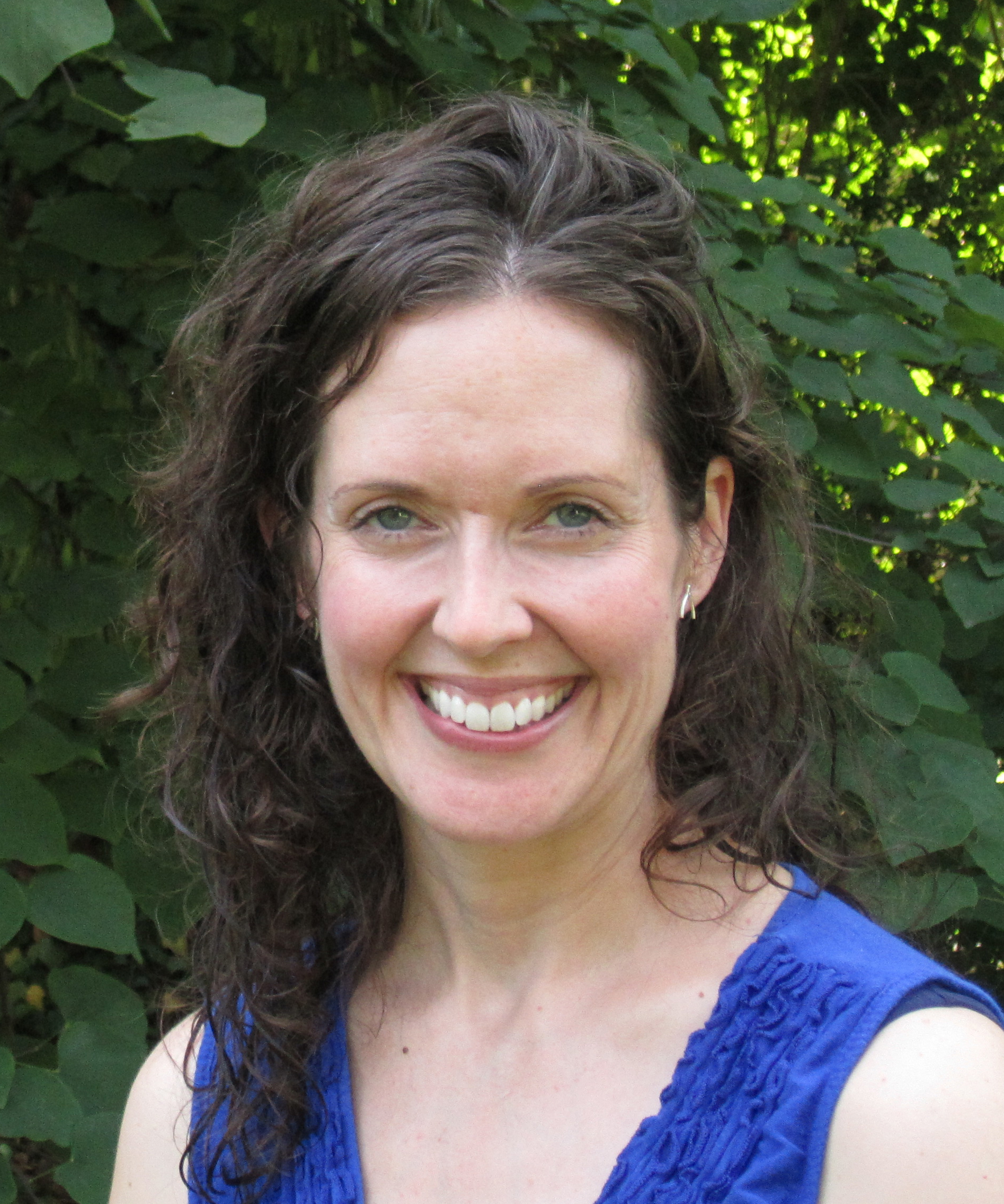
Jennifer Whitaker

ABOUT THE AUTHOR
Jennifer Whitaker is the director of the University Writing Center at the University of North Carolina at Greensboro and assistant poetry editor for storySouth. This is her first book.

BLURBS
“Whitaker’s debut collection wrenchingly captures an abusive parent-child relationship in a hardscrabble, desolate environment where, for instance, feral kittens fight off flies. . . . And though what follows is hard-bitten and relentless, with the sure knowledge that every twinkling gift has its price, Whitaker writes with a richness and variety that offers sustained reading throughout.”
      —Library Journal

“The Blue Hour casts a blue spell, using the tropes and gestures of traditional fairy tales—riddles, disguises, wishes, shape-shifting, entrapment, escape, and transformation—to trace a daughter’s experience of incestuous abuse. With language as sonically and somatically intricate as the subject she narrates, Whitaker looks unflinchingly at an ancient taboo and the infinite hour of its endurance.”
     —Lisa Russ Spaar, author of Vanitas, Rough

“Whitaker’s skills with sentence and sound, with spare yet suggestive language, with telling juxtapositions, with metaphor and misdirection, make the unbearable bearable just long enough that it can be seen, contained, and transcended. These are riveting poems, hard won, from a poet of exceptional talent.”
     —Jim Peterson, author of Original Face

“Chronicles a daughter in danger, a girl trapped in the dark underbelly of fairy tales. Predators—fathers, wolves, witches and their ghosts—drag us into the dark forest of sadism with no prince or woodsman in sight. Whitaker is a fearless poet whose subject is fear.”
     —Denise Duhamel, Brittingham Prize judge


512


Tuesday, January 19, 2016

Hive - Christina Stoddard (University of Wisconsin Press)

Today's book of poetry:
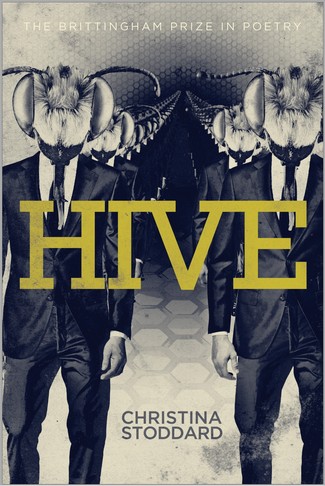
Hive.  Christina Stoddard.  University of Wisconsin Press. Madison, Wisconsin.  2015.
Winner of The Brittingham Prize in Poetry

Hive Cover

Christina Stoddard "brings the hammer down" hard.  These poems are the flaming sparks you get from raising a hammer high and bringing it down hard on an anvil.  And she doesn't miss a beat.   Every time you turn a page in this spellbinding collection you can feel the heat.  Stoddard is fully armed and taking names, and she is shooting in every direction.  

Hive is as rewarding a book of poetry as you'll find out there, this woman can burn.

Stoddard grew up in the Mormon Church and she is not all that happy about it.  These poems are brutal and beautiful, terrifying and exciting.

The Oxford Unabridged

was how I learned the word fellatio,
though I paused to look up orgasm
and my understanding of male genitals was abstract
at best. I had read the word fellatio in the newspaper,
Local section, in a story
about three runaways, two boys and a girl.
A man held them in a cabin
for two weeks. He raped the girl
and forced the boys to perform fellatio on him
repeatedly. I didn't have to look up rape--
I'd know that word since fourth grade
when Takeisha told me
that her uncle took off his pants
when he babysat and we told
our teacher. But I read
the definition of fellatio
and I considered what I knew
about repeatedly.
The man picked up the kids
hitching o the freeway
and said he'd take them as far
as Enumclaw. The girl
gave her testimony yesterday,
which sounded strange when I read it
because in our church
testimony was when we all stood up
to bear witness of Christ
on the first Sunday, in lieu of a sermon.
The article said the girl had a glass eye.
the man stabbed out her real one
when she tried to escape. The man
told her: I will not kill you, I will
take some things away.

...

One of the many things Today's book of poetry absolutely loved about Christina Stoddard's Hive is the sustain.  Stoddard never takes her foot off of the gas.  She pops these out of the park, page after page, like she was taking batting practice for fun.

There is a dark menacing undertoad that rolls under these pages.  Its a dark cloud hanging over the prayer you cannot retract.  Stoddard controls all the momentum with the precision of a surgeon.

The entire Today's book of poetry staff were sitting around our large central table this morning for today's read.  Everyone seemed in a rather solemn, somber mood.  We agreed that Stoddard did have a sense of humour but she is one tough nut.  The laughs don't come often but the dazzle is always on. Every person in the room ate up these intense little diamonds because they are such perfectly articulated anger.  Unanimous.

I Ask My Father If the Green River
Killer's Victims Go to Heaven

Because we are not equally loved on this earth,
because we are all God's children,
in the temple we baptize

lists of the dead. It is why
I step into the font, white dress
dragging like sailcloth.

An Elder takes both wrists
and pushes my body underwater
while saying a stranger's name.

In the water, I'm supposed to go absent.

I baptize you in the name of Lynette Snyder, who is dead
In the name of the Father, the Son, and the Holy Ghost

As I go under, I glimpse
the howling green river,
the parade of persuaded girls.

I see you, I tell them, I know
you are here.

I baptize you in the name of Karen Haskill, who is dead
In the name of the Father, the Son, and the Holy Ghost

Fifty times I drown.

I baptize you in the name of Melissa Porter, who is dead
In the name of the Father, the Son, and the Holy Ghost

I am weightless, light as a nest.
To save the others, the Elder
has to hold me down.

...

Christina Stoddard has a luminous career ahead of her.  Today's book of poetry knows great when we see it.

Hive questions faith in a world where faith is the beginning and the end to all things.  In a world where faith means belonging and questions mean banishment/escape to the dark and foreboding woods.  Stoddard response is to scream like she has been scalded.

God Made Everything Out of Nothing,
But the Nothingness Shows Through

The woman you are trying to love
has finally let you see her naked.
A clutch of seagull-shaped scars
ranges over her breasts
and you have never seen anything
like it, but that only means
you haven't seen much.
You have questions and 
all I can tell you is that the earth
is full of ashes. I know
it is beautiful sometimes to be violent.
That flood of surprise and pleasure
at what we are capable of
in the instant before blood
escapes the skin. We are
often told that loves comes
from inside us and maybe
she tired of waiting for it.
I know it is power
to open yourself. It is power
to stand naked before a man.
And there are those of us who need
to look upon the face
of the deep, who know
that emptiness was first, before God
allowed there to be light.

...

Today's book of poetry doubts that Hive was written in blood, but it sure seems that honest, it certainly feels that true.  This is brave stuff.  

Stoddard had better be working on her next book or TBOP will be sending out our Poetry Swat Team to investigate.

If Today's book of poetry handed out stars Hive would get them all.

Christina Stoddard
Christina Stoddard
photo: Dennis Wile

ABOUT THE AUTHOR

Christina Stoddard is the author ofHive, which was selected by Lucia Perillo for the 2015 Brittingham Prize in Poetry (University of Wisconsin Press). Christina’s poems have appeared in various journals includingstorySouth, DIAGRAM, and Spoon River Poetry Review. Originally from Tacoma, WA, Christina received her MFA from the University of North Carolina at Greensboro, where she was the Fred Chappell Fellow. Christina is an Associate Editor at Tupelo Quarterly and a Contributing Editor at Cave Wall. She currently lives in Nashville, TN where she is the Managing Editor of a scholarly journal in economics and decision theory.


BLURBS
“Hive is a joyride in a fast car that sometimes gets pulled over by a man in a suit with a Bible in his hand. Read these poems and you’ll know what I’m talking about!”
     —Lucia Perillo, Brittingham Prize judge

“Hive investigates the intersections of religion, race, class, and sexuality with grace and knowing. This is a revisiting of a Pacific Northwest that we often forget in our rush toward nostalgia—while the world was busy lauding the grunge scene, women went missing in the woods, and children died in the streets. Stoddard’s exquisite craft never forgets the errand: she raises the dead and offers full tribute and salve for those of us who have survived it.”
     —TJ Jarrett, author of Ain’t No Grave

“Christina Stoddard’s stunning first collection begins in ruin and the buzz of gathering flies. And that buzz grows into a more and more menacing hum in a journey through rapes and murders, through stray bullets and serial killers, through mental and physical and emotional and sexual and even spiritual abuse until the voice speaking the poems seems to come from a ‘mouth / fill[ed] with swarm.’ Yet in the end, miraculously—by their sheer courageous existence—these fierce poems soothe as much as they sting.”
     —Dan Albergotti, author of Millennial Teeth


427
DISCLAIMERS

Poems cited here are assumed to be under copyright by the poet and/or publisher.  They are shown here for publicity and review purposes.  For any other kind of re-use of these poems, please contact the listed publishers for permission.

We here at TBOP are technically deficient and rely on our bashful Milo to fix everything.  We received notice from Google that we were using "cookies"
and that for our readers in Europe there had to be notification of the use of those "cookies.  Please be aware that TBOP may employ the use of some "cookies" (whatever they are) and you should take that into consideration.