Showing posts with label b.h. Fairchild. Show all posts

Monday, April 17, 2017

My Favorite Tyrants - Joanne Diaz (The University of Wisconsin Press)

Today's book of poetry:
My Favorite Tyrants.  Joanne Diaz.  The University of Wisconsin Press.  Madison, Wisconsin.  2014.

Winner of the Brittingham Prize in Poetry
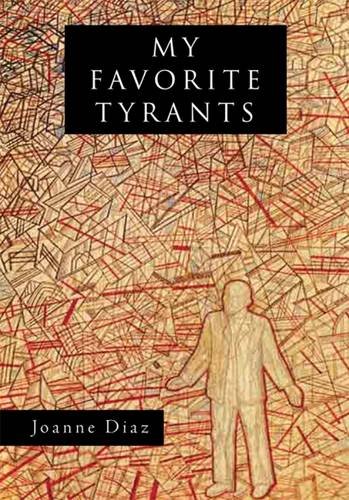


American poet Joanne Diaz is as solid as a rock.  My Favorite Tyrants is a second book of poetry from Diaz, following The Lessons.  The Lessons is now at the top of Milo's, our head tech, search list. My Favorite Tyrants has made a deep impression here.

In the past few weeks Today's book of poetry has been in narrative poetry hog heaven.  You'll remember that we recently wrote about B.H. Fairchild and his The Art of the Lathe and were seriously gob-smacked.  I've already warned you readers that a David Lee feature was in the offing, as well as a double-header from the indefatigable David Clewell.  And now Joanne Diaz.

Diaz is no drop in veracity or tenacity from these monsters.  My Favorite Tyrants is outstanding.   Diaz spends no time on false drama or proselytizing, instead she spins such exacting and true sounding tales we are forced to remember how good poetry can be.

Barbershop

To get there, drive past Hajjar Elemenatry School,
named after the child of Lebanese immigrants
who lived here his whole life and died as the much-loved war hero
and town physician. Coast past the ditch where the now-filled
Middlesex Canal once transversed the town lines of Billerica,
Burlington, Winchester, Cambridge, and Boston, transporting
raw cotton in one direction and colorful textiles
in the other. Take a left at the corner of Call and Pollard,
there at the house of Asa Pollard, the first man to give his life
in the Battle of Bunker Hill, twenty miles southeast of here.
Follow the necklace of shabby little ranches on Pollard
until you get to the town center, then drive around the rotary,
built around the tree beneath which George Washington
allegedly sat -- is there any town in the former colonies
that doesn't have such a tree? -- and keep turning
past the old town hall, which is the new library, then
the old library, which is now the senior center
where she got her flu shot the day before, then past
Sweeney's funeral home where she is now, in the basement,
beneath the hands of the mortician who injects her veins
with the formaldehyde that will preserve her until the next day,
when the hearse will drive her coffin to a plot that is being dug,
past Taylor Florist, where they will charge four hundred dollars
for a spray of lavender wrapped with cheap ribbons that say
Mother and Wife, to Jim's where you can see my father
getting his first barbershop haircut in forty-eight years.
The sideburns, already, are not to his liking, and the razor's edge
feels a size off from her Oster home barbershop razor,
and the plastic sheet that covers him now is so uncomfortable
compared with the flowered bed sheet that she used, stained
purple-brown as it was from years of her own home coloring treatments.
If you listen, you'll hear him tell the barber that he hasn't been
to a barbershop since 1961, but now that she is gone, he guesses
that this is what he'll have to do. In these first days, he's relieved
to be with strangers. With them it is almost easy to say,
My wife has died in this, his new language.

...

Joanne Diaz digests this bitter earth and then voices, in songs we recognize, songs we'll remember, the necessary journeys we take to make a family.  My Favorite Tyrants is much bigger than just family, Diaz also manages to work in some geo-political fanning of the flames.

Death is a big Diaz theme but she looks beyond the simple dark mystery and talks to us with reasoned empathy, tearful sympathy and breathless curiosity.  Diaz does all that without ever raising any maudlin excess.

The poems where Diaz talks about the death of her mother resonate with a clean and vibrant hum.   Remorse, respect, loss, wonder.  Diaz works all of them into narratives that play out so true you might think you already know the story.  You don't, but the real truth always sounds familiar.

Demeter's Last Stand

Last night, I alluded to my years as a Camp Fire Girl
and Averill revealed that she had been one, too,
and after she made the sign of a fire rising from her hand,

we chanted the promise that every Camp Fire Girl knows:
WoHeLo means work; I light the candle of work. WoHeLo means
health; I light the candle of health. WoHeLo means love;

I light the candle of love. How many times
did Lori Dembkoski and I giggle
during those camping expeditions in the backyard

of Mrs. D'Angelo, a kind woman who seemed to have invented
recycling when she filled her old knee-highs with soap chips
and knotted the ends to tree branches; when she poked

holes in gallon jugs and forced twigs into them
so that we could start and stop the water
as the jugs swung, unwieldy, from low branches;

when she told ghost stories that originated in her own house.
After a few years, Mrs. D'Angelo left us for a job
in Pennsylvania, and our new troop had to meet

in the low-ceilinged cafeteria at the middle school
where we resigned ourselves to cutting ochre-colored felt
amidst the stench of Tatter Tots. I don't know how long

it took for a janitor named Connie Rock to find us,
but our encounters with him in the hallway
did offer surprises. One week he'd kneel down

to compliment our felt handiwork and knee-socks;
another time he'd ask us to sit on his lap just for a little while;
and eventually we kissed him on his sallow cheeks

that were soured and lined with decades of hard drink
and smoke. One night, when all the parents
came to the cafeteria for an event

not worth the remembering, Connie found me
and called my name, and I went to him as I had
in the weeks before, I imagine now that my mother

saw then: the red sash full of badges that she had hand-sewn,
the blue hat that featured a small bright bird;
my smile at an old janitor as he cradled me on his lap

and smiled back, as if I were Persephone and he were Hades,
just after he had pushed through a cleft in the soil to steal me.
It took only a moment for my mother to seize my wrist

and hurry to the car. Mother, if I thanked you too little,
know that tonight I remember your besting of Demeter's speed,
and that you saved me from a lifetime of winters.

...


Our morning read was a stunner.  Earlier this morning Kathryn, our Jr. Editor, made every one of us listen to/watch the P.J. Harvey/Bjork video of the old Rolling Stones tune "Satisfaction."  Everyone in the room was on the edge of their seat.  Kathryn was convinced the video would be the perfect opener to a reading of My Favorite Tyrants and she was right.  Diaz brought down the house.

Diaz has a fascination for the American producer/actor/writer Larry David.  Larry David was the head writer for Seinfeld and then was the primary attention getter in Curb Your Enthusiasm.  I expect you readers are like me and reside in the love/hate faction for Larry David sentiment.  Diaz doesn't skip a beat as she culturally appropriates his skinny ass for a meeting with Antonin Artaud. In the real world I would pay anything to see that meeting.

On the Meeting of Larry David and Antonin Artaud

      after Philip Levine

In my dream, Antonin Artaud is a patient
at Bellevue, receiving electroshock treatments
for the schizophrenia that shattered him
for all of his adult life, and Larry David
has come to see him during visiting hours.
Antonin's eyes reveal a man who on most days
is frantic beyond reason, but today, Larry's
the one who's at the end of his rope.
He's just starred in his first feature-length film
and it's a flop. He knows he should never
have taken a role written thirty-five years ago
and intended for Zero Mostel, that great
heaving sweat machine who died too soon
to play the part. Larry's a writer, a comedian,
but no actor, and now he's stinking up
an already terrible movie. Even worse,
Larry's wife has left him -- not just
in the TV show, but in real life too, and all
because he probably complained too much
about the environmentally sound toilet paper.

At first, it might seem unlikely that Larry
should meet this great French surrealist.
But Antonin had a soul that could find the meaning
and fulfillment of its perfection only in its own disaster,
and in this regard, he and Larry are twins
born of the same seed. So when Antonin
sees Larry insult a nurse, trip on the foot
of a demented patient, and swear out loud
three times as he crosses the floor of the ward,
Antonin feels delight, perhaps for the first time
in years. Finally, a man who might slice
the veneer of bourgeois reality in two!
Larry is also having a good time. Blind
to socioeconomic distinctions, oblivious
to mental illness or wellness, Larry is pleased
with Antonin's frenetically spun moustache
and pulls on it in the hope that it's a fake.

In a few minutes, visiting hours will end,
and Larry will return to the lonely world
outside, the one that Antonin abandoned
years ago. The men look out the window,
first to the East River and the barges floating
downstream, and then, beyond the water
to the length of Long Island City, the old
PepsiCo sign a halo of bright red curves.
To Antonin, the sign is an interminable Rorschach test,
the answers to which he will never know.
To Larry, it is a reminder that he is thirsty.
When he goes to the vending machine
he loses his change after he pushes the button.
He walks away in disgust, and just as he
is about to leave the ward, he hears
the rubbery footfall of the nurse
whom he had insulted only minutes earlier.
She pushes the same button and gets two Pepsis,
but will not give one to Larry, who takes out
his small notebook to resume his endless work.

...

Today's book of poetry cannot say that the Brittingham Prize in Poetry winning My Favorite Tyrants is the best book of poetry we've ever seen but it is excellent.  We've been awfully lucky here at Today's book of poetry in recent months with the quality of the books we've received and Joanne Diaz can hold water with the very best of 'em.  

My Favorite Tyrants is a pleasure to push.  All you poetry junkies need this fix.

Image result for joanne diaz photo
Joanne Diaz

ABOUT THE AUTHOR
Joanne Diaz is the author of My Favorite Tyrants (University of Wisconsin Press, 2014) and The Lessons (Silverfish Review Press, 2011). She teaches at Illinois Wesleyan University.


BLURB
Forged of equal parts brains and brass, these poems bleed and shine and all but blind us. How wild they are, how beautiful! I love the way Joanne Diaz uses light and noise to tell us more than any history book can of the tyrants who distort yet give meaning to our lives: Castro, Stalin, Our teachers, our parents, ourselves."
     -  David Kirby


572

DISCLAIMERS

Poems cited here are assumed to be under copyright by the poet and/or publisher.  They are shown here for publicity and review purposes.  For any other kind of re-use of these poems, please contact the listed publishers for permission.

We here at TBOP are technically deficient and rely on our bashful Milo to fix everything.  We received notice from Google that we were using "cookies"
and that for our readers in Europe there had to be notification of the use of those "cookies.  Please be aware that TBOP may employ the use of some "cookies" (whatever they are) and you should take that into consideration.



Wednesday, March 22, 2017

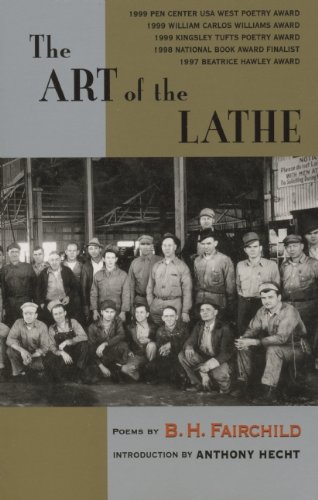
The Art of the Lathe - B.H. Fairchild (Alice James Books)

Today's book of poetry:
The Art of the Lathe.  B.H. Fairchild.  Alice James Books.  University of Maine at Farmington.  Farmington, Maine.  1998.

1999 Pen Center USA West Poetry Award
1999 William Carlos Williams Award
1999 Kingsley Tufts Poetry Award
1998 National Book Award Finalist
1997 Beatrice Hawley Award


For many knowledgeable poetry fans it will be old news that B.H. Fairchild's The Art of the Lathe is a contemporary classic.  Today's book of poetry got Fairchild's gem in the mail yesterday and as a result we are sailing slightly off course today.

With our vast resources Today's book of poetry has started to gather foreign correspondents.  We currently have Otis wandering through the poetry cellars of Sicily searching for treasure, he will be returning soon.  Our latest addition to the staff is a trumpet playing be-bop artist from St. Louis, Mark Twang.

Mark grew up in reasonably normal environs but somewhere early on someone dropped a Pork Pie hat on his noggin' and he hasn't been quite right since.  Twang has been raiding his own vast library to send pieces of gold north.  Twang sent David Lee to our door and you will be hearing much more about Mr. Lee in the near future because he is a monster.  We had a thing, instantly, for David Lee. So we put him in the system.

The system wouldn't wait for B.H. Fairchild's The Art of the Lathe.  Today's book of poetry apologizes for not having read it before but you simply can't read everything, or find it.  Twang had sent us individual poems by B.H. Fairchild in his letters, along with quotes from Sonny Rollins and a couple of Crying Charlies.  Today's book of poetry was instantly convinced by those poems.  When The Art of the Lathe arrived we knew no one would object if Fairchild skipped his place in line.

The Art of the Lathe is an eye-opening deal breaker of extraordinary beauty.  Fairchild uses some deep sonar of the human spirit to get inside of the reader and then sets off bombs of reason.  The Art of the Lathe is the real deal.  When Twang sent it to us he included a note where he suggested that The Art of the Lathe may be the best, pound for pound, book of poetry he has ever read.  I happen to know for a fact that Mark Twang has read, and understood, more poetry than I have so I take his opinion to heart. That and he's been right about everything else he has told us.

So when The Art of the Lathe arrived I dug in.

Dear reader please believe me when I tell you that Mark Twang was right as rain.  The Art of the Lathe may be the finest book of poetry I've ever had the pleasure of reading.

Body and Soul

Half-numb, guzzling bourbon and Coke from coffee mugs,
our fathers fall in love with their own stories, nuzzling
the facts but mauling the truth, and my friend's father begins
to lay out with the slow ease of a blues ballad a story
about sandlot baseball in Commerce, Oklahoma decades ago.
These were men's teams, grown men, some in their thirties
and forties who worked together in zinc mines or on oil rigs,
sweat and khaki and long beers after work, steel guitar music
whanging in their ear, little white rent houses to return to
where their wives complained about money and broken Kenmores
and then said the hell with it and sang Body and Soul
in the bathtub stroking their husband's wrist tattoo and smoking
Chesterfields from a fresh pack until everything was O.K.
Well, you get the idea. Life goes on, the next day is Sunday,
another ball game, and the other team shows up one man short.

They say, we're one man short, but can we use this boy,
he's only fifteen years old, and at least he'll make a game.
They take a look at the kid, muscular and kind of knowing
the way he holds his glove, with the shoulders loose,
the thick neck, but then with that boy's face under
a clump of angelic blonde hair, and say, oh, hell, sure,
let's play ball. So it all begins, the men loosening up,
joking about the fat catcher's sex life, it's so bad
last night he had to hump his wife, that sort of thing,
pairing off into little games of catch that heat up into
throwing matches, the smack of the fungo bat, lazy jogging
into right field, big smiles and arcs of tobacco juice,
and the talk that gives a cool, easy feeling to the air,
talk among men normally silent, normally brittle and a little
angry with the empty promise of their lives. But they chatter
and say rock and fire, babe, easy out, and go right ahead
and pitch to the boy, but nothing fancy, just hard fastballs
right around the belt, and the kid takes the first two
but on the third pops the bat around so quick and sure
that they pause a moment before turning around to watch
the ball still rising and finally dropping far beyond
the abandoned tractor that marks left field. Holy shit.
They're pretty quiet watching him round the bases,
but then, what the hell, the kids knows how to hit a ball,
so what, let's play some goddamned baseball here.
And so it goes. The next time up, the boy gets a look
at a very nifty low curve, then a slider, and the next one
is the curve again, and he sends it over the Allis Chambers,
high and big and sweet. The left fielder just stands there, frozen.
As if this isn't enough, the next time up he bats left-handed.
They can't believe it, and the pitcher, a tall, mean-faced
man from Okarche who just doesn't give a shit anyway
because his wife ran off two years ago leaving him with
three little ones and a rusted-out Dodge with a cracked block,
leans in hard, looking at the fat catcher like he was the sonofabitch
who ran off with his wife, leans in and throws something
out of the dark, green hell of forbidden fastballs, something
that comes in at the knees and then leaps viciously towards
the kid's elbow. He swings exactly the way he did right-handed,
and they all turn like a chorus line toward deep right field
where the ball loses itself in sagebrush and the sad burnt
dust of dustbowl Oklahoma. It is something to see.

But why make a long story long: runs pile up on both sides,
the boy comes around five times, and five times the pitcher
is cursing both God and His mother as his chew of tobacco sours
into something resembling horse piss, and a ragged and bruised
Spalding baseball disappears into the far horizon. Goodnight,
Irene. They have lost the game and some painful side bets
and they have been suckered. And it means nothing to them
though it should to you when they are told the boy's name is
Mickey Mantle. And that's the story, and those are the facts.
But the facts are not the truth. I think, though, as I scan
the faces of these old men now lost in the innings of their youth,
I think I know what the truth of this story is, and I imagine
it lying there in the weeds behind that Allis Chalmers
just waiting for the obvious question to be asked: why, oh
why in hell didn't they just throw around the kid, walk him,
after he hit the third homer? Anybody would have,
especially nine men with disappointed wives and dirty socks
and diminishing expectations for who winning at anything
meant everything. Men who knew how to play the game,
who had talent when the other team had nothing except this ringer
who without a pitch to hit was meaningless, and they could
  go home
with their little two-dollar side bets and stride into the house
singing If You've Got the Money, Honey, I've Got the Time
with a bottle of Southern Comfort under their arms and grab
Dixie or May Ella up and dance across the gray linoleum
as if it were V-Day all over again. But they did not.
And they did not because they were men, and this was a boy.
And they did not because sometimes after making love,
after smoking their Chesterfields in the cool silence and
listening to the big bands on the radio that sounded so glamorous,
so distant, they glanced over at their wives and noticed the lines
growing heavier around the eyes and the mouth, felt what their wives
felt: that Les Brown and Glenn Miller and all those dancing
  couples
and in fact all possibility of human gaiety and light-heartedness
were as far away and unreachable as Times Square or the Avalon
ballroom. They did not because of the gray linoleum lying there
in the half-dark, the free calendar from the local mortuary
that said one day was pretty much like another, the work gloves
looped over the doorknob like dead squirrels. And they did not
because they had gone through a depression and a war that
  had left
them with the idea that being a man in the eyes of their fathers
and everyone else had cost them just too goddamned much to lay it
at the feet of a fifteen year-old boy. And so they did not walk him,
and lost, but at least had some ragged remnant of themselves
to take back home. But there is one thing more, though it is not
a fact. When I see my friend's father staring hard into the
  bottomless
well of home plate as Mantle's fifth homer heads towards Arkansas,
I know that this man with the half-orphaned children and
worthless Dodge has also encountered for his first and possibly
only time the vast gap between talent and genius, has seen
as few have in the harsh light of an Oklahoma Sunday, the blonde
and blue-eyed bringer of truth, who will not easily be forgiven.

...

Today's book of poetry isn't much of a baseball fan and suspect that many of you aren't big ball fans either but we do know how difficult it is to dream the real thoughts of men and women and make them more than real on the page.  When Fairchild gets through with you it is almost possible to believe that the stories in his poems are your own experience.

As a recent convert to the House of Fairchild I have assigned Milo, our head tech, the task of filling all the missing Fairchild spaces on our racks.  He was able to find a copy of Fairchild's Early Occult Memory Systems of the Lower Midwest (W.W. Norton Books, 2003) on the shelves but that won't ever be enough.

Keats

I knew him. He ran the lathe next to mine.
Perfectionist, a madman, even on overtime
Saturday night. Hum of the crowd floating
from the ball park, shouts, slamming doors
from the bar down the street, he would lean
into the lathe and make a little song
with the honing cloth, rubbing the edges,
smiling like a man asleep, dreaming.
A short guy, but fearless. At Margie's
he would take no lip, put the mechanic big
as a Buick through a stack of crates out back
and walked away with a broken thumb
but never said a word. Marge was a loud
dirty girl with booze breath and bad manners.
He loved her. One night late I saw them in
the kitchen dancing something like a rhumba
to the radio, dishtowels wrapped around
their heads like swamis. Their laughter chimed
rich as brass rivets rolling down a tin roof.
But it was the work that kept him out of fights,
and I remember the red hair flaming
beneath the lamp, calipers measuring out
the last cut, his hands flicking iron burrs
like shooting stars through the shadows.
It was the iron, cut to a perfect fit, smooth
as bone chine and gleaming under lamplight
that made him stand back, take out a smoke,
and sing. It was the dust that got him, his lungs
collapsed from breathing in a life of work.
Lying there, his hands are what I can't forget.

...

B.H. Fairchild had some very rapt ears on his work this morning.  It is bitterly cold here in Ottawa today but our reading helped to heat up the office.  Milo, our head tech, was very dignified, Kathleen, our Jr. Editor, gushed.  Max, our Sr. Editor, harrumphed as he marched out into the cold but he was smiling when he marched back in.  Max gave us a world-class reading of "Body and Soul", Odin grinned from the corner.

Our foreign correspondent Otis is still in Sicily checking out wine cellars but he's scheduled to return later this week.   Otis also sent a note making sure I included him when the staff here at Today's book of poetry welcomed our newest member, Mark Twang.

After reading B.H. Fairchild's The Art of the Lathe I am now considering making all of our future staff take an oath of office by swearing on Fairchild.

The Art of the Lathe

Leonardo imagined the first one.
The next was a pole lathe with a drive cord,
illustrated in Plumier's L'art de tourner en perfection.
Then Ramsden, Vauconson, the great Maudslay,
his students Roberts, Fox, Clement, Whitworth.

The long line of machinists to my left
lean into their work, ungloved hands adjusting the calipers,
tapping the big lightly with their fingertips.
Each man withdraws into his house of work:
the rough cut, shearing of iron by tempered steel,
blue-black threads lifting like locks of hair,
then breaking over bevel and ridge.
Oil and water splash over the whitening bit, hissing.
The lathe on night-shift, moonlight silvering the bed-ways.

The old man I apprenticed with, Roy Garcia,
in silk shirt, khakis, and Florsheims. Cautious,
almost delicate explanations and slow,
shapely hand movements. Craft by repetition.
Haig and Haig behind the tool chest.

In Diderot's Encyclopaedia, an engraving
of a small machine shop: forge and bellows in back,
in the foreground a mandrel lathe turned by a boy.
It is late afternoon, and the copper light leaking in
from the street side of the shop just catches
his elbow, calf, shoe. Taverns begin to crowd
with workmen curling over their tankards,
still hearing in the rattle of carriages over cobblestone
the steady tap of the treadle,
the gasp and heave of the bellows.

The boy leaves the shop, cringing into the light,
and digs the grime from his fingernails, blue
from bruises. Walking home, he hears a clavier--
Couperin, maybe, a Bach toccata--from a window overhead.
Music, he thinks, the beautiful.
Tavern doors open. Voices. Grab and hustle of the street.
Cart wheels. The small room of his life. The darkening sky.

I listen to the clunk-and-slide of the milling machine,
Maudsley's art of clarity and precision: sculpture of poppet,
saddle, jack screw, pawl, cone-pulley,
the fit and mesh of gears, tooth in groove like interlaced fingers.
I think of Mozart folding and unfolding his napkin
as the notes sound in his head. The new machinist sings
  Patsy Cline,
I Fall To Pieces. Sparrows bicker overhead.
Screed of the grinder, the bandsaw's groan and wail.

In his boredom the boy in Diderot
studies again through the shop's open door
the buttresses of Suger's cathedral
and imagines the young Leonardo in his apprenticeship
staring through the window at Brunelleschi's dome,
solid yet miraculous, a resurrected body, floating above the city.

Outside, a cowbird cries, flapping up from the pipe rack,
the ruffling of wings like a quilt flung over a bed.
Snow settles on the tops of cans, black rings in a white field.
The stock, cut clean, gleams under lamplight.
After work, I wade back through the silence of the shop:
the lathes shut down, inert, like enormous animals in hibernation,
red oil rags lying limp on the shoulders
of machines, dust motes still climbing shafts
of dawn light, hook and hoist chains lying desultory
as an old drunk collapsed outside a bar,
barn swallows pecking on the shores of oil puddles--
emptiness, wholeness; a cave, a cathedral.

As morning light washes the walls of Florence,
the boy Leonardo mixes paints in Verrocchio's shop
and watches the new apprentice muddle
the simple task of the Madonna's shawl.
Leonardo whistles a canzone and imagines
a lathe: the spindle, bit, and treadle, the gleam of brass.

...

Today's book of poetry is thrilled to travel back to 1998 to bring you this masterwork.  Make no mistake, B.H. Fairchild's The Art of the Lathe is as good as it gets.

Image result for b.h. fairchild photo
B.H. Fairchild

ABOUT THE AUTHOR
B. H. Fairchild, the author of several acclaimed poetry collections and a recipient of Guggenheim and NEA fellowships, has been a finalist for the National Book Award and winner of the William Carlos Williams Award, the National Book Critics Circle Award, and the Bobbitt National Prize. He teaches in the creative writing PhD program at the University of North Texas.

BLURBS
“The Art of the Lathe by B.H. Fairchild has become a contemporary classic—a passionate example of the plain style, so finely crafted and perfectly pitched. . . . Workhorse narratives suffused with tenderness and elegiac music. . .”
     — Los Angeles Times

“With elegance and restrained subtlety, Mr. Fairchild interweaves topics that become something like musical themes, including the central theme of machine work. . . . Anyone who can lay claim to the authorship of this much excellent poetry wins my unqualified and grateful admiration.”
     — Anthony Hecht


B. H. Fairchild 
at VCP Poetry Series
video: Wayne Linberg


564

DISCLAIMERS

Poems cited here are assumed to be under copyright by the poet and/or publisher.  They are shown here for publicity and review purposes.  For any other kind of re-use of these poems, please contact the listed publishers for permission.

We here at TBOP are technically deficient and rely on our bashful Milo to fix everything.  We received notice from Google that we were using "cookies"
and that for our readers in Europe there had to be notification of the use of those "cookies.  Please be aware that TBOP may employ the use of some "cookies" (whatever they are) and you should take that into consideration.

Tuesday, August 23, 2016

Vampire Planet - New and Selected Poems - Ron Koertge (Red Hen Press)


Today's book of poetry:
Vampire Planet - New and Selected Poems.  
Ron Koetrge.  Red Hen Press.  Pasedena, California.  2016.


Today is our 500th poetry blog here at Today's book of poetry and we've saved something very special for the occasion.  Ron Koertge's Vampire Planet - New and Selected Poems is simply Divine. Bloodsucking otherworldly in fact.

Today's book of poetry first read Ron Koertge in the early 80's.  Diary Cows (Little Caesar Press, 1981) jumped off the shelf and into my hands the first time I darkened the door of City Lights Bookstore in San Francisco.  I was working as a chauffeur at the time and had a three day stopover in the city by the bay.  I was all Charles Bukowski and Jack Kerouac in the head at the time and Koertge was like a drink of some very fresh water.

Diary Cows did it then, Vampire Planet is doing it now.  How any one poet can be so hilariously insightful at full gallop simply baffles the bejesus out of me.  How splendid.

Diary Cows

Got up early, waited for the farmer.
Hooked us all up to the machines as usual.
Typical trip to the pasture, typical
afternoon grazing and ruminating.
About 5:00 back to the barn. What
a relief! Listened to the radio during
dinner. Lights out at 7:00.
More tomorrow.

...

Ron Koertge is an accomplished author outside of poetry world -- but we here at Today's book of poetry are so happy that this man continues to write poems.  In a perfect Today's book of poetry world Koertge would translate every bedtime story, rewrite every nursery rhyme, as far as we are concerned you could put a Koertge filter on it all.

Cinderella's Diary

I miss my stepmother. What a thing to say,
but it's true. The prince is so boring: four
hours to dress and then the cheering throngs.
Again. The page who holds the door is cute
enough to eat. Where is he once Mr. Charming
kisses my forehead goodnight?

Every morning I gaze out a casement window
at the hunters, dark men with blood on their
boots who joke and mount, their black trousers
straining, rough beards, calloused hands, selfish,
abrupt...

Oh, dear diary--I am lost in ever after:
those insufferable birds, someone in every
room with a lute, the queen calling me to look
at another painting of her son, this time
holding the transparent slipper I wish
I'd never seen.

...

Had to call Max, our Sr. Editor, out of his booky lair this morning to discuss the use of more than three poems for today's Today's book of poetry.  He enthusiastically exclaimed that for Saint Ron of K he'd take the heat from the front office.

Kathryn and Milo bebopped Koertge poem after poem to anyone who would listen this morning including three passers-by from the street.  They liked this next poem so much that they came in to our office, sat down and volunteered to work at Today's book of poetry.

Moving Day

While sitting home one night, I hear burglars
fiddling with the lock. This is what I've been
waiting for!

I run around to the back and open the door
invite them in and pour some drinks. I tell them
to relax, and I help them off with shoes and masks.

In a little while we are fast friends, and after
a dozen toasts to J. Edgar Hoover they begin
to carry things out. I point to the hidden silver,
hold the door as they wrestle with the bed,
and generally make myself useful.

When they get the truck loaded and come back
inside for one last  brandy, I get the drop on them.
Using Spike's gun, I shoot them both and imprint
Blackie's prints on the handle.

Then I get in the van and drive away,
a happy man.

...

All silliness aside I want to tell you faithful readers that it is poets like Ron Koertge and books like Vampire Planet that make this blog possible.  Vampire Planet should be on every single poetry shelf out there just like Billy Collins says.  This level of wise humour is two moons in the sky rare.

I talked to my brilliant wife K last night about today's blog and expressed deep concern that after 499 other poetry blogs where I suggested that they were all books you should read how do I express my enthusiasm for Vampire Planet with sufficient enthusiasm and originality?  She said she figured that by now the readers were either with me or long gone so just say what you feel.  So, take my word for it, Mr. Ron Koertge gives more poetry happiness per page than any other living poet I've found.

Why I Believe in God

I'd failed the examination allowing me to bypass the MA
          and go straight for a PhD, so I was forced to let
my friends forge ahead reading, if possible, longer and fatter
          books than before while I worked on something
by the Pearl Poet for my thesis.

          My advisor was Mrs. Hamilton, a world-class
medievalist and the most patient lady in the world.
          Every week I'd bring her a few pages of translation.
She would smile and correct everything. With her help,
          I finished.

An orals board consists of three members of the English
          Department and someone from another
discipline, usually an assistant professor from chemistry
          who drinks coffee from a beaker. But my guy
was from the German Department. He had a scar, for God's
          sake, that might've come from a duel. He
also wanted to begin because he had a few questions.

          "Vhat was the root of zis word? Zah root for zhat?
Who in his right mind vould mistake zhat as zis!" I glanced
           as Mrs. Hamilton who looked like she was watching
Thumper get hit by a tank. I took a deep breath and replied
          that I knew I was less prepared in German than
I should have been but German was the very next course
          I planned to take. I then hoped to move
to Germany and become German.

He sneered, but Dr. Rosenblatt, God bless him, asked me
          something easy: "What was Keat's first name?"
Then Mrs. Hamilton wanted to know if Whitman had a beard.
          Yes or no would be enough.

I was just getting my sea legs when Dr. Death leaned
          forward. "Vhat," he hissed, "is zah function
of zah ghost is Hamlet?" Actually he may have been
          trying to be nice because it isn't that hard
a question. The ghost is the key that starts the engine
          of the play. Without him, Hamlet is just
another pouty prince.

          But I froze. I couldn't think of anything.
My teachers stared at me. They leaned forward
          encouragingly. "Do you remember the ghost,
Mr. Koertge?" asked Mrs. Hamilton. "Yes, ma'am.
          "What was he in the play for?" My mind
was a blank. Less than a blank, a cipher. Less than
          a cipher, a black hole. Finally I said.
"Uh, to scare people?"

          They almost collapsed. Mrs. Hamilton put her
head in her hands. Dr. Rosenblatt murmured, "Oh, my God."

          Then they sent me out of the room. I pictured
myself selling aluminum siding. Or going into the Army.
          Or both. Then I heard the arguing begin:
Shakespeare had not been part of my course work. I'd
          been blindsided from the beginning by
an arrogant outsider. Dr. Hamilton said she knew the German's
          publisher; all she had to do was pick up
the phone and he would never see another word in print.

          They called me back in, said congratulations
and (all but you-know-who) shook my hand. Mrs. Hamilton
          gave me a hug and said she'd never wanted
a cocktail so badly in her life.

I stepped outside into the Tuscon heat. God was sitting on
          the steps in front of Old Main staring at his sandals.
"Ronald!" He waved me over. "I protected you when you
          drove home drunk, I introduced you to Betty Loeffler,
and I got you through that."
          "You introduced me to Betty?"
          "You were lonely."
          "Gosh, thanks."
          "You don't believe in me, but I believe in you. So I'm
interested in what you plan to do next.
          "Not get a PhD. I'm a terrible student."
          "You're telling me."
          "I like writing poetry."
God stood up. He had a great smile and, except for those sandals, a cool
outfit. "Fine. Be a poet. But don't say mean
things about people in your poems. Be generous. Don't be deep
           or obscure. Try and make people laugh." Then, just
before he disappeared, He kissed me. And that is why I am
           standing here tonight.

...

Vampire Planet is one big Olympic sized swimming pool and I don't want to leave.  In Koertge world other dimensions reveal themselves.  These dimensions present different future options, different distant pasts.  Koertge has a real knack for retelling stories we already know but with better endings.  In Koertge world future happiness is possible and the past is made more easy to bear knowing things are not always what they seem.

Koertge has a big bag of tricks.  Good poetry tricks.

Happy Ending

King Kong does not die. He gets hip to the biplanes,
lets them dive by and ionizes them. Halfway down
the Empire State, he leaps to another skyscraper,
then another and another, working his way north
and west until people thin out and they can disappear.

Fay's boyfriend is sure she is dead OR WORSE,
but just as he is about to call out the entire U.S.
Army, a scandal mag breaks this story: the couple
has been seen in seclusion at a resort somewhere near
Phoenix. Long lens telephoto shots show them sunning
by a pool. There are close-ups of Fay straddling
the monster's tongue and standing in his ear whispering
something Kong likes. Look, his grin is as big as
a hundred Steinways.

...

Ron Koertge is a poet I've been looking up to for a long time.  When Vampire Planet came through the Today's book of poetry doors - that was the day I knew this blog had been a worthwhile venture. Vampire Planet is a place I'd like to go.  Think of this book as a problem solver.  From now on, whenever someone asks you why you like poetry you can just go the shelf, pick up your well thumbed copy of Vampire Planet and hand it to them.  Say "here, eat this!"

Kathryn, our Jr. Editor, and Milo, our head tech, Max, our Sr. Editor and the three passers-by from the street have just opened a ten a.m. bottle of Tuscan red and are all sitting on the floor in a circle in an apparent happy poetry place.

Koertge will do that to you, he did it to me in San Francisco over thirty years ago and now he is doing again.  The old poems sound as fresh as morning rain, the new poems amaze and astonish.
Today's book of poetry has been in love with poetry since I was twelve years old and in a few days I'll be 60.  I saved Vampire Planet for my 500th blog mostly as a gift to myself for getting old but damn it, Koertge makes me feel young.

Vampire Planet

On weekends we go to movies. Pay a fortune
for plush, satin-lined seats.

We sip V-8 and bitch about six dollar popcorn.
A medium, if you can believe that.

But tonight's movies is worth it. A robot kidnaps
a blonde. He carries her everywhere.

We are out of blondes here. We should have
planned ahead.

At home, I'm restless. I hate the way some
moonlight sprawls acorss the children's

playhouse in the yard. I remember plunging
through heavy air toward some lamp-lit

room brimming with smooth flesh. My wife
tugs at my cape and asks, "What are you

thinking about, sweetheart?" We've been
married for light years, so I know when to lie.

"That robot. I feel sorry for him." Her, draped
across those stovepipe arms, his staggering

like a tipsy groom looking for the bridal
suite with its scarlet, heart-shaped bed.

...


Ron Koertge

ABOUT THE AUTHOR
Poet and young-adult novelist Ron Koertge grew up in rural Olney, Illinois, and received a BA from the University of Illinois and an MA from the University of Arizona.

Comfortable in both free verse and received form, Koertge writes poetry marked by irreverent yet compassionate humor and a range of personas and voices. He has published numerous collections of poetry, including the ghazal collection Indigo (2009), Fever (2006), and Making Love to Roget’s Wife (1997). His novels and novels-in-verse for young readers include Shakespeare Bats Cleanup (2006), The Brimstone Journals (2004), and Stoner & Spaz (2004).

Koertge’s honors include a fellowship from the National Endowment for the Arts, a California Arts Council grant, and inclusion in numerous anthologies such as Best American Poetry, Poetry 180, and Ted Kooser’s “American Life in Poetry” column. Koertge’s young-adult fiction has won awards from the American Library Association and PEN.

Koertge lives with his wife in South Pasadena, California and teaches in the MFA in Writing for Children & Young Adults program at Hamline University in St. Paul, Minnesota.

BLURBS


“"Whimsey meet Oddness. Meet Oddness, Pathos. Hey, Pathos let me introduce you to Funniness. Don't make fun of her name, though, don't try to be funny—leave that to her. Fantastical! Say, I'd like you meet Whimsey, Oddness, Pathos and Funniness. (Yeah, shush, we've heard that joke—stick with the fantastical, O.K.?) Is that . . . ? Look, it’s Ron Koertge, hanging out with Tenderness. Hey Koertge! C’mere, I want you to meet Whimsey, Oddness, Pathos and Fun . . . Oh, you know them already? Oh. You guys know Ron? For a long time? Oh. Yes. Right. I knew that.”"

—--Suzanne Lummis


“"Wit, the impeccably dressed and better educated sibling of funny, suffers an unstable reputation: clever yet aloof, socially polished but oddly cold. In the warmer, less formal surroundings of Ron Koertge’s poems, however, wit lets down its guard and, behold: charm, intelligence, amazing inventiveness, and a kind of sweetness in its patient regard for a world so frequently bereft of those qualities. So what could be more welcome than a new Koertge collection, where wit presides, and wisdom elegantly clothed in laughter is always in attendance.”"

—--B.H. Fairchild


“"Ron Koertge is an expert in the art of disorientation. His tongue-in-cheek poems are clever, of course, but they also dispense an unsettling, probably illegal mixture of Novocain and Kool-Aid. When you finish a poem by Koertge, you look around with the sensation that your living room furniture has been rearranged while you were away. This is his long-standing, one-person campaign for wakefulness in the human situation. The New & Selected Poems is a serious cocktail.”"

--—Tony Hoagland


“"Many Koertge classics are gathered here (like ‘Coloring’ and ‘Cinderella’'s Diary’) alongside new and surprising poems that journey deep into the imagination’s outer limits.Vampire Planet deserves a place in the poetry section of every heads-up reader.”"

—--Billy Collins

Ron Koertge
video:  edwinvasquez


500

DISCLAIMERS

Poems cited here are assumed to be under copyright by the poet and/or publisher.  They are shown here for publicity and review purposes.  For any other kind of re-use of these poems, please contact the listed publishers for permission.

We here at TBOP are technically deficient and rely on our bashful Milo to fix everything.  We received notice from Google that we were using "cookies"
and that for our readers in Europe there had to be notification of the use of those "cookies.  Please be aware that TBOP may employ the use of some "cookies" (whatever they are) and you should take that into consideration.
Sunday, July 12, 2015

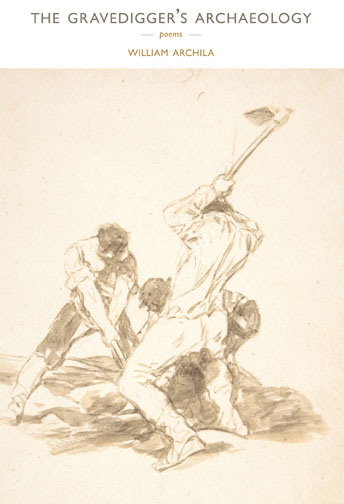
The Gravedigger's Archaeology - William Archila (Red Hen Press)

Today's book of poetry:
The Gravedigger's Archaeology.  William Archila.  Red Hen Press.  Pasadena, California.  2015.

Winner of the Letras Latinas/Red Hen Poetry Prize


The war in Salvador is the haunting underpinning for The Gravedigger's Archaeology and William Archila carries many ghosts.  These poems come at the reader full on with all that terror and then, Archila's gift to us, all that beauty.

The Night John Lennon Died

I come down the thrashed mountain
repeating, "The Lord is my shepherd, I shall not want,"
my mother's hand over mine, the moon on guard,
wind slapping my face, smell of rain and trees
as we enter the states, fog rolling out
at daybreak, suburbs glazed in light--
a load of refugees coming out of the ravine
across streets, hiding behind parked cars
dripped with mist, bodies low and close,
creeping on the ground like soldiers over puddles.

My mother in her best clothes -- Lee corduroy
Jacket, Levi's Jeans -- carries a newspaper
closer to her chest, the picture of a man
from Liverpool shot in front of his house.
I am eleven, running toward a father
who had become a kitchen helper, pots and pans
burned black, the slow drag of chain smoke
as he waited for the bus, the cold breath
of the American pavement on his back.

I never expected the next morning, grey and damp,
watching my father coming out of the wooden house.
I want to take the boy, who lost his dad in a gun blast,
say, here is mine, a man who left a country rift in half.
Here he is, defeated, this Salvadoran I will outgrow,
this one with the wet apron and yellow gloves.
I say nothing, not a single word, not even a sound
as he touches my head, my arms around his waist.

...

Most of us Canadians, quietly tucked under safe sheets have never been exposed to war beyond what filters in on the nightly news.  War appears to us in movies or a twenty-six minute sit-com.  The Gravedigger's Archaeology is one of those books of poems that makes Today's book of poetry wonder what every other book of poetry is about.

What I Learned From A War Too Small To Notice

To lie awake all night under the bed, stare
          at the springs, study of coils and hooks,
ironwork's constellation disarmed
          into a shattered landscape, light bulbs
doused with the grumbling sound of artillery.

          To cut off my breath, for at least a minute,
choke the dump thump of the heart's vein,
          then release, count the beat's thud, a muffled
blow like driving a nail into soft wood,
          one hit, one blue nail splitting the heart.

Night sounds magnified. Every foot's scratch,
         every backdoor squeak or cracked tile
on the rooftop was a loose private, down
         from the shanties they came, dressed
as civilians, triggers burning like live coals.

          My childhood of 1980
learned to take cover during shootouts,
          mold itself into the cut-corner
of the curb, lie half-drowned in the street's gutter,
          resembling a half-rotting animal.

My childhood of 1980
          saw my mother hanging wash
on a cold morning, her house dress wet
          from the load of clothes, my eyes on the church's
belfry, a needle in the sun's match flare,

         my eyes on pews overturned, saints fractured
on the floor, on their boots, black as a furnace,
         beside the altar the blunt weight
of the gun, the blade embracing the back,
         their faces covered with brown paper bags.

I didn't know what it meant. I didn't know
          I could never leave this war. Even now,
I am the buckets of water splashing
          on cobblestones, the dapples of mud,
that clothesline trembling in the wind.

...

There are many reasons for sorrow buried in the pages of Archila's utterly compelling The Gravedigger's Archaeology but that is not the destination.  There is hope in the desecration, small moments of joy ratchet out of the darkness as unexpected as shooting stars.

Don Santiago

Death always came to neighbors
just before dawn broke open, the sky
a steel grayness against the street.

The candle's dripping vein
began to glow for the great dead,

always more with the coming days,
always more powerful than birds;

while the moon white
as chalk sloshed through puddles,
a man clicking his rosary beads

fell in folds about the rooms,
a discharge of lead among the blankets.

The family does not live anymore.
They exist. They seemed lonely

as the barks of a black dog in an alley,
its stress strong and monotonous
as the steady drone of traffic.

What if I say this isn't an elegy,
but a recollection of Don Santiago,

a grave-maker and his sod-cutter,
and if I continue, the funeral band

will strike a note? There'll be an encore,
a priest and sermon for the spring.
Forget the pine box. Forget the altar

and the screaming like hogs
stuck in the bellies. I'll curse

the dawn turning pale over the highway,
eating up the ramp like white slate.

It's true, who needs another elegy?
Even the gravedigger and his spade are dead.

...

"The dark scavengers pick on a toe."
                         - from "The Night Watchman"

You can almost taste/smell the foul buzzard stench of rotting flesh.  You can certainly feel the sear/scar these horrors have tattooed on this generation of Salvadorans.

The poetry William Archila has siphoned off the drowning pool of what his country and people had endured is remarkable for its clear-headed candor.  This is an achievement that most of us, in our quiet and privileged progress, cannot begin to imagine.

This might be an example of real bravery.

William Archila

ABOUT THE AUTHOR
William Archila is the author of The Art of Exile (Bilingual Review Press, 2009), which won an International Latino Book Award in 2010 and was honored with an Emerging Writer Fellowship Award by The Writer’s Center in Bethesda, MD. He has been published in AGNI, American Poetry Review, Notre Dame Review, Crab Orchard Review, and The Georgia Review, among others. His book was featured in “First Things First: The Fifth Annual Debut Poets Roundup” in Poets & Writers. His second book, The Gravedigger’s Archaeology (Red Hen Press), recently won the 2015 Letras Latinas/Red Hen Poetry Prize.

BLURBS
“Tough music is the first phrase I reached for in describing William Archila’s poems, early Coltrane or perhaps Sonny Rollins or Mingus as analogues. For his dominant (though certainly not exclusive) themes are the almost unspeakably violent world of his Salvadoran childhood and the struggles of immigrant life in the United States, and yet spiraling up repeatedly in stunning riffs of word-song is the rare thing called duende, marvelous in itself but also in its evocations of beauty to be found in the life fully lived, the struggle never abandoned. The Gravedigger’s Archaeology is an aesthetic and moral triumph, and I felt honored to have read it.”
     ―B.H. Fairchild, National Book Critics Circle Award winner

“In his brilliant second book, The Gravedigger’s Archaeology, poet William Archila excavates the cratered memory of war and its aftermath, his pen chiseling a language of ‘black roosters & fossil bones’ in a lost country, ‘a country rift in half.’ But Archila’s pen is also a spade, as poet Seamus Heaney suggested, and this spade unearths ‘the ribcage / still clinging to its shirt and bodies / dumped in a black lava bed’. This is clandestine territory for the lyric, but it is territory Archila traverses with consummate skill. I have been waiting many years for a book that would guide us through that time and place, exhuming the remains with grace and dignity. Archila has written it.”
     —Carolyn Forché

William Archila
Poetry.LA Interview Series
video:  Wayne Lindberg


360

Poems cited here are assumed to be under copyright by the poet and/or publisher.  They are shown here for publicity and review purposes.  For any other kind of re-use of these poems, please contact the listed publishers for permission.