Showing posts with label mary di michele. Show all posts

Saturday, April 25, 2015

The Montreal Book Of The Dead - Mary di Michele (Vallum Chapbook Series #17)

Today's book of poetry:
The Montreal Book Of The Dead.  Mary di Michele.  Vallum Chapbook Series #17 - The Vallum Society for Education in Arts & Letters.  Montreal, Quebec.  2014.


The Montreal Book Of The Dead is a sterling little treat from the ever-strong voice of Mary di Michele.  di Michele is just a couple of years older than I am which is to say I have been around since her first book, Tree of August, which was published in 1978.

But it was the 1980 publication of Bread and Chocolate that turned me into a life-long reader and admirer of Mary di Michele.

Nothing has changed here, Today's book of poetry has all sorts of time for anything Mary di Michele writes.

The Unteachable

To be as if never born, Javier Marias
shows the dark back of time to critics, cats
and dogs, pronouncing how little of what
they are will last. Perhaps because I teach

what, I am told, is unteachable,
I want to defend scholars, remind the writer
that even this stone I kick is more assuredly immortal
than Shakespeare. We are all palimpsests

for genomes: writers, critics, and our pets.
Rumi was long-lived for a cat, seventeen years.
And many years have passed along with him,
yet still, raising my eyes from a book of poetry,

not scratched up by his jealous claws,
I might see him, in the periphery
of my vision, the striped gray fur turning
a corner. Disappearing.

Buddy was the first to teach me to love
dogs, to trust them with my hand, my heart
if not my muffins. What did I know?
I wanted a literary dog name, Bolden

from Coming Through Slaughter. Instead I was
given another way of being in the world,
away from the reading lamp, those long
evenings with him, ambling under stars,

walks in any weather. To be as if never
born. This cold Montreal spring, the run-off
iced over again, I am careful as I walk myself
across the park, not stopping to smell anything.

...

These poems are full of tender ghosts.

They are also so approachable that it is easy to miss how well crafted they are.  OK, that wasn't clear at all  --  what I mean is that di Michele knows her stuff.  These are poems that know how to act.

The Montreal Book Of The Dead is a long sighed-out love letter to di Michele's favourite city.  A tempered and loving elegy to the dead who swim in her memory.

Scotopia

Beacon shining from the top of Mount Royal,
a cross, unblinking under Capricorn.

Beaver lake is iced over. The ring
in his pocket stays in his pocket.

In the shadow of the red-tailed hawk, what's left
of a crow is now just tail feathers and wings

splayed out in the arms of a maple. To look
is to look away. Where the earth is flat we forget

we walk on a planet, but, from the view
at the summit, we remember

we are not alone, married and unmarried
alike for the stellar bridegroom,

orbiting above, astronaut or angel,
watches over us from the stratosphere.

In a flash, we see what he sees, the city
below from space: the mystery,

illuminated. This island city! This
island, Earth! Animal or mineral,

we all bow to the darkness,
we all turn in the light.

...

Mary di Michele has a type of quiet elegance in her poetry, this has always been the case.  It isn't easy to write with restraint - in di Michele's poems I would call this wisdom tempered with exactitude.

The Montreal Book Of The Dead is a fine chapbook.  It makes you want more.

Somewhere I Have Never Travelled

I arrived at the Canada-US border.
Flags fluttered though there was no wind.
Mine was the sole vehicle at the crossing.

I pulled up to a booth. Nobody
was there, I got out of my car
to peer behind the wicket: darkness

except for the blinking light of a phone.
I had my Canadian passport ready
declaring my Italian birth. The photo

didn't look like me. It felt strange to be
neither here nor there, neither coming
nor going. I arrived at the US-Canada border,

flags the only things moving.
The sun was low but I cast no shadow.

...

Mary di Michele

ABOUT THE AUTHOR
Poet, novelist, and member of the collaborative writing group, Yoko’s Dogs,Mary di Michele is author of eleven books including a selected poems,Stranger in You, Oxford University Press 1995, and the novel, Tenor of Love, Viking Canada, Simon & Schuster USA 2005. She lives in Montreal where she teaches at Concordia University. Her most recent books are The Flower of Youth, Pier Paolo Pasolini Poems, ECW Press, 2011, and with Yoko’s Dogs,Whisk, Pedlar Press 2013. Awards include first prize, CBC literary competition, the Air Canada Writing Award, and The Malahat Review long poem.

BLURB
“Envisioning the passage of time under the “full and unwaning” moon of Mont Royal’s beacon cross, di Michele recalls her Italian immigrant parents in Toronto and her current life in Montreal. This sequence, a sort of decameron, written with her customary brightness and gracefulness of diction, concludes at a deserted customs office where no one wants to see her passport: the truly borderless place of poetry itself.”
     - Sharon Thesen

Mary di Michele
Discusses tradition and innovation and studying
creative writing at Concordia University in Montreal.
Video courtesy of: Concordia Creative Writing


331

Poems cited here are assumed to be under copyright by the poet and/or publisher.  They are shown here for publicity and review purposes.  For any other kind of re-use of these poems, please contact the listed publishers for permission.


Tuesday, February 17, 2015

Two Tragedies in 429 Breaths - Susan Paddon (Brick Books)

Today's book of poetry:
Two Tragedies in 429 Breaths.  Susan Paddon.  Brick Books.  London, Ontario.  2014.


The deeper the reader goes into the utterly compelling Two Tragedies in 429 Breaths the more the past of Anton Chekhov becomes the present.  Chekhov and his family, his circle, are present in Susan Paddon's world.  They provide the narrative tool that compels Paddon to measure her sorrow, anger, guilt and joy.

Paddon's mother is dying in front of us with Chekhovian humour.  These poems don't bridge the two world so much as integrate them.  Paddon has rendered Chekhov's world as part of her own.

Place on a Lake

"But I am drawn here to this lake like a seagull." (The Seagull, Anton Chekhov)

My mother lives in a house on a lake that freezes
in a thousand meringues every winter,
just beyond the shore. She does not live

alone. My father is with her. Together
they weave a happy front, eat McDonald's
on Mondays and pretend everything

will be okay. Life is a list they're getting
through. My father's roots are in this place

on the lake, though it is not what it once was
when the ferry still came from Cleveland, when
Lombardo played the bandstand, before

the factories and smokestacks that won't let my mother forget
this is not her home. She grew up beside an ocean,
with real orange trees in the front yard. Now

she dreams of those trees, you can see it in the way
she closes her curtains, lies awake at night

reliving conversations from bygone decades,
the sounds of misplaced emphases, the offences she may have caused,
help me think of something nice, she whispers to my father
to quiet the voices that keep repeating in the cold sheets.

...

These poems are literary but not so that you'll have to visit the library.  Paddon quite seamlessly weaves Chekhov world into her first book and her mother's world as well, and then back again.

Paddon's mother is not on the road to recovery, but as sad as that terminal news is, this book is never morose, it is not a dirge.  Paddon uses the Chekhov narrative as a brilliant launching pad to her own family journey - and it all comes out so elegantly humane and insightful.  Paddon has a lock on grace.

My Mother's Sister

sent a new tablecloth in the post
a week before Christmas every year until
she started forgetting that too. When she lived in New York,
she had our names put onto even our lunch bags:
Susan, Susan, Susan, I carried it under my arm
like a teddy bear.

With my mother's sister it happened suddenly
and then slowly, and my mother has spent
so much of her life afraid (no aluminum, no
aspartame) of losing something very different
from what she is going to lose.

I once heard about a woman
who wouldn't have anything to do with garlic.
It wasn't fair, the way it could look perfect
from the outside and yet,
if you got unlucky, under the skin
it could already have turned.

...

Sad tales of family and death, yet somehow Paddon's Two Tragedies in 429 Breaths is anything but tragic.  It is thoughtful and touching, never trite.

No death is easy and platitudes don't pay respect.  Susan Paddon articulates the range of frustrations and joys, moments of fleeting hope against reason, all of this artfully managed in narrative that not only illuminates a family coming to terms with the death of their matriarch - but she weaves a pertinent second narrative through the arc of Anton Chekhov.

This is very seasoned stuff but never overly spicey.  It is also not nearly as complicated as my poor description suggests.  On the page this played out like an excellent movie, plenty of beauty, lots of pace, great story, saddish ending.

Closed Doors

I'll never know how my parents loved,
their bedroom door closed tight,
the sturdy furniture too big
for a room its size.

Or why we followed my father's car
in our New Yorker that time we saw him
on a street that wasn't his usual way home.
We didn't honk, or mention it later.

Were there certain perfumes he liked
more than other? Did he ever notice?
I wonder now if he sometimes takes the bottles
off the dresser, holds them

to his nose for a moment
while my sister, on the other side
of the door, picks up
the mess he needs to make.

These are things I hope
about my mother. I hope she felt
love each time they promised one another
everything would be alright.

...

The sad inevitable end is not really a tragedy in this case, more a trajectory.  Paddon is headed for great things - these poems will make the reader look forward to anything Paddon does in the future.

This is remarkable first book territory.  Susan Paddon, take a big bow.

Susan Paddon

ABOUT THE AUTHOR

Susan Paddon was born and grew up in St. Thomas, Ontario, attended McGill and Concordia in Montreal, and lived overseas in Paris and London before settling in Margaree, Nova Scotia. Her poems have appeared in Arc, CV2, The Antigonish Review and Geist.

BLURBS
"How is the death of the great Russian writer Anton Chekhov like the death of a Canadian mother? Susan Paddon expands the pastoral heroic structure of the elegy to include the small devotions of family life. Telescoping time and vast distances, the Chekhov family and the poet's occupy the same dimension in their loss and grieving. This is a moving and mature first book, filled with grace notes and deep resonance."
     - Mary di Michele, author of The Tenor of Rose and Stranger in You: Selected Poems & New

"This is a book that is not afraid to be -- and to name -- what it is: a tragedy. A book that moves us, along with its two heroes, steadily toward death. But it also includes, and is equally unafraid to wield, another force, just as powerful -- and that is poetry itself. This is a book that lives and breathes."
      - Johanna Skibsrud, Giller Prize-winning author of The Sentimentalists


Susan Paddon
Reads from Two Tragedies in 429 Breaths (Brick Books)
video by:  Brick Books


307

Poems cited here are assumed to be under copyright by the poet and/or publisher.  They are shown here for publicity and review purposes.  For any other kind of re-use of these poems, please contact the listed publishers for permission.


Wednesday, January 14, 2015

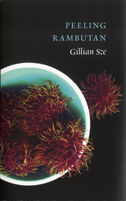
Peeling Rambutan - Gillian Sze (Gaspereau Press)

Today's book of poetry:
Peeling Rambutan.  Gillian Sze.  Gaspereau Press.  Kentville, Nova Scotia.
2014.


FOR SABERA

"sorrow becomes a friend if it hangs
around long enough"
                                --from East is the Sun Behind a Tree
                                           Gillian Sze

Back on October 14, 2014, Today's book of poetry (blog #257), I had the pleasure of writing about Gillian Sze's utterly illuminating second book, The Anatomy of Clay.  Peeling Rambutan feels and reads as though it were written by a different poet - but one of equally fascinating and obvious talent.

Whereas there was a lightness to The Anatomy of Clay, an almost casual brilliance - Peeling Rambutan has weight.  It is full of focused energy and power.  But it is never too heavy.  This balancing act takes game.

Once again, Gillian Sze is dazzling.

Come

and show me our various forms of leaving. By boat, by foot,
by the flash of our thumbs. By storm, by nightfall, by the
infant hours. Play me the heave of a train horn pushing
through the dark. Show me how a railway crossing rises as
easily and slowly as a dancer lifting one leg. Show me the
silent lightning, as if the sky surrendered, and we're waiting
for ash. Tell me that someone has already seen this and is
still looking up. Tell me how to prepare for the weather next
Saturday. tell me how to reduce stories to their simplest
parts. Tell me again our various forms of leaving. With the
engine running. With joy, avidity, stifled regret. Tell me how
the rooms fell silent. Faces looming in the back window.
The eye falling to the fence. Tell me about two-toned living.
The incompatibility of temper. the worlds you worked to
unite. the tumbling languages that refused to stay aloft. The
ground-bound postscripts. The plummeted paper planes.

...

Many of the poems in this third book of poetry by Sze are prose poems - and yet they flow easily enough, slide off of your tongue as though by design.

Contemplative is a good word to describe these precise poems of captured moments.  Like you are constantly walking into rooms of new discovery.  The edges are clear, reading them is like watching one of those old Polaroid photos come into focus in front of your eyes.

Garage Band

In Wen Chong Village, beneath a small light,
a group of old men settle on their plastic chairs.
Cradling their instruments,
they smoke cigarettes
and drink kung fu tea to defeat the dark.
Inside, their women fret over what to prepare
and pack for next day's lunch.
Outside, a weathered man stands to face his players
and wavers out a Canton opera,
spitting during the interludes,
and picking up at his cues.

...

Once again I have to mention Gary Dunfield & Andrew Steeves.  This book continues Gaspereau's tradition of making the most beautiful books of poetry that Today's book of poetry sees.  Looks shouldn't matter to poetry - but Gaspereau gives all other poetry presses something to aspire to.

How To Kill A Cockroach

Without qualm,
she peers at the bottom of her shoe and says,
Never let a cockroach see your hand's shadow.

...

Peeling Rambutan is a travelogue of sorts that takes you inside the minds and language of foreign people and places that you will most likely never see - and leaves you feeling like you've been there.

That's a great trick.  Bravo Gillian.

Gillian Sze

ABOUT THE AUTHOR
Gillian Sze is the author of two previous collections: The Anatomy of Clay (2011) and Fish Bones (2009). Her work has appeared in a number of national and international journals, and has received awards such as the University of Winnipeg Writers’ Circle Prize and the 2011 3Macs carte blanche Prize. Originally from Winnipeg, she now resides in Montreal.

BLURBS
Peeling Rambutan traces a young poet's journey into the interior of China, a place where "religion is a game of telephone and illumination," where epiphany is found in ancestral kitchens. Sze shows us a luminous, lyric landscape where old village vendors ride into Shanghai singing in rhyming couplets. What a beautiful, unforgettable trip reading this book is!
—MARY DI MICHELE, author of The Flower of Youth

Gillian Sze's Peeling Rambutan is an unforgettably vivid collection, combining her characteristic intimacy with subjects and a gut-punching instinct to get it across. Richly detailed with uncommon knowledge and observance, poised in articulation and always present. Gillian Sze is one of our most enchanting poets.
—DAVID MCGIMPSEY, author of L'il Bastard

Gillian Sze's voice is so assured and so clear. She sets out to explore where she is from, where "Here can't be found on a map," and then sends the images our way. She records, and then tattles in the best of ways: with curiosity and awe and humour. I felt at times that I was reading a novelist writing brilliant poetry. That is to say, these poems are busy with story. I loved them.
—DAVID BERGEN, author of The Age of Hope


Gillian Sze's sensuous, precisely-observed poems trace her identity across cultures, eras and continents, weaving together scraps of family lore, visits to changing landscapes, the smell of Malaysian fruits and Canadian snow. Her far-flung home, often in the air, often lonely and built from memory is of a sort many of us share. The poems in Peeling Rambutan enlarge our sense of who we are.
—JOHN STEFFLER, author of Lookout


Gillian Sze reads from The Anatomy of Clay\
video from ECW Press


292

Poems cited here are assumed to be under copyright by the poet and/or publisher.  They are shown here for publicity and review purposes.  For any other kind of re-use of these poems, please contact the listed publishers for permission.