Showing posts with label nick thran. Show all posts

Tuesday, March 14, 2017

Hard Work Cheering Up Sad Machines - Jason Heroux (A Stuart Ross Book/Mansfield Press)

Today's book of poetry:
Hard Work Cheering Up Sad Machines.  Jason Heroux.  A Stuart Ross Book.  Mansfield Press.  Toronto, Ontario.  2016.
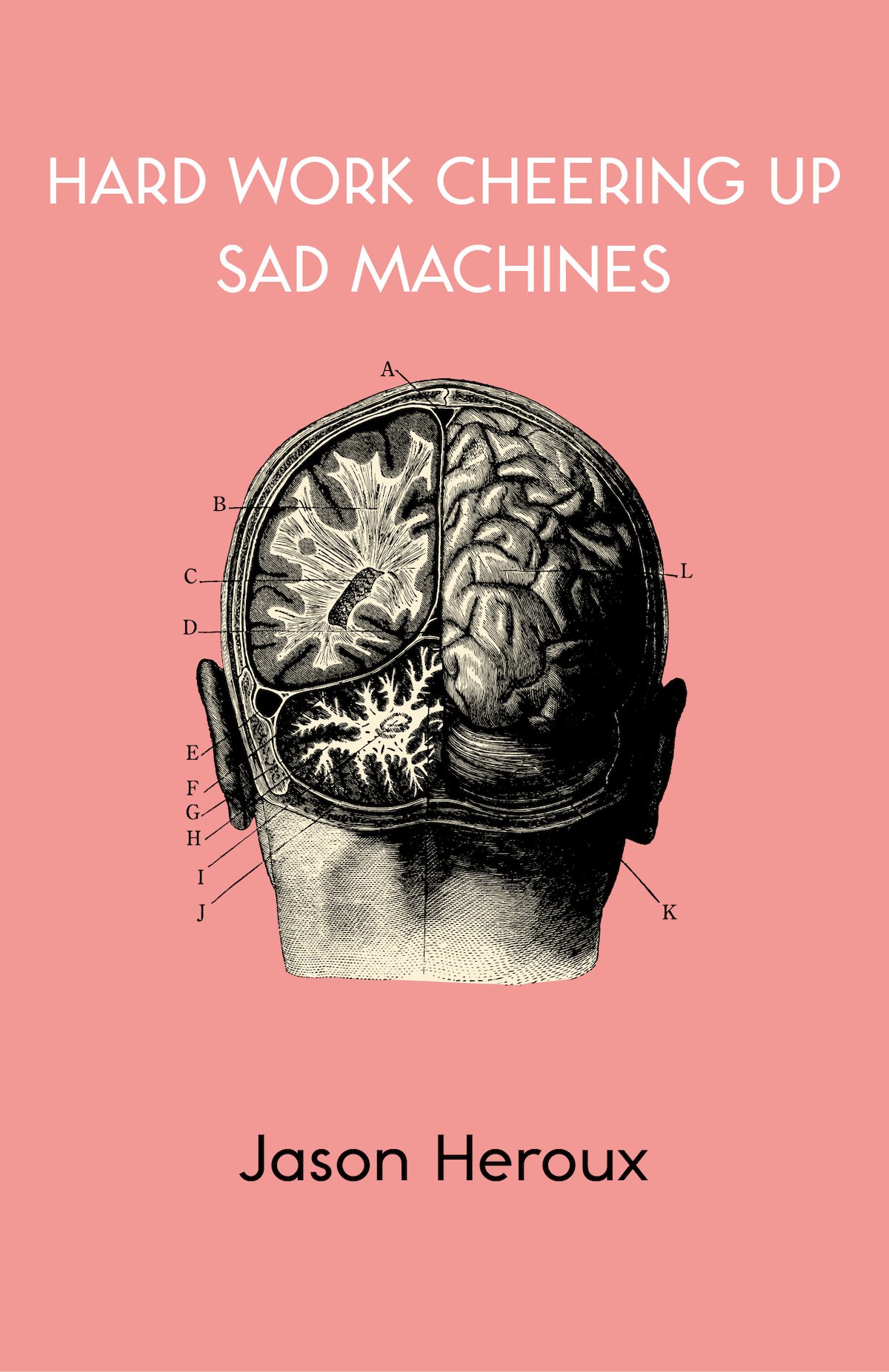

Today's book of poetry might just as well say it and get it out of the way.  Jason Heroux has become one of our favourite poets.  It's not like we didn't warn you.  

Back in September of 2013 Today's book of poetry took a look at Jason Heroux's chapbook In Defense of the Attacked Center Pawn (Puddles of Sky Press, 2013) and thought it was brilliant stuff and ripe with promise.  You can see that blog here:


Since then we've read Emergency Hallelujah (Mansfield Press, 2008) and had it scheduled for a blog, the only reason you're not reading about that now is that Hard Work Cheering Up Sad Machines came through the door and we simply couldn't resist.

Heroux's latest volume of poetry is a seriously strong statement of intent.  Heroux has discovered a shady planet of surreal shadows where he writes from some dark corner to illuminate everything we know. And boy, oh boy!, does he hammer out some choice humour along the way.

Hard Work Cheering Up Sad Machines

It's easy to breathe if you're breathing
breathe all you want the air is too cold
             and weak to run away
your life is a gift with your name on it
a word there's no word for
breathe all you want it's easy to breathe
             if you're breathing
the air is an all-you-can-breathe buffet
it's hard work cheering up sad machines
hard work cleaning a number's cage
our heartbeats are staggered staples
             holding us together
birds sing like kettles boiling song-water
your life is a gift with your name on it
and your life is a word there's no word for
breath all you want breathe all you want

...

Today's book of poetry could be easily convinced that the poet Jason Heroux is channelling the spirit and voice of the great American novelist, short story writer and cultural guru Kurt Vonnegut Jr. Heroux has a similarly morbid comic stranglehold on reality.

The dilemma for Today's book of poetry is that when it came to picking actual poems for today's blog I was stumped.  Hard Work Cheering Up Sad Machines is so ripe with lovely fruit that picking which little piece of wonder to share was beyond me so we resorted to the Odin resolution.  Whenever we are blocked we write down the page numbers of every poem we wish to consider, post them on a wall and then have Odin throw darts.  The poems we are using today were the first three he hit out of the dozens on offer.

Heroux's epigraph at the beginning of Hard Work Cheering Up Sad Machines is from the French author and anarchist Pierre Antin-Grenier (1947-2014).  Antin-Grenier was experimental and a loosely connected member of the "extrême contemporain" - a notion in continuous movement.

          It's in the hollow of the
          ordinary that the marvelous
          most often makes its nest
                                       -- Pierre Autin-Grenier

Today's book of poetry is convinced Heroux has lived up to the challenge; Hard Work Cheering Up Sad Machines rolls over the mundane and ordinary to punch out marvelous poetry from every unknowable landscape he encounters.

Yield

Our yield is now, this moment
is what will eventually
become of us, our only harvest
is the one we're gathering.
Water is drawn by the one
with the well. Whoever has lungs
will breathe in and out. The one
with the horse will ride into town.
Everything is nothing but horns
honking at death, and numbers
attacking numbers, apricot
jam stuck on the table knife.
Everything is nothing but almonds
divided by almonds, and grass blades
savouring our shadow's champagne,
a car without wheels crawling through mud.
Why does everyone seek refuge elsewhere?
Whoever has the orange will peel the skin.
Whoever has a thread will feed the needle.
The one with enough footsteps will walk to the store.
Our only harvest is the one we're gathering, this moment
is what will eventually become of us, our yield is now.

...

The first part of Hard Work Cheering Up Sad Machines is made up of shorter, one or two page poems.  Later on in the collection Heroux spreads out a little and writes some longer poems and poem sequences.  This all works.

Our morning read was a Heroux buffet.  We read from Hard Work Cheering Up Sad Machines of course, but we also opened up Emergency Hallelujah and In Defense of the Attacked Center Pawn. Milo, our head tech, led the charge this morning which should leave him in a good mood.  His new task is to now track down and procure the other thirteen titles Heroux has listed.

Today's book of poetry is certain that in the years ahead having Jason Heroux on your shelf will help to prove your smarts.

Blue Yodel of the Broken

What more do I want how many
more feathers would make me happy
on a bird how much extra egg yolk
do I need in an eggshell.
Our death chirps like a cricket
in the quietest corner of the dollar.
Bees are kept where two bones meet
a body develops in the body
where fruit trees are grown
the cows are kept
in the same name as the place
where the hay is kept.
Our death jumps into us the way
the moon leaps into a lake to cool off
swimming in the water that isn't there.
What more of a handshake
can you hold in your hand
how much of this fork
do you need to eat dinner.
The blown-out candle
is kept where the wish is kept.
How much more walnut meat
in the walnut shell would it take
to make us feel safe in the world.
I believe in the barbecue cover
that covers the barbecue I believe
in the same name as the place
where the bird is kept
the cage is kept.
How much more
piggy bank can
the piggy bank hold.
Wherever you are
you are a little rain
that never rained you are
a little hurt that never hurt anything.
Sometimes in the bank I touch
someone else's money and wake up

...

If you read Today's book of poetry more than once you'll realize I am praising a new book of poetry almost every other day.  I fear it could all just begin to sound like rain.  But the truth is that for every book of poetry Today's book of poetry posts there are three or four that don't make it.  I DO like every book that makes it onto the blog.  If the blog sometimes lacks a completely fresh veneer or the vocabulary to do these books justice it is entirely on Today's book of poetry.

Books like Jason Heroux's Hard Work Cheering Up Sad Machines are the reason this blog exists, I try to serve up gems every time out but this one is a highly polished jewel.


Jason Heroux

ABOUT THE AUTHOR
Jason Heroux is the author of three previous books of poetry—Memoirs of an Alias, Emergency Hallelujah, and Natural Capital, which was shortlisted for the 2013 ReLit award—and two novels. His work has been published widely in chapbook form and in journals, and has been translated into several languages. Jason lives in Kingston, Ontario.

BLURBS
“Jason Heroux continues to develop his bold style through the delightful fusion of otherwise jarring images.”
     —Jonathan Ball, Winnipeg Free Press
“Natural Capital is a helluva good read. I inhaled its 47 poems in one long breath—they left me excited and wondering exactly what it is that makes them so captivating.… Great book. I’d give it several major prizes all at once.”
     —Rod Pederson,  Arc
“Jason Heroux’s skill as an image-maker recalls Tomas Tranströmer.… In an ideal world, Heroux’s poems would be doled out monthly, one at a time. They would be slotted into the mailbox, or handed to us by some peculiar stranger on the sidewalk.”
     —Nick Thran,  Event
“At its heart, Heroux’s gift—however existential or surreally humanistic—lies in the transformation of ways of seeing the world, of analyzing it and of language. The poems themselves, in their unique ways of seeing, are humbling at the same time they are refreshing.”
     —Cynthia Reeser, Prick of the Spindle

Jason Heroux
Video:  Jason Heroux


561


DISCLAIMERS

Poems cited here are assumed to be under copyright by the poet and/or publisher.  They are shown here for publicity and review purposes.  For any other kind of re-use of these poems, please contact the listed publishers for permission.

We here at TBOP are technically deficient and rely on our bashful Milo to fix everything.  We received notice from Google that we were using "cookies"
and that for our readers in Europe there had to be notification of the use of those "cookies.  Please be aware that TBOP may employ the use of some "cookies" (whatever they are) and you should take that into consideration.


Tuesday, November 1, 2016

Caribou Run - Richard Kelly Kemick (Icehouse Poetry - Gooselane Editions)

Today's book of poetry:
Caribou Run.  Richard Kelly Kemick.  Icehouse Poetry.  Gooselane Editions.  Fredericton, New Brunswick. 2016.


Caribou Run is one of those books that the more you read the smarter you feel.  Richard Kelly Kemick is 106 years old and has apparently spent every minute of that time studying biology, Latin, animal husbandry in the wild, philosophy and so on.  Kemick has also apparently learned the languages of wolf and caribou as well.

Caribou Run is a bursting wonder of a thing, a mash-up of encyclopedic voracity, beautiful reason and a poetic joie de vivre.  

The Love Poem as Caribou

It's hard to imagine. As doves, yes,
or even vultures. But there's nothing of a ballad
in the hard weight of antlers. You can't cut
into an ode, stripping its skin to bones cabled
with muscle, or search its creased face for something
you can almost explain. And a sonnet has never
made me see myself inadequate beneath
the bright light of evolution's long apprenticeship,
acutely aware of the many failings of my own form.
But maybe it's in how a love poem will cross
a body of water without being about to see
the other side. Or maybe it's in the deep prints
left in the drifts, that speak of how hard
it must have been to move on from here.

...

Kemick's Caribou Run is ostensibly about the Porcupine caribou herd of the western Arctic and it is one beauty of a beast, obsessively and compulsively full to the brim, there is no limit to Kemick's poetic diligence.  His poem about the hurricane of mosquitoes turning the sky dark will haunt me forever.

We get to know the details of the multi-chambered stomach, a sad calving ground littered with calamity and the silent cows that follow.  But let's be clear, Kemick's caribou are not the miracle, the joy and wonder in Caribou Run is in the observations, not the observed.

A Thunderstorm Seven Kilometres
West of Old Crow, Yukon

Rising,the cumulonimbus swells against the stratosphere's hard shell,
spilling itself into a flattened sprawl: a cartoon piano hovering over

the freshwater flats. With increasing surface area, a negative charge colludes
         with the earth's own magnetism, grafting the ground positive.


This is what most people never realize: lightning comes from below as
      much as from above.

The negative sky, reacting to the positive soil, cascades step-leaders:
electric tendrils of fifty metres, unravelling for attachment, stretching
          for a circuit. The ground, in slower resurrection,
          grows forth splinters of light:
positive streamers, ribboning up
in search of their own electric awakening.
          Once a step-leader stitches a thread of plasma
                                                                and connects
                                                       with a positive-streamer
electricity ruptures from the thick sky. It is the only time
          the atmosphere touches earth.
          But the flash seen, the blue-white burn of lunar ice,
                                 is the ground channelling energy
               upwards, striking the cloud

into homeostasis. The channel,
in the shape of God's basilic vein, burns six times
                      hotter than the sun, boiling the sky to explode
a shock wave that rips the air apart,
          inflicts internal bruising on birds.

This meteorological movement, this visual presence of an
internal transfer, can, perhaps, be likened to the unexplainable
distance

of motherhood, which has within it something of a storm's great movement,
     its patient pursuit of the horizon.

...

Richard Kelly Kemick reminds us of Aristotle's eternal question "do animals die or stop living?", Well, try and anthropomorphize that.  Kemick does.

The office reading this morning was spirited.  Last night was Halloween and as luck would have it our head-tech, Milo, brought a set of costume antlers into the office today.  He insisted on wearing them all through this morning's read.

Today's book of poetry thinks that Caribou Run can run with the big boys, the big gals, it doesn't get much better than this when you're reading a book of poems.  Kemick had me rethinking certainties and looking back with awe.  Reason this crisp, rendered with beauty, doesn't come along all that often.  Richard Kelly Kemick flat out impressed us off our feet.

Upon the Autumn Equinox,
the Tundra Takes Inventory

Moss shimmering frost, streams clinking ice.
Puzzle pieces of slush around a boulder
that's rounded like a beached whale, the defenselessness
of a weight that can't contain itself. Catkins
passed over, crimson against brambled earth.
Muskox hair blown southwest from Banks Island,
and raven feathers, iridescent with twilight.
Sockets of ground squirrel holes, corkscrewed
beneath the sedge. A tensile horizon
and starlight rolls in like an optometrist's lens.
A woodpecker's hollow well. A fox paw.
A dryas trying to hold bloom, as the Beaufort
breeze undresses its petals, erasing itself into sky.

          The tall grass bends with wind, brushed
          like the swath of your hair in the breath
          the door made as you closed it behind you.

...

Today's book of poetry isn't much of a nature buff although I've spent my time in the woods and the wilds.  I am a Canadian and I do identify with our big, beautiful country, I can rejoice in nature and am touched when a poet brings me closer to it.

Today's book of poetry may stumble onto a more intelligent book of poetry sometime soon but it is unlikely.  Kemick is bursting out of the gate and onto the scene  all prodigy like and fully formed.  If books of poems were NHL goals Kemick would be having a Gretzky season.

"
Richard Kelly Kemick

ABOUT THE AUTHOR
Richard Kelly Kemick’s poetry, prose, and criticism have been published in magazines and journals across Canada and the United States, including the Fiddlehead, the New Quarterly, and Tin House (Open Bar).

He has won the poetry prizes of both Grain magazine and Echolocation. He lives in Calgary.

BLURBS
"You hear notes of McKay, Steffler, and Purdy's Baffin Island poems in this extraordinary first collection, which is marked throughout by a pulsing, joyful intelligence. Richard Kelly Kemick delivers us onto the great lone land with the precision and beauty of his lines. The book is breathtaking."
     - Time Lilburn, author of Assinboia

"Caribou Run honours its titles subject by its sheer depth of research and by its willingness to explore the relationship between man and nature from numerous angles. Wisecracking, earnest, and charmingly obsessive, Kemick introduces himself here as a poet who believes in something larger than his own self, and so is a poet to watch."
     - Nich Thran, author of Mayor Snow

gooselane.com

520


DISCLAIMERS

Poems cited here are assumed to be under copyright by the poet and/or publisher.  They are shown here for publicity and review purposes.  For any other kind of re-use of these poems, please contact the listed publishers for permission.

We here at TBOP are technically deficient and rely on our bashful Milo to fix everything.  We received notice from Google that we were using "cookies"
and that for our readers in Europe there had to be notification of the use of those "cookies.  Please be aware that TBOP may employ the use of some "cookies" (whatever they are) and you should take that into consideration.

Tuesday, June 2, 2015

Transmitter and Receiver - Raoul Fernandes (Nightwood Editions)

Today's book of poetry:
Transmitter and Receiver.  Raoul Fernandes.  Nightwood Editions.  Gibsons, British Columbia.  2015.


This can't be a first book.  I won't have it.  Someone is lying.

Raoul Fernandes does not only arrive fully formed and brilliant, Transmitter and Receiver is simply scintillating.

Every page is a new adventure ending in some new sort of delight for the reader.

Fernandes has one of the most delightfully optimistic/pragmatic imaginations/personalities Today's book of poetry has ever encountered.

By Way Of Explanation

You have this thing you can only explain
by driving me out to the port at night
to watch the towering cranes moving containers
from ship to train. Or we go skipping stones
across the mirror of the lake, a ghost ship
in a bottle of blue Bombay gin by your side.
I have this thing I can only explain to you
by showing you a pile of computer hardware
chucked into the ravine. We hike down there
and blackberry vines grab our clothes as if to say,
Stop, wait, I want to tell you something too.
You have an old photograph you keep in your
bedside drawer. I have this song I learned
on my guitar. By way of clarification, you send
me a YouTube video of a tornado filmed up close
from a parked car. Or a live-stream from a public
camera whose view is obscured by red leaves.
I cut you a key to this room, this door.
There's this thing. A dictionary being consumed
by fire. The two of us standing in front of a Rothko
until time starts again. A mixtape that is primarily
about the clicks and hums between songs. What if
we walk there instead of driving? What if we just drive
without a destination? There's this thing I've always
wanted to talk about with someone. Now
with you here, with you listening, with all
the antennae raised, I no longer have to.

...

Dare I say it?  Raoul Fernandes is an optimist.  The silly fool believes in love and we here at Today's book of poetry love him for it.

He is a concerned and informed optimist.

This is splendid poetry.

Transmitter and Receiver is just the right mixture of confidence and naivete.  I think Raoul Fernandes is just like my dear friend Bean Salad -- smartest guy in the room (almost any room), but entirely too cool to be aware of it himself, or if he is, to let it bother him.

These poems are peppered with those seminal "aha!" moments, everywhere you look you find those "I get it!" epiphanies and suddenly the whole world makes just a little more sense.

When The Teeth Of The Gears Meet...

the music chimes, the bicycle
climbs the hill, the clock releases
a bird. The streetlight blinks, goes night
day night day night. My bed
is a giant reset button I hold down
until morning. When the teeth
of the dream meet the teeth of the morning
I pour myself a cup of numbers in the kitchen.
Daydream a wheel inside a wheel. Daydream
children running from the shore with cupped
phosphorescence that dies out before
they reach us. Rushing back to do it again.
And I am a child running toward myself
and the teeth of the memory meet the teeth
of the day meet the clock, the highway, the heart.
Or the gears don't touch, just spin like ceiling fans.
What's a day? asks the sun. What's night?
asks the moon. Will you send me
that beautiful book about asteroids?
I want my life to change.

...

Man, oh man, oh man.  This Fernandes cat really does sing.

About half way through my second reading of Transmitter and Receiver I called a team meeting of everyone here at Today's book of poetry.  I got everyone in a circle -- and then we read that sucker out.  Everyone took a turn.  Read a poem out loud, watched all the jaws in the room drop, pass the book to the next person, repeat.  More jaws.

Eventually, Billy, our sweeper, brought out bags of gold glitter and rained them down over us all while we danced in circles of glee.

Yes, Today's book of poetry loved this book.  In fact, this is the most exciting book of new poems since reading Kayla Czaga's For Your Safety Please Hold On.  

Someone at Nightwood Editions is doing a hell of a good job.

Mixtape
   
He collects his friends' broken Walkmans
and builds a flying machine out of them. Straps in
and launches from his rooftop in the fading light,
just after the crows have passed. These are the controls:
rewind, fast-forward, play and stop. All other variables
are left to the music, old mixes from friends. One of the tape's
ribbon is wrinkled in places from a recent unspooling.
It murmurs and crackles, but it still lifts the rickety machine.
Another tape contains, in the last empty minutes, rainfall,
a train in the distance. Someone says something he strains
to hear. At this particular height, the landscape is toy-like,
a miniature model, despite what all hell
he has been through down there. The blue eyes
of backyard swimming pools. A soccer field
like a green diary, locked. What all hell.
He coasts for a while in silence just above the streetlights
after the last tape clicks to its end. Lifted by something
approaching grace.

...

Raoul Fernandes certainly knows how to make an entrance.

"...nobody knows
what it means, but it's not like we are in the business

of meaning things..."
                                -from "Driftwood"

Raoul Fernandes has chops like Miles Davis and Transmitter and Receiver is his first masterpiece, with chops like these Today's book of poetry expects there will be many more.

Raoul Fernandes

ABOUT THE AUTHOR
Raoul Fernandes has been writing poetry since childhood, and is involved in both online and offline writing communities. He completed the Writer’s Studio at Simon Fraser University in 2009. He was a finalist for the 2010 Bronwen Wallace Award for Emerging Writers, and winner of the 2010 Sakura Award at the Vancouver International Cherry Blossom Festival. His poem “After Lydia” was recently adapted into a short film. He lives and writes in Vancouver, BC.

BLURBS
“What I receive from these transmissions is a convincing sweetness, a weird wisdom. This book reminds me of David Berman’s Actual Air, but it’s warmer. Raoul Fernandes writes like a night school teacher teaching us ‘something about night itself.’ It’s an engaging class, an occasionally mind-altering class, and I finished it feeling more hopeful and human.”
     — Nick Thran

It is rare to encounter a first book as wise and realized as Raoul Fernandes's Transmitter and Receiver. These poems thrum with tulip vending machines, mixtapes made by friends, apology letters to forest fires, emotionally intelligent ATMS. Fernandes repeatedly points to the relationships between all things: a Facebook friend request is "a conch shell left on your doorstep"; a mind is a "Walkman that [keeps] eating cassettes." Even machines aren't strangers -- no one's a stranger: the technologies are usually sympathetic and love is the amplifier.
     -- Jen Currin

"There's this thing," Raoul Fernandes tells us, that he can't "explain" -- but shows us with genuine poetic panache in this highly affecting collection. That "thing" is "circuit-frying, synesthesia-inducing" and the poems here -- quirky, lyrical, humorous, aching, romantic, magical -- reveal it, each one "a little moon / you can pocket." Here, "night flowers open with ease / in the politician's garden" and "Love disperses like light / across the Alaskan wilderness." Transmitter and Receiver is a pure delight. I savour its kinetic imagination, its subtle intelligence, its palpable charm.
     -- Russell Thornton


347

Poems cited here are assumed to be under copyright by the poet and/or publisher.  They are shown here for publicity and review purposes.  For any other kind of re-use of these poems, please contact the listed publishers for permission.