Sunday, July 12, 2015

The Gravedigger's Archaeology - William Archila (Red Hen Press)

Today's book of poetry:
The Gravedigger's Archaeology.  William Archila.  Red Hen Press.  Pasadena, California.  2015.

Winner of the Letras Latinas/Red Hen Poetry Prize
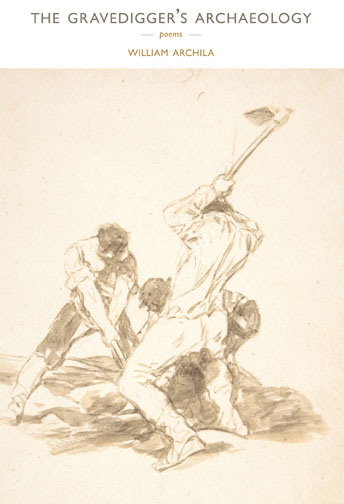

The war in Salvador is the haunting underpinning for The Gravedigger's Archaeology and William Archila carries many ghosts.  These poems come at the reader full on with all that terror and then, Archila's gift to us, all that beauty.

The Night John Lennon Died

I come down the thrashed mountain
repeating, "The Lord is my shepherd, I shall not want,"
my mother's hand over mine, the moon on guard,
wind slapping my face, smell of rain and trees
as we enter the states, fog rolling out
at daybreak, suburbs glazed in light--
a load of refugees coming out of the ravine
across streets, hiding behind parked cars
dripped with mist, bodies low and close,
creeping on the ground like soldiers over puddles.

My mother in her best clothes -- Lee corduroy
Jacket, Levi's Jeans -- carries a newspaper
closer to her chest, the picture of a man
from Liverpool shot in front of his house.
I am eleven, running toward a father
who had become a kitchen helper, pots and pans
burned black, the slow drag of chain smoke
as he waited for the bus, the cold breath
of the American pavement on his back.

I never expected the next morning, grey and damp,
watching my father coming out of the wooden house.
I want to take the boy, who lost his dad in a gun blast,
say, here is mine, a man who left a country rift in half.
Here he is, defeated, this Salvadoran I will outgrow,
this one with the wet apron and yellow gloves.
I say nothing, not a single word, not even a sound
as he touches my head, my arms around his waist.

...

Most of us Canadians, quietly tucked under safe sheets have never been exposed to war beyond what filters in on the nightly news.  War appears to us in movies or a twenty-six minute sit-com.  The Gravedigger's Archaeology is one of those books of poems that makes Today's book of poetry wonder what every other book of poetry is about.

What I Learned From A War Too Small To Notice

To lie awake all night under the bed, stare
          at the springs, study of coils and hooks,
ironwork's constellation disarmed
          into a shattered landscape, light bulbs
doused with the grumbling sound of artillery.

          To cut off my breath, for at least a minute,
choke the dump thump of the heart's vein,
          then release, count the beat's thud, a muffled
blow like driving a nail into soft wood,
          one hit, one blue nail splitting the heart.

Night sounds magnified. Every foot's scratch,
         every backdoor squeak or cracked tile
on the rooftop was a loose private, down
         from the shanties they came, dressed
as civilians, triggers burning like live coals.

          My childhood of 1980
learned to take cover during shootouts,
          mold itself into the cut-corner
of the curb, lie half-drowned in the street's gutter,
          resembling a half-rotting animal.

My childhood of 1980
          saw my mother hanging wash
on a cold morning, her house dress wet
          from the load of clothes, my eyes on the church's
belfry, a needle in the sun's match flare,

         my eyes on pews overturned, saints fractured
on the floor, on their boots, black as a furnace,
         beside the altar the blunt weight
of the gun, the blade embracing the back,
         their faces covered with brown paper bags.

I didn't know what it meant. I didn't know
          I could never leave this war. Even now,
I am the buckets of water splashing
          on cobblestones, the dapples of mud,
that clothesline trembling in the wind.

...

There are many reasons for sorrow buried in the pages of Archila's utterly compelling The Gravedigger's Archaeology but that is not the destination.  There is hope in the desecration, small moments of joy ratchet out of the darkness as unexpected as shooting stars.

Don Santiago

Death always came to neighbors
just before dawn broke open, the sky
a steel grayness against the street.

The candle's dripping vein
began to glow for the great dead,

always more with the coming days,
always more powerful than birds;

while the moon white
as chalk sloshed through puddles,
a man clicking his rosary beads

fell in folds about the rooms,
a discharge of lead among the blankets.

The family does not live anymore.
They exist. They seemed lonely

as the barks of a black dog in an alley,
its stress strong and monotonous
as the steady drone of traffic.

What if I say this isn't an elegy,
but a recollection of Don Santiago,

a grave-maker and his sod-cutter,
and if I continue, the funeral band

will strike a note? There'll be an encore,
a priest and sermon for the spring.
Forget the pine box. Forget the altar

and the screaming like hogs
stuck in the bellies. I'll curse

the dawn turning pale over the highway,
eating up the ramp like white slate.

It's true, who needs another elegy?
Even the gravedigger and his spade are dead.

...

"The dark scavengers pick on a toe."
                         - from "The Night Watchman"

You can almost taste/smell the foul buzzard stench of rotting flesh.  You can certainly feel the sear/scar these horrors have tattooed on this generation of Salvadorans.

The poetry William Archila has siphoned off the drowning pool of what his country and people had endured is remarkable for its clear-headed candor.  This is an achievement that most of us, in our quiet and privileged progress, cannot begin to imagine.

This might be an example of real bravery.

William Archila

ABOUT THE AUTHOR
William Archila is the author of The Art of Exile (Bilingual Review Press, 2009), which won an International Latino Book Award in 2010 and was honored with an Emerging Writer Fellowship Award by The Writer’s Center in Bethesda, MD. He has been published in AGNI, American Poetry Review, Notre Dame Review, Crab Orchard Review, and The Georgia Review, among others. His book was featured in “First Things First: The Fifth Annual Debut Poets Roundup” in Poets & Writers. His second book, The Gravedigger’s Archaeology (Red Hen Press), recently won the 2015 Letras Latinas/Red Hen Poetry Prize.

BLURBS
“Tough music is the first phrase I reached for in describing William Archila’s poems, early Coltrane or perhaps Sonny Rollins or Mingus as analogues. For his dominant (though certainly not exclusive) themes are the almost unspeakably violent world of his Salvadoran childhood and the struggles of immigrant life in the United States, and yet spiraling up repeatedly in stunning riffs of word-song is the rare thing called duende, marvelous in itself but also in its evocations of beauty to be found in the life fully lived, the struggle never abandoned. The Gravedigger’s Archaeology is an aesthetic and moral triumph, and I felt honored to have read it.”
     ―B.H. Fairchild, National Book Critics Circle Award winner

“In his brilliant second book, The Gravedigger’s Archaeology, poet William Archila excavates the cratered memory of war and its aftermath, his pen chiseling a language of ‘black roosters & fossil bones’ in a lost country, ‘a country rift in half.’ But Archila’s pen is also a spade, as poet Seamus Heaney suggested, and this spade unearths ‘the ribcage / still clinging to its shirt and bodies / dumped in a black lava bed’. This is clandestine territory for the lyric, but it is territory Archila traverses with consummate skill. I have been waiting many years for a book that would guide us through that time and place, exhuming the remains with grace and dignity. Archila has written it.”
     —Carolyn Forché

William Archila
Poetry.LA Interview Series
video:  Wayne Lindberg


360

Poems cited here are assumed to be under copyright by the poet and/or publisher.  They are shown here for publicity and review purposes.  For any other kind of re-use of these poems, please contact the listed publishers for permission.

Wednesday, July 8, 2015

Warden - Rebecca Wolff (Ugly Duckling Presse)

Today's book of poetry:
Warden.  Rebecca Wolff.  Ugly Duckling Presse.  Brooklyn, New York.  2014.


Brooklyn New York's Ugly Duckling Presse is to be admired.  Along with pounding out dozens of the most interesting books of poetry every year they also produced chapbooks of equally assured and sterling quality.

Rebecca Wolff's Warden is a bit of a banshee scream.  These poems bitch, squeal and moan electric about someone who dared die before a mutual story-line played out.  True love defeated by a mistaken tick in the eternal clock,

But this is no Romeo and Juliet, Wolff is a modern, urbane survivor, burdened with that pain only the left behind know.

Admit No Impediment

I'm going to get up from the table
and go to the bathroom.

When I get back,
if your napkin has moved
from the left side of your plate
to the right, I'll
know you want to.

There will be no need to speak.
Or, wait a minute,
maybe it should be if your napkin
hasn't moved.

I want to make this
as easy for you
as I can.

...

Warden can be sultry, seductive and completely surprising.  Wolff keeps a strong straight arm on tone, does not allow her mourning to become maudlin, but she is enduring truly sad glamour.

People channel grief in a infinite variety of ways, Wolff's narrator's grief is tied inextricably to her libido, her passion is a direct tie to the prison Warden leaves her in.

How Could I Have Gone So Batshit Crazy

I'll tell you exactly.

When I could no longer have you with me
or beside me,
I was beside myself.

The fibre
interoptic
and when severed

all my heart's blood ran out. I died. But I was

walking around dead and with your ghosted head

beside me all the time, on excursions

to get groceries, seated
by me

on the train, where
we
had never ridden
together
but we were

going places, you and I, I had to keep

you with me

so my eyes

inside your head
and all

through your eyes. Mania of
seeing through your eyes. At the molecular level, I
     reconstituted dead,
and even now the only happiness

that I know
is in those instances when I am mad again
and know
your love for me
again. Know it.

...

It's impossible for me to really consider what life might be like if I were to lose the woman I love.  I do think it is possible it would create moments of madness mixed in with the torrent of grief.  I've watched dear friends deal with this magnitude of loss and have never wanted to invade the privacy of it.

Rebecca Wolff's courageous prisoner doesn't appear to have that option, she is pleading for parole.

Let Your Secrets Die With Me

Coming flying around the corner as I do my only wish

is just to see you. Your head your face attached. Narrow

and finessed -- I only wish

just to see you. This is all that is left. And yet, and yes, that's total,
     what's broke, what is sorrow. What I learned

now to arrive: booming into sound, taking my only name
back from the crowd. You never spoke to me of

nothing but love, you never always said the things made a
template. I have

both the single and double and the minor in my rucksack. I
     have everything
that's yours and all the things you never gave me. I have gone

another round the corner left here. There is a place you left me.

Come now to the hollow derivation of your names. Egress further
complication to the name. You think cryptic stands of willow bank

caress my name? These are the famous sayings I have time and time
again professed, my public name. Tourniquet

correct, oblong

cancellation, I died when we were parted because everything
    you told me.

Caring only for your answer: die
today again when nothing tells me. That totality

was your name and what you told me, dies with me.

...

Wolff isn't looking for an easy way out of her morass and we all know that isn't there, but singing is a part of sorrow in many cultures and Warden is one plaintive song with monster High C clarity.

Today's book of poetry likes genuine, some dirt under the fingernails, Rebecca Wolff is all over that.

Rebecca Wolff

ABOUT THE AUTHOR
Rebecca Wolff is the author of three books of poems (Manderley, Figment, The King) and a novel,The Beginners, as well as numerous pieces of occasional prose. She is the editor of Fence and the publisher of The Constant Critic. A fellow at the New York State Writers Institute at the University at Albany, she lives in Hudson, New York with her children.

BLURB
Wolff brilliantly refuses to look over her shoulder as she writes and the pain that generated Warden is on full display, showing her injuries with greater ease and depth as the book nears its end and with devastating accuracy. Her poems remind us that no matter what, we must love, and the greatest pain is when that love fails.
     —John Ebersole


359

Poems cited here are assumed to be under copyright by the poet and/or publisher.  They are shown here for publicity and review purposes.  For any other kind of re-use of these poems, please contact the listed publishers for permission.

Monday, July 6, 2015

Once In The West - Christian Wiman (Farrar, Straus and Giroux)

Today's book of poetry:
Once In The West.  Christian Wiman.  Farrar, Straus and Giroux.  New York, New York.  2014.


Christian Wiman is firing on all cylinders, Once In The West was named as one of the New York Times' 10 Favourite Poetry Books of 2014.  It was also a finalist for the National Book Critics Award.

Wiman is letting us in on an ongoing conversation, he is stretching open that space where faith and belief intersect and is filling that gap with poems.

There is no proselytizing here, these are not sermons, nor God-mongering pander fests.  Instead, Wiman's Once In The West is a place where he is ironing it all out for his own movie and doing so in vibrant and arresting verse.  We all struggle with what we believe, rarely so boldly or with such pleasantly sad eloquence.

Native

At sixteen,
sixteen miles

from Abilene
(Trent,

to be exact),
hellbent

on being not
this, not that,

I drove
a steamroller

smack-dab over
a fat black snake.

Up surged a cheer
from men

so cheerless
cheers

were grunts, squints,
whisker twitches

it would take
a lunatic acuity

to see.
I saw

the fat black snake
smashed flat

as the asphalt
flattening

under all ten tons
of me,

flat as the landscape
I could see

no end of,
flat as the affect

of distant killing
vigilance

it would take a native
to know was love.

...

I'm not saying I hear Cormac McCarthy wandering around inside these poems but they do have a dry grit to them.

Christian Wiman explores his own theology without imposing a canon of belief on the reader.

I fear I am misleading you readers, Wiman's Once In The West does not read biblical -- it reads poetical.  These poems are not focused solely on faith or anything close to it, his scope covers a wide panorama yet never veers too far from those big questions.

Music Maybe

Too many elegies elevating sadness
to a kind of sad religion:

one wants in the end just once to befriend
one's own loneliness,

to make of the ache of inwardness --

something,
                     music maybe,

or ever just believing in it,
and summer,

and the long room alone
where the child

chances on a bee
banging against the glass

like an attack of happiness.

...

The reader will be forgiven for thinking Christian Wiman is some old jazzcat Mark Twain/Will Rogers because that is how he grabs you, with old unassailable wisdom, that is how he takes root. These poems come on you all quiet and reverent until you hear that whip snap.  Today's book of poetry always appreciates smart and Once In The West is all over that.

Little Killing Ditty

I have forgotten the little killing ditty
whispered to the red birds and the blue birds and the brown birds
not one of which I ever thought to give a name.

In the tall mesquite mistaking our yard
for a spacious place, I plugged away with my pellet gun
and got them often even in the eye, for I was trained

to my craft by primordial boredom
and I suppose some generic, genetic rage
I seem to have learned to quell, or kill.

They dropped like the stones I'd throw in Catclaw Creek
or fluttered spastically and panickedly up
whereupon I took more tenacious aim--

much more difficult now because they moved
--not me, frozen as if in a camera's flash--
troubling the tyranny of the ordinary

as if a wave of meaning or unmeaning
went rippling like heart through the yard.
Fire and fire and they fell and they fall, hard.

I felt nothing, and I will not betray those days
if days are capable of being betrayed,
by pretending a pang in my larval heart

or even some starveling joy when Tuffy yelped.
I took aim at the things I could not name.
And the ditty helped.

...

We have no faith here at Today's book of poetry but we admire good poetry and Christian Wiman's wit and fervent questions make for wildly entertaining reading.

I lied a little earlier, there is a sermon, an anti-sermon entitled "The Preacher Addresses The Seminarians" and it is a tidy little ditty.

Christian Wiman

ABOUT THE AUTHOR
Christian Wiman is the author of seven previous books, including a memoir,My Bright Abyss: Meditation of a Modern Believer (FSG, 2013); Every Riven Thing (FSG, 2010), winner of the Ambassador Book Award in poetry; and Stolen Air: Selected Poems of Osip Mandelstam. From 2003 to 2013, he was the editor of Poetry magazine. He currently teaches religion and literature at the Yale Institute of Sacred Music and Yale Divinity School. He lives in Connecticut.

BLURBS
By turns elegiac, brooding and funny, Once in the West is one of the very few American poetry books to deal seriously (and successfully) with the religious impulse.
- David Orr, The New York Times Book Review

Once in the West is Mr. Wiman's fourth book of poems, and his best. While reading it, I was reminded of something John Updike said about the theologian Karl Barth. 'Really, Barth's mind, so invariably earnest, always penetrates to some depth tonic for me,' Updike wrote. 'He makes me feel that rare thing, with authors, called love--one loves a man for thinking and writing so well.' Mr. Wiman is only rarely earnest in his new book, but at times his writing made me feel something similar.
 - Dwight Garner, The New York Times

As Wiman puts it, there are church-curdled hymns, gear grinding tenors and here and there, that rapt, famished look that leaps from person to person, year-to-year like a holy flu. . . Amid lonely and painful landscapes, he's mixed terse speech and lyric leaps to record unpredictable dialogues between body and soul. To be sure, there's a lot of ugly sadness in these poems - cheerless men or, as he says, cancer on a slow boil in the bones of a woman who sleeps five feet from the widescreen. But there's also a raw bareback grabbing at joy. Even in the grittiest spots, Wiman has got a knack for sounding metaphysical. Like the percolator described in one poem, these verses hold and withhold. They speak to the need - as Wiman puts it - to befriend one's own loneliness, to make of the ache of inwardness something - music, maybe. And they speak to the improbable places we're unaccountably called to love. For what does the chigger-bit and muddy-buttocked body of a former lover teach us about how to live? Can it be tragedy, asks Wiman in one poem. But here, there's such fervent prayer to exist - to know. In that raw hunger, we feel the redemption too.
- Tess Taylor, National Public Radio

Wiman's book confronts illness, loneliness, doubt, economic hardship and aging, as well as the suddenness of death, which makes no accommodation for young or old. . . This complicated attitude shapes the spiritual questioning in the book, resulting in such striking and roguish lines as these, 'Sunday zombies // chewing chewing our little cuds of God,' and, 'We lived in the long intolerable called God.' . . . The songs are not plaintive. There is too much edge to the voice for that. Wiman's penchant for crafting novel compound words adds another obvious musical quality to the poems. Unique verbal constructions, like 'everair,' 'laughteryawn,' 'quicklicks,' and 'razormusic,' appear in the book as poetic turns of phrase that indulge in the resonant sounds of words. However, these compound words, like kennings in Old English poetry, are jettisoned beyond music to the metaphorical evocations of such combinations. Wiman's poems sing to us in the face of uncertainty, urging us towards our task through song.
- Paul Otremba, Houston Chronicle

The speakers and people populating Christian Wiman's Once in the West suffer the loss of lovers, childhood friends, family, and even a landscape made nostalgic by time and distance (West Texas), but Wiman offers more than lines of longing and absence: he looks at his own mortality, the pain rising from all gradations of unknowns and imminence, and then subverts the elegiac from memorial to electricity. . . Throughout Wiman's work, in both his poetry and prose, mortality confronts art, the human condition of limitation and finitude challenging aestheticism. And vice versa; art confronts our condition. This poem especially, but throughout Once in the West, Wiman embraces loneliness, that nuisance we seemingly always want to reject, dismiss, even annihilate. . . Once in the West is populated by noise, chaos, things that recede and undulate. There is fire, burning, dawning, electricity, climbing--constant movement, though it isn't always linear, momentous, or climatic. Religion is a system straining against this chaos; and Wiman fights religion and its failure to answer its own silence.
- Caitlin MacKenzie, The Rumpus

In his fourth poetry collection, Once in the West, Wiman explores the 'hard horizonless country' of his West Texas roots, his religion, his family and the joy of being alive. Here, [Wiman] proves himself to be a writer who can show us the world poetically from a metaphysical, mystical, religious viewpoint. His poetry can sustain, lift up, support--it is sustenance for the soul . . . His is an intense, intimate poetry, employing surprising meter, rhyme and word juxtaposition to share ideas, opinions and memories. . . Wiman's poetry shows us how to experience and confront the fear of death, and the sustenance of a faith in something greater.
- Tom Lavoie, Shelf Awareness

The first half or so of this harsh and sometimes masterful fourth outing from poet, memoirist, and editor Wiman (Every Riven Thing) might represent the best verse he has yet penned . . . A former editor of Poetry magazine, Wiman's wide reading there perhaps helped him develop his serious, careful, and widely admired technique . . . These poems of anger and devotion . . . [are] part of a serious poet's lifelong thought about life and death, about body and soul, about memory and family, about this world and what is beyond.
- Publishers Weekly


Christian Wiman, former editor of Poetry magazine and now lecturer in religion and literature at Yale Divinity School and the Yale Institute of Sacred Music, offers further evidence that his voice is among the most compelling in contemporary poetry. . .These poems are filled with delightful language play, with coined words that are just about perfect, and lyrical flights that make the reader stop and pronounce them aloud.
- Jill Peláez Baumgaertner, Christian Century
If Once in the West were a painting it would be expressionistic, gestural, smeared with primary colour and inky black. In effect it is heart-wrenching.
 - Beverley Bie Brahic, The Times Literary Supplement

Christian Wiman
Extended Interview with Jeffrey Brown
PBS NewsHour
video courtesy of: PBS NewsHour


358

Poems cited here are assumed to be under copyright by the poet and/or publisher.  They are shown here for publicity and review purposes.  For any other kind of re-use of these poems, please contact the listed publishers for permission.

Saturday, July 4, 2015

The Tongues of Earth - New and Selected Poems - Mark Abley (Coteau Books)

Today's book of poetry:
The Tongues of Earth - New and Selected Poems.  Mark Abley.  Coteau Books.  Regina, Saskatchewan.  2015.


We here at Today's book of poetry were tickled to read Mark Abley's The Tongues of Earth.  Many of these poems are newly trimmed and polished, others are simply new.  Abley has a very consistent tone and voice but multiple personalities, luckily for us readers - they are all razor sharp.

The Almost Island

                                     Rising
and rising as the planet's crust
buckles and two continents shuffle closer,
inching up like a secret Ararat from
a ridge on the ocean's turbulent floor
through miles of lightening water, each crag
within view of the surface explored by dolphins
and sharks, reconnoitered by petrels:
immune to the force of rain and fog:
all prepared for some radiant Thursday morning
when the sea recedes with grudging compliance
from a peak that has become dry land.

Not yet, not for us, though gossip tells
how the wide-eyed crew of a Japanese trawler
rescued a woman from Buenos Aires
who had walked off a yacht after midnight:
imagine her shock as she found herself, not
in the airless depths but chest-high in chilly water,
balancing on a hidden summit. "Am I dead
already?" she asked the black waves; and as if
in response, a long-submerged craving for life
poured over her like a passion for mangoes --
their texture, their flavour, their unpredictable
sweetness.

...

What I like about Mark Abley's very clever The Tongues of Earth is that each poem is its own brave new world.  One minute you are in Amsterdam and you have those Dutch issues, the next you are in Labrador with that anciently dead body -- but in truth the reader is always on firm footing because Abley makes it so.  These poems each seem to come equipped with their own Rosetta Stone, you don't realize you are reading the code.

I am making these poems sound more complicated than Mark Abley has made them.  Abley has honed and crafted these gems just south of any formalism, they are taut as a drum, and they roll.
These poems are build on very solid foundations.

Radnorshire

When my mother dies, the eyes of a shepherd
born in the Crimean War will die again.
No-one's left who remembers his clannish ways,
his moorland dogcalls, his turns of phrase:
nothing of him roams a working mind
except those blue, unclouded eyes she met
as she tottered along a puddle-specked lane
toward a market in the primrose season.

His names will linger, cut on a stone
up the slope from where I set fresh marigolds
on grandparents I never knew. Nearby
a baker was tidying his wife and parents,
dead within a year while the foe spoke Spanish
in the South Atlantic. "Like Job of old
in the Bible," he told me, wiping his brow,
"the slate was swept clean, you might say."

...

Mark Abley is a chameleon and The Tongues of Earth a cornucopia of human adventure, love, loss and hope.  Abley is able to conjure as many faithful persona's as he needs.  They people these poems with intelligent wit.

Abley has a sharp and sensitive bullshit barometer, he is all over any nonsense, recognizes and refutes at full-steam.  These beautifully articulate poems carry Abley's occasional disdain with such high standards you almost never see the gentleman's punch coming for you.

Fire

     "We scorched and boiled and baked to death more people in Tokyo
        that night of May 9-10 than went up in vapor at Hiroshima and Nagasaki."
        - Gen. Curtis LeMay

Sixty years later, when the rain has dwindled
and darkness has pacified the baritone crows,

a Tokyo sky mutates into trembling
scrolls and screens, a calligraphy of fire,

the planet Saturn, snails, a weeping willow,
childish faces with eyes that linger an extra

second, two heads of cats, a geodesic dome
inside a heart that morphs into a galaxy

as the watching girls in flip-flops and kimonos
and a few of their t-shirted boyfriends ooh and aah.

the crackle of a dozen explosions peeling
clouds above the harbour into blood orange juice;

I nibble an octopus roll and sip Pocari Sweat,
wisps of purple smoke playing hide-and-seek among

the towers as I brush against a man in the crowd,
his wiry, salt-coloured hair at my shoulder;

How, I want to ask, did you manage to live
when the sky delivered fire that broke your city,

frying infants on their mothers' backs,
boiling children alive in the canals, killing

a hundred thousand people in a night...but I don't
speak his tongue; and the old man is beaming.

...

These poems leave me a little punch-drunk.  There are many, many poems in Mark Abley's The Tongues of Earth that are simply startlingly good.

Abley's voice resonates with the trusted wisdom of someone you would want at your campfire.  His poems sound/feel like stories that we need to pass along.

Mark Abley

ABOUT THE AUTHOR
Mark Abley is a Canadian poet, journalist, editor and non-fiction writer.  He has published three previous books of poetry, two children's books and several works of non-fiction.  He has won Canada's National Newspaper Award for critical writing and received a Guggenheim Fellowship for research into language change.
Born in Warwickshire, England, he moved to Canada as a small boy, won a Rhodes Scholarship from the University of Saskatchewan and has been a contributing editor of both Maclean's and Saturday Night magazines, and a regular contributor to the Times Literary Supplement.  For sixteen years he worked as a feature writer and book-review editor at the Montreal Gazette.  He lives in Montreal.

BLURBS
"The poems of Mark Abley are as durable as stone and as delicate as first light; it is as if they have belonged to us forever."
     - Joe Fiorito, author of The Closer We Are to Dying

"As Abley laments the overlooked, endangered and the extinct, he sings of what endures, in music that pleasure(s)...like a lover: each time we lose a language the ghosts who made use of it cast a new bell.  That ringing is this urgent, beautiful book."
     - Julie Bruck, author of Monkey Ranch

Mark Abley
Irving Layton Centenary
video:  Endre Farkas
Mark Abley paying homage to the Canadian poet Irving Layton (1912-2006) upon his Centenary.


357

Poems cited here are assumed to be under copyright by the poet and/or publisher.  They are shown here for publicity and review purposes.  For any other kind of re-use of these poems, please contact the listed publishers for permission.

Thursday, July 2, 2015

Puppets in the Wind - Karl Krolow (Translated from the German by Stuart Friebert) - The Bitter Oleander Press

Today's book of poetry:
Puppets in the wind.  Karl Krolow.  Translated by Stuart Friebert.  The Bitter Oleander Press.  Fayetteville, New York.  2014.


The German poet Karl Krolow (1915-1999) summed up his own poetry best when he said "I don't like any ballast."  Krolow lived through the worst years in European history and you can hear his stern and concise wisdom in these poems.

Karl Krolow was a highly decorated, respected and influential figure in modern German literature.
His poetry is a pared-down, plain-speaking and thoroughly contemporary.

Stuart Friebert, the translater of Puppets in the Wind, states in his introduction, well, he implies, that Krolow is that no-nonsense grandfather -- the one you can rely on to tell it straight, "to honour the weight of the everyday."

True Fall

I see on a map how
its artistic colors surface in Holstein,
then as rust spots
slowly run their course south.
A tiny lightbulb as sun
sits over the Republic.
My true fall moves
up the Rhine through Hessen
with everything that's good,
health food stores, garbage bins,
German like the weather forecast,
academic at heart.
No painter commits
suicide over it.
A forest of copper beeches
burns away along Lake Constance
in the usual colors
before the history of Impressionism
fades away.

...

As promised, these plain speaking poems are trimmed to essence.  Kark Krolow's sure voice is stripped of everything that doesn't drive the poem home.

Today's book of poetry likes to look at poetry in translation.  In our last blog we looked at the modern South Korean write Kim Hyesoon and her technicolour Sorrowtoothpaste Mirrorcream.  Poems in translation are like a looking glass into other cultures.  Today's book of poetry has also looked at books translated from French, Cree, Spanish, Italian, Icelandic and so on.

But Karl Krolow's Puppets in the Wind is the first German book of poems we've been lucky to see come through the door.  Krolow was born during the first big war and lived through the second.  It is a difficult century and he sure lived in a difficult place, these poems are like icebergs, beautiful shiny and succinct on the surface.  Big unknown mass beneath looming and full of centuries.

Free Fall

And generally: give up.
But don't hang just yet on the clothes' hook
or the showerhead in the bath,
don't disappear around the familiar bend just yet,
even if there's nothing
more for you to do.
It's still a bit early
to show your tongue
and bob around with a stiff member.
For now you're skittish about
this sight and wait without panic
for a free fall
that won't end.

...

Today's book of poetry enjoys Krolow's simple line, his ability to keenly observe the smaller moments of our existence without guile or much complaint.

These straight forward poems celebrate clarity while exploring the universe, one moment at a time.

These poems remind me of the voice of Kurt Vonnegut.  Smart, crisp and a little annoyed at how predictably stupid human beans can be.

Old Enough

A lot of things happen everywhere
every time for the last time.
The first time's
long ago. When he's
old enough and foolish
about some things, everyone thinks
he's still got all sorts of things going,
and he lets loose a torrent
of little goodbyes.
His vocabulary lightens up.
You never forget enough
of what's over with now.
Charming folks, altogether
different sorts of humans,
can't see anything
that's missing now:
a big hunk of life,
honest love and a lot
of change in arteries
growing narrower.
An aria from the opera:
passion.
You take some liberty now,
call it hot flashes.
Only later the others say
what bad form this was.
That doesn't mean a thing.
On the other hand, cheerfulness
is considerably nicer, if it
comes along.

...

Stuart Friebert has done a remarkable job, even if I don't understand the German text, I can see that his diligent efforts speak Krolow's language.

Today's book of poetry likes that Karl Krolow's poetry "about nothing" in fact turns out to be poetry about everything.  Krolow's brings the universe down to small steps, one in front of the other.

Karl Krolow


ABOUT THE AUTHOR
Karl Krolow (1915-1999) was the author of more than twenty-one volumes of poetry in his lifetime, each with a physiognomy of its own. A noted critical essayist, he always furnished an exacting commentary on four decades of international poetry. Every German prize for literature honored his name and work, yet in translation his work is barely known. Scattered over the last forty plus years, only six books of his work in translation have appeared. Michael Bullock's Foreign Bodies and Invisible Hands, two wonderful renderings, along with Herman Salinger'sPoems Against Death (all in 1969), and now this third selected edition of poems, Puppets in the Wind translated by Stuart Friebert.


356

Poems cited here are assumed to be under copyright by the poet and/or publisher.  They are shown here for publicity and review purposes.  For any other kind of re-use of these poems, please contact the listed publishers for permission.