Today's book of poetry: Two O'Clock Creek (Poems New and Selected). Bruce Hunter. Oolichan Books. Fernie, British Columbia. 2010.
I like sport metaphors. Bruce Hunter, may he forgive me, fits perfectly into my NHL of poets.
Billy No Longer The Kid
mean and mouthy
tough man on the cemetery crew
going for low
but the dead and those nearly
the old guys don't care
at twenty
proud of the fact
he's hot shit on the backhoe
(you can tell by the way he wears his hat
CAT diesel, high off of his forehead)
neck red with more than sun
under the striped tank top
gut already roly
from too many lunchroom beers
at the U.A.W. hall
the other day
one tree in the entire place
he hits it in third gear
it takes two trucks
to pull the bucket from the trunk
Billy hatless
broken glasses and nose bloodied
old Carlos tells him
what he already knows
what's the hurry
you're gonna get here soon enough
...
Bruce Hunter is the Bob Gainey of Canadian poetry. Hard, hard working, every time out you get his best, and his best is professional at the highest end of the spectrum.
Spring Opening - Lock Four
After hours
on the grass banks of the Welland.
Drinking Billy's whisky,
squinting at black-bottomed lakers
downbound out of Erie.
Glare of white funnels,
idle deck gantrys and radar's easy lope.
Six of them squat in the current
where the lazy willows fan.
Their sailors smoking at the rails
watching leggy women with cameras
on the lock walls.
When the siren goes, six horns sound
and a ship descends
like a toy boat in a drained bathtub.
Water spills from the sluice,
spring shipping opens
with the great iron gates.
The stack shudders,
pops a cloud of diesel
as the iron-loaded laker
pulls for Montreal.
Beside me, Billy tilts the empty bottle
stares through the long neck
as if we're all sailors
set on this plank of earth,
this side of the telescope,
drifting towards that one day
when we wish we were elsewhere.
One of the sailors sees us
and waves. Billy blows across the bottle's neck,
like a ship's horn,
his eye ringed with whisky and spit.
...
This isn't Wayne Gretzky breaking scoring records or Christian Bok breaking language - these poems are those of a disciplined journeyman who makes everything real. There is never a bad shift or a false move. Hunter is always protecting the net. Two O'Clock Creek is choice work, through and through.
Light Over Morning
The third floor of a flat
on Tyndell Avenue
after the final streetcar trundles in,
she rises like a blind sleepwalker
to sit naked at the piano.
Ovoids of white buttocks on the cool bench,
the slope of her shoulders,
soft works of light.
Her fingers roll deftly on the keys
while the neighbours below dream melodically.
Her man sleeps
somewhere across the city.
An old story, a woman:
he left at Christmas time.
But consider her and the half-light
over the face, the elegant curve of her hair.
The way the music rises like drowsy love.
On the piano a conch shell
curled like a pink ear.
And the light like a mist
waist-deep through the room.
And somewhere else, say Palestine
or a dozen other places,
in the same light
one man stalks another,
while her incendiary notes remain
pressed beneath fingertips.
But unlike those others
dying for scrubland, a village,
one God or another,
this man, the lover
if he has yet lived
has done nothing to earn his death.
And I tell you,
he or any of us
does not deserve such music.
...
Read Bruce Hunter's Two O'Clock Creek and you might want to call this "blue collar" poetry. Narrative poetry that unfolds with grace and a consistent voice, the kind you can trust. Hunter's poems are metronome constant, earth bound and earthy. Real flesh and blood people living messy lives and attempting to be honourable. That could be the story of any of us.
And back in the day the Russians thought Bob Gainey was the best hockey player on earth. I don't think Bruce Hunter is the best poet on earth, but he sure plays an admirable game.
www.oolichanbooks.com
Showing posts sorted by relevance for query bruce hunter. Sort by date Show all posts
Showing posts sorted by relevance for query bruce hunter. Sort by date Show all posts
Wednesday, June 19, 2013

Friday, December 13, 2013
The year so far...
Today's book of poetry will be seen tomorrow. Until then, here is a list of the blogs/reviews so far:
The Flower of Youth - Mary Di Michele
Under the Keel - Michael Crummey
The Polymers - Adam Dickinson
1996 - Sara Peters
The Occupied World - Alice Major
The Fetch - Nico Rogers
There Devil, Take That - Jonarno Lawson
The End of Travel - Julie Bruck
I See My Love More Clearly From A Distance - Nora Gould
A Little Book of Meat - Selima Hill
The Illustrated Statue of Liberty - Bruce Rice
Trivia Thief - Alberto Nessi
High Lonesome - Patricia Lee Lewis
Excerpts From Improbable Books - Stephen Brockwell
Without End - Adam Zagajewski
Song of the Taxidermist - Aurian Haller
The Country Between Us - Carolyn Forche
Deep Water - Ward Maxwell
My Life in Pictures - Christian McPherson
The Chimney Stone - Rob Winger
All That Desire - Betsy Struthers
In This Thin Rain - Nelson Ball
Ghost Music and Fancy Clapping - Mark D. Dunn
When This World Comes To An End - Kate Cayley
Stever Kulash & Other Autopsies - Catherine Owen
The Hottest Summer In Recorded History - Elizabeth Bachinsky
Late Moon - Pamela Porter
Glossolalia - Marita Dashsel
Devilry - Yi-Mei Tsang
The Essential Tom Marshall - Tom Marshall
Ignite - Rona Shaffron
Porcupine Burning - Blair Trewartha
The Wind River Variations - Brian Brett
Between Dusk and Night - Emily McGriffin
Ink on Paper - Brad Cran
Timely Irreverence - Jay Millar
Metaphysical Dog - Frank Bidart
A Grain of Rice - Evelyn Lau
Everything, now - Jessica Moore
Great Canadian Poems for the Aged - Michael Boughn
Selected Poem - Tim Bowling
Undus Mundus - Mari-lou Rowley
Blissful Times - Sandra Alland
Runaway Dreams - Richard Wagamase
Day Moon Rising - Terry Ann Carter
What Happened - Tom Walmsley
Sucks to be You - Suzannah Showler
The Flicker Tree - Nancy Holmes
Gulf - Leslie Vryenhoek
The Truth of Houses - Ann Scowcroft
Hungry - Danial Karasik
White Sheets - Beverley Bie Brahic
Brilliant Falls - John Terpstra
How Poetry Saved My Life - Amber Dawn
Enter The Raccoon - Beatriz Hausner
milk tooth bane bone - Daniela Elza
Skin Like Mine - Garry Gottfriedson
Alien, Correspondent - Antony Di Nardo
Two-O'clock Creek - Bruce Hunter
A Bee Garden - Marilyn Gear Pilling
Alongside - Anne Compton
Teeth, untucked - Nicholas Papaxanthos
The Lease - Matthew Henderson
Ocean - Sue Goyette
Agony - Steve Zultanski
Dark Matter - Leanne McIntosh
The Adultery Poems - Nancy Holmes
Four Hundred Rabbits - Steve Artelle
Phrases - E.D. Blodgett
Whiskey Sour City - Vanessa Shields ed.
Rebel Women - Vancy Kasper
Punchline 1.0 - Aaron Tucker
Masham Means Evening - Kanina Dawson
Need Machine - Andrews Faulkner
You Exist. Details Follow - Stuart Ross
Animal Husbandry Today - Jamie Sharpe
Interruptions In Glass - Tracy Hamon
A Nervous City - Chris Pannell
Trobairitz - Catherine Owen
Indigena Awry - Annharte (Marie Baker)
Too Bad - Sketches Toward A Self-Portrait - Robert Kroetsh
Voices in the Waterfall - Beth Cuthand
Seawrack - David Helwig
Prez, Homage to Lester Young - Jamie Ried
No Ordinary Place - Pamela Porter
That Other Beauty - Karen Enns
Conflict - Catherine McNair
Beckett Soundings - Inge Israel
The Art of Plumbing - Brecken Hancock
In Defense of the Attacked Center Pawn - Jason Heroux
been shed bore - Pearl Pirie
Teeth - George Bowering
For Display Purposes Only - David Seymour
The Song Collides - Calvin Wharton
Rock Creek Blues - Thelma Poirier
Why does it feel so bad? - Simon Thompson
We Are Not The Bereaved - Jesse Eckerlin
Living Under Plastic - Evelyn Lau
Arguments With The Lake - Tanis Rideout
Petrarch - Tim Atkins
Children of Air India -Renee Sarojini Saklikar
Bit Parts For Fools - Peter Richardson
Incarnate - Juleta Severson-Baker
Knife Throwing Through Self-Hypnosis - Robin Richardson
Death Cantos - Diana Arterian
War Reporter - Dan O'Brien
Meeting the Tormentors in Safeway - Alexandra Oliver
What's Best For Us - Linda Crossfield
The Secret Signature of Things - Eve Joseph
X - Poems and Anti-poems - Shane Rhodes
Medallions of Belief - Fred Wah
Previously Feared Darkness - Robert Priest
The Robot Dreams - Michael e. Casteels
The True Names of Birds - Susan Goyette
Infiltration - Ben Groh
The Sound the Sun Makes - Leanne McIntosh
Light Light - Julie Joosten
Thank You For The Window Office - Maged Zaher
Whirr & Click - Madeline Maylor
Rituals - Rae Armantrout
Psychedelic Norway - John Colburn
Bizarre Winery Tragedy - Lyle Neff
Her Red Hair Rises With The Wings Of Insects - Catherine Graham
on deck:
Slack Action - Jeffery Donaldson
Saturday, October 15, 2016
The Largeness of Rescue - Eva Tihanyi (Inanna Publications)
Today's book of poetry:
The Largeness of Rescue. Eva Tihanyi. Inanna Publications & Education Inc. Toronto, Ontario. 2016
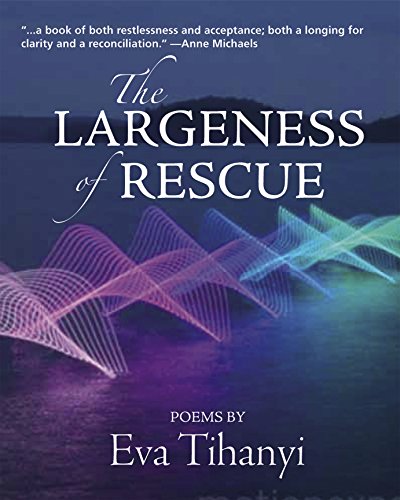

“The Largeness of Rescue is a book of both restlessness and acceptance; both a longing for clarity and a reconciliation. In this way, the poems form a moving whole, seeking resolution in the larger embrace of art.”
—Anne Michaels, Author of Fugitive Pieces and The Winter Vault
"Eva Tihanyi’s The Largeness of Rescue explores the many ways we both long for and resist rescue—rescue from ourselves, from each other, from the vagaries of the world. These poems sit poised at the cusp of a paradox, that place between “hope and hopelessness,” “horror and wonder” (“Precept”) where the personal explodes into the public realm. “I” becomes “you” becomes “we.” This is a book about borders, about “the middle place of possibility” that can move us past “carrion fear.” Tihanyi’s cycle contains both shorter lyrics and long poems, some of which explore the lives of artists and visionaries whose work sustained a precarious creativity: the Romantic poets, T.S. Eliot, and jazz trumpeter Chet Baker. Among these luminaries, also arise the poet’s peers, family, friends, fellow artists, and loves. The book reveals how, not despite, but though our common uncertainties and frailties, we hold the power to rescue. Rescue becomes not only a noun but a verb. Choosing to become rescuers (each in our own small way) is in itself a means of rescue. In the end it is the heart’s measure that proffers hope: “but always I will side with love / and always I will choose.”
—Susan McCaslin, author of Into the Mystic: My Years with Olga and The Disarmed Heart
"The Largeness of Rescue is a grave and tender collection, much preoccupied with issues of choice and destiny, and how they resonate throughout our lives. “Is it a tragedy when you choose?” she asks of the self-destructive jazz genius Chet Baker, and envisions T .S. Eliot turning his back on the “bad Russian novel” of his life to “foray into literature / on a plank of contrived neutrality / which he himself does not trust.” Most of the personae of these poems are nameless and their struggles and regrets less celebrated, but no less resonant: having been laughed at at twelve for his clumsiness, a man refuses to dance, in later years, with the wife who loves dancing, so that “Eventually / no one is dancing.” What connects them all is an awareness of life’s central paradox: we are always hoping to arrive somewhere better, even though all we have is the present moment."
—Susan Glickman, author of Safe as Houses
"With clarity and insight, Eva Tihanyi’s poetry offers both personal revelation and mature reflection on art, time and history. Serene in spirit and precise in language, The Largeness of Rescue is her finest work."
—Carole Giangrande, author of Here Comes the Dreamer and Midsummer
"Among my favorite poems in this reflective collection are those tributes Eva Tihanyi composes to the artist. There is her powerful evocation of Chet Baker and the “tendrils of melody” and charismatic notes” that emanate from his “brooding trumpet”; the complex mix of his giftedness, his inconsolability, the lure of fame and the prison of his addiction. Then too, she offers a rich portrait of T. S. Eliot, who struggled to “crack the code of his insurgent heart”; and before him, Tihanyi remembers the legacy of the Romantic Poets, the places they lived and their “allegiance to words,” which can “ignite like a tiny sun.” As she notes the particulars of all their lives, and the continuum of learning our own, Tihanyi asks that we pledge to live—to live in love—in spite of the paradoxes which fill this collection with subdued wonder."
—Carol Lipszyc, author of The Saviour Shoes and Other Stories and Singing Me Home
"Long-time readers of Eva Tihanyi’s powerful poetry have always appreciated her clarity and candor. Now, in her eighth collection, The Largeness of Rescue, we see the poet’s deep reckoning with loss, longing and mortality. Whether it’s a student crying in her office, or the slow demise of jazz genius Chet Baker, or the poets Byron, Keats, and Shelley in Italy, Tihanyi’s soulful poems show an intrimate understanding of life—and often the great human cost of art. Tihanyi offers us poetry that whispers from one heart to another."
—Bruce Hunter, author of Two O'Clock Creek, new and selected poetry and In The Bear's House
"Eva Tihanyi writes with clarity by employing powerful metaphors and epigrammatic language with an unflinching philosophical honesty to capture the conditions of our lives. If there is a dark atmosphere in some of these poems, there is also an underlying hope expressed in tender affirmation."
—Laurence Hutchman, author of Beyond Borders
“Art is not a closed circle / or a straight line.” Eva Tihanyi’s poems evoke many moments of art, from Chet Baker’s music drifting from an Italian prison to a cave artist place handprints on rock. She pieces these moments together along the curving trails of lyric and perception."
—Alice Major, author of Intersecting Sets: A Poet Looks at Science and Memory's Daughter
The Largeness of Rescue. Eva Tihanyi. Inanna Publications & Education Inc. Toronto, Ontario. 2016
Eva Tihanyi won us over pretty early into her excellent The Largeness of Rescue. Tihanyi is so eloquently reasonable that we started to hope she could explain everything.
Then we read "Bridge" which was written in memory of Dorothy Farmiloe and recognized immediately that we were on terra firma. Today's book of poetry has long admired Dorothy Farmiloe and so we went to the stacks this morning and were able to retrieve three chapbooks and one trade volume of poems. Poems for Apartment Dwellers (Fiddlehead Poetry Books, 1970), Winter Orange Mood (Fiddlehead Poetry Books, 1972) and Blue Is The Colour Of Death (Fiddlehead Poetry Books, 1973), and Words For My Weeping Daughter (Penumbra Press, 1980).
Doronthy Farmiloe (1921-2015) published ten poetry books/chapbooks by our estimation, another ten or eleven published books in different fields, but has never been widely known or championed, Today's book of poetry has always thought she had the real goods and are tickled pink that Tihanyi thinks it too. Eva Tihanyi giving Dorothy Farmiloe the nod tells Today's book of poetry plenty.
Circles and Lines
1.
July 31, 1960
Chet Baker races toward Viareggio,
the late afternoon road uncoiling
like a languid serpent, the horizon
an illusion of certainty, his quest for home
a stubborn unacknowledged longing
without end or consolation.
Needs, wants, must have a fix.
Stops at a gas station in Lucca, locks
himself in the washroom,
does not reappear.
Time passes. The attendant knocks,
then bangs, keeps banging, eventually
assumes emergency.
When the police arrive,
they find a disheveled man
standing dazed before the blood-spattered sink
syringe in hand.
It will linger for days, the stench
of Paco Rabanne cologne and week-old sweat.
2.
Is it tragedy when you choose?
3.
The trial eight months later
is sensational, the defendant
found guilty.
San Giorgio Penitentiary looms
at the centre of town, its medieval walls
and black windows as unrepentant
as its celebrity prisoner who, for years a vagrant
in his own life, is now jailed in it.
The second wife has been discarded,
the new mistress ensconced in the Hotel Universo,
the press duly scandalized.
Served: an Italian drama
of operatic proportions..
The world laps it up
like a thirsty dog.
4.
Before the arrest, a triumph:
Chet Baker plays Il Bussolotto,
a grand nightclub lounge on the Tyrrhenian Sea.
The patrons anoint him their trombo d'oro, adore
the intimate coolness of his jazz worship
in the summer air.
What they don't see:
how at the end of the night
he tosses his horn on the piano
rushes out for the next fix.
How in the morning
the sun falls in
through the sea-facing picture window,
alights on the tarnished horn, such sad beauty.
5.
Art is not a closed circle
or a straight line.
The heart embraces its craving, the blood rises,
a great irrational wave washing over
the unsuspecting bones, and all is deluged
in its red tidings, the secret song divulged,
its rhythm, rhythm, rhythm
beating some time into submission, beating time.
If this were true, it couldn't be said.
And to hold it: impossible
as a signature on water.
6.
Church bells and lone trumpet --
the sounds of Lucca that summer
as the locals gather along the promenade
to hear "Someone to Watch Over Me"
in the evening stillness.
During the day Chet Baker plays chess,
waits for visits from his mistress
who waits for his release.
Even the air waits.
And every night the sound
of the brooding trumpet, tendrils of melody
curling and winding, climbing and falling,
tender above all.
7.
Flashback.
There is nothing as seductive as genius.
Women will endure almost anything for it, the lure
of greatness, the shiny hook
upon which adulation squirms.
The young man in the jeans and white T-shirt
has it, the chiseled dark glamour,
the allure of those
who resist being loved.
The woman are many and various,
the trumpet's charismatic notes
sliding into their ears like promiscuous tongues.
Chet Baker looks down while he plays,
speaks little, smiles less.
He is a Gabriel for sinners,
a corrupt angel resisting rescue.
But they all try to save him, the women.
They try.
8.
.After prison Chet Baker is Chet Baker.
No closed circle, no straight line.
The mistress eventually becomes the wife,
bears him three children.
Many years from now at his funeral
a vase of white roses
will suddenly and inexplicably shatter,
strewing flowers and broken glass
as her feet.
...
As most of you faithful readers already know - a good jazz poem will sucker punch Today's book of poetry every time. And "Circles and Lines" is a doozey.
Write about Saint Chet of Baker or Lady Sir Charlie Parker and you will get our full attention. Write about them well and you end up on this blog, were it possible we'd throw throw garlands at your feet.
If it were only Dorothy Farmiloe and jazz Today's book of poetry would be happy enough but there is so much more of value going on in The Largeness of Rescue. Tihanyi is trying to figure out that most difficult thing - how to be a good person. Today's book of poetry comes away from The Largeness of Rescue thinking that Tihanyi wants us to celebrate as much as we can, whatever small victories we inhabit, Tihanyi's poems suggest we celebrate them. This is good advice.
Precept
To focus on not focusing:
sometimes this is the answer,
sometimes not.
Remember: all that is placed in water
either sinks or floats.
You are your own forest,
and all the green shimmering
and all the darkness.
What gathers in the margins
of your invisible life
is depleted and replenished
as time, in its alternating current
of hope and hopelessness
moves you.
Look it in the eye:
the horror and the wonder
that is transience.
Where there is fear,
celebration cannot enter.
...
Eva Tihnayi describes love as the cat in her poem "The Schrodinger Principle". Today's book of poetry has always assumed that the practical lesson to be learned from the Schrodinger Principle is that life doesn't exist until you actively engage in it. You have to open the box, you have to jump into love, before you'll have any idea of what it is or where it will go. Of course Today's book of poetry is frequently wrong.
There was some head shaking around our skeptical office this morning but Today's book of poetry is with Tihanyi when she says "but I will always side with love."
Eva Tihnayi has published eight previous poetry collections but when we checked our shelves we could only put our hands on two of them, Prophecies Near the Speed of Light (Thistledown Press, 1984) and In The Key Of Red (Inanna Publications, 2010). Those both got passed around along with the Dorothy Farmiloe at our morning read today. A few poems slipped out and that was just fine, there is nothing we like more at our morning read than variety and context.
Caregiver
A constellation of endings,
loss after loss.
You are supposed to be happy.
It is summer, after all.
Yet it is hard to watch
history repeat itself,
the same
but never the same.
And it is always personal
though from a distance
we don't admit this.
Every day
you watch over your mother.
Every day
you watch over your sister.
On your watch
love never falters.
...
Hope. Today's book of poetry always loves to see hope and are reassured by The Largeness of Rescue that hope is still a good thing. Eva Tihanyi's template for a more understanding, listening, tolerant and mentoring world is one we can all get behind.
Eva Tihanyi
ABOUT THE AUTHOR
Eva Tihanyi teaches at Niagara College and divides her time between Port Dalhousie (St. Catharines) and Toronto. The Largeness of Rescue is her eighth volume of poetry. She has also published a collection of short stories, Truth and Other Fictions.
BLURBS
The big theme—perhaps the only theme—is the narrative that unfolds between the bookends of our birth and our death. Each of us is born into a time and place—our present—and must answer the questions only we can answer for ourselves: Who are we? What will we do? What choices will we make? The Largeness of Rescue helps us travel along our own storyline by doing what the best art does so well: engages us with ourselves and with our world, and encourages us to slow down and consider our very humanness.“The Largeness of Rescue is a book of both restlessness and acceptance; both a longing for clarity and a reconciliation. In this way, the poems form a moving whole, seeking resolution in the larger embrace of art.”
—Anne Michaels, Author of Fugitive Pieces and The Winter Vault
"Eva Tihanyi’s The Largeness of Rescue explores the many ways we both long for and resist rescue—rescue from ourselves, from each other, from the vagaries of the world. These poems sit poised at the cusp of a paradox, that place between “hope and hopelessness,” “horror and wonder” (“Precept”) where the personal explodes into the public realm. “I” becomes “you” becomes “we.” This is a book about borders, about “the middle place of possibility” that can move us past “carrion fear.” Tihanyi’s cycle contains both shorter lyrics and long poems, some of which explore the lives of artists and visionaries whose work sustained a precarious creativity: the Romantic poets, T.S. Eliot, and jazz trumpeter Chet Baker. Among these luminaries, also arise the poet’s peers, family, friends, fellow artists, and loves. The book reveals how, not despite, but though our common uncertainties and frailties, we hold the power to rescue. Rescue becomes not only a noun but a verb. Choosing to become rescuers (each in our own small way) is in itself a means of rescue. In the end it is the heart’s measure that proffers hope: “but always I will side with love / and always I will choose.”
—Susan McCaslin, author of Into the Mystic: My Years with Olga and The Disarmed Heart
"The Largeness of Rescue is a grave and tender collection, much preoccupied with issues of choice and destiny, and how they resonate throughout our lives. “Is it a tragedy when you choose?” she asks of the self-destructive jazz genius Chet Baker, and envisions T .S. Eliot turning his back on the “bad Russian novel” of his life to “foray into literature / on a plank of contrived neutrality / which he himself does not trust.” Most of the personae of these poems are nameless and their struggles and regrets less celebrated, but no less resonant: having been laughed at at twelve for his clumsiness, a man refuses to dance, in later years, with the wife who loves dancing, so that “Eventually / no one is dancing.” What connects them all is an awareness of life’s central paradox: we are always hoping to arrive somewhere better, even though all we have is the present moment."
—Susan Glickman, author of Safe as Houses
"With clarity and insight, Eva Tihanyi’s poetry offers both personal revelation and mature reflection on art, time and history. Serene in spirit and precise in language, The Largeness of Rescue is her finest work."
—Carole Giangrande, author of Here Comes the Dreamer and Midsummer
"Among my favorite poems in this reflective collection are those tributes Eva Tihanyi composes to the artist. There is her powerful evocation of Chet Baker and the “tendrils of melody” and charismatic notes” that emanate from his “brooding trumpet”; the complex mix of his giftedness, his inconsolability, the lure of fame and the prison of his addiction. Then too, she offers a rich portrait of T. S. Eliot, who struggled to “crack the code of his insurgent heart”; and before him, Tihanyi remembers the legacy of the Romantic Poets, the places they lived and their “allegiance to words,” which can “ignite like a tiny sun.” As she notes the particulars of all their lives, and the continuum of learning our own, Tihanyi asks that we pledge to live—to live in love—in spite of the paradoxes which fill this collection with subdued wonder."
—Carol Lipszyc, author of The Saviour Shoes and Other Stories and Singing Me Home
"Long-time readers of Eva Tihanyi’s powerful poetry have always appreciated her clarity and candor. Now, in her eighth collection, The Largeness of Rescue, we see the poet’s deep reckoning with loss, longing and mortality. Whether it’s a student crying in her office, or the slow demise of jazz genius Chet Baker, or the poets Byron, Keats, and Shelley in Italy, Tihanyi’s soulful poems show an intrimate understanding of life—and often the great human cost of art. Tihanyi offers us poetry that whispers from one heart to another."
—Bruce Hunter, author of Two O'Clock Creek, new and selected poetry and In The Bear's House
"Eva Tihanyi writes with clarity by employing powerful metaphors and epigrammatic language with an unflinching philosophical honesty to capture the conditions of our lives. If there is a dark atmosphere in some of these poems, there is also an underlying hope expressed in tender affirmation."
—Laurence Hutchman, author of Beyond Borders
“Art is not a closed circle / or a straight line.” Eva Tihanyi’s poems evoke many moments of art, from Chet Baker’s music drifting from an Italian prison to a cave artist place handprints on rock. She pieces these moments together along the curving trails of lyric and perception."
—Alice Major, author of Intersecting Sets: A Poet Looks at Science and Memory's Daughter
514
DISCLAIMERS
Poems cited here are assumed to be under copyright by the poet and/or publisher. They are shown here for publicity and review purposes. For any other kind of re-use of these poems, please contact the listed publishers for permission.
We here at TBOP are technically deficient and rely on our bashful Milo to fix everything. We received notice from Google that we were using "cookies"
and that for our readers in Europe there had to be notification of the use of those "cookies. Please be aware that TBOP may employ the use of some "cookies" (whatever they are) and you should take that into consideration.
Thursday, March 12, 2015
Fantasy - Ben Fama (Ugly Duckling Presse)
Today's book of poetry:
Fantasy. Ben Fama. Ugly Duckling Presse. Brooklyn, New York. 2015.

"Sunset", a four page prose poem, opens Fantasy by Ben Fama, and reading it is like the first time you do a drug that opens up new worlds.
Fama lets loose with one remarkably sustained howl at our current trajectory.
Fama literally bombards and overloads the senses in his run-on stream-of-brilliant-consciousness prose poems.
Then he inserts one of these little bon-bons:
Elle
i would
make out
with you
hold hands
smoke weed
etc
...
Ben Fama's sense of humour eats monsters for breakfast. These poems feel as though they were written by a sky-diver in mid-fall/flight, a luge racer on LSD, the last bloody man standing.
Fama is not ahead of the curve, he is the curve, bending the world to his narrative with Hunter S. Thompson/Fran Lebowitz gusto and zeal.
These damn poems make you feel like you are inside the mind of a higher order of alien - processing everything current about the earth and doing it at inhuman speed. It's a kaleidoscope that is ferociously entertaining.
Frank O'Hara
The only time I wish
other people heard my thoughts
is when I put your name
into youtube.com
right now I'm thinking
I wish you were still alive
so I could be your partner
whether in art or life
I'm not really sure
mostly life I think
but they say
life imitates art
so who knows
...
It is completely unfair of me to rant poetic about the longer poems of Ben Fama and then not include them. They make up the biggest part of Fantasy, and they are as tasty as your favourite dessert.
The longer poems in Fantasy challenge inclusion in Today's book of poetry but they are splendid catalogues, social registers, stylish lists with a Jim Carroll New York cool and a Joyce Carol Oates smart.
We took turns reading the longer poems out loud here at the office. The interns took turns. There was howling laughter, much looking up references, copying down lines to repeat later and generally just causing a joyous ruckus. All thumbs up for Ben Fama here.
Wayne Koestenbaum queries about Fantasy "how did Fama invent a tone so perfect and icy, so equal to our times?" And he is exactly right. How?
The Line of Beauty
I love summer, the luxury of poetry, gin
and tonic, quinine lost in juniper
...
These short poems are really a tease. Ben Fama's Fantasy as a whole is a masterwork and perhaps a masterpiece, only time will tell.
Today's book of poetry always likes it when anyone gives a tip of hats, props, to Saint Margaret of Atwood, one of Canada's sacred treasures. Fama does that.
Fama is firing on all cylinders in this fine, fine, fine book of poems.
Three 'fines' only because four would look ridiculous - "and a man in my position can't afford to be made to look ridiculous."

Ben Fama
ABOUT THE AUTHOR
Ben Fama is the author of several chapbooks and pamphlets, including the artist book Mall Witch (Wonder), Cool Memories (Spork), Odalisque (Bloof), and Aquarius Rising (UDP). His writing has appeared in The Believer, Denver Quarterly, Boston Review, Jubilat, Lit, and The Brooklyn Rail, among others. He is the co-founder of Wonder, and lives in New York City. Fantasy (UDP) is his first full-length poetry collection.
BLURBS
Sometimes something gets written and it surprises you, though it feels familiar. An early-twenty-first century decadence with its adderalls. Still the colloquials and the coteries of the New York School, but now with selfies, with crying selfies even. And klout scores. And there is fashion week, the Miami, the Los Angeles. Tans. Pools. I read Fantasy again and again, thinking I could learn to recite its spell on my own. It is a book about an end. An end of our economic empire. Of the fantastical expansion of income. And the poems here just keep going. They keep going to work. They plan what to do when one encounters an active shooter situation. Sort of. Because there is no plan really that makes sense except maybe to keep showing up to work stoned.
—JULIANA SPAHR
Ben Fama’s softly amalgamated new book, Fantasy, quietly elicits states of mind that we do and do not continue to inhabit. Memory traces, evacuations of past ruins pile up under present day linguistic and textual edifices. The socio-political erupts gently at the edges of fanboy/fangirl communiqués in which “fundamentalists decried jolie for using her wealth to surmount death and god.” In Fantasy, Fama uses his poetic intelligence to override dilemmas of understanding, and agitate all our ADLs (activities of daily living)—no small task for these overripe poetic times.
—KIM ROSENFIELD
Fama has many faces, and fame comes in many sorts and sizes—from the one-week notoriety of the cover story to the splendor of an everlasting name (I may be quoting), i.e., Anaïs Nin commiserates with Trent Reznor about the fact that Kate Moss’s tan lines are, right now, more famous than either one of them.Fantasy is a Zipcar to cruise by such commiseration on the way to a resort Google maps can’t locate, but that “if you can’t afford it,” at least you can “affect it,” and there’s still “Glamour all night.”
—BRUCE HAINLEY
Ben Fama
reading at Space Space
video: Bianca Stone
317
Poems cited here are assumed to be under copyright by the poet and/or publisher. They are shown here for publicity and review purposes. For any other kind of re-use of these poems, please contact the listed publishers for permission.
Subscribe to:
Posts (Atom)