Showing posts with label biblioasis. Show all posts

Sunday, May 6, 2018

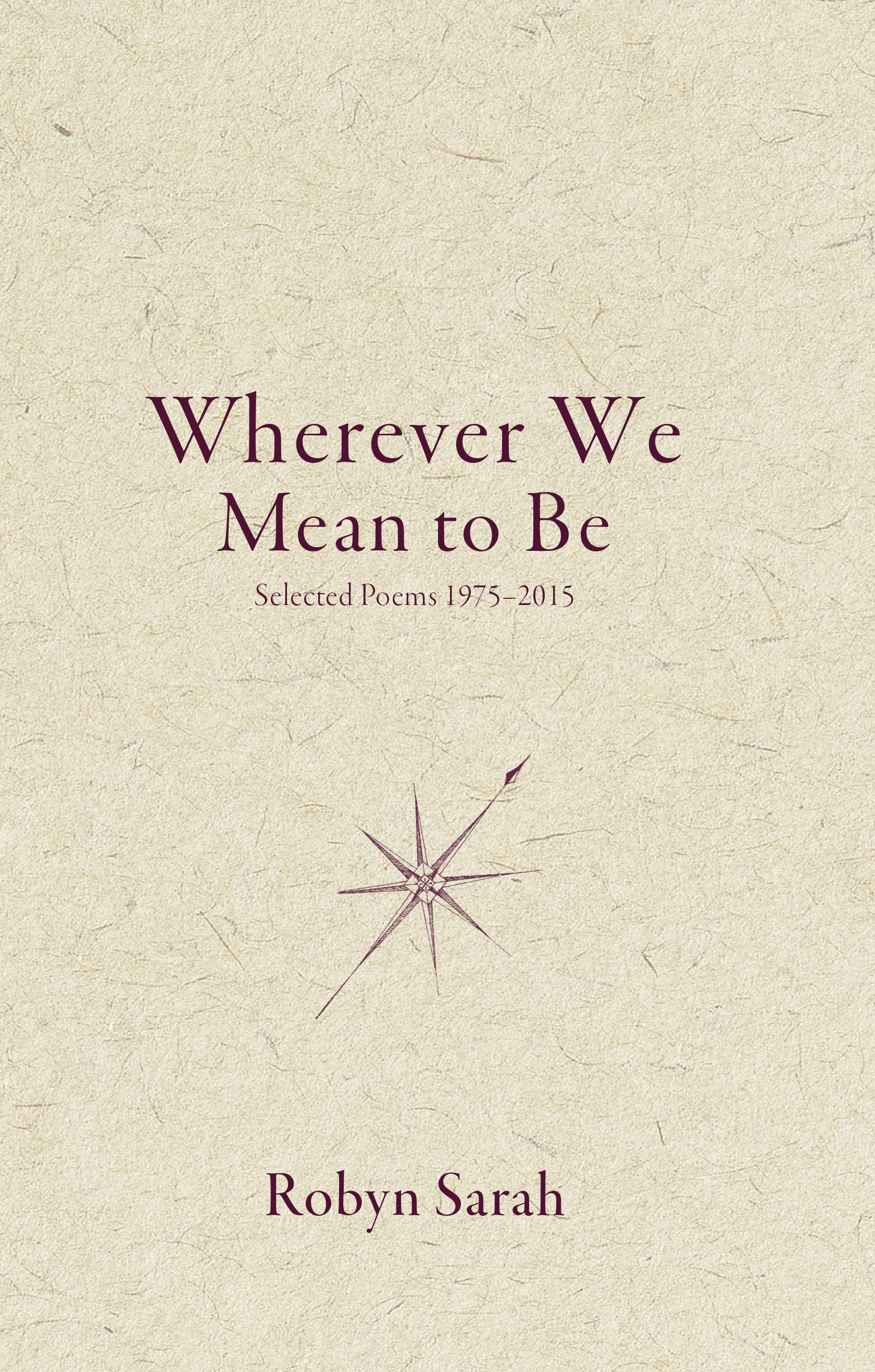
Wherever We Mean To Be / Selected Poems 1975 - 2015 - Robyn Sarah (Biblioasis

Today's book of poetry:
Wherever We Mean To Be / Selected Poems 1975 - 2015.  Robyn Sarah.  Biblioasis.  Windsor, Ontario.  2017.

Shadowplay  -  1978  -  (Fiddlehead Books)
The Space Between Sleep and Waking  -  1981  -  (Villenuve)
Anyone Skating On That Middle Ground  -  1984  (Vehicule Press)
Becoming Light  - 1987  -  (Cormorant Books)
The Touchstone: Poems New and Selected  -  1992  -  (House of Anansi)
Questions About The Stars  -  1998  (Brick Books)
A Day's Grace  -  2003  (Porcupine's Quill)
Pause For Breath  -  2009  -  (Biblioasis)
Digressions: Prose Poems, Collage Poems, and Sketches  -  2012  (Fitzhenry & Whiteside)
My Shoes Are Killing Me  -  2015  (Biblioasis)

Two things. 

First thing:
Any poet in Canada would kill to have Robyn Sarah's list of publishers behind their names.  Okay, I wouldn't kill, but I might maim.  

Second thing:
The K seal of approval will start this production.  As I sometimes do, I read some poems to K last night after we'd retired to our reading stations in bed.  I read K Robyn Sarah poems.  The first clue was that K didn't say stop.  K loves poetry, but she doesn't love it all.  Robyn Sarah passed the very difficult K standard with flying colours. 

It shouldn't come as a surprise, Robyn Sarah has been writing about those moments that make up a life, a relationship, a childhood, with candor and a firm tenderness since she first crossed Today's book of poetry radar back in the late seventies.  

There are no strange animals in Sarah's poetry forest, but you'll recognize the beasts and the fauna.  

Broom at Twilight

Some climbs end nowhere.  Like the unplanned climb
I took this evening.
                               I'd gone down the beach
some little way, and though the sun was low,
I thought that it would see me round those rocks
to the next cove, with time enough to watch
the tide come in (and maybe make it back
without getting my feet wet.)
                                              No such luck —
beyond that stretch, the tide was in already,
and there was nothing to do but climb the cliffs
up to the road, and walk back home that way.

Dark doesn't wait, this time of year.  I climbed,
and the sun went down as I went up.  Went right on
falling beyond the unseen edge faster
than I could find my holds.  (Footholds in clay,
handholds on anchored roots.  And all the while
the sky fast darkening out from above.)

                                                               Near water,
the grey hour's luminous.  And by the beach
I should have had no trouble finding my way.
Where I came up, though—something blocked the light.
It was the sameness that surprised me.
                                                              Broom:

a forest of it.  Higher than my head.
And not in clumps, the way it seems to grow
by day—but in a sold wall.  An army
bristling with strange intent.  The broom I knew
grew in tall waving tufts like uncut hay
to wade through at high noon.  This broom stood up
like earth's raised hackles in the failing light —
a massing of ominous spikes against the sky

and stems that wouldn't give way.  I couldn't find
the mouse-paths children make to get to the sea—
but had to plunge (broom closing over me)
into a tangible edgeless element,
banking on where I thought the road must be.

...

Today's book of poetry thinks that "Broom at Twilight" would safely pass as the life story of most of us.  The best laid plans leading to an ominous turn of events, none the less we plunge ahead with hope.  

In Robyn Sarah's Wherever We Mean To Be /  Selected Poems 1975 - 2015, Sarah understands that the dramas in our small lives are our operas, our movies, the real played out screenplays of our lives.  The choices we make depending upon where our hearts and our heart's commitments reside.  In her poem "Riveted," Sarah makes her mission statement clear:

                                             "—riveted, as it were;
      spellbound by our own imperfect lives
      because they are lives,
      and because they are ours."

Today's book of poetry is a little muddle today for a variety of reasons.  Almost all of them good ones.  Our hero/mentor/buddy Stuart Ross has taken up residence in the Today's book of poetry guest room.  It should have his name on it.  Yesterday Today's book of poetry got a package in the mail from our St. Louis correspondent David Clewell.  Campbell McGrath and David Hilton arrived in such bounty that we are blushing.  

Today's book of poetry is also rushing a little.  K and I are heading to Peterborough in a few minutes to see some family and look after some business, maybe have a northern route road trip on the way back tomorrow.  It is always good to see family and we will both see our sisters and that's just about the best trip you can take.

Looking forward to seeing family and thinking about my friendships with Stuart Ross and David Clewell make me all poetry sentimental and now I want to throwout my Robyn Sarah notes and tell you that Today's book of poetry was compelled to write about Wherever We Mean To Be.  

***

A few days have passed.  We looked after our Peterborough business and made it back to Ottawa.  Stuart Ross has left but we are expecting a visit from Larry Cowan today.  Today's book of poetry and Mr. Cowan have never met in person so we are excited about that.  Mr. Cowan's Monk Press is going to do a chapbook for us in the not too distant future.

Sarah's poems have been swirling around in my head for the last week.  Usually Today's book of poetry is on to the next thing, the next poet, the next blog.  Robyn Sarah has lingered like a much welcomed house guest.

Once Desire

Once, desire was a soft roaring
between us, like white water,
and we adjusted our voices
to be heard above it
till it seemed to us
that we whispered: as any sound,
heard long enough, becomes silence.

I would like to go back to that time,
when the power was still outside of us
and we were as if asleep, cocooned
in the white rush of it.  Unharmed
and unarmed.  When we were a
dream of wings.  Before this
perilous flying.

...

Our morning read was orchestrated by our new intern, Maggie, and she did a splendid job.  Maggie could have been a conductor for music or for a train, she's a talented young woman.  Maggie assigned each of us particular poems, using Maggie logic, and it seemed to work out just fine.

Robyn Sarah had a great deal to do with that.  Sarah, much to my great delight, doesn't build any walls around her poems, they are all the same, they all pull you into her narrative as though you'd been there all along.  Robyn Sarah writes solid poems that you can depend on.

Stormblue

     "You're rich, and you want to be loved like a poor man."
                    —Les enfants du paradis

The way a woman loves a man
without money: for the holes
in his socks, for the tilt
of his eyebrows, for his voice
singing a song or murmuring
behind a door, for the fragrant
smoke of his pipe bluing the air
in the small old cozy cluttered room,
for his patched elbows, his
tweedy jackets from the Nearly New,
for the blind intelligence
of his body in love, for his hands,
quiet on the table, their dance
in the air when he speaks,
for the mole
on the back of his neck, for a few
old jokes that he likes to tell,
for his laugh,
for the way his hair sticks up
in the morning, for the cleft
in his chin, for a dimple
(seldom seen) in his left cheek,
for his dreams, and the light
that they put in his eyes
evenings of dreamy talk—

For the blue of his eyes
that she calls
his baby eyes
that grow stormblue
in anger at being loved
for the foolish things
she loves him for,
because they are all he has
to give her,
because he knows
that she knows
he will never
have more.

...

Today's book of poetry has been reading Dame Robyn Sarah since the late 70s and almost always with a hint of jealousy.   It takes a lot of polished brass to hit the mark and keep on hitting it.  Sarah has been consistent all these years.  Wherever We Mean To Be is a beautiful comfort and Robyn Sarah remains a clear investment.

Spending time with Robyn Sarah's Wherever We Mean To Be will be poetry time well spent.


Image result for robyn sarah photos

Robyn Sarah

ABOUT THE AUTHOR    
Robyn Sarah is the author of eight poetry collections, two collections of short stories, and a book of essays on poetry. Her most recent poetry collection is Pause for Breath (Biblioasis, 2009). Le tamis des jours, selected poems in French translation with parallel English text, was published in 2007, as was Little Eurekas: A Decade’s Thoughts on Poetry. Her writing has appeared widely in Canada and the United States, and her poems have been anthologized in Fifteen Canadian Poets x 2 and x 3, The Bedford Introduction to Literature, The Norton Anthology of Poetry and in Garrison Keillor’s Good Poems for Hard Times. She lives in MontrĂ©al.

BLURBS
“A poem by Sarah could fit into the palm of your hand … Wherever We Mean To Be showcases [her] gifts: her visual clarity, no-nonsense voice, compressed language, rhythmic prowess, and metaphoric agility. These qualities speak from a long-cultivated focus and bespeak a writer who pays fierce attention to the basic fact of being in the world.” —Anita Lahey, The Walrus

“This city, read by a kind of hidden code, seems lost in time; lives lived in its outmoded rooms have a timeless quality…the voice remains utterly its own, in pursuit of what Sarah calls “the lost soundtrack of daily life.” —Canadian Jewish News


Robyn Sarah reads from Questions About The Stars (Brick Books)
Video:  Brick Books


683

DISCLAIMERS

Poems cited here are assumed to be under copyright by the poet and/or publisher.  They are shown here for publicity and review purposes.  For any other kind of re-use of these poems, please contact the listed publishers for permission.
We here at TBOP are technically deficient and rely on our bashful Milo to fix everything.  We received notice from Google that we were using "cookies"
and that for our readers in Europe there had to be notification of the use of those "cookies.  Please be aware that TBOP may employ the use of some "cookies" (whatever they are) and you should take that into consideration

Friday, October 6, 2017

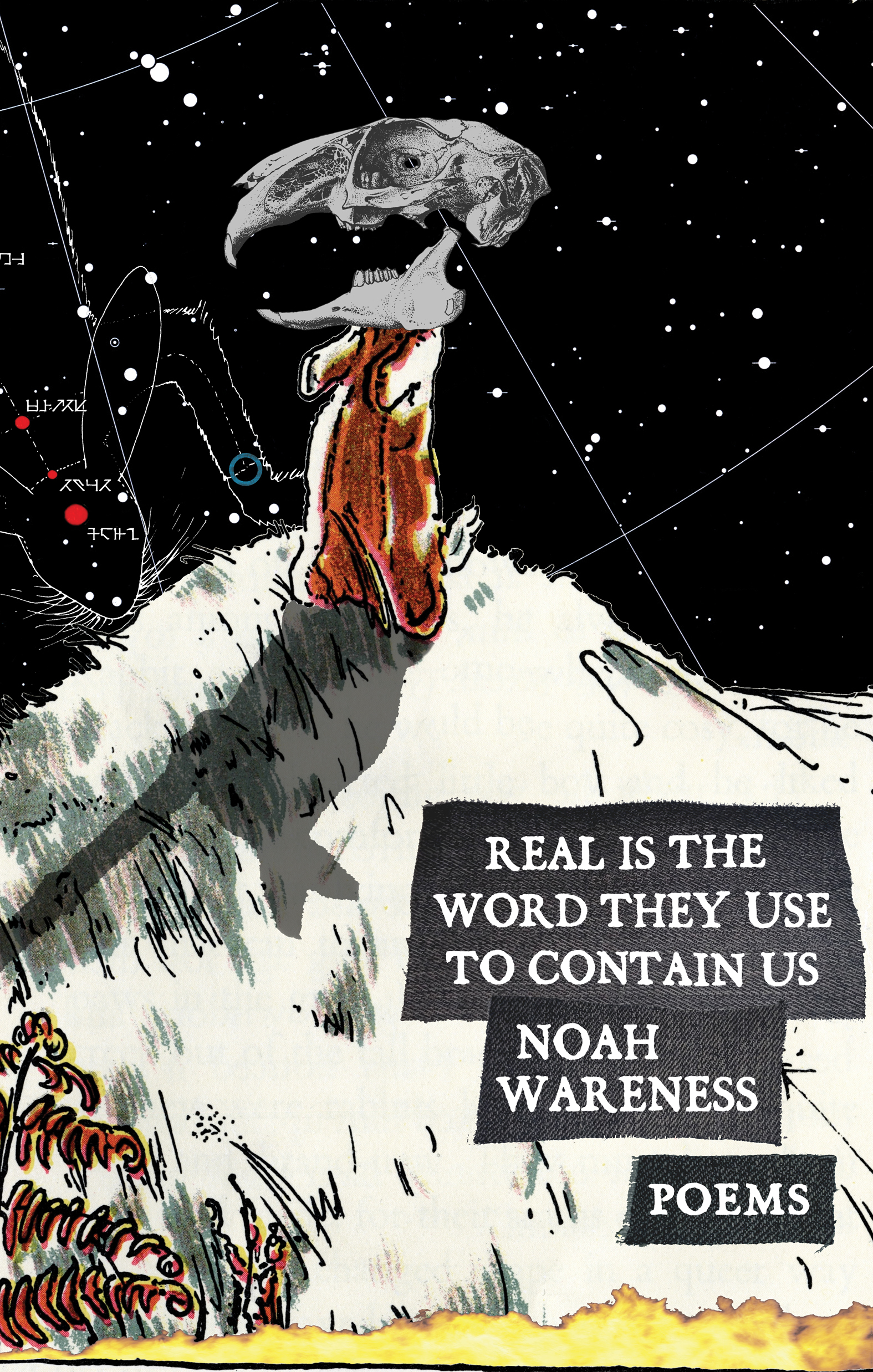
Real is the Word They Use to Contain Us - Noah Wareness (Biblioasis)

Today's book of poetry:
Real is the Word They Use to Contain Us.  
Noah Wareness.  Biblioasis.  Windsor, Ontario.  2017.


No idea who Noah Wareness really is but that's one hell of a pseudonym.  Today's book of poetry is fairly certain there's a man behind the curtain controlling all the levers like an all-seeing Wizard of Oz.  Noah Wareness is a great pen name.

Opening up Real is the Word They Use to Contain Us is a little like listening to Richard Pryor for the first time all those years ago.  I was working in a small movie theatre that was on the second floor of an old building in Peterborough.  There was a boxing club on the first floor.  We showed a real variety of flicks.  You also never knew what would be playing on the box between shows.  Never did find out who owned the records we played but that's where I first heard Paco de Lucia.  That's where I first heard Richard Pryor.  I remember it clearly because it flicked a switch.

These are truly great poems, stories, bribes, menus and memos for the cleverly deranged.  Real is the Word They Use to Contain Us is as much a manifesto as it is a book of poems.  These poems are a declaration of war in a battle most of us don't know is being fought.

Noah Wareness is cavalier, candid and so damned sharp that there's a genuine fear of cutting yourself on his wit.

I'm No Expert

but I heard the physician Duncan MacDougall
devised a sensitive platform-beam balance
to weigh terminal patients as they expired,
eventually placing each departing soul between
eleven and forty-two grams.
                                              I'm no expert, but
I've got a bathroom scale, and I read it before
I sad down, you know? And when I stood up
over a pound had vanished. I'm no theologian,
but I've certainly weighed my share of turds,
an experiment most anyone can replicate.
                                                                   You sit
and think about Plato dividing the soul: reason,
volition, desire: three perforated squares.
Later theorists added compassion and stillness,
microtubules, parallel processing and generative
grammar; but in 1911, in his backyard garage,
MacDougall built a transcranial camera to catch
every last detail staining the bowl.
                                                       Nobody'd call
me an engineer, though. I don't know the weight
of compassion, or what might foil its tendency
to rise.
           Don't ask me why corn kernels float.

...

Real is the Word They Use to Contain Us genuinely does not read like any other of book of poetry I have ever encountered.  Noah Wareness writes with a strange lyricism somewhere south of a ranting Nick Cave and north of the razor wire strung out by William S. Burroughs.  And he does it with some sort of hyper stream-of-consciousness and the extracted musk glands of honey-badgers.  Wareness is relentless as he dive bombs down on the assigned targets with his massive artillery.

It is hard to narrow in on precisely what it is Noah Wareness is running toward but the trip is the thing and Real is the Word They Use to Contain Us chases you like a bull breathing hard on your blistered and bloodied feet as you search the maze for daylight.

Today's book of poetry could have used a Sherpa to help navigate some of this terrain but just when the air gets too thin and the load gets too heavy Wareness comes along with something so beautiful, wise, alarming, exciting or illuminating that it lightens your load, solves your concerns.

A Wagging Wheel

welcome to the smoking
industry.
it's not what you
think. it's worse.

ever since youtube
got started we've been making
like zero money.
nobody pays anymore
for smoking.

all those
iphone 6
motherfuckers
at the bus stop
doing streaming
video,

and white
clouds in the office
windows
overhead
clearing up
one by one.

now we're working in
rented port-a-
potties. the
big ones you can drive
a wheelchair in.

your bachelor's degree? it's
a piece of paper.
welcome to the smoking industry.

four, five of us smoking
in a green plastic
shitter
behind a horse stable
only we're still
artists,
artisans.

in these suffocating
boxes there's
no lights
ventilation
water 
or electricity.

you can's see your hands.

you vomit.

the office tips sideways.

and when the cheques
come they're typed
on the thinnest paper
basically kleenex.
pissing blood
after a long day's
smoking
and the cheque's ripped,
you can't
read the numbers
then plus there's the
sixteen-year-olds
who hitch here in freight cars,
all clown paint and
brandishing cleavers,
they show up
around sundown
like a teen vampire movie
and they don't stop singing
the same song.

ROCK ME MAMA LIKE A WAGGING
WHEEL, ROCK ME, MAMA, ANY
WAY TIME TO FEEL, HEY, MAMA,
WAKE UP AND ROCK ME

ROCK ME MAMA LIKE A WINTER'S
TURNING OF RAIN, ROCK ME
MAMA ALL DAY IN A TRAIN, HEY,
MISTER, YOU GOT A SMOKE

and every one
of 
them, in between
the checkings
of their phones,
will ask
to bum a smoke.

they got on emergency
psychiatric welfare by
cutting
GODSPEED U BLACK
EMPOROR
in the ikea coffee
tables
of their mothers,
and they say they stopped here
to bum a smoke.

they say that's the only
reason they stopped here.

well fuck.

rookie,
this is it,
the smoking
industry. and

fuck youtube and the world internet,

fuck not being able
to read
cause you had one ordinary stroke, fuck
mirrors cracking when
they look at you,
fuck dropping bread in the toilet,
fuck
warning labels
getting bigger every morning,
fuck
trying to use
a toothbrush when you
have oral
cancer, fuck the
exchange ratio,
fuck
burn marks on my air
fresheners, fuck the emergency
tracheotomy industry,
fuck
being forcibly restrained
and prevented from 
smoking
at your own child's sleepover,
fuck tar sticking your eyes shut,
fuck
stepping outside
for one minute
and birds hitting you in the chest,

fuck whoever came up
with the name noam chompy
for a dog,

FUCKING KIDS
GET OUT OF MY OFFICE
WITH YOUR RUBBER BAND
TOILET PAPER
TUBE
GUITARS.

okay?

okay.
welcome to the smoking industry.
here's
your gun.

it probably won't even go off.

...

Just following Noah Wareness through this labyrinth of poems, prose poems, connecting passages, asides, contracts, pamphlets and other assorted paraphernalia is a quest.  But rewarding at every turn.  You can't have poems this incendiary without making some burn holes in the carpet.  Something is going to spill over.

At this morning's reading we noticed the door to Max's office open and "gone fishing" sign on his desk.  Not sure where he has ventured off to but we will keep his office just the way he likes it.  The rest of the staff tackled Real is the Word They Use to Contain Us with considerable gusto and aplomb.

Today's book of poetry understands that Noah Wareness is an outsider poet; unaligned to any isms and with a big tongue in his cheek.  We won't even pretend we were prepared to deal with a poet of this nature - but boy, oh boy - we were damned happy to take a kick at the can.  Originality is rare as hen's teeth and Noah Wareness is one of the most original voices we've encountered in a good while.

Everything's Politics
for Melanie

The words are the power the words would destroy.
Now it's December, I wrote about this park already,
the powder snow streaming over the walking paths,
blowing in ribbons, billows, all torn kitecloth trailing,
revealing in its traces the soft flank of the wind.
It isn't a sign. It's not the wind's mixed metaphor.
The wind ins't the snow's; and nothing's ours, too.

Either way, now it's March. On Highway 17, Emese
calls them snow snakes. Our tires run them down.

There's nothing in this frail little magic, not to hold,
no stone for power's throat. We ask the words for
true and false, the power the words would destroy.
It's just how seeing makes more seeing, this mind,
ours, running up to itself with shapes in its mouth.
The world's netted through with words, whichever
way, but always too fine to catch nothing at all.
When I finish this page, it was raining instead.
Either way, it's past four in the night. It's not now.
The wind's come looking back like something else.

...

It's not very often a book like Real is the Word They Use to Contain Us comes along but when they do it is cause for celebration here at Today's book of poetry.

Not only can Noah Wareness cook with elan, he's added some new and pleasing spices that were entirely new to our palate.

Image result for noah wareness photo
Today's book of poetry 
thinks this might be a photo of
Noah Wareness.

ABOUT THE AUTHOR
Noah Wareness uses STAEDTLER pens, SHRANDER imagery, THOSS nightmares and WEER narrative frames.

BLURBS
"...something approaching genius... every word from the stage was a perfectly-shaped bullet..."
     -  Michael Rowe

"Reading this book will make you see the world a little differently."
     -  Zachariah Wells


616

DISCLAIMERS

Poems cited here are assumed to be under copyright by the poet and/or publisher.  They are shown here for publicity and review purposes.  For any other kind of re-use of these poems, please contact the listed publishers for permission.


We here at TBOP are technically deficient and rely on our bashful Milo to fix everything.  We received notice from Google that we were using "cookies"
and that for our readers in Europe there had to be notification of the use of those "cookies.  Please be aware that TBOP may employ the use of some "cookies" (whatever they are) and you should take that into consideration.

Friday, April 28, 2017

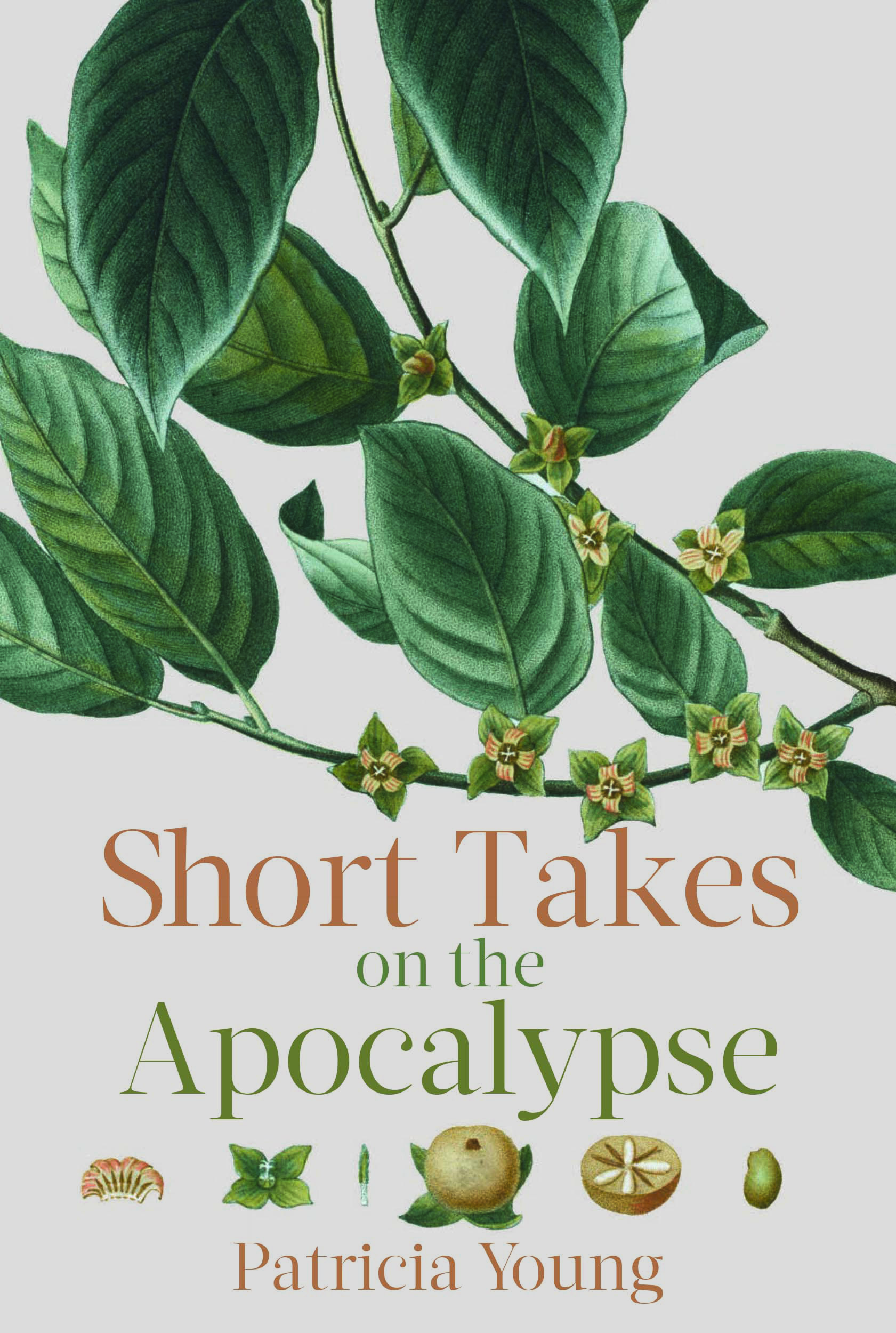
Short Takes on the Apocalypse - Patricia Young (Biblioasis)

Today's book of poetry:
Short Takes on the Apocalypse.  Patricia Young.  Biblioasis.  Windsor, Ontario.  2016.


Patricia Young is the author of eleven previous books of poetry and Today's book of poetry has had our eye on her work for a long, long time.  We had Milo, our head tech, check the stacks this morning and much to our disappointment he came back with a miserly three Patricia Young titles, Melancholy Ain't No Baby (Ragweed Press, 1985), What I remember from my time on earth (Anansi, 1997) and Night Eaters (Quatro Poetry, 2002).  After reading her latest, Short Takes on the Apocalypse, Today's book of poetry is reminded how much we admired this poet's work.

Short Takes on the Apocalypse isn't a party trick but this book does have a catch; each poem begins with some sage epigraph from a resplendent group that ranges from George Bernard Shaw to Marilyn Manson to Kurt Vonnegut.  It all works.  Somehow Young is able to use these witticisms as a springboard and once she takes to the air all sorts of marvelous hell break loose.

Tornado In The Bible Belt

                     Never open... with the weather.
                                       -Elmore Leonard

Strong southerly winds tore through the upper atmosphere. Hot air
clashed with cold. High-speed gusts rotated around a calm centre,
and then a funnel-shaped cloud was sucking up dust and debris and
a small child--my child. For twelve minutes his body spun like a 
blob of butter inside nature's blender. I cursed God and the complex
interactions between updraft and surrounding winds, cursed the
third layer of dry air and His vortex howl. How dare the Almighty
sweep my boy up, then drop him like a cigarette butt far from the
house. All night I searched the fields. Searched and searched until a
voice rang out of the blackness--I am safe in Jesus' arms. And then
silence unlike anything I'd ever known.

...

Short Takes on the Apocalypse, Young's twelfth book of poems, is an exploration.  Young is looking at it all; love, sex, death and her Hungarian grandmother.  Young brings a masterful poise to her narratives, these stories resonate so true - and that would be good enough - but Young is so much more.

This is funny stuff, biting and instructive.  Young has experience and wit and this book swells to bursting with both.  We laughed, we cried.

Vanishing

            I don't believe in an afterlife but I still fully expect
                               to see my brother again.
                                                            - Maurice Sendak

It doesn't matter where I go, what clothes I'm wearing,
which way my head's turned, north or south, if my mouth's
open or shut, if I'm awake or dreaming, I'm always with

you, on a bus in an eastern European town. Same overcast
sky, same up-turned cart in the middle of the road, hay
spreading across pavement, a donkey and farmer, shoulders

slumped: stance of unspeakable resignation. Time's lost
or frozen, the traffic's blocked and the bus driver's cursing
in a language so luminous with rage we understand every

blue letter word. Late afternoon commute, men with wind-
lashed faces and women in bright scarves. Bored girls
flipping open cell phones or the make-up cases on their laps.

Wherever I go a dull wash is descending upon the same
mud-splattered scene. We're twenty-two, we're forty-five,
we're sixty-eight, but no matter, day will lurch into night

and then into another day, the seasons will shift, the planets
align, the spilled hay will be cleared for passage, the driver
will sat back down, his diesel engine will sputter and combust,

we'll look out the back window as farmer, donkey and cart
grow small, then smaller, the dead will chatter into
the vanishing point. The bus will continue down the road.

...

It occurs to us here at Today's book of poetry that Young must be some sort of serious reader of the highest order to have found the range of epigraphs that frame these poems like paintings.  As it happens these poems are painterly, Short Takes on the Apocalypse is like a grand vernissage curated by Young.  It's a life story and Young doesn't flinch for a second, her panorama covers the past, present and future.  

Today's book of poetry has always, or at least since 1985, felt a kinship with Young's voice but perhaps that is only wishful thinking.  She has the plain, clear, intelligent voice Today's book of poetry aspires to.

Father Suite

             A father is always making his baby into a little woman.
                 And when she is a woman he turns her back again.
                                                                             -Enid Bagnold

In his shirt pocket, a package of Gitanes. I loved that package.
Wanted to be the Spanish lady shaking a tambourine. In Canada
my father became the model immigrant. Worked hard. Built
chimneys for a living. The feather in the cap, he'd say, his accent
stubborn. He laid brick, stone, concrete blocks. Climbed ladders
to the sky. He was king of flues and updrafts. Threw his little girl
into the air. So proud of her English. How she pronounced spark
arrestor, wall thimble, directional cowl. I was polished and pretty. At
sixteen landed a bit part in Rossini's La Cenerentola. On closing
night, kissed my backstage hero inside the folds of the velvet
curtain (how did my father know? what did he see?). When the
applause stopped, I was shipped off to Eastern Europe to die like
the grasses, rot in the earth.

                                                          *

Squatting before the hearth, my Hungarian grandmother ate
meaty potatoes right out of their skins. Scrubbed the floors of her
cramped apartment with a vile-smelling soap. Squirted vinegar
on the windows. Wiped them down with crumpled newspaper
until the glass squeaked. Sometimes I'd catch her looking at me
as though she understood my fundamental flaw. Her words were
foreign and disjointed and pierced with disappointment. At night
she wept. The delicate sound of her sadness was hard as nails.
She still longed for her son, my father. All those years later she
still missed the man I now hated. And such hatred! Ferocious.
Operatic. It rattled my bones.

                                                            *

I returned home to find him asleep on the front porch, big grey
wolf guarding the door. An empty bottle of plum brandy tipped on
its side. I shook him. Nudged his leg. He was still handsome in an
aging playboy sort of way. The cab driver, watching from the street,
was waiting to see me safely inside. I wanted to run back, ask him
to take me away. Instead, I slid down beside my father and began
to talk about my years in Budapest. How I stopped eating. Took up
smoking. Grew to love my grandmother. I talked about my soul-
deep passion for the backstage boy who'd painted the backdrop of
Don Magnifico's rundown mansion. You almost killed me, I said,
and pulled a blue and white cigarette package from my purse. My
father roused. Opened an eye. Squinted. He looked at the faceless
gypsy woman with a clinical and tender curiosity.

...

Our morning read was excellent.  How could it not be?  Both Milo and Kathryn, our Jr. Editor, made lists of the names Young referenced.  They are both determined to be good readers and are willing to jump off of any springboard they can find.

Young, a Governor General Award short list nominee, twice, is a true pro.  Every poem in Short Takes on the Apocalypse stands on it's own, adds some light where there was dark.

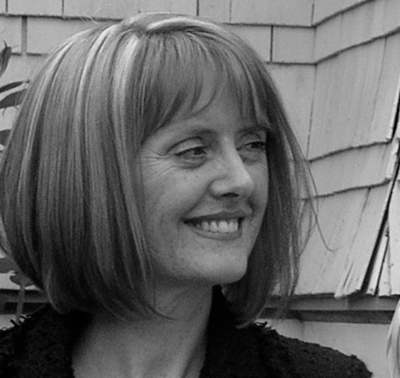
Image result for patricia young photo
Patricia Young

ABOUT THE AUTHOR
Patricia Young is the author of twelve books of poetry, and one book of short fiction, Airstream (Biblioasis, 2006). A two-time Governor General’s Award nominee, she has also won the Pat Lowther Memorial Award, the Dorothy Livesay Poetry Prize, the CBC Literary Competition, the British Columbia Book Prize for Poetry and the League of Canadian Poets National Poetry Competition. She lives in Victoria, British Columbia.

BLURBS
“Young is a masterful technician. She masons each brick into place just so. …She thrives on ambiguity and twists while fostering a rapt interest in them in the reader.”
     — Prairie Fire

“With her sure hand wielding the knife of understanding, Young cuts not just to the bone, but well beyond into realms that transcend the here, the now and the merely personal.” 
    — Monday Magazine

“Accute and quirky observation which cumulates at insight.” 
     — Freefall


576

DISCLAIMERS

Poems cited here are assumed to be under copyright by the poet and/or publisher.  They are shown here for publicity and review purposes.  For any other kind of re-use of these poems, please contact the listed publishers for permission.

We here at TBOP are technically deficient and rely on our bashful Milo to fix everything.  We received notice from Google that we were using "cookies"
and that for our readers in Europe there had to be notification of the use of those "cookies.  Please be aware that TBOP may employ the use of some "cookies" (whatever they are) and you should take that into consideration.

Friday, September 16, 2016

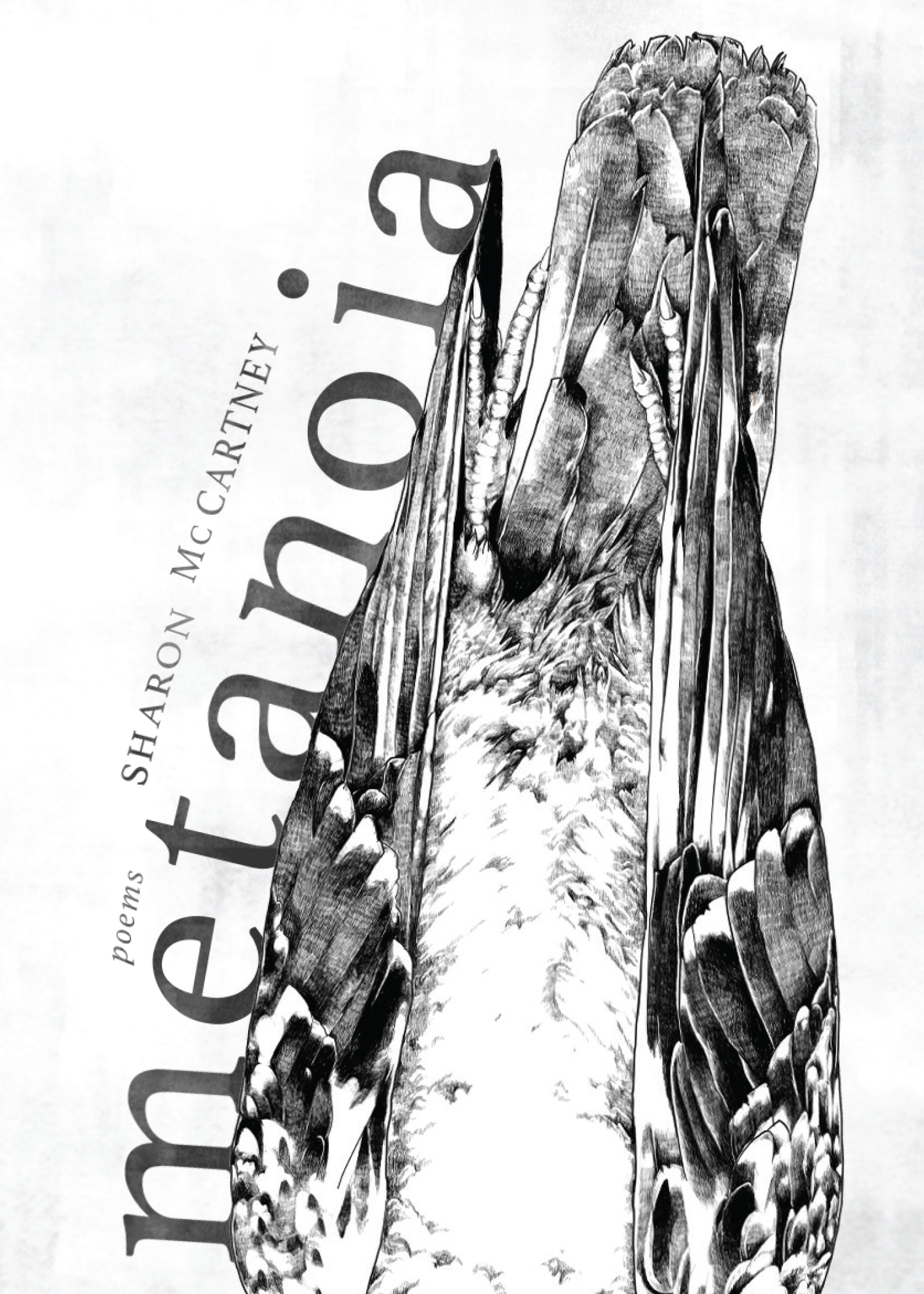
Metanoia - Sharon McCartney (Biblioasis)

Today's book of poetry:
Metanoia.  Sharon McCartney.  Biblioasis.  Windsor, Ontario.  2016.


Metanoia  -  "change in one's way of life resulting from penitence or spiritual conversion."

Metanoia is a book length poem where Sharon McCartney lets all of her ya-yas out.  These meditations are robust and fearless and not without humour.

Metanoia is a consciously streamed commentary on what the heart wants and what it is willing to settle for.  Love in uncompromising but loneliness is a compromise waiting to happen.

from Metanoia

The banker snored outrageously and twitched in his sleep.
I could not sleep beside him.
This became an issue.
That last night, I snuck off to the spare bedroom,
hoping for an hour or two.

At 5 A.M., I heard him downstairs, loading
his vehicle, the door slamming, his shoes,
angry. He tromped upstairs, perched on the edge
of the bed in the dark, saying, darkly,
"I didn't want to leave without saying goodbye."

No, I thought, you didn't want to leave without hurting me.

...

McCartney's confessions can sound braggart cold but she is always on the precise pulse of where the skin tears.

Fearing too much Tennessee Ernie Ford in her future, the speaker in Metanoia finds any advice from her parent past antithetical, she wants to break free of all expectations and attempts to, only to crash and break again and again on the sharp shores of her own preconceptions of love, lust, desire and hope.

from Metanoia

I strung the fat man along;
I thought I was sparing him.

A lie. I was sparing myself.

Because I waited too long to speak,
I became revulsed.

The last time we had sex, I said to myself,
"This is the last time."
I did not say that to him.

...

Perhaps we are all mercenaries of love destined to karma payment for our sins and misdemeanours. Sharon McCartney has left Today's book of poetry wanting more with Metanoia, not because of any lack, quite the contrary, Today's book of poetry could read this sort of unselfish wisdom all day long.

McCartney sounds/feels so true that you feel terrible empathy for her unwanted lovers as well as her own unsatisfied angst rattling around in her big dreamy head.  At the same time the poems excite the reader with their candor because whenever McCartney rattles her own cage lust hits a target.

from Metanoia

What I felt so many years ago in the grade 9 English classroom,
how I lost my sense of membrane, of containment, my self
leaching into the Bermuda lawn beyond the sliding glass door,
into the eucalyptus, the succulents, the birds of paradise

...

Our morning read was taken over by an enthusiastic Kathryn, our Jr. Editor.  She insisted that Metanoia needed a woman's voice and she was the one to provide it - she was right.  Kathryn read the heart right out of these poems and into the room.  

Sharon McCartney has shared an emotional pilgrimage with carnal candor and a hopeful heart.  Today's book of poetry is always going to have all sorts of time for anything this dynamic and emotionally honest.  That's how revelations happen.

McCartney, Sharon
Sharon McCartney

ABOUT THE AUTHOR
Sharon McCartney is the author of Hard Ass (2013, Palimpsest Press), For and Against (2010, Goose Lane Editions), The Love Song of Laura Ingalls Wilder  (2007, Nightwood Editions), Karenin Sings the Blues (2003, Goose Lane Editions), and Under the Abdominal Wall (1999, Anvil Press). Her poems have been included in the 2012 and 2013 editions of The Best Canadian Poetry in English. In 2008, she received the Acorn/Plantos People’s Prize for poetry. She lives in Fredericton, New Brunswick, where she works as a legal editor.

BLURBS
“So much is revealed in so few words … It’s a book that feels light, but its delivery is heavy, and worthy of contemplation … McCartney is merciless in exposing vulnerability, but also builds an intimacy integral to Metanoia‘s achievement.”
     —Quill & Quire

“Sharon McCartney is something else, a poet with a personal vision who, in work after work, digs deeper into the exposed tissue of her own soul.”
     —NumĂ©ro Cinq

“McCartney’s poetic voice is direct, confessional, and, at times, philosophical, examining the nuances of family dynamics, romance, friendship, and illness. These lyric narratives are structured in single-stanza bursts of emotion and infused with plenty of raw vulnerability … These poems explore a romance with directness and emotional punch.”
     —Jennifer LoveGrove, Quill and Quire

“No unnecessary word, no dull word, no stock imagery, every new insight or description at once astonishing and just, everything at once new and yet polished, diamond hard. Her language is brilliant, sensuous, startling, sometimes relaxed and cajoling, sometimes savage.”
     —M. Travis Lane, The Antigonish Review

“You don’t read these poems, you feel them: Hammer in the head, shod foot on the throat, stiletto in the heart. It’s those combos of wild, piercing insights (or unusual but poignant images); yep, that’s what makes it good for you–or kills you, laughing.”
     —George Elliott Clarke

“Darkly obsessive, For and Against documents the rolling flux of life–the raw wounds of relationships in moments that are, in turn, anguished, edgy, droll, and affectionate. McCartney’s poems are an extreme sport–one well worth playing.”
     —Jeanette Lynes, author of The New Blue Distance

“McCartney has shown a delightful felicity in previous books with stapling phrases into the memory. For and Againstexpands this strength with different material, and it’s a testament to her talent that rawness isn’t diminished by an attention to fluency.”
     —Brian Palmu


“With her unflinching eye and masterful yet never flamboyant command of language, McCartney consistently distinguishes herself from her literary contemporaries.”
     —The Oxonian Review


503

DISCLAIMERS

Poems cited here are assumed to be under copyright by the poet and/or publisher.  They are shown here for publicity and review purposes.  For any other kind of re-use of these poems, please contact the listed publishers for permission.

We here at TBOP are technically deficient and rely on our bashful Milo to fix everything.  We received notice from Google that we were using "cookies"
and that for our readers in Europe there had to be notification of the use of those "cookies.  Please be aware that TBOP may employ the use of some "cookies" (whatever they are) and you should take that into consideration.

Thursday, September 24, 2015

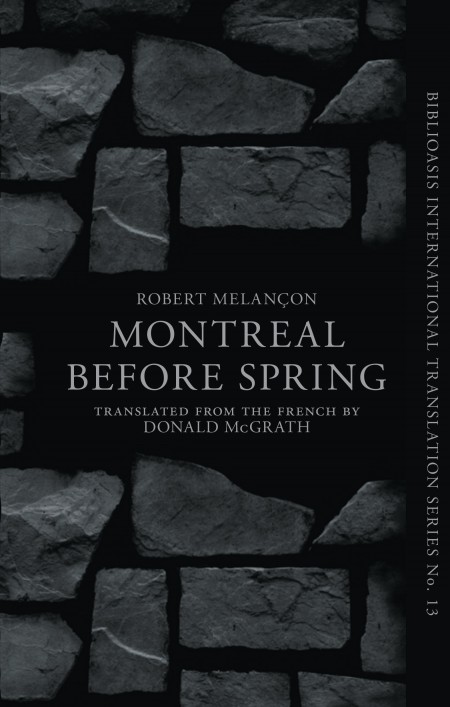
Montreal Before Spring - Robert Melancon (Biblioasis)

Today's book of poetry:
Montreal Before Spring.  Robert Melancon.  Translated from the French by Donald McGrath.  Biblioasis.  Windsor, Ontario.  2015.


Robert Melancon translated Earle Birney into French, that puts him in damned good stead here at Today's book of poetry.  Earle Birney is one of the cornerstones of our belief in poetry.  If Robert Melancon likes Birney then let's open this book.

And there it is.  We're not suggesting that there is much similarity in voice or style - but Melancon, like Birney, knows everything under the sun and is a gentleman about sharing it.

Montreal Before Spring is an occasional weather report, both literally and figuratively.  Melancon is taking and talking the temperature of Montreal at the same time as he is celebrating the city.  And the citizens.

Eden

Sunset, noise of cars,
and all those people
rushing everywhere
at once; delightful
just the way it is!
The mixed aromas,
the shifting colours,
street signs and the air
you drink in, having
so little else to do.

So delightful! Night
unfolds its banners
between the buildings,
the far horizon
reddens, turns coal black.

You go forth, drunk on
the multitudes, drunk
on everything, while
the lampposts sprinkle
nodding streets with stars.

...

Melancon sees the big and the small and treats them with equal respect and curiosity.  There is a lovely, long letter/poem to the Canadian poet George Johnston that is filled with admiration for Johnston's writing, both his poetry and his handwriting.  That's no joke, a handwritten note from Johnston looks like it was laboured down onto velum by some very devout monks.  I like this.  I like this celebration of friendship and craft.  Melancon does it again with a laudatory epistle to/about Jean-Aubert Loranger (one of Canada's first modernist poets).  These meditations on friendship give us a good look into the poetic heart of a soulful man.

A Voice Heard In A Dream,
Upon Awakening

"Your days will pass, one by one,
words in a breathless sentence strung
together without punctuation, your actions,
those thoughts that come as such a cost,
won't follow you, but if they do
it will be as perpetually vain regrets, little
will it matter, very little, whether you
betray or remain faithful, because each will
come to you in turn, everything will
be lost as if you'd been dreaming, it's like
a dream, the disorder of an old man's life
that comes back at the end, you'll descend
into lower depths you don't suspect are there,
you'll be seized, at times, by an unfathomable joy
before the expanse that evening will open up
where the streets run out; impassive, the world
will continue on its course, flowers
that will fade in autumn will come, snow
that will melt like snow in the sun, each day
will bring with it the History you'll throw out
with the newspaper, with your boredom, you'll
have friendships that you'll lose, love you'll see
falling away from you, that you'll try
in vain to hold on to, everything will be
given to you, everything taken away,
everything will come, everything pass away
like this night I've pulled you from, now go."

...

Today's book of poetry hear's A.M. Klien, Raymond Souster, Louis Dudek, St. Leonard of Cohen, Irving-King of Layton in these poems along with a host of other giants.  Today's book of poetry is embarrassed to admit our knowledge of French language poetry from Quebec is sadly uninformed. Melancon's Montreal Before Spring is a welcome introduction (for this reader) to another fine Canadian writer.

Robert Melancon's poetry has moments full of playful vigour, there is never any pious posturing but there are deeply meditative philosophical questions along the way, baked into the cake, under that sweet icing.  He deals with big issues before you know he's on to them and while you contemplate that Melancon reflects on the angle of the sun setting over Montreal rooftops.

Master class stuff.

Afternoon Song

This sky, grey as your eyes.
The endless snow. The day
seems to have stopped.

Your arms wind round me, I don't
even have to close my eyes
to believe that you are here.

I look out at the afternoon,
as idle as a man lost
in his thoughts. The clouds

stretch out. The air
wraps around itself. The whole city's
an alcove where I go to meet you.

...

Montreal Before Spring is an annual, a year-round love story/poem to the coolest city in North America.  Robert Melancon loves the city and the people and the snow and the sun.  Montreal Before Spring has everything except good bagels, good smoked meat.

There is a great tenderness in these poems.  TBOP loves that.

Donald McGrath's translation is invisible, seamless.

Robert Melancon

ABOUT THE AUTHOR
Robert Melançon is one of Quebec’s most original poets. He won the Governor General’s Award for Poetry for his collection Blind Painting and shared the Governor General’s Award for Translation with Charlotte Melançon for their French version of A.M. Klein’s The Second Scroll. A long-time translator of Canadian poet Earle Birney, Melançon has been the poetry columnist for the Montreal newspaper Le Devoir and the Radio-Canada program En Toutes Lettres. He lives in North Hatley, in Quebec’s Eastern Townships.

ABOUT THE TRANSLATOR
Donald McGrath grew up in a fishing village on the Avalon Peninsula of Newfoundland and moved away from the island at the age of nineteen to study art at the Nova Scotia College of Art and Design. He has been a longshoreman, factory worker and waiter, and currently works as a translator in Montreal, where he has lived for the past twenty-five years. He has published in periodicals and reviews in Canada, Australia and the UK, and is the author of one previous poetry collection, At First Light (1995).

You can see a TBOP blog about Donald McGrath's poetry here:  http://michaeldennispoet.blogspot.ca/2014/06/the-port-inventory-donald-mcgrath.html


Donald McGrath


BLURBS
“Poetry, in Melançon’s hands, is a way of seeing.”
      — GoodReports

"Melancon's work is rich and deceptively simple."
     -- Globe and Mail


384

DISCLAIMERS

Poems cited here are assumed to be under copyright by the poet and/or publisher.  They are shown here for publicity and review purposes.  For any other kind of re-use of these poems, please contact the listed publishers for permission.

We here at TBOP are technically deficient and rely on our bashful Milo to fix everything.  We received notice from Google that we were using "cookies"
and that for our readers in Europe there had to be notification of the use of those "cookies.  Please be aware that TBOP may employ the use of some "cookies" (whatever they are) and you should take that into consideration.


Friday, January 23, 2015

Inheritance - Kerry-Lee Powell (Biblioasis)

Today's book of poetry:
Inheritance.  Kerry-Lee Powell.  Biblioasis.  Windsor, Ontario.  2014.


Kerry-Lee Powell is Winner of the 2013 Boston Review Fiction Contest and the 2013 Malahat Review Far Horizons Award.

Damn it all to hell if she isn't the best thing since sliced bread.

Inheritance could be the best book of poems I've read since my own father died.  Inheritance starts as an elegy to a dead father.  It doesn't stop there.

If this book doesn't show up on every "best of" list, every award nomination list, there is nothing I can do about it - but it should.

These harrowing poems could only venture forth out of a deep and abiding love for truth,  It is a scourging, searing swat of emotional intensity.

The Last of the Hitlers

The storm tore a pier off Long Island Sound,
unearthed a row of oaks and a Mafioso corpse
from the grounds of the Federal Reserve.

New York at dusk is neo-classical,
all coloumns and wingless silhouettes
crowding the high windows.

Down here it's sewage and hazard warnings,
sirens shrieking like bereaved women
and the last of the Hitlers on his daily walk,

holding the frail vial of his body taut
because he's vowed to spare the world his blood
and let the ignominious line die out.

If he spills a drop the taint will spread,
infect the causeway and the flooded marsh.
Last of the Hitlers, last of the Patriarchs.

Although in this gloom he could be you or anyone,
a Canute who seeks to command
the engulfing waves with a stay of his hand,

while a fresh storm on the Atlantic gathers force.
Let the Greats smash
their pianos in resounding finales,

lash the air with salt and applause
for this lone man at the land's drowned end,
as if he was the last monster, the last god.

...

Powell is searching for all those lost souls caught adrift and sinking.

She looks around those corners and sheds light towards the all encompassing darkness as though she were an usherette, flashlight in hand, in an old theatre while Bela Lugosi lit up the black and white screen.

Malefic

What isn't clear is how she keeps breathing
in the locked trunk of his car, mouth and nostrils

taped or how he steers the slack heap
of her body up the stairwell to the unlit

place he often dozes in while shady figures
on the screen steal off with other bundled shapes

in loosely strung narratives but where also he lies rapt
staring up through cracked plaster

to where his secret star throbs like an ache
in the temples, spelling out the nightly pattern

and pace of the recurring thoughts that spur him
to become at first a dimly felt presence

between streetlights and entrances
but every now and then a face, blurring amid

stunned winces and repeated blows in the unkempt
room that shifts in and out of focus,

ink spraying in all directions, because she
is a bird in a chimney

fingers smeared with soot, reaching for her one
chance for escape, when the grabbed fabric

drags behind her in that ordeal from the window
to the bathroom where he is a looming angel

to whom she falls in sudden worship, across slicked
tiles and into fragments in black plastic,

back in the trunk and again when the officials
dredging the canal look up to guess which high rail

he has leaned from, the unknown perpetrator
to see his own ill-defined silhouette in the water

and the weighted sack shatter that brief mirror.

...

Kerry-Lee Powell is fearless in the way fearless people can be -- her laser purpose would seem to be to illuminate that unseen moment.  There are human interactions we recognize only after the fact, if ever, if at all.

Powell sets her poems out to feed off of these moments, she mines the internal conflict, makes it public.

Inhuman

They called from the hospital to say
this time you were really dying.
I was fifteen, late home from the movies,
mouth bruised from kissing.

I'd seen so many deaths on the screen,
with knives and guns, capes and fangs.
Death didn't drain off into an armchair
as monotonous as your laboured rasp.

Twice I stood by you, shifting from one
leg to the other, my kindnesses stolen
from soaps, from stars with skin like milk,
their breasts over the flattened soldiers.

At the hospital I couldn't pretend
I wanted to lean into you as the others leaned
to heave their grief out into kisses. I backed off,
tried to look like a loved one, a human.

It's no wonder that your face
visits my face in the mirror the least often.
My neglected grandfather, I would like you to have seen
that string of teenage suck-marks around my neck.

Your blood, my first romance.

...

Pity the dead, pray over the dying.

Kerry-Lee Powell uses her personal history like a spring board.  Watch as she jack-knives into your thoughts.

These poems stay with you.  The jack-knife in this case isn't the dive.  Powell actually cuts into you, leaves a mark.

Kerry-Lee Powell

ABOUT THE AUTHOR
Born in Montreal, Kerry-Lee Powell has lived in Australia, Antigua, and The United Kingdom, where she studied Medieval and Renaissance literature at Cardiff University and directed a literature promotion agency. Her work has appeared in journals and anthologies throughout the United Kingdom and North America, including The Spectator, The Boston Review, and The Virago Writing Women series. In 2013, she won The Boston Review fiction contest, The Malahat Review’s Far Horizons Award for short fiction, and the Alfred G. Bailey manuscript prize. A chapbook entitled “The Wreckage” has recently been published in England by Grey Suit Editions. A novel and short fiction collection are forthcoming from HarperCollins. Inheritance is her first book.


295

Poems cited here are assumed to be under copyright by the poet and/or publisher.  They are shown here for publicity and review purposes.  For any other kind of re-use of these poems, please contact the listed publishers for permission.