Showing posts with label raymond souster. Show all posts

Friday, November 24, 2017

Tusk-a-Loose'a - Mark Laba (Puddles of Sky Press)

Today's book of poetry:
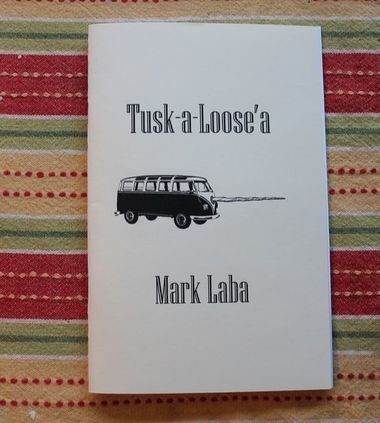
Tusk-a-loose'a.  Mark Laba.  Puddles of Sky Press.  Kingston, Ontario.  2017.
Picture

4


I'd bury the hatchet with anyone

Whether it be in spruce maple pine

Or crime scene tape

On a TV show

Where a guy in a lakeside motel dies

While watching static on a TV screen

Thinking it was messages from

His dead wife

And the hatchet that I'm holding

Is the one that did

The trick.

...


It has finally happened.  

The first perfect poetry book.

Now, it's a short book, a chapbook in fact, but here is why I think Mark Laba's Tusk-a-Loose'a is perfect.

The front cover, perfect.  Simple, visually arresting, pure and twisted.

Inside.  Every single poem worked, pulled their weight.  Got the job done.  It was marvelous.  When I'm reading poetry for Today's book of poetry I usually write down page numbers of poems I particularly like and want to use for the blog but with Tusk-a-Loose'a I enjoyed the first poem, and then the second and then the third and then the fourth, and so on.  It was sweep, a perfect game, the opposite of a no-hitter but more rare.  

Today's book of poetry didn't have to write down a thing because every poem blasted past with the same high-tone velocity, we wanted to share every damned one.

Mark Laba has been around since we first discovered snow, but I've never met the man.  More's the pity.  Laba has endless wit, he knows exactly how close to the edge to take his reader - before pushing them over.

1


Asphalt opens

To the arteries of trees beneath

Scrabbing across shadow-strewn and rain-sodden streets

Where raccoons occasionally cross

To wash

The severed heads of their little squirrel victims

And encase them in plexiglass displays

They stole from the hobby shop.

...

It is hard to imagine doing more with any less.  Laba throws the reader around like a rag doll, not so much misdirection as vibrant lead step in a dance duo.  Mark Laba reads like Stephen Wright and Saint Nelson of Ball had a child with a young Raymond Souster, before the banks got him.  Laba is like that wisecracking kid at the back of the classrooms of our youth, the one that always had the right thing to say and was willing to say it at the wrong time.

Today's book of poetry had Milo, our head tech, check out the stacks to see what he could find from Mark Laba.  Our pickings were unfortunately slim with only Movies in the Insect Temple (Proper Tales Press, 1981) and The Thing In Exile which was co-authored with Steven Feldman and Stuart Ross (Books By Kids, 1975).  After reading Tusk-a-Loose'a Today's book of poetry will be on the hunt more of anything by Mark Laba.  It turns out he may be the best poet in Canada you've never heard of.

8


Lately I've thought about the narwhal tusk

As a navigation device for my mini-van

A way to breeze along through the bi-ways and highways

Of a nation I just invented that I call well I forget

What I called it

But you can bet your bottom dollar

It was one hell'uva nation

Before it sank into the ocean

Which wasn't my fault

As I was at the orthodontist

And my second-in-command

Was crushed under an avalanche

Of packing peanuts.

...

Mark Laba writes like a wise hipster Yoda.  "Good poems, you must."  This little chapbook punches way above its weight.

Our morning read was hillll-lair-eeeeeeeeee-ous.  These poems snapped around the room like the flick of a wet towel in a happy locker room.  The energy went around the room as though we had all had our fingers in the same poetry socket.

Today's book of poetry is here to tell you that Mark Laba is a poetry time bomb, and Tusk-a-Loose'a is one of those marvels that makes you happy to have it in your hands.

6


You can only Doppler your way

Out of so many situations like

Judging dog shows or liquefying things for future museums

But as the echo recedes

So does your memory

Until soon you're that old guy in the wheelchair at the beach

With a blanket over his legs

Yelling at the seagulls to stop crapping on his toupee.


...


Only flaw in Mark Laba's perfect Tusk-a-Loose'a is that we wanted more of it.

Image result for mark laba poet photo

Mark Laba

ABOUT THE AUTHOR
Mark Laba lives in Vancouver where he once talked his way into being a restaurant reviewer for a  Vancouver newspaper, but it ruined his appetite. He's been writing for a long time, although he takes breaks occasionally to indulge in his twin-passions for ventriloquism and cephalopod massage therapy. If you need to speak with him he's usually behind the cardboard baling machine in the Safeway shipping dock at 41st and Cambie on Monday, Wednesday and Friday from 10am until 1pm. Otherwise he devotes his time to a discarded sofa-bed rescue centre.


633
DISCLAIMERS

Poems cited here are assumed to be under copyright by the poet and/or publisher.  They are shown here for publicity and review purposes.  For any other kind of re-use of these poems, please contact the listed publishers for permission.


We here at TBOP are technically deficient and rely on our bashful Milo to fix everything.  We received notice from Google that we were using "cookies"
and that for our readers in Europe there had to be notification of the use of those "cookies.  Please be aware that TBOP may employ the use of some "cookies" (whatever they are) and you should take that into consideration

Thursday, September 24, 2015

Montreal Before Spring - Robert Melancon (Biblioasis)

Today's book of poetry:
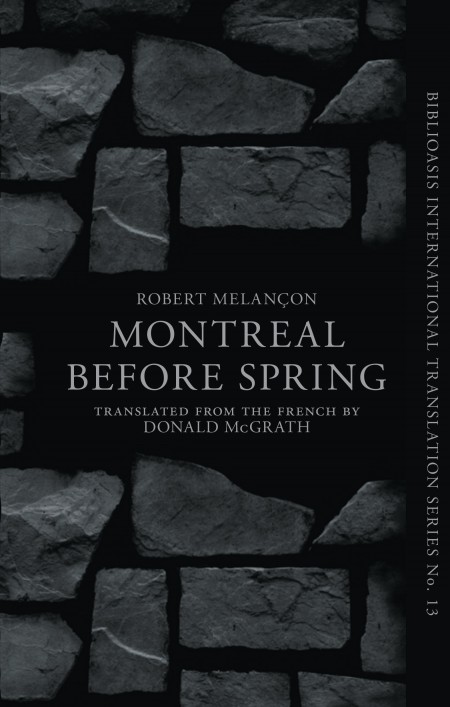
Montreal Before Spring.  Robert Melancon.  Translated from the French by Donald McGrath.  Biblioasis.  Windsor, Ontario.  2015.


Robert Melancon translated Earle Birney into French, that puts him in damned good stead here at Today's book of poetry.  Earle Birney is one of the cornerstones of our belief in poetry.  If Robert Melancon likes Birney then let's open this book.

And there it is.  We're not suggesting that there is much similarity in voice or style - but Melancon, like Birney, knows everything under the sun and is a gentleman about sharing it.

Montreal Before Spring is an occasional weather report, both literally and figuratively.  Melancon is taking and talking the temperature of Montreal at the same time as he is celebrating the city.  And the citizens.

Eden

Sunset, noise of cars,
and all those people
rushing everywhere
at once; delightful
just the way it is!
The mixed aromas,
the shifting colours,
street signs and the air
you drink in, having
so little else to do.

So delightful! Night
unfolds its banners
between the buildings,
the far horizon
reddens, turns coal black.

You go forth, drunk on
the multitudes, drunk
on everything, while
the lampposts sprinkle
nodding streets with stars.

...

Melancon sees the big and the small and treats them with equal respect and curiosity.  There is a lovely, long letter/poem to the Canadian poet George Johnston that is filled with admiration for Johnston's writing, both his poetry and his handwriting.  That's no joke, a handwritten note from Johnston looks like it was laboured down onto velum by some very devout monks.  I like this.  I like this celebration of friendship and craft.  Melancon does it again with a laudatory epistle to/about Jean-Aubert Loranger (one of Canada's first modernist poets).  These meditations on friendship give us a good look into the poetic heart of a soulful man.

A Voice Heard In A Dream,
Upon Awakening

"Your days will pass, one by one,
words in a breathless sentence strung
together without punctuation, your actions,
those thoughts that come as such a cost,
won't follow you, but if they do
it will be as perpetually vain regrets, little
will it matter, very little, whether you
betray or remain faithful, because each will
come to you in turn, everything will
be lost as if you'd been dreaming, it's like
a dream, the disorder of an old man's life
that comes back at the end, you'll descend
into lower depths you don't suspect are there,
you'll be seized, at times, by an unfathomable joy
before the expanse that evening will open up
where the streets run out; impassive, the world
will continue on its course, flowers
that will fade in autumn will come, snow
that will melt like snow in the sun, each day
will bring with it the History you'll throw out
with the newspaper, with your boredom, you'll
have friendships that you'll lose, love you'll see
falling away from you, that you'll try
in vain to hold on to, everything will be
given to you, everything taken away,
everything will come, everything pass away
like this night I've pulled you from, now go."

...

Today's book of poetry hear's A.M. Klien, Raymond Souster, Louis Dudek, St. Leonard of Cohen, Irving-King of Layton in these poems along with a host of other giants.  Today's book of poetry is embarrassed to admit our knowledge of French language poetry from Quebec is sadly uninformed. Melancon's Montreal Before Spring is a welcome introduction (for this reader) to another fine Canadian writer.

Robert Melancon's poetry has moments full of playful vigour, there is never any pious posturing but there are deeply meditative philosophical questions along the way, baked into the cake, under that sweet icing.  He deals with big issues before you know he's on to them and while you contemplate that Melancon reflects on the angle of the sun setting over Montreal rooftops.

Master class stuff.

Afternoon Song

This sky, grey as your eyes.
The endless snow. The day
seems to have stopped.

Your arms wind round me, I don't
even have to close my eyes
to believe that you are here.

I look out at the afternoon,
as idle as a man lost
in his thoughts. The clouds

stretch out. The air
wraps around itself. The whole city's
an alcove where I go to meet you.

...

Montreal Before Spring is an annual, a year-round love story/poem to the coolest city in North America.  Robert Melancon loves the city and the people and the snow and the sun.  Montreal Before Spring has everything except good bagels, good smoked meat.

There is a great tenderness in these poems.  TBOP loves that.

Donald McGrath's translation is invisible, seamless.

Robert Melancon

ABOUT THE AUTHOR
Robert Melançon is one of Quebec’s most original poets. He won the Governor General’s Award for Poetry for his collection Blind Painting and shared the Governor General’s Award for Translation with Charlotte Melançon for their French version of A.M. Klein’s The Second Scroll. A long-time translator of Canadian poet Earle Birney, Melançon has been the poetry columnist for the Montreal newspaper Le Devoir and the Radio-Canada program En Toutes Lettres. He lives in North Hatley, in Quebec’s Eastern Townships.

ABOUT THE TRANSLATOR
Donald McGrath grew up in a fishing village on the Avalon Peninsula of Newfoundland and moved away from the island at the age of nineteen to study art at the Nova Scotia College of Art and Design. He has been a longshoreman, factory worker and waiter, and currently works as a translator in Montreal, where he has lived for the past twenty-five years. He has published in periodicals and reviews in Canada, Australia and the UK, and is the author of one previous poetry collection, At First Light (1995).

You can see a TBOP blog about Donald McGrath's poetry here:  http://michaeldennispoet.blogspot.ca/2014/06/the-port-inventory-donald-mcgrath.html


Donald McGrath


BLURBS
“Poetry, in Melançon’s hands, is a way of seeing.”
      — GoodReports

"Melancon's work is rich and deceptively simple."
     -- Globe and Mail


384

DISCLAIMERS

Poems cited here are assumed to be under copyright by the poet and/or publisher.  They are shown here for publicity and review purposes.  For any other kind of re-use of these poems, please contact the listed publishers for permission.

We here at TBOP are technically deficient and rely on our bashful Milo to fix everything.  We received notice from Google that we were using "cookies"
and that for our readers in Europe there had to be notification of the use of those "cookies.  Please be aware that TBOP may employ the use of some "cookies" (whatever they are) and you should take that into consideration.


Tuesday, September 8, 2015

Miscellaneous Wreckage - Greg Simison (Thistledown Press)

Today's book of poetry:
Miscellaneous Wreckage.  Greg Simison.  Thistledown Press.  Saskatoon, Saskatchewan.  2014.


In Greg Simison's fourth collections of poetry, Miscellaneous Wreckage, he is letting all his ya-ya's out.  There are some absolutely hilarious divorce poems wafting around inside this madhouse of humour and stiff-upper-lip resolution.  Simison's poems sound like your favourite smart-ass uncle ruminating with educated candor.

There are no poetry tricks, gimmicks or hysterics.  These are salt of the earth, steady, sturdy poems.
Think of Raymond Souster with a couple of wise scotch into him.

Dreams of the Grand Banks

Amateur anthropologists, we sift
through rock mounds in the field looking
for artefacts: pounders, scrapers, awls
and spear points, gathered and tossed here,
broken and twisted beyond any use, alongside
all the miscellaneous wreckage of farm life.

And though no stone tools reveal
themselves, digging through the third pile
we soon expose the old, disjointed bones of
a man's life: a dozen Johnnie Walker bottles,
evidence of a love of whiskey; the rusted cans of
Repeater, his tobacco brand, and what we first take

to be an old shed roof, on closer
inspection, turns out to be the bleached
ribs of a homemade rowboat. So this strange
country delivers yet one more mystery:
a boat in the middle of a wheatfield. The closest
lake, three miles to the north, alkaline and lifeless

since the last ice age; the closest fish,
ten miles to the west, unless we count the
bony few swimming through rock fifty feet
beneath the ground where he himself now floats.
Of course, ever the romantic, I start reconstructing
a dreamer: a homesick fisherman, new immigrant

or hopeful maritimer with a one-way
ticket, swapping one sea for another, only to
find himself marooned, a landlocked homesteader
with no way back when the dream finally turned
to dust. And I imagine him out there late at
night, seated in the stranded boat, washed up on that

stone island, sipping whiskey and
drunkenly arguing with the indifferent
moon. Rolling one-handed smokes in the
dark, he lights the wooden matches with a
blackened thumbnail, creating sudden small stars,
but stars too brief and too late to steer an old sailor home.

...

Today's book of poetry thinks, as the poet has already confessed, that Simison is a hopeless romantic in slightly grumpy skin.  We took a poll around the office and eventually came to a consensus, we here at Today's book of poetry believe that Simison has a large gold ring in one of his ears in case he buys the farm on a foreign shore.

He is clearly a pirate.

The comedy and ease of these heartwarming poems disguise a specific moral code of conduct that Simison has built his voice around.  He doesn't waver and we like this voice.  It is smart, brash, bold and ultimately - very tender.

9C

After they took his leg to slow down the
cancer, I visited one evening and announced

he may as well have had a sex change
because from them on I'd be calling him Peggy.

He retaliated in a hoarse whisper
that despite the fact I was God's own fool,

he was still prepared to cut me
a deal on a barely worn right shoe,

but quickly changed the subject, knowing
within a month I'd have the pair for nothing.

...

If you are lucky you have a Greg Simison in your life.  A wise/wisecracking decoder, someone who tells the terrible truth with compassion.  These poems grow on you, they compound, and collectively they hum.

Simison has made no attempt to package these poems as a narrative, each poem stands alone, yet cumulatively coalesce into something important.  Miscellaneous Wreckage would make Simison's proper and prim mother proud, it is tea on the table.

Calls

My brother calls at 1 a.m.
to tell me the ambulance has
taken her to the Civic Hospital,

suggests it would be best
if I flew out as soon as possible.
I call my children with the news.

Book a ticket. Pack a suitcase.
With terrible practicality, learned
at her side, include a black suit, A tie.

And realize, on perhaps
this longest night of our lives,
we're all simply small children

who've only been outside
playing grownups until our
mothers call us home, one last time.

...

Reading Miscellaneous Wreckage was like meeting up with an old friend and hearing all their stories. Greg Simison writes with just the right amount of distrust and disdain to disguise how much his loves this world and all of us in it.

  Greg Simison

ABOUT THE AUTHOR
Greg Simison was born in Guildford, England, and came to Canada as a child. He is the author of four books of poetry. His latest collection, Miscellaneous Wreckage, was released by Thistledown Press in 2014. Simison spent eight years writing a weekly column for a small newspaper in B.C. , and was both scriptwriter and director for Organized Crimes, a theatre company that produced more than twenty-five Murder Mystery events throughout the Okanagan Valley. He currently resides in Moose Jaw.

BLURB
The poems in Miscellaneous Wreckage are always approachable, marked as they are by a sense of humour and a light touch, by surprising turns of phrase and clever twists of thought. Greg Simison is the kind of poet who knows that crows and ravens are 'properly dressed year round / for either death or dining out'. Simison, however, is firmly on the side of life, inheriting from an English mother the notion that troubles are best met by heating up the kettle and 'getting on with this living business'.
     -  Robert Currie, author of Running in Darkness and Witness
380
DISCLAIMERS

Poems cited here are assumed to be under copyright by the poet and/or publisher.  They are shown here for publicity and review purposes.  For any other kind of re-use of these poems, please contact the listed publishers for permission.

We here at TBOP are technically deficient and rely on our bashful Milo to fix everything.  We received notice from Google that we were using "cookies"
and that for our readers in Europe there had to be notification of the use of those "cookies.  Please be aware that TBOP may employ the use of some "cookies" (whatever they are) and you should take that into consideration.


Sunday, August 30, 2015

When We Were Old - Peter Unwin (Cormorant Books)

Today's book of poetry:
When We Were Old.  Peter Unwin.  Cormorant Books Inc.  Toronto, Ontario. 2014.


When We Were Old not only echoes the title of the great and under-appreciated Raymond Souster's When We Were Young, the poetry contained within maintains the high standards of Saint Raymond of Souster's work.  That is no small accomplishment.

But it is another excellent Canadian writer that comes to mind when I read and reread these hard packed gems.  Many years ago I had the honour of sharing a scotch or two with Alistar MacLeod. MacLeod  is absolutely one of the best writers ever and I'm willing to bust heads on this one. MacLeod is sacred territory in this house so when I tell you that Peter Unwin's poems impart some of that same sense of hard earned wisdom, that sense of urgency towards kindness, I am not giving faint praise.

The Family Place

The children are up
even if we are not.

The dew is on the land
even if we are somewhere else.

The mice are in the traps,
even if we prefer to think

otherwise about ourselves.
The brush is in the hair, the birds

are at it, the coffee's cooked
and the day

is about to get cracked
by us.
...

Unwin writes with a great sweetness that is entirely devoid of saccharine.  These poems are never sentimental but they are deeply tender and moving.

There is also a feeling of hope and we here at Today's book of poetry are big fans of optimism of any kind.  These poems make clear that it's a thin, thin line, perhaps even that old razor's edge that Somerset ranted so eloquently about - but there are reasons to hope.  We do have a chance.

As I'm typing this blog up from the tatters of the notes my staff confettied I realized Unwin has a dark sense of whimsy under his encyclopedic noggin'.  Dark whimsy and hope, that's the ticket.

The Cost of Life

It doesn't get any cheaper than this;
to be wide awake at an early hour, partnered
to a sleeping woman who snores softly,
the cat yawning from the corner
of the bed, the stupid but inoffensive
dawn chatter of birds who mean no harm
unless you're a worm. The children
are spent, but soon they will bolt from bed
in search of Cheerios and tales of Athena;
the part where she explodes from Zeus's
head is irresistible to them and they can't
get enough of it. Outside the window
the sunlight puts poetry on the leaves
of the maple tree. I am enriched by this but
I can't describe it, it beggars both
the imagination and the family budget.
We are set for now; there is no milk
in the fridge, the washing machine
is broken and the clock ticks too loudly
but all of the household cancers
are in remission, the medical bills
getting paid by an imaginary uncle
who made a fortune in the Maldives.

...

Unwin's When We Were Old is his first volume of poetry although he is well established in other writing fields - we will be wanting much more from Mr. Unwin.  It is clear he has much to say and now that we know how excellently he says it - we want more.

This is mature poetry and it sings an adult song with humour, grace and intelligent candor.  Raymond Souster would be tickled.

Cabin at Night

At night this cabin is a ship
captained by you and me
lit by kerosene
and lurching to the North Star.

Over us the constellations fall
like harpoons. We have survived
every phase of the moon
you and me, but we will drown

with the smell of each other's hair
in our nostrils. This cabin
will wreck for generations
without us

but it will sail, it will lurch on
with another you tapping
at the face of a compass
and another me, straining at the pumps.

...

Today's book of poetry is very fond of the poetry of Peter Unwin.  Once you read When We Were Old you will be too.

Peter Unwin

ABOUT THE AUTHOR
Peter Unwin was born in Sheffield, England, and raised in Southern Ontario. He studied at Carleton University in Ottawa.
His previous fiction includes the short story collection The Rock Farmers, which was shortlisted for the Stephen Leacock Medal for Humour, and the novel Nine Bells for a Man.
His non-fiction includes The Wolf’s Head: Writing Lake Superior and Hard Surface: In Search of the Canadian Road.   Peter published a collection of short stories, LIFE WITHOUT DEATH (2013) which was a finalist for the Trillium Book Award in 2014.
He has travelled extensively in the Canadian north. Currently, he is a Master’s candidate in Culture and Communications at York and Ryerson universities. An avid practitioner of martial arts, baseball, and literature, he lives in Toronto with his wife and two daughters.

Peter Unwin
Reading his poem "Fighting in Poetry"
Video: clipin


377
* * *

Today's book of poetry would like to acknowledge our recent sporadic posts.  I'd like to blame it on my horrid staff of lolligagers and miscreants, but in fact, it is all my doing.  My father, Russell William White, passed away recently and as a result there have been some logistical difficulties.  A great door has closed and in my mind a great man has passed.  My father was as kind as any man you've ever met.  The world is slightly off kilter but we are righting our ship.

We will continue with a flexible schedule for another couple of weeks and then it is back to our regularly scheduled program

* * *

DISCLAIMERS

Poems cited here are assumed to be under copyright by the poet and/or publisher.  They are shown here for publicity and review purposes.  For any other kind of re-use of these poems, please contact the listed publishers for permission.

We here at TBOP are technically deficient and rely on our bashful Milo to fix everything.  We received notice from Google that we were using "cookies"
and that for our readers in Europe there had to be notification of the use of those "cookies.  Please be aware that TBOP may employ the use of some "cookies" (whatever they are) and you should take that into consideration.