Showing posts with label earle birney. Show all posts

Monday, October 1, 2018

Thin Air of the Knowable — Wendy Donawa (Brick Books)

Today's book of poetry:
Thin Air of the Knowable.  Wendy Donawa.  Brick Books.  London, Ontario.  2017.


Oh Thank You, thank you, thank you, Wendy Donawa.  The spirit of St. Earle of Birney is alive and well and kicking in Canadian poetry and Wendy Donawa has made it so.  Listen to this:

          Reefs—
          crenellated sawback
          dogtooth, lace—
          pouring scree down cross-hatched gullies,
          sending shale, sandstone, limestone,
          spilling this chert, cousin to flint, to chalcedony.
          And slate—shale's bastard progeny—fine-grained,
          foliated, its fossils' traces
          measuring Earth's time scales.

                                                     from "Stone's Deep Accord, Its Steady Presence"

You'd almost think big Earle was standing behind her dictating magic through a tall angels breath.  And this is not to suggest in any way that Ms. Donawa is anything but original, in a day when it is hard to do so.  And she's not borrowing diddly from Sir Earle, but Thin Air of the Knowable will remind you that giants and their ghosts still roam, we can hear them whisper when we can incant their names.

And then, in her poem "Travelling Light" Donawa invokes the voice of the graceful, subtle and wise  Phyllis Webb's "Wilson's Bowl."  Turn the page, put your foot on the gas and all of a sudden you are neck deep in "Coming Down Through Rockfall" and you realize you could be under the pen of Patrick Lane, maybe even a gentler Peter Trower, Lorna Crozier too.

On My Bedroom Window, Frost Flowers

Chunter and clunk from the basement
where my father stoked the morning furnace
by the concrete laundry tub, the coal bin.
The old house coughed up lukewarm air
through baseboard's metal grates,
I dressed fast,
             cold toes clenched on colder lino.
             On my bedroom window, frost flowers.

After school that day
chrysanthemums tapped frozen heads
against the fence
where I leaned my bike.

I let myself in, groped
in the darkening kitchen, blowing
on red knuckles, when,
just perceptibly, the house groaned,
gathered and puckered the air like
skin on scalded milk, like
hair prickling my neck.

Only my father, home early still
overcoated in the desolate front room,
moaning.  My brother dead these six weeks, I 
slammed the cocoa tin down
hard as anything and 
lit the fire.


Odd to find the old place still there.
It stands quiet in the dusk; it seems smaller,
its sensible brown shingles now a heritage palette
of caramel, cobalt, plum,
liquefying through a scrim of mist,
and the first lights coming on.

💫💫💫

Why is Today's book of poetry seeing all these great Canadian poets?  Because Wendy Donawa evokes memories of the poems we love best, there is an old time elegant wisdom inside this musical voice.  It's that we've heard songs like these from voices we looked up to, learned from.

Today's book of poetry wants to draw attention to every line on Donawa's "Time is Enough."  Donawa draws these poems right out of the earth beneath her feet.

Time is Enough

                   Time is enough, more than enough, and matter multiple and given.
                                     — Annie Dillard, "Newborn and Salted"

Time arrested, the nutty kernel secret in its shell.
And prairie burrow, either trap or haven.
Perhaps the marrow, soft and fatty in its boney cavities?
Or should I say, the spikey peach pit of the stalled heart?
Stasis, something diminished, but still
                                     time is enough, more than enough.

The coiled fiddlehead unfurls, glaciers melt and
hurtle down riverbeds, a child's soft weight
turns to bone and sinew and denial, and we transport
the day's gleamings into night:
those astonishments of sorrow, of joy.

In the brown shallows at the lake's edge,
three ancient pickerel—as long as my arm!—
scraped their bellies on smooth stones.
Slow arching backs, fins signalling out of water,
a lolling pod of miniature breaching whales.
Their languid progress through bright air,
dappled water, lattice of branch and root,
                                    and matter multiple and given.

💫💫💫

This morning's reading was a quieter affair than the norm for two reasons; half our usual gang were at large and Wendy Donawa's poems are quietly insistent.  Maggie, our newest intern, has been strangely absent for the past few days.  Kathryn and Milo, our Jr. Editor and Senior Tech, apparently have foot and mouth disease but it could also be foot in mouth.  I called their doctor, Dr. Vinnie Boombauts, and he denied knowing both of them, by name.

Today's book of poetry cannot adequately cover all the ground Donawa's Thin Air of the Knowable tracks over.  Cancer raises its villainous head in Thin Air of the Knowable, so does treaty rights, feeding pots and Schrodinger's cat and all the while Daedalus is watching as Icarus shrugs himself into the sea.  David Blackwood and Rip van Winkle conspire.  All the while Wendy Donawa comports herself with class, finds the story, rips out the poem, and shares the landscape.

Consider the Heart and its Breaking

A hollow fist-sized muscle, an incessant
knock on the door of our lives—
whether in love or terror,
ennui or tranquility.
Its receiving galleries set the beat of our breath,
our passion's pulse and cling,
and the long sleep after.

Buddhists have one word for heart-mind.

Mammals, we have fully divided hearts, two pumps.
Fully divided. We know this well:
The heart is deceitful above all things, and desperately wicked,
says the Book. But with heartbreak our two-ness splits, falls apart,

our woe bypasses reason, hijacks self-respect,
leaks through Vivaldi's adagios and the radio's hurtin' songs,
sobs abjectly.

Heartbreak, intransitive, parses the body,
puts on old clothes I thought had gone to Oxfam.

Longing's soundscape is ecstasy's simulacrum;
its cadence moaning oh, oh, oh,
and stretching vowels: alienate, ache, crave.

Consider whales' hearts, car-sized.
You could somersault in them.
How to imagine their unfathomable longing;
the massive adagio of their briny lust
must roll down ocean trenches,

cross latitudes,
fill the abyss.

Envy the hummingbird the tiny berry of its savage heart.

💫💫💫

Today's book of poetry was entirely enthralled by Wendy Donawa's excellent Thin Air of the Knowable.  We suggest reading these poems out loud with the person you love most.

Image result for wendy donawa photo

Wendy Donawa

ABOUT THE AUTHOR
Wendy Donawa, formerly a museum curator and academic in Barbados, now lives on the West Coast and participates in Victoria’s vibrant poetry scene. Her poems have appeared in anthologies, magazines, and online publications across Canada. She was a finalist in The Malahat Review’s 2013 Open Season Competition, and in 2015 she was runner-up in the inaugural Cedric Literary Awards. She has published three chapbooks, Sliding Towards Equinox (Rubicon Press, 2009), Those Astonishments of Sorrow, of Joy (Leaf Press, 2012) and The Gorge: A Cartography of Sorrows (JackPine Press, 2016). Thin Air of the Knowable is her first collection.

BLURBS
“Wendy Donawa’s poetry rests at the very edge of beauty where a wild delicacy resides.” 
     —Patrick Lane

“Like the watchmakers of old, Wendy Donawa puts a spyglass to her eye and fixes her vision to the minute, to all that carries on beneath our imperfect sight—worlds upon worlds brought into the sharpest focus.” 
     —Pamela Porter


Wendy Donawa
Reads from Thin Air of the Knowable
Video:  Brick Books


718
Poems cited here are assumed to be under copyright by the poet and/or publisher.  They are shown here for publicity and review purposes.  For any other kind of re-use of these poems, please contact the listed publishers for permission.

We here at TBOP are technically deficient and rely on our bashful Milo to fix everything.  We received notice from Google that we were using "cookies"
and that for our readers in Europe there had to be notification of the use of those "cookies.  Please be aware that TBOP may employ the use of some "cookies" (whatever they are) and you should take that into consideration.


Monday, April 10, 2017

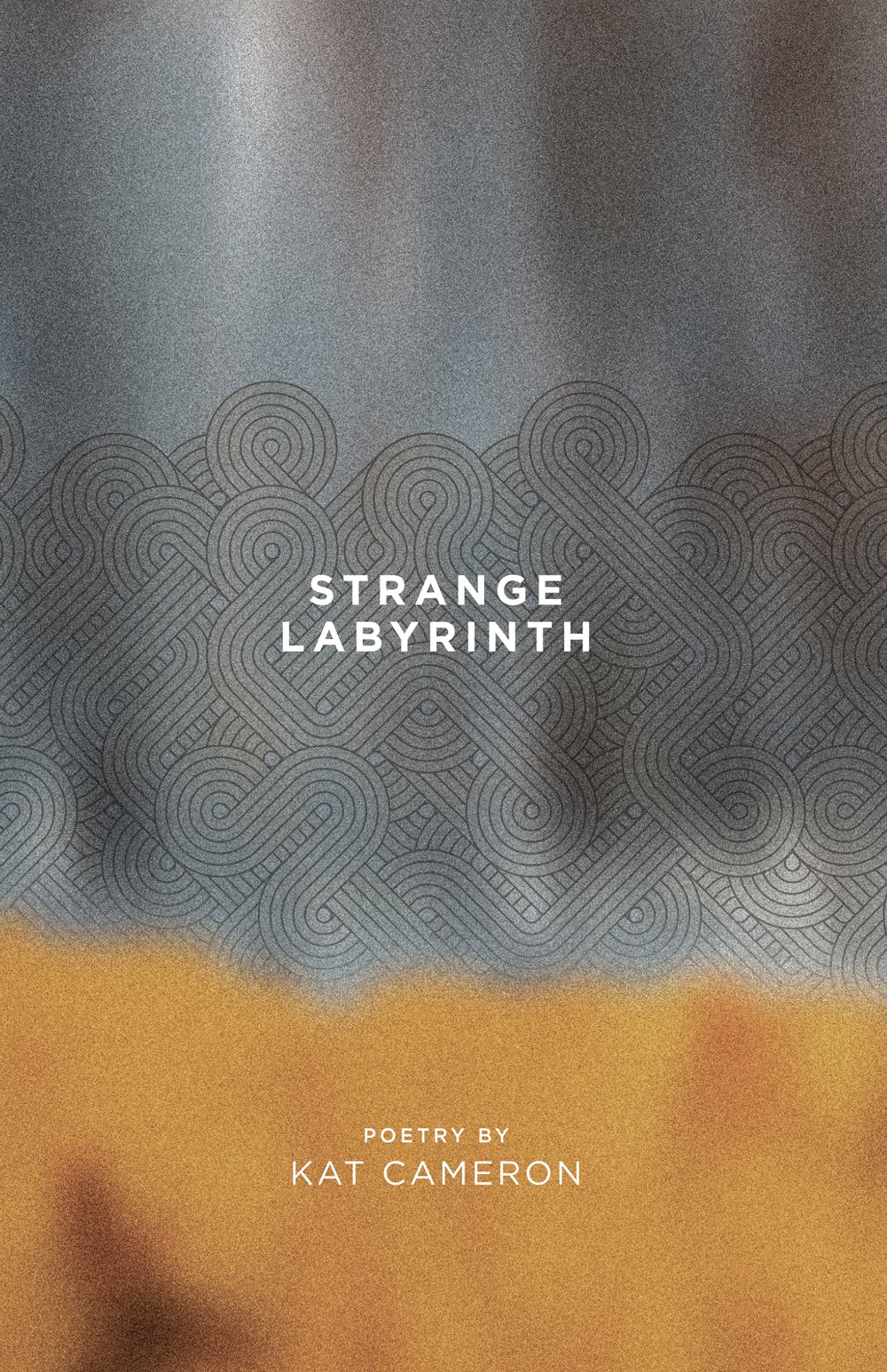
Strange Labyrinth - Kat Cameron (Oolichan Books)

Today's book of poetry:
Strange Labyrinth.  Kat Cameron.  Oolichan Books.  Fergie, British Columbia. 2014.


Kat Cameron reads twice her age, how else to explain the kaleidoscopic range of her cultural, historical and literary references where she tips her hat, says "how do you do?" to a myriad of misfits and heroes,  markers.  Today's book of poetry was on side from the start.  Strange Labyrinth is as advertised, we enter some strange territory and the exit isn't always certain but Cameron's curiosity and interests have a large span.

And the reader never feels lost.  

Cameron creates poems that have emotional certainty at the heart of them as though they arrived fully formed and knowing which way to lean into the wind.

The Palliser Slide

This rock slide destroyed one side of Mount indefatigable.
The largest rock slide in North America, it was four times larger
than the Frank slide.

Frozen waves, aeons buried in the cresting line.

In a basin, mountain-rimmed, slate-grey ramparts cross and gird, hold
back the inverted sea of sky. Far off, wavering in the foreshortened air,
snow-ghosts climb, flint heels striking fire from shale.

Ammonites spiral time in twisted coils.

Below, the darkness of the firs. A tortured path pulls and climbs
its way past clinging meadows, spots of sun. Frail jellyfish,
Queen Anne's lace, float by bristling blots of red paintbrush.

The air is thin, three thousand feet above the far earth's floor.
Marmots whistle warnings on the wind.

...

Today's book of poetry hears echoes of Saint Earle of Birney and his beautiful "David" in "The Palliser Slide," if only a frisson.  Cameron's nature capture has the same reverent awe, she makes the panorama present right there on the page.

Cameron works a whole magical lode of tenderness into her Strange Labyrinth.  Today's book of poetry doesn't want to give away any secrets but Kat the C has a thing for Mary Shelley's monster. e.e. cummings, Byron, Sylvia Plath, Elizabeth Bishop, Eliot, Pound and Vincent the Goth Van Gogh all show up, Marcus Aurelius and his Meditations sharpen Cameron's tools.  Strange Labyrinth brims with smart lyric animations and host of glamorous accomplices.

Today's book of poetry doesn't want to give the wrong impression, Kat Cameron's earthy poems aren't inhabited by or about the above mentioned iconic figures.  They are all just along for the ride. Cameron is writing about this world and our place in it, the space women inhabit that men don't know about.

Digging out the Twitch

The first sunny day in weeks and I'm in the garden,
digging out thick twitch grass, the heavy dirt clotted deep
with spidering white roots. When we bought this house,
I had plans, even though my uncalloused hands, smooth with
dishwater and lotion, spent the day tapping staccato keys.

All summer, I neglected this bed. Faded vines hang
from the fence, like shreds of forgotten sunsets.
I'm sowing the colours of spring; wanton tulips,
narcissi, and clusters of purple crocuses.

But past failures slow me down. I feel the strain
in my back, my aging knees, the shovel loads of
heavy doubt. All I can do is go on. Now
the gloves are off. I push tiny bulbs into shallow graves
feeling the soft dirt crumble with promises.

...

Our regular early morning read here at Today's book of poetry was a bit dishevelled today.  I have recently spent a few days working out in the real world with real people.  Once in a while I get work at the Art Bank and it is one of my favourite places on earth.  Picture a large warehouse carefully packed with around 20,000 works of the best contemporary Canadian art.  It's a dreamland.  I worked as an Art Technician for many years, transporting and installing art work.  In recent years I've worked mostly in the Frame Shop.  It is work I thoroughly enjoy.  So my brain and tired old posterior has been toiling hard at the Art Bank.

When I haven't been at the Art Bank I've been in David Lee world.  David Lee is a poet from Texas who now lives in Utah.  Our St. Louis correspondent, Mark Twang, sent us a couple of David Lee's books along with a Copper Canyon Press CD with David Lee Reading from A Legacy of Shadows and News from Down to the Cafe.  Today's book of poetry will be dealing with Mr. Lee in the near future but I've been making the staff listen to his CD non-stop for the last couple of days.  Now everyone around here is running around with a David Lee accent.  Beer bottle on their hip.

The other good, but distracting, news is that the sun is out.  It really does feel like spring and when that happens most of us here in Ottawa get a little sun drunk.  Everyone in town will be out on patios and in shorts by noon.  For all I know it could snow again tonight.

So our morning read was slightly distracted, we opened all the doors and windows for the first time since October.  Kathryn, our Jr. Editor, made sure that we all cottoned onto the strong feminist voice that inhabits these poems.  Cameron isn't burning down the house with strident polemics, she's informing the house because they need to know.  Once Kathryn laid down the law Kat Cameron's poems worked their way around the room, humour popped out when we least expected it, along with Frankenstein, Cameron kept us well entertained.

from Camille

II. Le Baiser

Two bodies.

I long to stroke his back
the soft deep groove from neck
to ass.

His hand holds the hollow
of my hip.

I pull him towards me,
me leg angles
my body closer.

Fused marble.

One kiss banished the lovers to the
second circle of hell.

I wish I could banish Rodin
as easily.

...

Kat Cameron's Strange Labyrinth isn't really so strange at all.  These intelligent poems "examine the choices women make," flirt joyously with strange dancers, summon memory.  Strange Labyrinth is a powerful debut.

Today's book of poetry will be anxious to see more from Kat Cameron.

Kat Cameron

ABOUT THE AUTHOR
Kat Cameron was born in Swift Current, Saskatchewan. She completed an MA in Creative Writing at the University of New Brunswick and has worked as an ESL teacher in Japan, a substitute teacher, and an editorial assistant. Her poems and short stories have appeared in literary journals across Canada, including CV2, Descant, The Fiddlehead, FreeFall, Grain, Literary Review of Canada, Room, Prairie Fire, PRISM International, and subTerrain. She teaches English and writing at Concordia University College in Edmonton and is currently working on a poetry manuscript, "Lighting over Wyoming," with the assistance of an Alberta Foundation for the Arts Grant.

BLURBS
Strange Labyrinth moves across subtle moods and ideas, as if these were keys on a piano under the deft fingering of a virtuoso. Kat Cameron’s poems disturb our sense of time and distance, as figures in family history are simultaneously standing beside us and vanishing in the uncertain world of memory.” 
     ~Ross Leckie

“An accomplished debut. This is a collection of sweeping breadth with respect to subject matter, locale, and literary influence. Cameron writes poems of quiet elegance, and strategic feminism. Strange Labyrinth is imbued with the ghostly, yet grounded, idiosyncratic spirits of ancestors. Cameron is a poet to watch.”
     ~Jeanette Lynes, Author of The Factory Voice


570

DISCLAIMERS

Poems cited here are assumed to be under copyright by the poet and/or publisher.  They are shown here for publicity and review purposes.  For any other kind of re-use of these poems, please contact the listed publishers for permission.

We here at TBOP are technically deficient and rely on our bashful Milo to fix everything.  We received notice from Google that we were using "cookies"
and that for our readers in Europe there had to be notification of the use of those "cookies.  Please be aware that TBOP may employ the use of some "cookies" (whatever they are) and you should take that into consideration.

Thursday, September 24, 2015

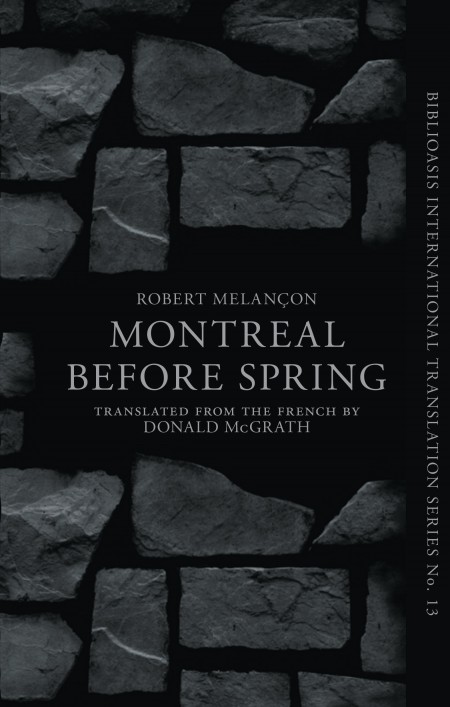
Montreal Before Spring - Robert Melancon (Biblioasis)

Today's book of poetry:
Montreal Before Spring.  Robert Melancon.  Translated from the French by Donald McGrath.  Biblioasis.  Windsor, Ontario.  2015.


Robert Melancon translated Earle Birney into French, that puts him in damned good stead here at Today's book of poetry.  Earle Birney is one of the cornerstones of our belief in poetry.  If Robert Melancon likes Birney then let's open this book.

And there it is.  We're not suggesting that there is much similarity in voice or style - but Melancon, like Birney, knows everything under the sun and is a gentleman about sharing it.

Montreal Before Spring is an occasional weather report, both literally and figuratively.  Melancon is taking and talking the temperature of Montreal at the same time as he is celebrating the city.  And the citizens.

Eden

Sunset, noise of cars,
and all those people
rushing everywhere
at once; delightful
just the way it is!
The mixed aromas,
the shifting colours,
street signs and the air
you drink in, having
so little else to do.

So delightful! Night
unfolds its banners
between the buildings,
the far horizon
reddens, turns coal black.

You go forth, drunk on
the multitudes, drunk
on everything, while
the lampposts sprinkle
nodding streets with stars.

...

Melancon sees the big and the small and treats them with equal respect and curiosity.  There is a lovely, long letter/poem to the Canadian poet George Johnston that is filled with admiration for Johnston's writing, both his poetry and his handwriting.  That's no joke, a handwritten note from Johnston looks like it was laboured down onto velum by some very devout monks.  I like this.  I like this celebration of friendship and craft.  Melancon does it again with a laudatory epistle to/about Jean-Aubert Loranger (one of Canada's first modernist poets).  These meditations on friendship give us a good look into the poetic heart of a soulful man.

A Voice Heard In A Dream,
Upon Awakening

"Your days will pass, one by one,
words in a breathless sentence strung
together without punctuation, your actions,
those thoughts that come as such a cost,
won't follow you, but if they do
it will be as perpetually vain regrets, little
will it matter, very little, whether you
betray or remain faithful, because each will
come to you in turn, everything will
be lost as if you'd been dreaming, it's like
a dream, the disorder of an old man's life
that comes back at the end, you'll descend
into lower depths you don't suspect are there,
you'll be seized, at times, by an unfathomable joy
before the expanse that evening will open up
where the streets run out; impassive, the world
will continue on its course, flowers
that will fade in autumn will come, snow
that will melt like snow in the sun, each day
will bring with it the History you'll throw out
with the newspaper, with your boredom, you'll
have friendships that you'll lose, love you'll see
falling away from you, that you'll try
in vain to hold on to, everything will be
given to you, everything taken away,
everything will come, everything pass away
like this night I've pulled you from, now go."

...

Today's book of poetry hear's A.M. Klien, Raymond Souster, Louis Dudek, St. Leonard of Cohen, Irving-King of Layton in these poems along with a host of other giants.  Today's book of poetry is embarrassed to admit our knowledge of French language poetry from Quebec is sadly uninformed. Melancon's Montreal Before Spring is a welcome introduction (for this reader) to another fine Canadian writer.

Robert Melancon's poetry has moments full of playful vigour, there is never any pious posturing but there are deeply meditative philosophical questions along the way, baked into the cake, under that sweet icing.  He deals with big issues before you know he's on to them and while you contemplate that Melancon reflects on the angle of the sun setting over Montreal rooftops.

Master class stuff.

Afternoon Song

This sky, grey as your eyes.
The endless snow. The day
seems to have stopped.

Your arms wind round me, I don't
even have to close my eyes
to believe that you are here.

I look out at the afternoon,
as idle as a man lost
in his thoughts. The clouds

stretch out. The air
wraps around itself. The whole city's
an alcove where I go to meet you.

...

Montreal Before Spring is an annual, a year-round love story/poem to the coolest city in North America.  Robert Melancon loves the city and the people and the snow and the sun.  Montreal Before Spring has everything except good bagels, good smoked meat.

There is a great tenderness in these poems.  TBOP loves that.

Donald McGrath's translation is invisible, seamless.

Robert Melancon

ABOUT THE AUTHOR
Robert Melançon is one of Quebec’s most original poets. He won the Governor General’s Award for Poetry for his collection Blind Painting and shared the Governor General’s Award for Translation with Charlotte Melançon for their French version of A.M. Klein’s The Second Scroll. A long-time translator of Canadian poet Earle Birney, Melançon has been the poetry columnist for the Montreal newspaper Le Devoir and the Radio-Canada program En Toutes Lettres. He lives in North Hatley, in Quebec’s Eastern Townships.

ABOUT THE TRANSLATOR
Donald McGrath grew up in a fishing village on the Avalon Peninsula of Newfoundland and moved away from the island at the age of nineteen to study art at the Nova Scotia College of Art and Design. He has been a longshoreman, factory worker and waiter, and currently works as a translator in Montreal, where he has lived for the past twenty-five years. He has published in periodicals and reviews in Canada, Australia and the UK, and is the author of one previous poetry collection, At First Light (1995).

You can see a TBOP blog about Donald McGrath's poetry here:  http://michaeldennispoet.blogspot.ca/2014/06/the-port-inventory-donald-mcgrath.html


Donald McGrath


BLURBS
“Poetry, in Melançon’s hands, is a way of seeing.”
      — GoodReports

"Melancon's work is rich and deceptively simple."
     -- Globe and Mail


384

DISCLAIMERS

Poems cited here are assumed to be under copyright by the poet and/or publisher.  They are shown here for publicity and review purposes.  For any other kind of re-use of these poems, please contact the listed publishers for permission.

We here at TBOP are technically deficient and rely on our bashful Milo to fix everything.  We received notice from Google that we were using "cookies"
and that for our readers in Europe there had to be notification of the use of those "cookies.  Please be aware that TBOP may employ the use of some "cookies" (whatever they are) and you should take that into consideration.