Showing posts with label oolichan books. Show all posts

Tuesday, January 9, 2018

Tumour - Evelyn Lau (Oolichan Books)

Today's book of poetry:
Tumour.  Evelyn Lau.  Oolichan Books.  Fernie, British Columbia.  2016.


Tumour is the third poetry title by Evelyn Lau that Today's book of poetry has shared with our faithful readers.  We figure you have to feel the same way about her work as we do.  Had Milo, our head Tech, go to the stacks and besides Living Under Plastic (Oolichan Books, 2010) and A Grain of Rice (Oolichan Books, 2012) which you can read about here:


We also had You Are Not Who You Claim (Porcepic Books, 1990), Oedipal Dreams (Coach House Press, 1992) and In The House of Slaves (Coach House Press, 1994).  These other Evelyn Lau titles were on the shelves but came out to play at our morning read.  More about that later.

Evelyn Lau has become, in Today's book of poetry's estimation, a "can't miss" poet.  This reader knows for a certainty that there will be ample reward for any time spent invested between the covers of an Evelyn Lau poetry book.

Tumour does not let us down.  Lau navigates some difficult water with various family relationships.  We know Lau is working for harmonious solutions but the usual barriers of personality, culture, vanity and ego have to run their indelicate course.

Vagina

The indignity of seeing you change,
even you. Your lips used to be springy
to the touch, a miniature trampoline,
a little fat cushion of flesh. It seems someone
let all the stuffing out. Now the inner labia,
once so tidy and trim, are stretched
and distended, and sometimes poke out
like the tip of a tongue in a cruel tease.

That's all you want me to say about you.
Lately you've grown reticent as a maiden aunt
in your middle age, desiring flannel nightgowns
and ten o'clock bedtimes. So open to proposition
in your prime, it won't be long before
you grow a white fur, prepare for hibernation.

...

Lau is putting all her excellent cards on the table.  She will go there.  The title poem in Tumour is about a dear Aunt and her end.  Very succinctly Lau rambles over the big three, LOVE, SEX & DEATH.  Lau knows that ultimately these are what we really think about and her objectivity is bracing.

Today's book of poetry admires how quickly Lau gets to the important true thing in her poems, she names it.  This is mature poetry free of the frivolous nature of flirtation, Lau gets to what we really want/need to say/hear.

Ancient History

All I wanted was the small grace
of sleep, that swift darkening.
But Ativan led me through the dream gates
to the childhood house on Cambridge Street--
the bang of the metal mailbox,
the lurch of the key in the lock,
the sweaty sheen of linoleum.
Shoes lined against the wall in a mad precision.

My stomach flip-flopped in fear--
somewhere in the house, the mother,
like an escaped tarantula. I am shrieking
in my sleep, a horror film with the sound
turned down, the milk duvet an avalanche
stuffing ears and nostrils with snow,
the scrap-metal sky a dun glow, fading.

Finally, words shatter the surface:
You didn't protect me--
the indignant wail of a four-year-old
choked out in a thick-tongued mumble,
a rasp into the sour breath of the pillow.
Would you believe it?
In a few months I'll be forty.

...

Mortality is a mean bastard.  You know it is out there but you really don't feel the full weight on your shoulders until you see those you love fall to mortality's certain charms.  Evelyn Lau has a voice that knows.  This voice has the experience of a life of extremes.

Our morning read was a gas.  With our six Evelyn Lau titles on hand and in full rotation it was a lesson in perspective, perseverance and passion.

Remembrance Day

On the eleventh hour of 11/11/11,
I am at Winners with the other bargain hunters,
the early Christmas shoppers, the bored.
It's soggy, miserable out. The sky
has swallowed all the light, sunk
into a greyed puff of dirty down.
Trenches of rainwater in the road,
burnt leaves mulching underfoot,
mourning of seagulls. A clerk's voice
breaks into the piped-in '80s music
to remind us of the day. She stumbles
over a few lines of "Flanders Fields",
announces a minute of silence.
Who knew sixty seconds could be
this long? We rotate round the racks
of marked-down designer clothes
in the uncomfortable stillness.
I glance around--there's nothing
on anyone's face, just a slight frown
of concentration as a sweater slips
off a hanger, a flinch of irritation
at being bumped by a stranger's cart
from behind. My friend Szeming
who was ten years old during the Japanese
occupation of Hong Kong remembers
the meagre two meals a day, going without
the luxury of socks or sweets. Remembers
the crowd peering into a bucket
on the sidewalk--a street urchin's head,
discarded after the rest of him
had been used for food. The relentless rain
drills the windows. In the distance,
the jet roar of thunder. What a relief
to be inside this bunker, bathed
in artificial heat and light, training our sights
on the perfect winter coat, holiday dress.
Finally, the tinny music cranks up again
and we relax, relieved of the burden
of remembering. Some young woman
is singing about love, how love
is like a battlefield.

...

Today's book of poetry has been a big fan of Evelyn Lau for a long time.  Tumour is another fine example of why we always have time for this tough and tender poet.  She always finds our heart.


Evelyn Lau

ABOUT THE AUTHOR
Evelyn Lau was born in Vancouver in 1971. She is the author of several volumes of poetry, two works of non-fiction, two short story collections and a novel. Runaway: Diary of a Street Kid, published when she was 18, was a Canadian best seller and was made into a CBC movie starring Sandra Oh in her first major role. Lau’s prose books have been translated into a dozen languages worldwide. You Are Not Who You Claim won the Milton Acorn People’s Poetry Award; Oedipal Dreams was nominated for the Governor-General’s Award.

Her work has appeared in over a hundred literary magazines, garnering four Western Magazine Awards and a National Magazine Award. She has also won the Air Canada Award for Most Promising Writer and the Vantage Women of Originality Award. Her poems have been included in the Best American Poetry and Best Canadian Poetry series. She has read from and discussed her work at literary festivals and universities around the world; she presently freelances as a mentor to aspiring writers through UBC’s booming Ground and SFU’s Writing and Publishing Program.


Evelyn Lau
Reading her poem "Fatal Attraction"
Video: Vancouver Poetry Slam


649

DISCLAIMERS

Poems cited here are assumed to be under copyright by the poet and/or publisher.  They are shown here for publicity and review purposes.  For any other kind of re-use of these poems, please contact the listed publishers for permission.


We here at TBOP are technically deficient and rely on our bashful Milo to fix everything.  We received notice from Google that we were using "cookies"
and that for our readers in Europe there had to be notification of the use of those "cookies.  Please be aware that TBOP may employ the use of some "cookies" (whatever they are) and you should take that into consideration

Thursday, September 14, 2017

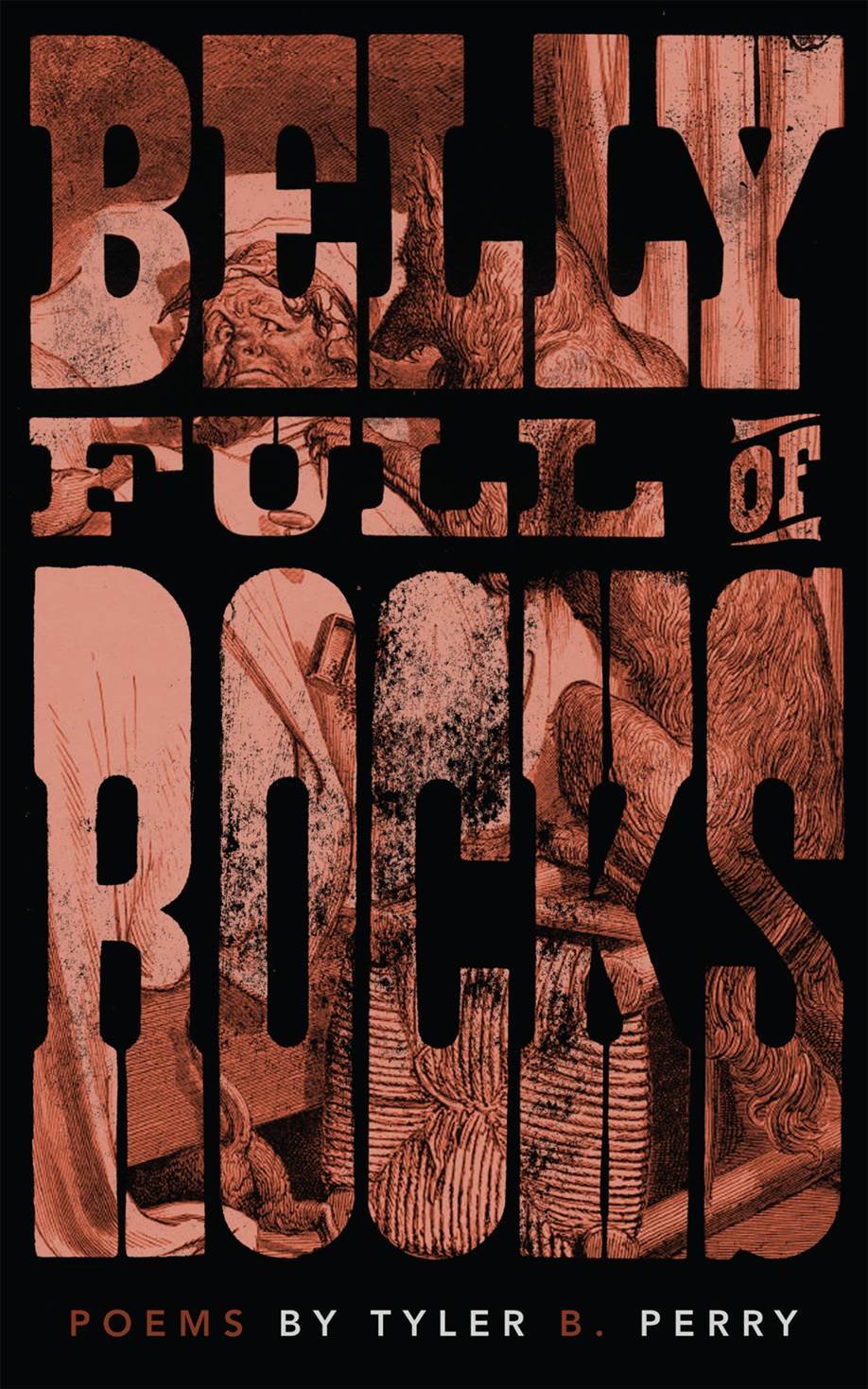
Belly Full of Rocks - Tyler B. Perry (Oolichan Books)

Today's book of poetry:
Belly Full of Rocks.  Tyler B. Perry.  Oolichan Books.  Fernie, British Columbia.  2016.


Tyler B. Perry inhabits fairy tales like Wayne Gretzky handled the puck, with utter disregard for tradition, the other players and a few of the essential laws of gravity.  Perry's poems offer us up an entirely new world or unearthly charms.

How much fun are the poems in Belly Full of Rocks?  More than you thought possible.  Because we all know the earlier versions of these stories Perry has a known template to dive off of, but when he begins to show his marvelous romp skills all hell breaks loose.

Once inside the fairy tales of our youth Perry delights in the helter-skelter reconstruction of an entirely new set of rules.  Perry establishes a new paradigm.  Our dark fears join our dark intentions and Perry almost dares us to peer into the foreboding new light:  Perry is casting light into the dark corners our heroes never admitted to.  Maybe we had the wrong heroes.

So, the wolf has had his bad day, tried to move on, but...

Wolf in the city

I've acquired a small house in the suburbs.
In the city, but close enough to the outskirts
that I can roam the river valley, prowl

the yards of cottages in the foothills.
I don't go into town much, except to buy
groceries and stroll the streets

after dark. At first I was self conscious,
but soon realized I could go
pretty much anywhere incognito.

A heavy pea jacket and a tuque,
fur sticking out from my collar,
snout tucked in. Mostly

I walk. I'm patient now, knowing
I'll have to learn the ways
of the city before I start

to hunt. I snuggle up
to street lamps, run my tongue
along two rows of teeth: shredders

and bone crushers. One day
the girl with the red hood will pass by,
and this time I won't forget to chew.

...

Belly Full of Rocks is a beautiful case of sustained magic.  We know after reading the first delightful poem in this collection that we are not in Walt Disney World fairy tale territory; Perry is more closely and easily aligned with The Brothers Grimm.

Red Riding Hood and the Three Little Pigs have never shared this much venomous rage nor been more like you and I.  On the surface the poems in Belly Full of Rocks play fast and loose with the fairy tales we all know and love.  It's clear to Today's book of poetry that there is ample sub-text at every turn.  There are primal urges vying the limelight right along with with primal fears, these fairy tale creature might be searching for salvation but Perry is reaching for illumination.

Tyler B. Perry deserves our admiration for the consistency of his conceit and how his new universe is such an eerie parallel to our own.

And that damned wolf, he doesn't know when to quit...

My story doesn't end

and I never seem to win.

I've been sliced, stuffed, drowned, skinned,
boiled and eaten, and yet I come again,
slinking with my trickery,

wicked about the eyes, meaning
to spring down upon you
and devour you in the darkness.

You can kill me and kill me and kill me,
but I will feed on your hate
and when the shadows
are their darkest, you will see my eyes:

two lanterns coming towards you
in the night.

...

This morning's read here at the office was a celebration, these poems ripping off of the tongue like bon-bons for the brain.  They only taste like candy, the reality is far more substantial, nutritious.

Belly Full of Rocks was such a pleasure to read that Today's book of poetry is starting to feel spoiled but in truth we read a fair bit of chafe here at TBOP before we find gems like this.  Tyler B. Perry is not the guy want reading to your children before they retire for the night - not if you ever want them to sleep.  This is for the grown-ups.

Tyler B. Perry goes that extra step, he even arranges for you to feel empathy for that notoriously evil old wolf and his sad lanterns.

I want to hunt

but the rocks slow me down,
my claws too loud on city sidewalks.
Streetlamps dampen the glow of my eyes.

Those pigs with their soft flesh and keen snouts
seemed to smell me before I even knocked,
heard the panting of my hungry breath.

By the time I'd reached the clever third,
he was waiting for me. He might as well
have left the door ajar and set out a pot of tea.

I still drip from the broth, my flesh
torn and bones bruised, chewed to a pulp.
My wounds throb, call to the moon.

Even the alley vermin aren't afraid
of me as I collapse and curl against the curb.
They crawl into my folds for heat.

When the white van pulls up I barely notice
until I feel the snare around my neck
and a sharp sting on my haunch.

I hear the trotters on the pavement,
the scurry of mice, feel soft arms
around me and sleep.

...

Today's book of poetry says to jump into this water head first.  Belly Full of Rocks is what we want from a book of poetry here at Today's book of poetry: it's amusing, arresting and alarming in all the best possible ways.  Perry has woven us into these myths, given them back to us to consider once again.  

Fine, fine, fine stuff.

Tyler B. Perry

ABOUT THE AUTHOR
Tyler Brendan Perry graduated from the optional residency Creative Writing MFA program at the University of British Columbia, and teaches high school in Calgary Alberta, where he lives with his wife, two kids, and a dog. He was captain of the 2010 Calgary poetry slam team, and is one of the organizers of the Alberta provincial high school poetry slam, Can You Hear Me Now? This is his second book of poetry.

BLURB
"You now what stories do, with their subliminally charged plots and scary messages, but do you wonder where they come from and what happens to those characters afterwards? Stay tuned, as Tyler Perry is about to reveal that you carry your stories within you, like stones in the wolf's belly, that you are both reader and author, puppet and puppeteer. Perry's Huntsman, standing outside his daughter's door listening to her breathe and toss in bed, senses the 'thin skin / of glass between her and the forest.' He also understands the gossamer that separates dream from reality. Setting out to carve children from whitebark pine, he finds them already there, ingrained in the wood, having 'seeped into the living / tree from the earth... his hands the engine of their release.' Hold your breath, step inside."
     - Gary Geddes, author of The Resumption of Play

oolichan.ca

608

DISCLAIMERS

Poems cited here are assumed to be under copyright by the poet and/or publisher.  They are shown here for publicity and review purposes.  For any other kind of re-use of these poems, please contact the listed publishers for permission.


We here at TBOP are technically deficient and rely on our bashful Milo to fix everything.  We received notice from Google that we were using "cookies"
and that for our readers in Europe there had to be notification of the use of those "cookies.  Please be aware that TBOP may employ the use of some "cookies" (whatever they are) and you should take that into consideration.

Monday, April 10, 2017

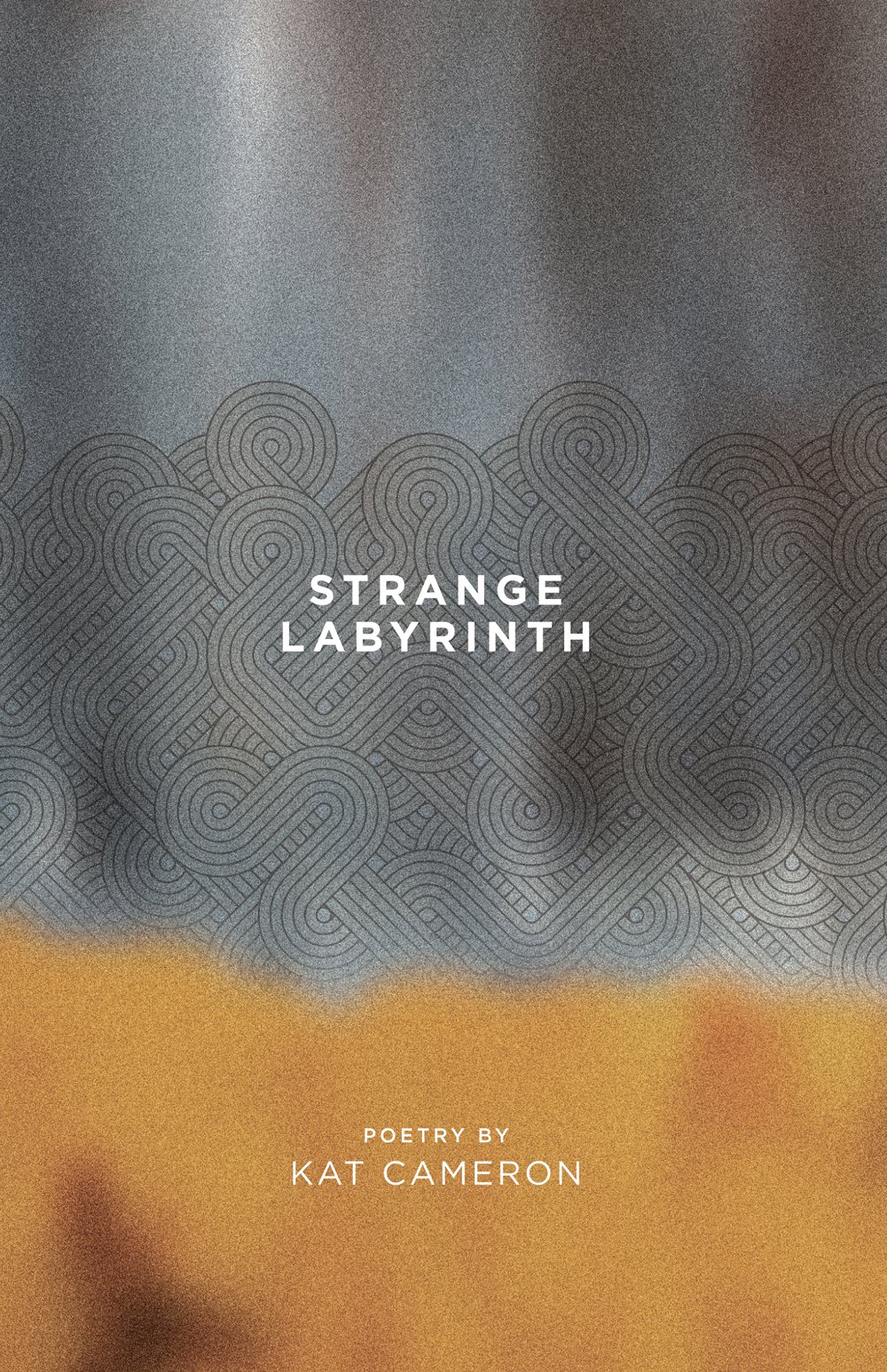
Strange Labyrinth - Kat Cameron (Oolichan Books)

Today's book of poetry:
Strange Labyrinth.  Kat Cameron.  Oolichan Books.  Fergie, British Columbia. 2014.


Kat Cameron reads twice her age, how else to explain the kaleidoscopic range of her cultural, historical and literary references where she tips her hat, says "how do you do?" to a myriad of misfits and heroes,  markers.  Today's book of poetry was on side from the start.  Strange Labyrinth is as advertised, we enter some strange territory and the exit isn't always certain but Cameron's curiosity and interests have a large span.

And the reader never feels lost.  

Cameron creates poems that have emotional certainty at the heart of them as though they arrived fully formed and knowing which way to lean into the wind.

The Palliser Slide

This rock slide destroyed one side of Mount indefatigable.
The largest rock slide in North America, it was four times larger
than the Frank slide.

Frozen waves, aeons buried in the cresting line.

In a basin, mountain-rimmed, slate-grey ramparts cross and gird, hold
back the inverted sea of sky. Far off, wavering in the foreshortened air,
snow-ghosts climb, flint heels striking fire from shale.

Ammonites spiral time in twisted coils.

Below, the darkness of the firs. A tortured path pulls and climbs
its way past clinging meadows, spots of sun. Frail jellyfish,
Queen Anne's lace, float by bristling blots of red paintbrush.

The air is thin, three thousand feet above the far earth's floor.
Marmots whistle warnings on the wind.

...

Today's book of poetry hears echoes of Saint Earle of Birney and his beautiful "David" in "The Palliser Slide," if only a frisson.  Cameron's nature capture has the same reverent awe, she makes the panorama present right there on the page.

Cameron works a whole magical lode of tenderness into her Strange Labyrinth.  Today's book of poetry doesn't want to give away any secrets but Kat the C has a thing for Mary Shelley's monster. e.e. cummings, Byron, Sylvia Plath, Elizabeth Bishop, Eliot, Pound and Vincent the Goth Van Gogh all show up, Marcus Aurelius and his Meditations sharpen Cameron's tools.  Strange Labyrinth brims with smart lyric animations and host of glamorous accomplices.

Today's book of poetry doesn't want to give the wrong impression, Kat Cameron's earthy poems aren't inhabited by or about the above mentioned iconic figures.  They are all just along for the ride. Cameron is writing about this world and our place in it, the space women inhabit that men don't know about.

Digging out the Twitch

The first sunny day in weeks and I'm in the garden,
digging out thick twitch grass, the heavy dirt clotted deep
with spidering white roots. When we bought this house,
I had plans, even though my uncalloused hands, smooth with
dishwater and lotion, spent the day tapping staccato keys.

All summer, I neglected this bed. Faded vines hang
from the fence, like shreds of forgotten sunsets.
I'm sowing the colours of spring; wanton tulips,
narcissi, and clusters of purple crocuses.

But past failures slow me down. I feel the strain
in my back, my aging knees, the shovel loads of
heavy doubt. All I can do is go on. Now
the gloves are off. I push tiny bulbs into shallow graves
feeling the soft dirt crumble with promises.

...

Our regular early morning read here at Today's book of poetry was a bit dishevelled today.  I have recently spent a few days working out in the real world with real people.  Once in a while I get work at the Art Bank and it is one of my favourite places on earth.  Picture a large warehouse carefully packed with around 20,000 works of the best contemporary Canadian art.  It's a dreamland.  I worked as an Art Technician for many years, transporting and installing art work.  In recent years I've worked mostly in the Frame Shop.  It is work I thoroughly enjoy.  So my brain and tired old posterior has been toiling hard at the Art Bank.

When I haven't been at the Art Bank I've been in David Lee world.  David Lee is a poet from Texas who now lives in Utah.  Our St. Louis correspondent, Mark Twang, sent us a couple of David Lee's books along with a Copper Canyon Press CD with David Lee Reading from A Legacy of Shadows and News from Down to the Cafe.  Today's book of poetry will be dealing with Mr. Lee in the near future but I've been making the staff listen to his CD non-stop for the last couple of days.  Now everyone around here is running around with a David Lee accent.  Beer bottle on their hip.

The other good, but distracting, news is that the sun is out.  It really does feel like spring and when that happens most of us here in Ottawa get a little sun drunk.  Everyone in town will be out on patios and in shorts by noon.  For all I know it could snow again tonight.

So our morning read was slightly distracted, we opened all the doors and windows for the first time since October.  Kathryn, our Jr. Editor, made sure that we all cottoned onto the strong feminist voice that inhabits these poems.  Cameron isn't burning down the house with strident polemics, she's informing the house because they need to know.  Once Kathryn laid down the law Kat Cameron's poems worked their way around the room, humour popped out when we least expected it, along with Frankenstein, Cameron kept us well entertained.

from Camille

II. Le Baiser

Two bodies.

I long to stroke his back
the soft deep groove from neck
to ass.

His hand holds the hollow
of my hip.

I pull him towards me,
me leg angles
my body closer.

Fused marble.

One kiss banished the lovers to the
second circle of hell.

I wish I could banish Rodin
as easily.

...

Kat Cameron's Strange Labyrinth isn't really so strange at all.  These intelligent poems "examine the choices women make," flirt joyously with strange dancers, summon memory.  Strange Labyrinth is a powerful debut.

Today's book of poetry will be anxious to see more from Kat Cameron.

Kat Cameron

ABOUT THE AUTHOR
Kat Cameron was born in Swift Current, Saskatchewan. She completed an MA in Creative Writing at the University of New Brunswick and has worked as an ESL teacher in Japan, a substitute teacher, and an editorial assistant. Her poems and short stories have appeared in literary journals across Canada, including CV2, Descant, The Fiddlehead, FreeFall, Grain, Literary Review of Canada, Room, Prairie Fire, PRISM International, and subTerrain. She teaches English and writing at Concordia University College in Edmonton and is currently working on a poetry manuscript, "Lighting over Wyoming," with the assistance of an Alberta Foundation for the Arts Grant.

BLURBS
“Strange Labyrinth moves across subtle moods and ideas, as if these were keys on a piano under the deft fingering of a virtuoso. Kat Cameron’s poems disturb our sense of time and distance, as figures in family history are simultaneously standing beside us and vanishing in the uncertain world of memory.” 
     ~Ross Leckie

“An accomplished debut. This is a collection of sweeping breadth with respect to subject matter, locale, and literary influence. Cameron writes poems of quiet elegance, and strategic feminism. Strange Labyrinth is imbued with the ghostly, yet grounded, idiosyncratic spirits of ancestors. Cameron is a poet to watch.”
     ~Jeanette Lynes, Author of The Factory Voice


570

DISCLAIMERS

Poems cited here are assumed to be under copyright by the poet and/or publisher.  They are shown here for publicity and review purposes.  For any other kind of re-use of these poems, please contact the listed publishers for permission.

We here at TBOP are technically deficient and rely on our bashful Milo to fix everything.  We received notice from Google that we were using "cookies"
and that for our readers in Europe there had to be notification of the use of those "cookies.  Please be aware that TBOP may employ the use of some "cookies" (whatever they are) and you should take that into consideration.

Saturday, January 21, 2017

Between Lives - Nilofar Shidmehr (Oolichan Books)

Today's book of poetry:
Between Lives.  Nilofar Shidmehr.  Oolichan Books.  Fernie, British Columbia.  2014.


Women are marching all over the world today and Today's book of poetry salutes each and every one of them.  

Nilofar Shidmehr is an Iranian-Canadian poet with a considerable voice to add to the choir. 

Between Lives a second book of poetry from Nilofar Shidmehr could find purchase on any number of different poetry shelves.  This book could easily be considered a book of feminist poetry and thoroughly at home in Women's Studies, just as easily Between Lives could be on a Diaspora Poets shelf.

Nilofar Shidmehr seems fearless when she reveals the true life of women in the Iran of her youth. Shidmehr's poems are heavy with a flaming authenticity, crystal clear in focus and heartbreaking when you feel the crippling burden of gender.

Alive

Under the knife blade
my mother's broken hand in a sling,
purple peels fall
over the face of the counter.

Her swollen cheek is marked
by a bruise, the shape of an eggplant,.
She tilts over to check if the meat
is soft. The oil leaps up, scalds.
She pulls back, leans on a crutch hidden
under the torn wing of her white chador.
I see the scratches on her neck
as she turns her head. The wooden spatula
slips from her fingers onto the floor.

She bends to pick it up, but I reach out first,
snap up the spatula, flinging it into the basin.
Do you know who are you cooking for?
I yell at my mother, shoving her aside,
taking her place at the stove. 
He loves his Baademjaan, deep-fried,
she whispers, with tears in her charcoal eyes.

The stew simmers slowly.
But I turn my head away and hold
onto the image from the week past
swirling around, again, in my head --

Feet tangled in the hem of her chador;
my father, leaning over the banister,
slips his hands back in his pockets,
watching as she rolls down the stairs, still alive.

...

Shidmehr brings us moments of gentle humour, uninhibited passion and matrimonial bliss as well as some of the other kind.  But in Between Lives the real focus is elsewhere.  Between Lives opens up the tribulations of giving up your culture, your home, your past, the place of your birth and jumping into an entirely different life in another land.  We are reminded that the cultural shock and toll is only a small part of the immigrant/refugee story.  Most of us will never experience that sort of isolation, that split from family, history and those left behind.

Make no mistake, Today's book of poetry was blown away time and time again by the candor in Nilofar Shidmehr's remarkable poems.  Shidmehr reveals more than we expect and to marvelous effect, she goes beyond lifting the veil, we get a look beyond the proverbial chador and right into the mind's eye of a woman facing enormous struggles who is both observant and outraged.

Racing Back to the Time When My Daughter Was Born

I am at the gym on Life Fitness,
my daughter's arrival from Iran
only six days away --
my girl who arrived
in this world twenty-three years ago.

When I start exercising, my heart
rate is at 100: the same as
a hundred-year-old's
working to her maximum capacity.
On the chart, I look at the rate
for young hearts like my Saaghar's: 160.

And then I think about my own heart,
about how it's going to race
the moment when Saaghar will emerge
from Customs -- dragging a bag
and looking for the woman
from who she had emerged --
an umbilical cord dragging
behind her -- a cord
that had to be cut
for her life to go on.

I continue to go on running
on Life Fitness and my heart beat
picks up, echoing in my mind
hers from more than two decades ago,
coming through the stethoscope at my gynecologist's:
it sounded as if I had a horse inside me,
galloping full force ahead in my veins,
the rhythm of her hooves ringing
in the curves of my skin.

That sound sewed me to Saaghar,
despite an unwanted pregnancy
because of a slight displacement
of the diaphragm my gynecologist had placed
one day after our wedding -- the same trusted woman
gynecologists who had also confirmed
the existence of a hymen without which
there could be no marriage.

Another doctor, however,
Mr. Aaryaanpour, had arrived at the delivery room
after ten hours of excruciating pain,
because he had decided to ignore
nine phone calls from the head-midwife, begging him
to leave the gambling party he was at
and immediately attend to his patient
whose cervix was not opening enough
for the baby to come out.

He was the one who cut me open
and delivered that beating heart inside me,
who then transformed to a bruised
black-haired baby.
My husband had forced me to change
that once-trusted-woman-gynecologist
in the seventh month, because she had suggested a C-section,
and gave her professional opinion
that I was not a good candidate for natural delivery.
My sister-in-law, Ashraf, had insisted
that a woman who did not experience pain
at childbirth could not be a good mother.

Her words became the seeds
of a small dispute which grew
larger every day and after nine months
was delivered in the shape of a premature divorce.
Ashraf then said that a bad mother
is not entitled to the custody
of her brother's child and had to, without delay,
be separated from the newborn.

From my husband's mouth, her words
were thrown at me like stones.
The blows were so severe that I cannot
even remember how with my remaining
strength, I managed to pull myself out from that hold
of pain and escape, so today, on February 13, 2013,
more than twenty years later,
I am in Vancouver on Life Fitness
running again with all my strength
to get me heart beat closer
to my daughter's: to 160.

The chart on the machine informs me
that the more people age, the more
their heart rate and the age match up:
this is good news for me, I'd imagine,
my daughter's heart and mine
perhaps are closer now compared
to the time she was yet undelivered--
at that time no matter how much my heart
beat fast, it could not even get close
to the dust rising from the hooves
of that horse that I imagined
was inside me, galloping forward.

But now that there is a hope, an opportunity,
an opening, I smile at my pulsating
image in the glass;
now that her heart has slowed down
and mine is speeding up;
now that she is about to arrive
at the place where I live.

Still I have to run faster
our hearts are twenty points apart --
I have to run faster
even though I have raced
for many years to meet
the moment when she will arrive
again, like a newborn, in my arms.

...

This morning's read was another spirited adventure.  I had called our researcher Otis into the office this morning to translate the few lines of Farsi in Shidmehr's text.  It's good to have a cat like Otis on staff, he speaks Farsi, Italian, Russian, at least one kind of Chinese but I can't remember if it is Mandarin or Cantonese, French and so on.  Otis informed me this morning that he was heading to Sicily for a couple of months and he was doing it Wednesday.  Today's book of poetry will be sad to see him go and jealous for his adventure.

More importantly Otis was able to impart some context on Iran and knowing what Otis knows it was reassuring when he sized up his reading of Between Lives and declared that Shidmehr was not only the real deal in every way but a very brave real deal.  Today's book of poetry had no doubts but it is always nice to get things confirmed by a pro.

This Drunken Russian Man Intends on Peeing,

opens his fly,
bravely and pulls

his small change out

as if yanking something as precious
as an American Dollar.

Facing a wall as high as Tsarist Russia
before Communism, he releases himself,

humming an old heroic song,

while fissures on the wall,
now fresh and satiated, sing along

to a melody that scores
the sudden collapse of the Tsardom.

Shaken, I stand there too,

as I eye the man,
and wish I could be like him--

fly foolish
before everything falls apart,

singing along,

with, I, too, could display
my crack so openly.

...

Today's book of poetry marvelled at how Shidmehr was able to handle the difficult elephants in her complicated life with such charm and aplomb.  Shidmehr, as a woman, as a feminist or as an immigrant, does not need the approval of men like me.  But men like me sure hope the rest of you get a chance to read Between Lives.  Dignity comes at a mighty stiff price for some people.  Nilofar Shidmehr has turned hers into poetry that is smart and confident, she has turned it into hope.

Nilofar Shidmehr

ABOUT THE AUTHOR
Nilofar Shidmehr is an Iranian-Canadian poet, writer and a scholar of arts-based qualitative research focused on poetic inquiry. Her first book of poetry in English Shirin and Salt Man was nominated for a BC Book Prize in 2009 and her first book of poetry in Farsi Two Nilofars: Before and After Migration has received worldwide recognition among the expatriate Iranian community. Nilofar is a cultural and educational activist and a part of the Iranian women’s movement.

Nilofar earned a PhD in education and an MFA in creative writing from the University of British Columbia. Her next scholarly project is to investigate how the lyrical and performative modes of inquiry can be included in discourse analysis, literary criticism, and critical reading and writing practices to integrate and advance literacy. Her next creative project is to write a collection of short stories about the lives of Iranians in Iran and Canada. She lives in Yaletown with her husband.
BLURBS
"The voice of Nilofar Shidmehr's poetry moves restlessly between two imagined lives: one, a life rooted in the past and in Iran, a life of strict gendered expectations but also of continuity and familiarity; the other, a life in Canada, relatively uncompromised by gender segregation, but yet still troubled by the pain of exile and others' prejudice. These poems speak plainly of mothers, of daughters, of lovers, but always beneath each simple story is the pulse of an intelligent, sensuous desire. These poems are feminist, moist, fragrant! Each word bursts, ripe in the mouth, like pomegranate."
    - Sonnet L'Abbé (Canadian Poet and Critic, Winner of Bronwen Wallace Memorial Award, 2000)

"In this stirring collection Between Lives, Shidmehr's direct voice and unflinching gaze put her among such great activist poets as Martin Espada, Dionne Brand, and Pablo Neruda. With a clear gaze and arresting imagery. Shidmeher brings to light the violence and injustice of women's lives in Iran and in the diaspora. Fully wrought and deeply personal, this is a necessary book by an accomplished writer.
     ~Elizabeth Bachinsky, nominee for Governor General's Award for English-language poetry

"These poems are the untold stories of contemporary Persian women's lives, lives portrayed with intimacy and lyricism, despite their subjugation. These are poetics meditations that only a poet simultaneously intimate with a place, and exiled from it, can offer. In this book, men and women are like 'fire and cotton,' and must be kept apart; they are 'flammable with the slightest spark.' Nilofer Shidmehr's poems burn with a fierce, haunting fire.
     - Rachel Rose, Winner, Audre Lorde Award for Lesbian Poetry 2013


543

DISCLAIMERS

Poems cited here are assumed to be under copyright by the poet and/or publisher.  They are shown here for publicity and review purposes.  For any other kind of re-use of these poems, please contact the listed publishers for permission.

We here at TBOP are technically deficient and rely on our bashful Milo to fix everything.  We received notice from Google that we were using "cookies"
and that for our readers in Europe there had to be notification of the use of those "cookies.  Please be aware that TBOP may employ the use of some "cookies" (whatever they are) and you should take that into consideration.

Thursday, October 6, 2016

Ex-Ville - Rhona McAdam (Oolichan Books)

Today's book of poetry:
Ex-Ville.  Rhona McAdam.  Oolichan Books.  Fernie, British Columbia.  2014.


How about this?  Rhona McAdam writes with quiet distinction.  What I mean is that extraordinary events full of miraculous people are not her terrain.  Instead McAdam's poems trace, with elegance, the small movements and moments of our real lives in real time.

What a convoluted attempt to intone what McAdam handles with ease  -  the straight forward goods.

Sleep

We court it with deep breaths:
quietly at first, so it will not hear us
and startle.

But then as we circle the darkness
where it may be hiding, we begin to forget
and from far down in our throats, songs escape
through creaking doors, our guttural
wood-cutting songs, our sea-lion songs,
our songs of the heron, night-fishing
interrupted, whose singing can wake the dead.

We cannot hear the sound of those songs.
They stop us remembering
how we called up sleep, we once-young, once-dreamers.

We are too tired to remember how to sleep,
how to find our way in
to what takes us safely to morning.

When morning comes we are still in the forest
with burning eyes, looking for shadows
to step into, a mossy bank where we can set down
our mind full of burdens and be still,
take a long silent breath
the length of a moon's arc, and be still.

...

Today's book of poetry has been here before.  Back in March of 2015 we looked at McAdam's Cartography (Oolichan Books, 2006).  You can see that here:


Not much has changed.  Today's book of poetry is still enamored by McAdam's gentle certainty.  And then again in the eight years between Cartography and Ex-Ville we bet that a lot has changed for McAdam.  She has seen more of the world, and it has seen her, the poems in Ex-Ville come from a voice of experience.

McAdam sees the frayed edges of the world, it's in these narratives, in her voice - but she remains an optimist, you can hear that too.

Today's book of poetry feels at home in McAdam world.

Greyhound

What is this but a race
against comfort. The question
is not when to sleep
but how small
can you become, just where
is your soft forgiving self, and can it
accommodate an armrest, the ridge
of a windowsill, another armrest.
Will your knees endure, your neck?

The viewing screens
stay blank, their content too long
ago contested. The audio is mute.
Entertainment is officially
dead on this bus.

The air twists with illicit smoke
and the driver's heavy reprimand
fills a silence lanced
with the tinning beat
of inadequate headphones.

Full moon watches
over my shoulder. Big headphones guy
pulls his hoodie over baseball cap;
drug dealer's got a big gold ring
on every finger, one eye open, one
closed hand on his suitcase.

Junkie girl stays locked
in the washroom for another hour.
Young runaway wraps himself
in a sleeping bag and bangs
the seat rest when he turns. Old guy
snores and stinks in the seat ahead of me.

Through this choppy night
every town that wakes us
has a Walmart, Tim Hortons,
a Shell and McDonalds
guarding its flank, heralded
by a shock of streetlights.

At every stop the driver bangs
the microphone to life.
He's a long way from home,
his accent undefiled.

At every stop the girl with AIDS
shuffles from the back and down the steps
for a smoke, hoarding its crushed remains.

At every stop the young men
follow her, shivering in their caps
and gleaming sneakers, they all blow smoke
at the oblong windows of every station,
watching the driver's weary loadings
and unloadings.

When we make the last stop
before dawn, everyone descends
then boards again, rustling sandwiches,
cracking cokes and iced tea. Drug dealer
hauls his case back on board,
knocks back burger after burger,
his iPhone finally mute. The runaway
peels back the plastic from his breakfast,
a pale cross-section of bleached bread,
pink strata of luncheon meat.

Mountains loom, showing their
snowing teeth as light cracks the summits.
We follow its spill down the hill into morning,
all the night road's bleary citizens
gathered in this battered ship.

...

Today's book of poetry has been on that bus, more than once. 

Whether it is on a bus, in a tired airport or a European city we've longed to see Rhona McAdam makes us feel a little less like a stranger in a strange land.

This morning's reading was interrupted by the sounds of construction next door.  The guy on the gas-powered radial stone saw had it timed perfectly.  Whenever one of us started to read a poem he'd whip into a stone cutting frenzy with his diamond tipped monster.  Of course it was all coincidence, he couldn't see into our offices and from an earlier conversation I'm pretty sure he's a poetry fan.

Once we got over the noise outside Ex-Ville gave us a damned good morning read.

Furlough

The soldier joins our flight in Dallas:
twitchy, red-eyed, pungent,
his stories sandstorms
of words accelerating
during take-off, then levelling
to a steady hum of detail,
two days and sixteen drinks
out of the desert.

Six years in to a four year tour of active duty.
Seen it all at 24. Infinite the things he'll do
in two years' time when he's pretty sure
they can't call him back again... but rules
change, he knows, in times of war.
He's done with Bosnia, Afghanistan.
Passed over for promotion every time.
Peacekeeping now, a guard at Abu Ghraib. Their hands
are tied; they can't do a thing. Prisoners
spitting in his face. Do we know how hot
the desert gets? 140 in summer, no lie.
He used to love the beach, now he craves rain,
snow, silence. Or not silence, but the sounds
of Bellingham, the streets he grew up on,
homeless with his mother from the age of two.
The army seemed like heaven the way they explained it.
A free education. Maybe med school. Now he'd like
to go back to that recruiting office.
Take his gun apart, and clean it, piece by piece.
Eye to eye with the recruiter. Do we want to read
his novel? He wrote it nights, on guard at Abu Gharib.
Maybe he'll be a writer after this. He has a girl
back home; she's always asking him
for money. Maybe this time he'll end it. Not yet
but in two weeks, before he gets back on that plane.
The flight attendant slips him
another drink in spite of his uniform.
Because of it. He drains it
for the guys he left behind.
A drink for each of them
while he's out. He promised.
One more down. 133 to go.

...

We think Rhona McAdam must be one hell of a listener.  Ears wide open.  The more we read of Rhona McAdam's fine poetry the more we like it.  There's a fierce clarity to her compassion and we always have room for that.

Rhona McAdam

ABOUT THE AUTHOR
Rhona McAdam was born in Duncan—a great-granddaughter of the town's namesake—and grew up on Vancouver Island. She lives in Victoria, BC. She has post-graduate degrees in communications planning, adult education and library and information science, and has worked in Canada, England and throughout Europe. Her poetry has been published in Canada, the US, Ireland and England and has been praised for her unique and engaging voice, her clarity, and her ability to balance the ethereal with the real. She has a gift for creating vivid landscapes, both actual and emotional.

Rhona McAdams
Winter Poets
Video: Times Colonist


510

DISCLAIMERS

Poems cited here are assumed to be under copyright by the poet and/or publisher.  They are shown here for publicity and review purposes.  For any other kind of re-use of these poems, please contact the listed publishers for permission.

We here at TBOP are technically deficient and rely on our bashful Milo to fix everything.  We received notice from Google that we were using "cookies"
and that for our readers in Europe there had to be notification of the use of those "cookies.  Please be aware that TBOP may employ the use of some "cookies" (whatever they are) and you should take that into consideration.

Friday, May 6, 2016

New & Selected Poems - W.H. New (Oolichan Books)

Today's book of poetry:
New & Selected Poems.  W. H. New.  Oolichan Books.  Fergie, British Columbia.  2015.


New & Selected Poems by the distinguished W.H. (Bill) New is the book of poetry everyone in Canada should take to the cottage for the summer.  This is stuff you want to go back and browse like a catalogue full of goodies.

In it you will find highlights from these fine books:

Science Lessons - 1996
Raucous - 1999
Riverbrook and Ocean - 2002
Night Room - 2003
Underwood Log - 2004
Touching Ecuador - 2006
Along a Snake Fence Riding - 2007
The Rope-makers Tale - 2009
YVR - 2011

Our guy Bill has been nominated for the Governor Generals Award and that doesn't happen by accident.  Today's book of poetry enjoys New's easy calm with language regardless of the form he employs.  Stylistically New ranges far and wide but his rational eagle eye is always in focus and the result is poetry that is always sharp.

That and he can be so humanely tender without making us cringe.

Chemistry

One, Lorna, even to mention her name
causes him to change colour, fires him
into blurted declarations of like. She acts:
he reacts, red and blue as litmus paper
and just as wet. He grins a lot, gawkily,
picks berries with her if he can, flirts
at the edge of touch and gesture,
flushes if others overhear.
In his dream, words like care and kissing
come to him articulate and whole;
awake, he needs a catalyst to say them,
mixes them up, lingers awkwardly till she
places a ripe raspberry on her tongue
and shares with him her taste for bittersweet.

...

Today's book of poetry has told you before how much we love W.H. Auden's "Musee des Beaux Arts" so when W.H. New takes a crack at Icarus in his poem "21.  Safety" we were all ears.  And New does not disappoint.  He has 'the Knowledge'.  New has an old cab driver's understanding of the ins and outs of things, the quickest way to get from one place to another with the smallest fuss.  

21.  Safety

Icarus as a boy played with army
trucks, not frisbees, played cops-&-
robbers, marbles in a ring, not hop-
scotch, kites, addy-addy-I-
over: he watched the ground, held fast
to things -- water, earth -- turning away
from dangerous fire & insubstantial air.

You'd have forecast for him an ordinary job --
something that kept his hands occupied,
farm irrigation, yard work in the maze,
something that gave him the lie of the land,  But he held
fast because of the gnawing away: it was always
there, & the first leap up he was vulnerable --
monster on one side, father on the other,

alternating tales of damnation &
derring-do -- inexorably, flame drew him,
& air appeared to hold him up: what
the old stories never tell is whether
he regretted choosing, or lived finally
only at the point of falling, knowing at last the difference
between fear and safety, tumbling into the sea.

...

Today's book of poetry is convinced of the deep and generous heart at the centre of W.H. New's New and Selected Poems.  Robert Kroetsch has called New "the flaneur" and he is right on.  These observational poems all point in one direction and we here at Today's book of poetry believe that direction is hope - we took an office survey at this morning's reading.

Darwin's Tulip

she talks of things she no longer sees,

fine print,
petitpoint,
thin lines--

listening,
you watch her lift fog from the river,

one hand brushing away the blur

                    *
presence: the scent of
roses in an empty room, the way

bedclothes fold against
bare skin

                   *
listening for what the ear cannot
tell you: the rumpled sea, the halfmoon

shoot of a Darwin's tulip, the first

                   *
drawing a line in air, water, sand:
this far and--
                     oh--

where did it go--
              the river, the wind--

...

"I Want To Talk About You" is blaring from one corner of our office to the other on this rather spectacular sunny spring morning here in the nation's capital.  We have deep, deep respect for Saint John of Coltrane.  One of the best things about running your own operation is having control of the music situation.  Of course I usually let the minions have their way -- but I do remind them from time to time of the classics.  

Books like W.H. New's New & Selected Poems makes our job a cinch.


W.H. (Bill) New

ABOUT THE AUTHOR
W. H. (Bill) New retired in 2003 as University Killam Professor at the University of British Columbia. A native of Vancouver, he earned an M.A. in Canadian Literature from UBC in 1963. In 1966 he was awarded his PhD from the University of Leeds, where he specialized in the English-language literatures of the Commonwealth. He then returned to the University of B.C. to set up a Commonwealth/ Postcolonial Literatures program.

Honoured by the Killam Research and Teaching Prizes (1988, 1996), the Gabrielle Roy Award (1988), the Jacob Biely Prize (1995), the Association of Canadian Studies Award of Merit (2000), and the CUFA Award for Career Achievement (2001), he was elected to the Royal Society of Canada in 1986. In 2004 he was awarded the Governor General’s International Award for Canadian Studies and the Lorne Pierce Medal for his contributions to critical and creative writing. He has taught or lectured in Australia, China, France, Germany, India, Italy, New Zealand, Spain, the UK, and the USA. In 2002, The University of Toronto Press published his Encyclopedia of Literature in Canada. It has been praised in Canada and the UK for its innovative perspective and described in France as indispensable. In 2006 he was awarded the Order of Canada. Recently he received the 20th Annual George Woodcock Lifetime Achievement Award.


468

DISCLAIMERS

Poems cited here are assumed to be under copyright by the poet and/or publisher.  They are shown here for publicity and review purposes.  For any other kind of re-use of these poems, please contact the listed publishers for permission.

We here at TBOP are technically deficient and rely on our bashful Milo to fix everything.  We received notice from Google that we were using "cookies"
and that for our readers in Europe there had to be notification of the use of those "cookies.  Please be aware that TBOP may employ the use of some "cookies" (whatever they are) and you should take that into consideration.