Showing posts with label milton acorn. Show all posts

Thursday, June 6, 2019

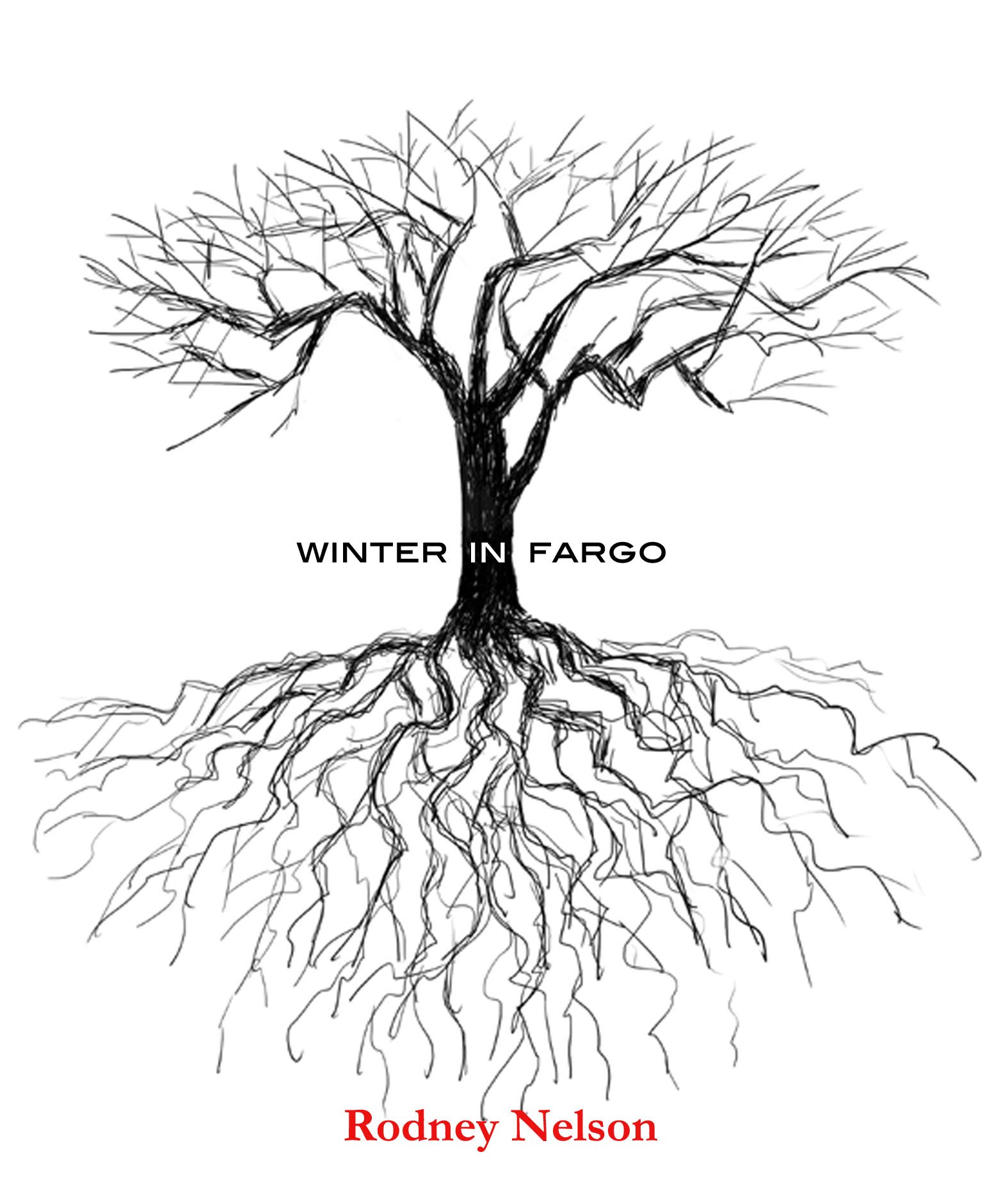
Winter in Fargo - Rodney Nelson (Ravenna Press)

Today's book of poetry:
Winter in Fargo.  Rodney Nelson.  Ravenna Press.  Spokane, Washington.  2016.


Rodney Nelson only uses English as a template because these poems are in a whole new language.  Today's book of poetry was in after about three poems, hooked by the simple beauty of Nelson's accomplishment.  Winter in Fargo is all about place and Nelson takes us all firmly to Fargo.

Winter has never quite been like this before.  Winter in Fargo dials into a collective unconscious where we are comfortable with Nelson's unique vision.  The reader transported, lulls and rolls onto the crisp white landscape, and discovers it ripe with new mystery.

Candelmas

northern prairie had not thralled me
yet even on the cross-quarter
day I would not have wanted to
be any other where
                   I had
taken to Flagstaff and Yuma
and Petaluma easy in
winter and would have liked to try
the time in any one of them
again
                   but when the sun came up
on the cross-quarter day to ten
below and showed that prairie had
moved into town I wanted the
white and still and would not have been
any other where anytime

πŸ’«πŸ’«πŸ’«

Winter in Fargo is strong and slow, almost languorous, so Today's book of poetry is thinking Keith Jarrett, The KΓΆln Concert.  Slow and languorous until the all consuming sweep of it blows over you like a snow squall.

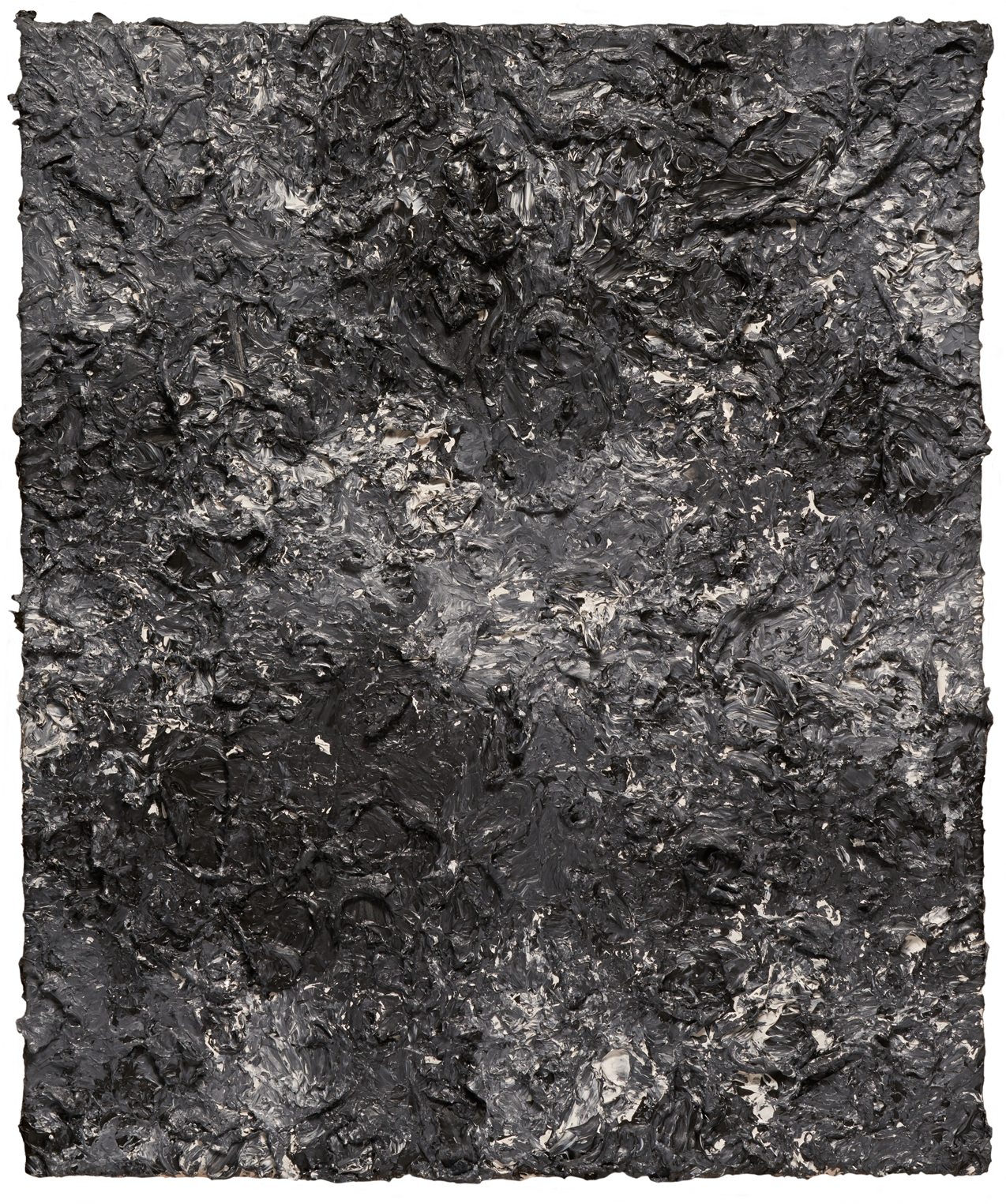
Rodney Nelson has his own smooth.  These poems had instant cred here in the Today's book of poetry offices.  Milo, our head tech, said it felt like Cormac McCarthy without the obvious violence.  Kathryn, our Jr. Editor, thought Nelson's Winter in Fargo reminded her of the thickly layered canvases of London artist Ron Martin.

Related image

Groping and Meditating on a Confusion of Shapes
Ron Martin
Courtesy of the Canada Council Art Bank

The Ron Martin painting shown is huge, several feet wide and several feet high.  Martin's monochromatics contain unique depths and Rodney Nelson makes us feel as though we are in a new world, with new horizons, new nightfalls.

Of Gwendolyn Macewan

age and a river flood in
childhood we had in common
                      same river and flood
                      but when
a Canadian mentioned
the name I did not read on
may have noted an inward
fixity that I lacked
                       her
Bohemian Embassy
in Toronto was part of
my San Francisco and I 
leant towards cabalas too if
never the Cabala
                        I
would have taken any
                                    Earth-
                                    Light
          over the
                                    Afterworlds
that she went into dying
by her own vodka at the
moment almost I quit it
and we did not get to have
in common the age I am
now or the historical
tried-and-untrue one out there
                        I
doubt that she affected
what I wrote and she would not
have read it but another
look at her work reminds me
of the much I have not known
                        not to believe
                                        that she has
                                        yielded all her mystery
                     to
                                        admit there is something
                                        else you cannot name
                     in that
land or the inward country
I have yet to follow to
we had that other time in
common
                     maybe a shadow

πŸ’«πŸ’«πŸ’«

Today's book of poetry is almost always going to pay special attention to any poet who gives special attention to Gwendolyn MacEwen.  When Today's book of poetry first became truly enamoured with poetry it was through Earle Birney's great poem David that opened the door, but the next thing we read was beautiful Gwendolyn's The Armies of the Moon.  Today's book of poetry was enthralled.  Also, Gwendolyn was once married to Saint Milton of Acorn, yet another reason to hold MacEwen in the highest esteem.  Gwendolyn MacEwen is Canadian Poetry Royalty in the offices of Today's book of poetry.

Rodney Nelson nodding Gwendolyn's way is a strong indicator to Today's book of poetry of the granite like base Nelson is standing on, he has built Winter in Fargo from a formidable foundation.  Perhaps his diction is from an older time, perhaps from a generation yet to come - all Today's book of poetry knows is that it is enthralling.

Snow in April

not the right look or smell to the two-week
mild but we had not wanted to let on
and when cold hit again we put out more
suet because what had only seemed to
go away could only seem to return
                       the
river upped and would be greatening
anyhow but we knew the prairie was
still in town and did not want to let on

πŸ’«πŸ’«πŸ’«

Rodney Nelson's embrace of the natural world, his intimate interaction with the world he names still doesn't hide his history, he has seen violence, the horrors men can inflict on other men.  Yet Winter in Fargo is a celebration of a particular physical geography/and an exploration of the language of the prairie.

Rodney Nelson's Winter in Fargo is wildly entertaining restraint of the first order.

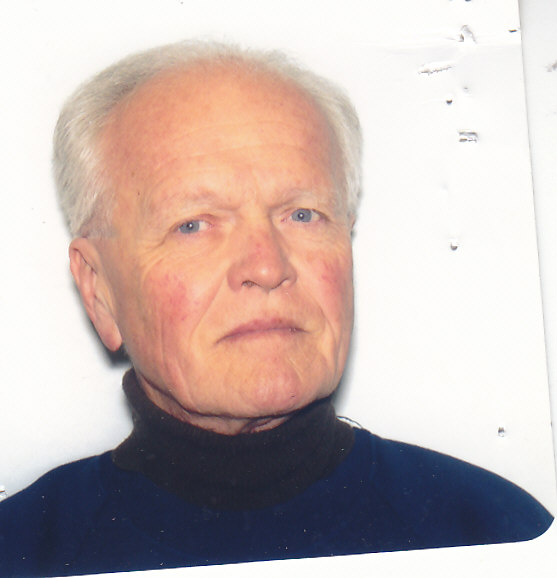
Image result for rodney nelson winter in fargo

Rodney Nelson

ABOUT THE AUTHOR
Rodney Nelson began as a poet long ago but turned to fiction and drama writing in order to make a living outside of the classroom.


761

DISCLAIMERS

Poems cited here are assumed to be under copyright by the poet and/or publisher.  They are shown here for publicity and review purposes.  For any other kind of re-use of these poems, please contact the listed publishers for permission.

We here at TBOP are technically deficient and rely on our bashful Milo to fix everything.  We received notice from Google that we were using "cookies"
and that for our readers in Europe there had to be notification of the use of those "cookies.  Please be aware that TBOP may employ the use of some "cookies" (whatever they are) and you should take that into consideration.


Groping and Meditating on a Confusion of Shapes 

Saturday, May 12, 2018

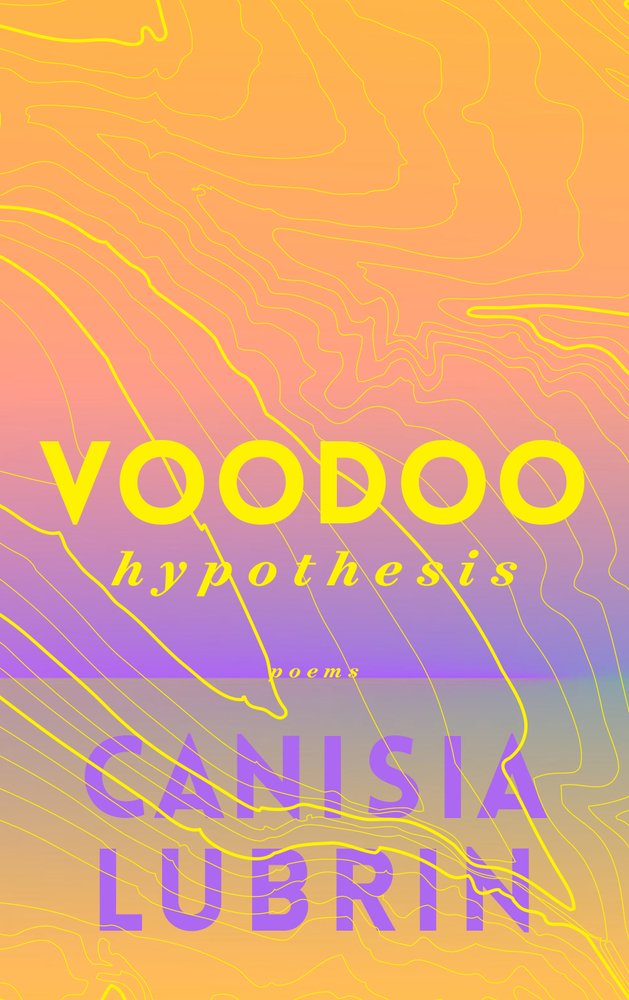
Voodoo Hypothesis — Canisia Lubrin (A Buckrider Book/Wolsak & Wynn)

Today's book of poetry:
Voodoo Hypothesis.  Canisia Lubrin.  A Buckrider Book/Wolsak & Wynn.  Hamilton, Ontario.  2017.

SHORTLISTED FOR THE RAYMOND SOUSTER AWARD


Today's book of poetry does not like to admit that we were wrong, about anything.  Canisia Lubrin's Voodoo Hypothesis has proved Today's book of poetry to be as wrong as we could possibly be.  We have been supping on our own words.

On our first reading of Voodoo Hypothesis our reaction was luke warm.  But not warm enough to get excited enough to write about.

And then, contrary to our belief system about readings and how they relate to the printed page  —  Today's book of poetry heard Canisia Lubrin read.
                                                                                Damn.

It has never felt quite so good to be so wrong.

Today's book of poetry remembers seeing Allen Ginsberg on stage with the CeeDees back in 1980's Toronto.  I even got to shake the hand of the great man.  Saw Irving Layton when he was still close enough to his prime to be a walking God.  I heard Earle Birney read, he came to our home and had tea.  Saw Al Purdy a few times too.  Today's book of poetry read with Milton Acorn once and he was a true giant.

But Canisia Lubrin reciting her title poem Voodoo Hypothesis with nary a page in sight was one of the more prodigious poetic feats I've ever encountered.  Griffin nominated poet Sandra Ridley was in the audience.  Today's book of poetry is a big fan of Sandra Ridley and we listen any times she speaks.  After the reading Sandra and I were talking about Lubrin and agreed, one of the monster readings we'd ever witnessed.  Hands down.

It was stunning to behold.  Lubrin was somewhat sheltered from the view of much of the audience, reading from a well lit corner of the Manx Pub, so not everyone got to see exactly what was happening, but I was front row center.  I saw the lightning bolt she shot across the room.

Voodoo Hypothesis

Before sight, we imagine
that while they go out in search
of God
we stay in and become god,
become: Curiosity,
whose soul is a nuclear battery
because she'll pulverize Martian rock
and test for organic molecules
in her lab within a lab within
a lab. She doesn't need to know our fears
so far too grand for ontology, reckoning.

Did you not land with your rocket behind
you, hope beyond hope on the tip of your rope
with the kindness of antigravity slowing you down,
you, before me, metal and earthen. But I am here to
confirm or deny, the millions of small
things that seven minutes of success were hinged upon
when I was little more than idea and research,
in the hypnotic gestures of flame and Bunsen burner,
and into parachute
no one foresaw, the bag of rags at the end
of the tunnel - all memory now,
this Paraclete.

Where else is a pocket
of air more deadly than the atomic bomb?
Would this only happen on Earth?
Has Mars run out of tolerance for the minutiae

of air pockets, fingerprints and worry?
Aggregates of metal, Curiosity
and her clues to calm our fears for what's coming.
Mars and her epic storms, her gargantuan
volcanoes have long ceased their trembling,
her crazy flooded planes, frozen and in cinema.
Martian life now earth and revelation's phases:
Earth problem,  not Mars problem.

But why
should I unravel over all this remembering?
            Great thing about landing
            is that I've arrived

at your service, at your sand, at your valley
and unsentimental magma.
Before me screams planes like Mojave Desert, Waikiki, Nagasaki,
nothing too strange to keep Curiosity off course.
Even though the Viking missions found no conclusive pulse
and we declared you dead, O Mars,
never mind that we named your heights and depths
from orbit. And from your spheres of minerals
where oceans once roared - we've learned little
of your lenience for empire.
Forgive us what Spirit uncovered in the silica of your ancient hot springs.

Ah, yes, we've come back home.
Phoenix told us we inherited the numberless
stories of your hydraulic pathologies
but I am Curiosity. If I kill the bitch right,
she'll take us deeper and convince us to send earthlings
to set up Earth colonies on your deserts. They won't ever
come back, but that's not so bad when we trade in
the grander scheme.
As though the colonials, the Tribe Traders
and all the pharoanic masquerades of gone times
were not fair threat. That we won't know the depth
of our homeward seas
is nothing when

the sun's still got our backs.
And while waters still vaporize before us
Curiosity will keep on until the organic secrets
of that Martian puzzle become as household to us
as carbon. Oxygen wasn't the only disaster to befall Earth,
to bless her with life.

Apollo drilled on the moon and got stuck
and the harder we've drilled down here
the more we've loosened our screws.
Perhaps there'll be no one left to give
a damn about the death of our privates

unless we prove ourselves enigmas,
the alien we think we know is the alien we only dream
up starting from the bottom
of the Curious.

We wake and die through
the crowns and thorns and craned chapters,
we move too quick for understanding.
Still, through the decades we predict,
Curiosity confirms the cold-slain dust.

Then come her conches blown
in the hard-won postcards travelling
on space dust faster than a bullet
to say:

hey,
I'm here. I safe. Wish you were here.
See Gale Crater, Mount Sharp, just as you've said.
Come bask with me in the wonders of a Martian. Good afternoon,
you of flowering faith. Set sail for home,
because we will all wear the consequences of this choice.
And you never should have said
goodbye.

...

So, Today's book of poetry went back to the poetry drawing board and started over with Voodoo Hypothesis.  Happily we were able to see what we'd foolishly over-looked on our first reading.  Lubrin's engines were running a little faster that what we were used to.  With some slight adjustments, a mental kick in the ass reminder, so to speak, Today's book of poetry was finally able to slip into the correct gear.

Luckily for us and luckily for you too.  

Canisia Lubrin is a poet you are going to want to stay in tune with, her voice is the next generation of strong Canadian women.  This is a vibrant voice keening with history, richly tempered by the lessons of systemic diaspora and frantic with love disguised as hope and reason.

Bjork and PJ Harvey are blasting from the office box, a complete re-invention of the Stones classic "Satisfaction" and it seems to be complete synchronicity.

Today's book of poetry thinks Bjork and Harvey would be down with the Lubrin train.  Voodoo Hypothesis invokes zombies, St. Lucian folklore, the ghost of Saint Derek of Walcott, Creole dynamism and more.

Even more.  Today's book of poetry is going into the future with a word we will borrow from Lubrin.  Frequent readers will recognize that in Today's book of poetry language to "burn" is one of the highest compliments we can manage.  Lubrin introduces Today's book of poetry to the Creole word Bwile.  Bwile/burn, also means lust.  Lubrin has improved our vocabulary and our mood.

Epistle To The Ghost Gathering

Dregs have formed us
molten inside. Here, a road, the core
this earth, a single-celled fire
a break in the vein: no exact archipelago
to dream what sealed its original shape.

Still we hail a fire that buzzes us in,
our swat-genes: still, our song
our burden beyond sanity: don't be afraid.
This may not have been the only home
reshaped by our before-selves- 
Scarlet alphabets breaking the chains
of this age. Music not dialogued
in the cosmic blues.
A castoff in that short fuse, these
dogged admissions in asteroidal jazz.
Even loss can love what we mimic
in tanglewood, found summers in us - 
A dance extinction loves, us until a great
height forms that almost-slay in us: come home.

...

Our morning read had Alexander, our historian, chain smoking and shaking his head.  "This is a deep river" he said, shaking our reading copy of Lubrin's Voodoo Hypothesis, "and we're going to have to all jump in."  

Today's book of poetry did not waltz into Voodoo Hypothesis on first reading and it was our fault.  Our primary reading skills need some honing from time to time.  Canisia Lubrin provided the perfect platform for us to stretch our sympathies as we stretch our understanding, reminding us once again of how much we have to learn. 

Kathryn, our Jr. Editor, and Maggie, our new intern, both adored Lubrin from the get go and looked at me like I were stupid when I passed it by the first time.  Kathryn and Maggie were right, and I was wrong.  (I had to promise to print that)

Up The Lighthouse

Think you are apart from the name
             that stuck, apart from relics of
supersun, vulva and misnomer
   garden and virgin and beast.
   You must know, black isn't always the void:

to be a living fossil, light-years old
perhaps, the bougainvillea must think itself
aloof. that its fruitless state by twilight recalls
the bloom of suns. Small suns considered
suns because they remain, vibrant
no matter how barren the winter - how dark.

Think yourself manly as tiers of black pyramids
you mark, golden with vomit. Think the ancestral
footsteps in that spring-rushed courtyard, a stooled help.

Think yourself womanly as the one-eyed tower,
with patience to turn a thousand years of rancid
butter into a mountainscape
of nigger dreams, ascending - 

black isn't always a void.

...

Canisia Lubrain can burn, burn, burn.  Today's book of poetry never likes to be wrong, but even worse is not learning the lesson.  Voodoo Hypothesis is the next book of poetry you should read.

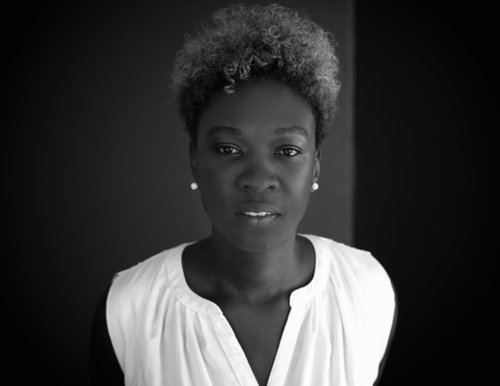
 Photo credit: Anna Keenan

Canisia Lubrin

ABOUT THE AUTHOR
Canisia Lubrin was born in St. Lucia. She has had work published in literary journals including Room, the Puritan, This Magazine, Arc, CV2 and The City Series #3: Toronto Anthology. She has been an arts administrator and community advocate for close to two decades. Lubrin has contributed to the podcast On The Line, hosted by Kate Sutherland for The Rusty Toque. She studied at York University where she won the President's Prize in poetry and the Sylvia Ellen Hirsch Memorial Award in creative writing. Lubrin holds an MFA from the University of Guelph and teaches at Humber College. She lives in Whitby, Ontario.

BLURBS
“In Canisia Lubrin’s debut collection of poetry, she pointedly observes that ‘the alien we think we know is the alien we only dream up.’ Voodoo Hypothesis is an imperative invocation of black dreams, an invitation for the living and the dead to define themselves. With poems at once epic and intimate, Voodoo Hypothesis requires a reverence for the individual word, to bear witness to Lubrin’s ‘brilliance indistinguishable from magic.’”                                                                                                    – Vivek Shraya, author of even this page is white and She of the Mountains
Canisia Lubrin’s lush, winding poetic lines are the incantations of a furious imagining. Lubrin’s speakers seem to have lived in generations of bodies of the African diaspora, and through centuries of migrations, slavery and neo-capitalism. Yet hers is still one single, contemporary vision – grieving, mongrel-cultured, exiled from the Caribbean archipelago’s sun. Here is a brilliant new Canadian voice, in the lyric lineage of Dionne Brand and M. NourbeSe Philip, raising up language like a shield against European histories and sciences, raising up poetry like a sacrifice of sweat and blood.”                – Sonnet L'AbbΓ©, author of Killarnoe and Sonnet’s Shakespeare
Voodoo Hypothesis is an interior in motion: a gorgeous, searching intelligence. It is a womb/tomb of luminous inquiry. A semi-permeable ship where your mind is in concert with Lubrin’s forward propagating lineation, a participatory dreamscape that leads you back to your own culpability. This is a work that reads you, too.”                                                                                                                           – Liz Howard, author of Infinite Citizen of the Shaking Tent and winner of the Griffin Poetry Prize
686
DISCLAIMERS

Poems cited here are assumed to be under copyright by the poet and/or publisher.  They are shown here for publicity and review purposes.  For any other kind of re-use of these poems, please contact the listed publishers for permission.
We here at TBOP are technically deficient and rely on our bashful Milo to fix everything.  We received notice from Google that we were using "cookies"
and that for our readers in Europe there had to be notification of the use of those "cookies.  Please be aware that TBOP may employ the use of some "cookies" (whatever they are) and you should take that into consideration
Thursday, June 29, 2017

After Hours - Darrell Epp (Mosaic Press)

Today's book of poetry:
After Hours.  Darrell Epp.  Mosaic Press.  Oakville, Ontario.  2016.

Hamilton Ontario Poet Darrell Epp

The best poems in Darrell Epp's After Hours remind you of the first time you got stoned.  The first time you felt dangerous.

You know how you felt the first time the veil came down.  The first time you saw behind the wizard's screen.  Welcome to a new Oz.

Epp has just the right amount of disgruntled dissatisfaction to fill these poems with the proper vigour. Hope doesn't come easily but it is buried in the seams of After Hours.  Maybe under an old car with a mad dog chained to the bumper, the hard-packed soil oil stained.

The Mongol Invasions

i have as of late acquired the ability to
turn myself into fictional characters,
it's an old man in a rent-controlled
basement today--no one suspects
he's really an eccentric billionaire
with a thousand years of memories.
i prowl the malls, laugh at the
baffled cluelessness of the
bargain-hunting taxpayers.
i seem to recall having
magic powers, a dozen
wives and x-ray eyes;
watching atoms knit
themselves into pairs,
then clans, then faces.
maybe a face will say
hi to me today, maybe
i'll make a new friend
who truly understands:
we'll trade war stories
about missing dorothee
and rampaging across
asia with genghis khan.

...

Today's book of poetry positively romped through Darrell Epp world.  I want to tell you that Epp made me think of Bukowski but in truth Epp is not a Bukowski cat.  So then I'm thinking somewhere between Johnny Rivers melancholy and Len Gasparini rant and maybe with a modernized Milton Acorn thrown in there for a touch of righteous rage.

How silly to be looking for comparisons when Epp can so clearly stand on his own.  These quick and sharp narratives cut clean as a razor.  Epp has found a voice just below the bellow of flat out rage and is comfortable roaming that dangerous territory.  It certainly makes for kick-ass poems.

Our morning read was like watching young kids with their first fireworks, setting them off one at a time.

Contraindications

an unpolluted pacific

a garden of eden sky

the man in the moon

a star's molten heart

a volcano's teardrop

put one of the above under your
tongue every 4 hours or as needed.

do not mix with food, do not answer
the phone, and if anybody asks, tell

them you haven't seen me, tell them
you haven't seen me for months.

...

After Hours is Darrell Epp's second book of poetry.  Today's book of poetry didn't have to go far to find his first book, Imaginary Maps (Signature Editions, 2009), we have a copy on shelf of "coming attractions."  Today's book of poetry will be looking at Imaginary Maps in the not too distant future.

When Milo, our head tech, put Imaginary Maps down on my desk I had an immediate flashback to the first time I read it.  Cue big smile.  Epp is a quick study because he allows the reader immediate entrance to his chaotic world, seasons it with kindness.

The Robert Crumb type front cover of After Hours has a Bukowski type "Hank" character with angel's wings sitting with other barflies as eternity sneaks up on them.  Rarely are covers so apropos.

Telephone Game

the message ran around the world; by the
time it came back to me i had a wooden
leg and lived in a castle made of bone.

my pet unicorn could sing like a bird.
i was a wanted man, one step ahead
of irs, kgb and other sinister acronyms.

i beat superman at arm-wrestling and
punished all who loved me. love's a
word poets use as a crutch, like 'very'

and 'and.' funny how love brought out
my inner martyr: a lesser man would
have broke both your arms. what was

it, that thing you thought you wanted?
sorry. but don't look at me, look at the
universe, downright peacock-y in its

nightly burlesque: supernovae like
popped corks; the milky way,
waving her spiral arms like shiva

herself; the gravity that pulled me
to you, indiscriminate, affirmative, it
felt like heaven, or the next best thing.

...

Maybe After Hours is an entirely coincidental title pick but Today's book of poetry is convinced Epp is giving a big nod to ol' Martin Scorsese's flick of the same name, After Hours (1985).  In the episodic flick, think of individual poems, the hero/loser is entirely over his head from one late night misadventure to another.  The character presents as though he were on top of things, as though he were in control whereas the movie is one continuous lesson in how he controls nothing at all.

Darrell Epp's After Hours discombobulates the reader in much the same way.  It is a great ride. Buckle up.

Image result for darrell epp photo
Darrell Epp

ABOUT THE AUTHOR
Darrell Epp’s poetry has appeared in dozens of magazines around the world including Maisonneuve, Poetry Ireland, Sub-Terrain, and The Saranac Review. His previous poetry collection was entitled Imaginary Maps (2009). He lives in Hamilton, Ontario.

BLURBS
“In Epp’s second collection of poems, he explores diverse themes and imagery firmly rooted against a gritty postmodern backdrop.” 
     – The Hamilton Spectator

“A fun, sly jumble of poems that often tackle weighty issues”
     – Jonathan Ball, Winnipeg Free Press

“In After Hours, Darrell Epp proves himself as adept at bricolage as he is at ventriloquism. That he manages to not only interpolate discrete, oblique, and temporally disconnected texts and cultural signifiers into his poems, but does so while remaining consistently tethered to the visceral reality of his native Hamilton, a city he describes in “No Sweat” as “awesome and oblivious/and no help at all,” is no mean feat.”

     – Phillip Crymble, Hamilton Arts & Letters


“I enjoyed these poems immensely.”

     – William Peter Blatty, author of The Exorcist


“Lucid, raw and honest poems, refrains that slide with grace and wit from the particular to the general, from past to present and back again, authentic and absorbing.”
     – novelist and screenwriter Rudy Wurlitzer (Pat Garrett and Billy the Kid and Little Buddha)


“If you ever get caught in the subway between stations, try to sit beside a guy like the guy who wrote these poems.”
     – novelist David Gilmour (The Film Club, Back On Tuesday)


“Funny and fun to read, playful but also deadly serious…a depth of experience got at only in the best poetry.”

     – novelist Samuel Thomas Martin (This Ramshackle Tabernacle, A Blessed Snarl)

mosaic-press.com

588

DISCLAIMERS

Poems cited here are assumed to be under copyright by the poet and/or publisher.  They are shown here for publicity and review purposes.  For any other kind of re-use of these poems, please contact the listed publishers for permission.

We here at TBOP are technically deficient and rely on our bashful Milo to fix everything.  We received notice from Google that we were using "cookies"
and that for our readers in Europe there had to be notification of the use of those "cookies.  Please be aware that TBOP may employ the use of some "cookies" (whatever they are) and you should take that into consideration.

Thursday, September 17, 2015

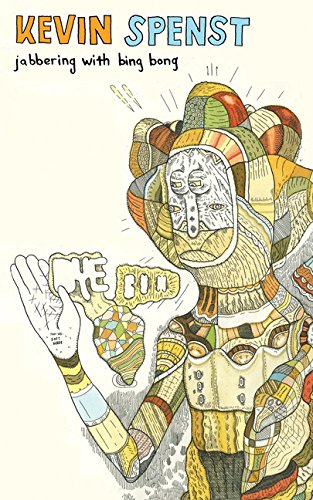
Jabbering with bing bong - Kevin Spenst (Anvil Press)

Today's book of poetry:
Jabbering with bing bong.  Kevin Spenst.  Anvil Press.  Vancouver, British Columbia.  2015.


Crystal Gayle is whisper-crooning the Tom Waits' classic "Take Me Home" and the lake is as quiet and still as bathwater in an bathtub. I've sent the entire staff off on a scavenger hunt into the woods with at least three impossible tasks.  I expect them to be gone for hours.

Most likely they will find a quiet spot, sit and smoke bobo, tell each other lies.

Kevin Spenst's Jabbering with bing bong is a little like Crystal Gayle singing Tom Waits.  A beautiful clash-turn-cascade of juxtaposing cultures.  Spenst has that distinct voice we recognize on first hearing, like Waits, like Gayle, unique and hauntingly familiar.

Pray Goodbye

At sixteen, I folded into prayer for the last back-
and-forth time in my basement bedroom with
one brick wall, and cheap wood siding
and a box-filled fireplace. It was midnight.
The cement floor, covered in carpet scraps,
was equally unseen and cold. The brick wall
stopped halfway, continuing as a ledge of its
lower self, a makeshift closet. An opening at
the end led you under musty clothes toward
a wooden door with a metal latch to a crawl
space under the stairs. A history of fear, of play.
Despite the darkness, my eyes were closed.
I can no longer believe in you, I prayed in bed,
If I'm wrong, I hope I find my way back.

...

These crisp missives chirp, chortle and chide and in no time at all Spenst has taken us around an unexpected corner.  Spenst has a strangle hold on contemporary culture and the reader tied in knots with these dense little sausages packed to bursting with poetic meat.  These poems have a great sense of wondrous play that disguise the shot to the brain Spenst has just knuckle-balled your way.  He gains quick and slick access to the part of our brains that love poetry.

Jabbering with bing bong, although laced with as much sadness and uncertainty as anyone need carry, brims with poems that will make your brain happy.  You are going to be pleased you paid the price of admission for this show.

A Brief History of Lust

Fenris Wolf Esquire beds little Red,
colonizes her limbs
in a cherry bowl motel room
rented by the century. Whispers,
is Red your real name? Whispers,
I only feel at home inside you.

...

Fenris Wolf drops in about half-way through Jabbering with bing bong.  He snorts and cockwalks through several excellent poems.  He caterwauls and smells like sex but he doesn't hang around for long.  Too bad.

If there were ever a sequel to Jabbering..., Today's book of poetry would like to hear more about the big, bad Wolf.

This reader is sad to see the Wolf go.

On we go into the back half of Jabbering with bing bong (which is a GREAT title), and it is delightful.  Spenst dances over these quirkily terrained poem scapes as though he had an extra set of legs.  These poems are so bursting full of ideas that you hardly have time to digest one train of thought before another comes screaming into the station.

Jabbering with bing bong is full of literary characters, you never know when John Berryman might drunkenly jump from a bridge, or Margaret Atwood opine robustly.  Wallace Stevens and Milton Acorn, Al Purdy and, well.  You catch the drift.  But Spenst doesn't just name drop, he uses the aura and glow from each of these giants to make them all welcome, necessary.

Pray/Goodbye

       for Rob

Even under the real mask of bipolar disorder
Halloween is a bad time to kill yourself: an
awkward costume, a shroud of ugly absence.
Earth holds more dead weight. Soggy cardboard
tombstones line the house next door. Anger
lurks behind ghouls at our front door. What we
must offer you is love. You hammered out
the personal into concave dusks, listening spaces
you opened with a tilted head for writing students
and friends. Your ex will go to San Francisco
for eleven days. I wish her warmth. We walk
with heaviness as if gravity has increased.
Saint Suicide, we pray that yours will be
the last. Suspend our disbelief forevermore.

...

Today's book of poetry is smart enough to trick his minions into the woods for the morning but not smart enough to adequately express the wonder and playfulness of these acid-etched songs.  Kevin Spenst has just made a place for himself at the table,  Jabbering with bing bong is first class jabbering of the highest order.  The best jabbering you'll see for a while.

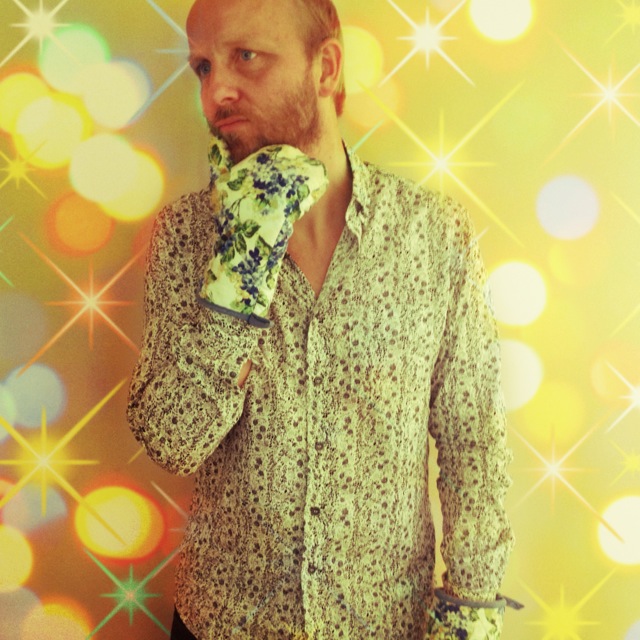
Kevin Spenst

ABOUT THE AUTHOR
In addition to the UK, the United States, Austria and India, Kevin Spenst’s poetry has appeared in over a dozen Canadian literary publications. In the spring of 2014 Kevin did a 100-venue reading tour of Canada in support of small poetry presses with his chapbooks Pray Goodbye; Retractable; Happy Hollow and the Surrey Suite; What the Frag Meant and Surrey Sonnets.


BLURBS
“Belief and disbelief rub up against each other in this startling and flawless debut collection. … These important poems do not redeem so much as allow the possibility of redemption.”
      —Jen Currin, author of The Inquisition Yours

“Fearless, attentively probing, and sonically sharp, he is a rare counter-theosophist rhapsodist. Spenst’s Jabbering…is the work of a remarkable shepherd.”
     —Sandra Ridley, author of The Counting House

“Kevin Spenst provides further proof that the best writing these days is in the practice of poetry. Hang on tight as you are winged deftly through the human strains…curiosity, sexuality, death, religion and striving—it’s all here.”
     —Dennis E. Bolen, author of Black Liquor

“Kevin Spenst’s muscular vocabulary, vigorous pace and nimble references to cultural details enliven his exploration of topics ranging from adolescence to God to Fenris wolf.”
     —Sarah Klassen, author of Journey to Yalta

Kevin Spenst
Reading at the Human Bean in Cobourg, Ontario
as part of his 100-Chapbook Tour across Canada
Video:  Wally Keeler


382
DISCLAIMERS

Poems cited here are assumed to be under copyright by the poet and/or publisher.  They are shown here for publicity and review purposes.  For any other kind of re-use of these poems, please contact the listed publishers for permission.

We here at TBOP are technically deficient and rely on our bashful Milo to fix everything.  We received notice from Google that we were using "cookies"
and that for our readers in Europe there had to be notification of the use of those "cookies.  Please be aware that TBOP may employ the use of some "cookies" (whatever they are) and you should take that into consideration.