Showing posts with label nancy eimers. Show all posts

Saturday, December 21, 2019

House of Sparrows: New and Selected Poems - Betsy Sholl (University of Wisconsin Press)

Today's book of poetry:
House of Sparrows: New and Selected Poems.  Betsy Sholl.  University of Wisconsin Press.  Madison, Wisconsin.  2019

WINNER OF THE FOUR LAKES PRIZE IN POETRY
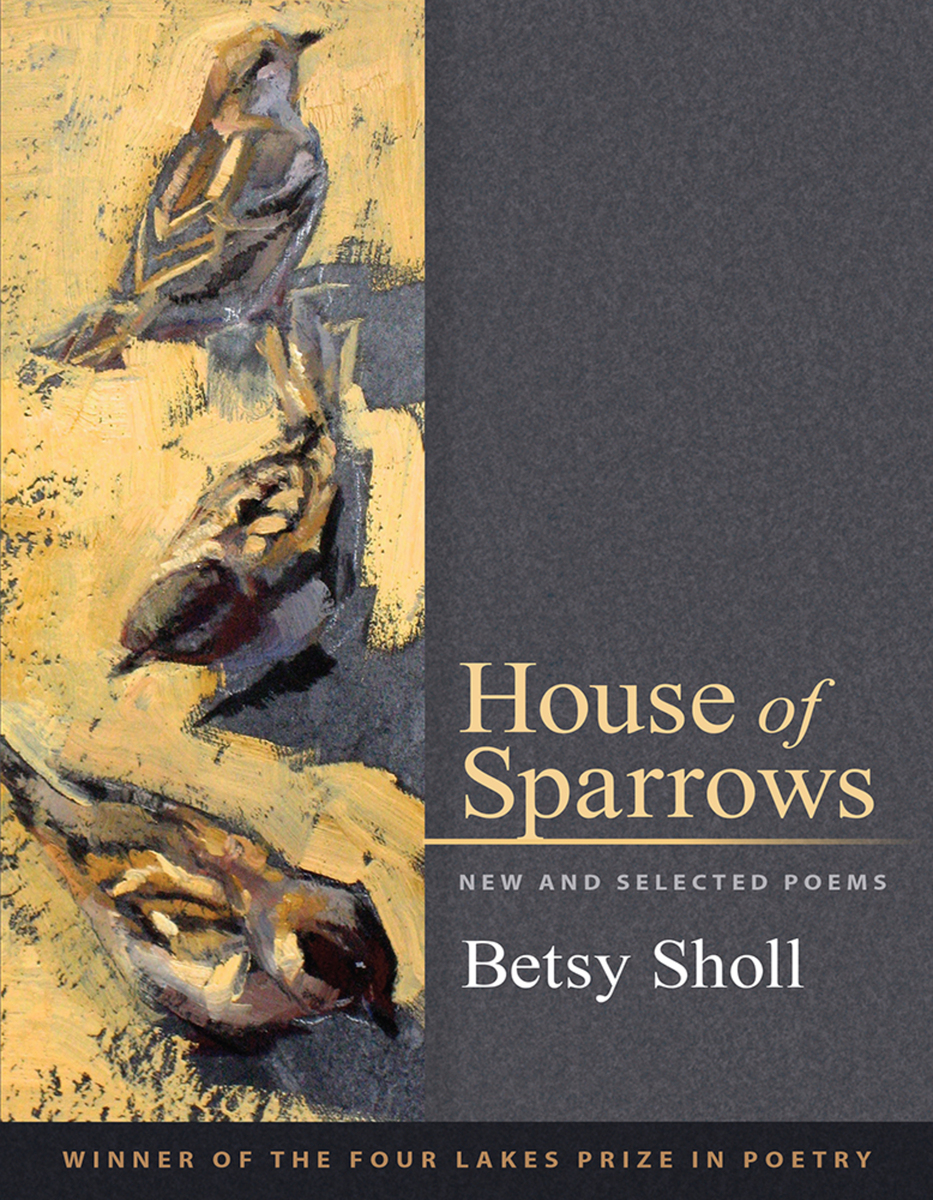


cover of book


The first thirty-seven delightful pages of House of Sparrows: New and Selected Poems, are new poems from the desk of Betsy Sholl.  These poems, on their own, are more than worth the price of admission.  House of Sparrows is the latest from Ms. Sholl, the latest in a sizable line-up of killers.  

Today's book of poetry looked at Betsy Sholl's Otherwise Unseeable (University of Wisconsin Press, 2014) back in May of 2014.  You can see that blog/review here:


House of Sparrows brings together selected poems from five of Betsy Sholl's previous collections, The Red Line (1992), Don't Explain (1997), Late Psalm (2004), Rough Cradle (2009) and Otherwise Unseeable (2014).  Like the only other Betsy Today's book of poetry is familiar with, Betsy Struthers, Sholl has built a formidable practice one huge brick at a time.  Those of you not familiar with the very fine Canadian poet Betsy Struthers need to brush up on your Betsy's.

Sholl's new poems read like testaments that have already stood the tests of time, they read like needed wisdom.  Sholl's poetry hums honest, wicked shrewd, all hammered out of a giant and tender heart that beats a solemn, sad song.  Then Sholl throws in some hope, some redemption.  It is all so human.

Betsy Sholl creates poetry that echoes like music both longed for and cried to.  Betsy Sholl can burn.

Her Story

     Johnson City, Tennessee

What a ruckus - those fricatives inside
that truck, spitting our roadside grit
digging itself in deeper.

Overhead the sky's one eye looks down.
Near full it rose, rusty as the truck's
undersides and dented with shadows.

Below, out of gas, trapped, that truck
hardly looks like it once jumped red lights,
gunned through town, took hairpins

with a squeal. As to the woman inside
pounding the wheel, she just saw her man
of fourteen years take off with somebody

blond and younger. She's got a fifth
on the seat beside her, a pistol,
a box of ammo already emptied out

into every Slow Curve, Falling Rock,
Soft Shoulder she passed downshifting
on the upgrade. Who you think does that?

she'll ask months later, then grin.
But now, inside that bucket of rust,
it's just her hollowed out, a full bottle

of sleep, and the moon overhead
watching, so she points her pistol,
pulls the trigger and laughs, bitter

as the pills she unscrews and scatters
like buckshot across the road.
The she lean back into liquor's drift.

Come morning, an old man will drive up,
peer in, see all that trouble
and hook up chains to haul her out.

He'll give her gas enough to get to town,
tell her, Now you never mind, Honey,
you just go on - and she will.  She will.

💥💥💥

When Sholl is in a corner she has no problem employing one of Today's book of poetry's favourite tricks.  She calls on some giant like Theolonious Monk, crawls into one of his recipes until all the pieces fit.  Betsy Sholl does this better than Today's book of poetry (damn her).  When she was writing these poems we doubt she was worried about their influence on Today's book of poetry or anyone else.  But in this small world you can never tell who is listening, taking notes.  Bowing in appreciation.

Betsy Sholl knows the difficulty caused when two things are true at once.  That life isn't black or white or fifty shades of gray.  Our limitless palette is gaudy with riches and yet we struggle to be kind, knowing, coming correct.  House of Sparrows is ironic and serious as a heart attack, the language nuanced, instantly recognizable as a voice that should be listened to.


House of Sparrows

What if every time we saw the word sorrow
we switched it to sparrow?

     For my life is spent with sparrows...
     With drunkenness and sparrows...

Or if it went the other way, the song would be,
     His eye is on the sorrow...

🐦

My eye's on the neighbor's eaves,
and the copper-roofed house we put up in our yard,

its many rooms, multiple nests, generations --
as if we brought this clamor on ourselves,

this hurdy-gurdy, rabble, host and quarrel
of sparrows
      mixed with the morning radio

🐦

broadcasting a bombed hospital, bodies
under fallen roof tiles, shards of over-voice and wailing,

while outside birds flare up, knock each other off the feeder,
sparrows the color of rubble, of dust and mud,

burnt cars, blown-out windows, of wreckage
they could roost in, the earth a house of sparrows

🐦

on Sparrow Street, hunger house, and woe
to the poor who are spared nothing,

who gather at borders to beg and forage, are sold
     two for a penny, five for two cents.

And yet doesn't it say the Lord God
attends -- bends down to count

🐦

each one shot, starved, buried in rubble? --
A man of sparrows and acquainted with grief,

who says, when I bow my head,
     Sparrows are better than laughter.

And to the rabble, the wailing, the how, the when,
who says,
     Your sparrows will turn to joy--

💥💥💥

Today's book of poetry will be in Ottawa for Christmas this year but we have suspended our annual Christmas Eve festivities for family reasons.  Shortly after Christmas Today's book of poetry and our much better other half will be heading to Montreal.  We are heading to Montreal to gain all the weight we've lost in the last year.  We both love Montreal and will do our best to eat well and find poetry, drink well and find poetry.  You know the drill.  Montreal is one of the finer places on the planet to spent time with the one your love.

House of Sparrows reminds Today's book of poetry of why we started writing these blogs/reviews in the first place.  Sometimes the poetry we get to read is simply too splendid not to be shared.  Betsy Sholl meets that standard.  We'll be scanning bookshelves in Montreal for the rest of Betsy Sholl's titles.


Betsy Sholl

ABOUT THE POET   
Betsy Sholl is the author of nine poetry collections including Otherwise Unseeable, Rough Cradle, Late Psalm, Don’t Explain, and The Red Line. A former poet laureate of Maine, Sholl teaches at the Vermont College of Fine Arts.

BLURBS
“Her work brings the poetry of Nathaniel Mackey to mind: its specificity, its engagement with and curiosity for living, even in the bluer stretches.”
—Boston Globe

“Very polished poetry that with careful attention can, in Wordsworth’s phrase, lift us up when fallen.”
—Central Maine

“A quiet, yet powerful journey through nature, memory, regret, and hopefulness. Readers will find themselves returning to its deftly understated voice again and again.”
—Split Rock Review

“This magnificent collection proves yet again why Sholl is one of our truly indispensable writers, whose poems engage what must be addressed if we are to fully encounter, as she writes in her triumphant title poem, ‘the wailing, the how, the when.’ I remain awestruck by her artistry.”
—Sascha Feinstein

“I love Sholl’s unyielding honesty, the great heart and deep intelligence of her vision.”
—Nancy Eimers

“It’s difficult to love the world enough, especially for someone like Sholl, who sees with such searing clarity its cruelty and sorrow. But, like Keats, she dares to, in poem after poem in this masterly collection. And we are all the richer for it.”
—David Jauss


797


DISCLAIMER
Poems cited here are assumed to be under copyright by the poet and/or publisher.  They are shown here for publicity and review purposes.  For any other kind of re-use of these poems, please contact the listed publishers for permission.
We here at TBOP are technically deficient and rely on our bashful Milo to fix everything.  We received notice from Google that we were using "cookies"
and that for our readers in Europe there had to be notification of the use of those "cookies.  Please be aware that TBOP may employ the use of some "cookies" (whatever they are) and you should take that into consideration.




Sunday, November 22, 2015

No Shape Bends The River So Long - Monica Berlin & Beth Marzoni (Parlor Press/Free Verse Editions)

Today's book of poetry:
No Shape Bends The River So Long.  Monica Berlin & Beth Marzoni.  Parlor Press/Free Verse Editions.  Anderson, South Carolina.  2015.

WINNER OF THE NEW MEASURE POETRY PRIZE


Today's book of poetry is not at all sure how No Shape Bends The River So Long was constructed. Did Monica Berlin write one line and then Beth Marzoni the next?  Did they take turns writing poems and then edit them together.  It is impossible to discern what wizardry is behind these poems.

Not quite as rare as hen's teeth but Today's book of poetry sees very, very few volumes of poetry written by two poets.  In this case the poetry is seamless, and stunning.  Marzoni and Berlin may be secret Siamese twins connected where thought begins.  

Clearly Marzoni and Berlin are tributaries that merge to sing river.

Air so lousy with it everything's made heavy-thick

& dishearted we'll turn down the news. Dishearted

by the rush of alongside & what is, what
we'll hear scorched & think scoured, here

swallowed, silted. Humbled we'll corner-fold
those pages, map the measure it would take

to burn off all this too muchness. Fire has its own
idiom--its sentence turns, becomes another kind

of weather on our tongues. So, all this talk
to buttress the palate against

some awful caving in. We'd rather the music
of loss quiet. If only a needle

after the album's end. If only
a phone booth, that other era

overseas, a coin's tinny drop. If before
all sound rushes back

then every disaster we've known gathers up
that space in the static of if. As in, if the wind

turns. As in, if the rain holds
or if the bridge cannot. Then then

kicks up its storm in our chests leaden
where dishearted didn't begin but stays on.

Because fire season & then sputtered out,
because gone under & all bears down,

called or not. Edges singed or worn
thin or too saturated, because will run out

of names come winter. Because so many places
we recognize or think that we do

until the river changes its mind. Or
sixty years late & twelve miles from where

it crashed, the plane & its crew surface.
That glaciered silence heaves off any grief

we might call mass grave, call memorial
turned monument turned natural wonder.

...

The Mississippi is one mighty river and has more stories than the fish that swim beneath her waves. Berlin and Marzoni take the river metaphor in every direction at once. 

And because we are water only recently free of the primordial ooze these poems draw us in like gravity.  Water only flows in one direction and in No Shape Bends The River So Long the reader is reminded again and again and again that the river makes its own path.

Imagine we can hear winter breaking its hold on the river
      & how

it might all go down: just a little shove, avulsing, just the body

delta swtiching, like weight one leg to the other, like
balance, like necessity, like that--no, like letting go,

but then not & this & everywhere today
spring all mixed up, birds confused, even scientists

releasing news then taking it back, say heliosphere then interstellar,
revise just farther than anywhere we've mapped. The ocean

floor they map from space so we can watch the earth
heave & sigh, watch ourselves cross the dark we push

away down the hall, down the block, across town. This town,
most any, keeps tight, a closed door, turned down

blind. Think strange, think foreign, think not mine, think
thank god, & claim the stars, weather, even

birdsong a place to close our eyes against ruin. & the flung.
the careening, the slow dissolve we call

against it & the piled-up, wreckage we'll keep
dragging to curb, to landfill, to bury.

When paved avenues again made floodway think
dam or burrow or nest, we remember invention's not

a human thing. We forget places we can walk under
water & forget nothing disappears--it just drops off

our map. Trace spreads out the atlas & physics reports less
stuff we don't understand by a tiny amount & we spread out

to find tiny, & follow the roads we'll always travel
back to iota. We should imagine something

unimaginable: begin with moonscape but then try
that water might bed down deeper places

where the sky cover is less periled, made of more
normal matter. & less periled we might know better

what to make of it & what to do with our hands.

...

These particularly rich and expansive poems are ripe with hope and longing even as they are heavy with the dark clouds of every storm, past and future.  Berlin and Marzoni are attempting to have a conversation with a great river, a conversation with water, for all of us.

Today's book of poetry was entirely enthralled in this conversation from the first poem to the last. 
This is champion poetry.  

When the rain says wait, says not so fast, says this season
     we've measured in so many

stunned inches isn't yet through with us, isn't this what you wanted?

So, turn your sorry back to urgent or at least what begs
doing because there's nothing left our bodies can tend. Now every city

that banks itself against what's rising dislocated, every ramshackled-
falling-down, & the highways & the bridges bottomland, grounded low.

Made of less water we might absorb deluge, extend our limbs
to soak up at the washout, wring sopping dry, but the only body

more water than us is water & So, all at sea & maybe worse
than helpless our sad wade through the wires or anxious

waiting on the wires: that kind of course that drifts, that channel
toward lost. Even all hands on deck won't change the facts, can't

unknot: what holds us won't contain what's coming in at the breach
& won't anchor to shore. For all its translucence

we can't figure water & So, the fields
stay unplanted under so much shimmer & wave & elsewhere heavy, that

quiet, when these streets last disappeared. In standing rain we gage
or aimless shove toward grate & gutter, warn children already chaffing

summer's edge back from the creek-sprung moment & it must have
seemed just for them the way it always seemed for us tideless all

these years & then again as if out of nowhere & suddenly &
all at once our ankle-deep & that pull.

...

These poems strike at the American heartland, the valleys of the great Mississippi, the gaping thirsty maw of the land.  Water makes up its own mind, floods change the very shape of the land and water loves this.  Water shapes the lives of everyone that is touched by rain and Berlin and Marzoni want us fully immersed in the conversation.

They take us into deep water again and again and again.


Beth Marzoni

Monica Berlin

ABOUT THE AUTHORS


Monica Berlin
On faculty since 1998, Monica Berlin is the Associate Director for The Program in Creative Writing, an Associate Professor, & Chair of the Department of English at Knox College. A recipient of the Philip Green Wright-Lombard College Prize for Distinguished Teaching, she teaches poetry, creative nonfiction, fiction, & late 20th & 21st century American literature. She holds degrees from Knox College, Western Illinois University, & Vermont College.

Berlin is also the project director for The Knox Writers’ House digital archives of contemporary literature, & runs a small literary studio, The Space, in downtown Galesburg.

Her collaborations with Beth Marzoni have been published in many journals. Their collection of poems, No Shape Bends the River So Long, was awarded the 2013 New Measure Poetry Prize and was published by Free Verse Editions/Parlor Press in January 2015.

New solo poems & creative nonfiction were recently published or are forthcoming in numerous journals, including Passages North, Midwestern Gothic, The Cincinnati Review, Hayden's Ferry Review, Cimarron Review, Hobart, Mantis, Quiddity, & Grist. Meanwhile, Berlin is currently at work on a collection of essays & keeps trying to make new poems. She lives in Galesburg, Illinois with her son.

Beth Marzoni
Beth Marzoni is a poet, a teacher, an admirer of bridges, & a pie-enthusiast who lives as close as she can to the confluence of the Black, the La Crosse, & the Mississippi rivers. A graduate of Knox College, she earned her Ph.D. from Western Michigan University, & is currently an Assistant Professor of English at Viterbo University. There she teaches workshops in poetry, fiction, & creative nonfiction as well as courses in 20th & 21st century British literature, modern & contemporary poetry, environmental literature, & composition.

Marzoni plays well with others. Her collaborations with Monica Berlin have been published in Better: Culture & Lit, Boston Review, Colorado Review, Denver Quarterly, DIAGRAM, Meridian, New Orleans Review, TYPO, & Vela among others. Their book of poems, No Shape Bends the River So Long, won the 2013 New Measure Poetry Prize & was published by Free Verse Editions at Parlor Press in 2015. With Natalie Giarratano, Marzoni co-edits Pilot Light, a journal of 21st century poetics & criticism.

Marzoni's poems have received national recognition from Crazyhorse & New Ohio Review. In 2008 she was the recipient of an AWP Intro Journals Award. Recent work has been published in Hayden's Ferry Review, Cimarron Review, Pastelegram, Puerto del Sol, & Grist.

BLURBS
“What to make of this grand experiment over months and miles of river by two poets, not one—Monica Berlin and Beth Marzoni—plus whatever third spirit they’ve invented together? Like music from the 8th century written by Anonymous, that haunting ubiquitous voice, these poems feel unsettlingly interchangeable, keep coming like the country’s longest river dream-documented here in a rich rush, dense with repetition and sorrow by poets who ‘think like a glacier or a stone, sand . . . years / like consistent rain.’ The Mississippi never had better companions or more devoted ones, save Mark Twain perhaps, or more to the point, his troubled, star-crossed Huck. The sense of human and nonhuman history, even prehistory stuns, keeps bothering this shared-solitary work. ‘Wake to any weather & know that / long ago there also was.’ I’ll take that as rare solace.”
      —Marianne Boruch

“No Shape Bends the River So Long is a book of atmospheric turbulence and diminishing water levels, inner weather forecasts, dark and light, friendship, the stillness in waiting rooms, a river’s traffic—or what poets Monica Berlin and Beth Marzoni, a So & So in dialogue with us and each other, call ‘the rush of alongside & what is.’ In the zig-zag process of traveling the Mississippi River Valley, together they navigate with beauty and resonance the ‘hours of drought, of waiting, the new low- / watermarks of the lakes,’ the trees ‘that sound like rain & morning.’ This is ecopoetry, it is intimate conversation, it is meditation, the turning inward, the swinging back out from mind to world around the bend. I deeply respect and admire this book for its love of place; its tumbling, digressive progress; its glints of joy and thoughts too deep for tears.”
     —Nancy Eimers


TBOP sidebar.  The poems in this collection were selected by Carolyn Forche, which is a good thing, AND you must watch the killer video below.  It's a very fine poetry video.


Monica Berlin & Beth Marzoni
"All the particular places we've known [...]"
Video:  Better Magazine


410

DISCLAIMERS

Poems cited here are assumed to be under copyright by the poet and/or publisher.  They are shown here for publicity and review purposes.  For any other kind of re-use of these poems, please contact the listed publishers for permission.

We here at TBOP are technically deficient and rely on our bashful Milo to fix everything.  We received notice from Google that we were using "cookies"
and that for our readers in Europe there had to be notification of the use of those "cookies.  Please be aware that TBOP may employ the use of some "cookies" (whatever they are) and you should take that into consideration.