Showing posts with label theolonious monk. Show all posts

Saturday, December 21, 2019

House of Sparrows: New and Selected Poems - Betsy Sholl (University of Wisconsin Press)

Today's book of poetry:
House of Sparrows: New and Selected Poems.  Betsy Sholl.  University of Wisconsin Press.  Madison, Wisconsin.  2019

WINNER OF THE FOUR LAKES PRIZE IN POETRY
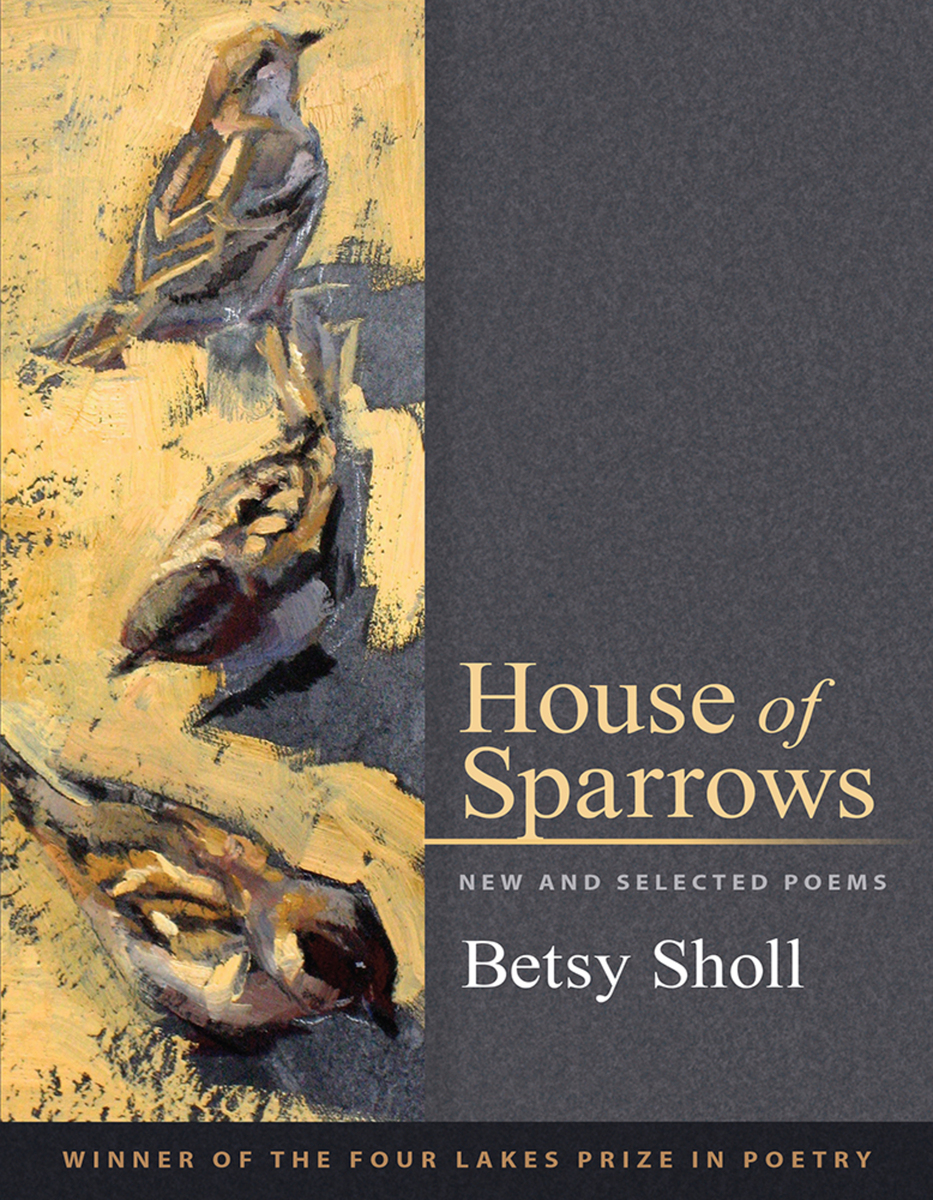


cover of book


The first thirty-seven delightful pages of House of Sparrows: New and Selected Poems, are new poems from the desk of Betsy Sholl.  These poems, on their own, are more than worth the price of admission.  House of Sparrows is the latest from Ms. Sholl, the latest in a sizable line-up of killers.  

Today's book of poetry looked at Betsy Sholl's Otherwise Unseeable (University of Wisconsin Press, 2014) back in May of 2014.  You can see that blog/review here:


House of Sparrows brings together selected poems from five of Betsy Sholl's previous collections, The Red Line (1992), Don't Explain (1997), Late Psalm (2004), Rough Cradle (2009) and Otherwise Unseeable (2014).  Like the only other Betsy Today's book of poetry is familiar with, Betsy Struthers, Sholl has built a formidable practice one huge brick at a time.  Those of you not familiar with the very fine Canadian poet Betsy Struthers need to brush up on your Betsy's.

Sholl's new poems read like testaments that have already stood the tests of time, they read like needed wisdom.  Sholl's poetry hums honest, wicked shrewd, all hammered out of a giant and tender heart that beats a solemn, sad song.  Then Sholl throws in some hope, some redemption.  It is all so human.

Betsy Sholl creates poetry that echoes like music both longed for and cried to.  Betsy Sholl can burn.

Her Story

     Johnson City, Tennessee

What a ruckus - those fricatives inside
that truck, spitting our roadside grit
digging itself in deeper.

Overhead the sky's one eye looks down.
Near full it rose, rusty as the truck's
undersides and dented with shadows.

Below, out of gas, trapped, that truck
hardly looks like it once jumped red lights,
gunned through town, took hairpins

with a squeal. As to the woman inside
pounding the wheel, she just saw her man
of fourteen years take off with somebody

blond and younger. She's got a fifth
on the seat beside her, a pistol,
a box of ammo already emptied out

into every Slow Curve, Falling Rock,
Soft Shoulder she passed downshifting
on the upgrade. Who you think does that?

she'll ask months later, then grin.
But now, inside that bucket of rust,
it's just her hollowed out, a full bottle

of sleep, and the moon overhead
watching, so she points her pistol,
pulls the trigger and laughs, bitter

as the pills she unscrews and scatters
like buckshot across the road.
The she lean back into liquor's drift.

Come morning, an old man will drive up,
peer in, see all that trouble
and hook up chains to haul her out.

He'll give her gas enough to get to town,
tell her, Now you never mind, Honey,
you just go on - and she will.  She will.

💥💥💥

When Sholl is in a corner she has no problem employing one of Today's book of poetry's favourite tricks.  She calls on some giant like Theolonious Monk, crawls into one of his recipes until all the pieces fit.  Betsy Sholl does this better than Today's book of poetry (damn her).  When she was writing these poems we doubt she was worried about their influence on Today's book of poetry or anyone else.  But in this small world you can never tell who is listening, taking notes.  Bowing in appreciation.

Betsy Sholl knows the difficulty caused when two things are true at once.  That life isn't black or white or fifty shades of gray.  Our limitless palette is gaudy with riches and yet we struggle to be kind, knowing, coming correct.  House of Sparrows is ironic and serious as a heart attack, the language nuanced, instantly recognizable as a voice that should be listened to.


House of Sparrows

What if every time we saw the word sorrow
we switched it to sparrow?

     For my life is spent with sparrows...
     With drunkenness and sparrows...

Or if it went the other way, the song would be,
     His eye is on the sorrow...

🐦

My eye's on the neighbor's eaves,
and the copper-roofed house we put up in our yard,

its many rooms, multiple nests, generations --
as if we brought this clamor on ourselves,

this hurdy-gurdy, rabble, host and quarrel
of sparrows
      mixed with the morning radio

🐦

broadcasting a bombed hospital, bodies
under fallen roof tiles, shards of over-voice and wailing,

while outside birds flare up, knock each other off the feeder,
sparrows the color of rubble, of dust and mud,

burnt cars, blown-out windows, of wreckage
they could roost in, the earth a house of sparrows

🐦

on Sparrow Street, hunger house, and woe
to the poor who are spared nothing,

who gather at borders to beg and forage, are sold
     two for a penny, five for two cents.

And yet doesn't it say the Lord God
attends -- bends down to count

🐦

each one shot, starved, buried in rubble? --
A man of sparrows and acquainted with grief,

who says, when I bow my head,
     Sparrows are better than laughter.

And to the rabble, the wailing, the how, the when,
who says,
     Your sparrows will turn to joy--

💥💥💥

Today's book of poetry will be in Ottawa for Christmas this year but we have suspended our annual Christmas Eve festivities for family reasons.  Shortly after Christmas Today's book of poetry and our much better other half will be heading to Montreal.  We are heading to Montreal to gain all the weight we've lost in the last year.  We both love Montreal and will do our best to eat well and find poetry, drink well and find poetry.  You know the drill.  Montreal is one of the finer places on the planet to spent time with the one your love.

House of Sparrows reminds Today's book of poetry of why we started writing these blogs/reviews in the first place.  Sometimes the poetry we get to read is simply too splendid not to be shared.  Betsy Sholl meets that standard.  We'll be scanning bookshelves in Montreal for the rest of Betsy Sholl's titles.


Betsy Sholl

ABOUT THE POET   
Betsy Sholl is the author of nine poetry collections including Otherwise Unseeable, Rough Cradle, Late Psalm, Don’t Explain, and The Red Line. A former poet laureate of Maine, Sholl teaches at the Vermont College of Fine Arts.

BLURBS
“Her work brings the poetry of Nathaniel Mackey to mind: its specificity, its engagement with and curiosity for living, even in the bluer stretches.”
—Boston Globe

“Very polished poetry that with careful attention can, in Wordsworth’s phrase, lift us up when fallen.”
—Central Maine

“A quiet, yet powerful journey through nature, memory, regret, and hopefulness. Readers will find themselves returning to its deftly understated voice again and again.”
—Split Rock Review

“This magnificent collection proves yet again why Sholl is one of our truly indispensable writers, whose poems engage what must be addressed if we are to fully encounter, as she writes in her triumphant title poem, ‘the wailing, the how, the when.’ I remain awestruck by her artistry.”
—Sascha Feinstein

“I love Sholl’s unyielding honesty, the great heart and deep intelligence of her vision.”
—Nancy Eimers

“It’s difficult to love the world enough, especially for someone like Sholl, who sees with such searing clarity its cruelty and sorrow. But, like Keats, she dares to, in poem after poem in this masterly collection. And we are all the richer for it.”
—David Jauss


797


DISCLAIMER
Poems cited here are assumed to be under copyright by the poet and/or publisher.  They are shown here for publicity and review purposes.  For any other kind of re-use of these poems, please contact the listed publishers for permission.
We here at TBOP are technically deficient and rely on our bashful Milo to fix everything.  We received notice from Google that we were using "cookies"
and that for our readers in Europe there had to be notification of the use of those "cookies.  Please be aware that TBOP may employ the use of some "cookies" (whatever they are) and you should take that into consideration.







Thursday, February 15, 2018

Send - Domenico Capilongo (Guernica Editions)

Today's book of poetry:
Send.  Domenico Capilongo.  Essential Poets Series 244.  Guernica Editions.  Toronto - Buffalo - Lancaster (U.K.).  2017.


Today's book of poetry knew we'd heard the name Domenico Capilongo before so we sent Milo into the stacks.  As soon as Milo sat Capilongo's first two books down on my desk I remembered.

Domenico Capilongo does plenty in his first book but Today's book of poetry remembered how Capilongo nailed that whole furtive first kiss with his poem "Shera-Lee" from I Thought Elvis Was Italian (Wolsak & Wynn, 2008).  Today's book of poetry remembered thinking that maybe Capilongo was another Len Gasparini character but he soon wrote us out of that illusion.  I Thought Elvis Was Italian was all James Brown hip and e.e. cummings poetic, quoting John Lennon and tipping the old hat to Saint Michael of Ondaatje.  We loved it.

Hold That Note (Quattro Books, 2010) had Louis Armstrong, Theolonious Monk, Billie Holiday, John Coltrane and Tom Waits as angels in the wings.  You just know that Today's book of poetry is going to have a lot of time for that, all the time in the world.

Send is a whole new ball game.  A clean slate.  But Today's book of poetry doesn't own a phone, of any kind.  There is a land-line phone in our office, plugged into the wall.  Today's book of poetry has never sent or received a text.  Domenico Capilongo's Send bursts at the seams with messages that you need to receive.

Contrary to the constantly public display of "texting" by the current POTUS there are texts worth reading, messages worth hearing.  Send is full of them.

Capilongo gives us instant access in his efforts to capture the languages and means we use to communicate. Capilongo catalogues it all from Morse Code to "whistled languages."

after

all the selfies. all the shame. after all the tex-
ting. all the comments. all the sexting. after
all the nakedness. all the pain. after all the
instagram. all the secret tattoos. after all the
tweeting. all the play-by-play. after all the
facetime. all the snapchat. the skype. after
all the auto-correct email. all the googling
after all.

...

Marconi and Alexander Graham Bell both put in cameos in Capilongo's efforts to search out every step forward in our haste to communicate faster.  Today's book of poetry suspects that some of these communiques are "found poems" and we can only celebrate Capilongo's keen sense of every methodology.  Domenico Capilongo is an all-in type poet if his first two books are any indication and in Send he invests it all in how we communicate.

Capilongo's sense of humour is abundant in these compellingly readable poems.  Today's book of poetry fears I am out of my depths because I can only think I know what it means when Capilongo titles a poem "Christopher Marlow Pocket Calls William Shakespeare."  The poem itself is hilarious.

kiss me like houdini's wife

straightjacketed and ready to take the plunge
in the dark. his mind racing through steps.
through the math of the weight of water. the
pressure of oxygen in his lungs. the sound
of the eyes of the crowd all around him. the
kiss from his wife. his tongue meets hers.
she slips a key into his mouth. he pushes it
into the corner of his cheek for later. the
crowd takes a breath. kiss me.

...

Our morning read started a little later than usual today.  It's not snowing in Ottawa for the first time in weeks but there is a misty rain that is falling and coating everything it touches in a lovely coat of ice.  Milo insisted we use all three Capilongo titles for the morning read but agreed we would hammer through Send first. 

Much to Capilongo's credit he happily jumps into concrete poems when he feels the need.  Here Today's book of poetry feels terribly unqualified to comment except to say that in most cases these poems surprised us with the clarity of a particular message, for us they were dead on.  And that is first time Today's book of poetry has ever said that!

During the reading we passed those poems around for everyone to see and then kept on with the rest.

In Capilongo's exhaustive and almost encyclopedic search for examples of how we choose to communicate he never loses sight of the reader, always makes certain they are engaged, Capilongo is communicating in a direct line with us.  The poems in Send got Today's book of poetry on Capilongo's side early.  After that the intriguing entertainment/exploration never let up.

carretto siciliano

in argentina or brazil there are ex-nazi soldiers in their
eighties who still hide in the shadows of trees. who still
wear large hats with sun glasses. they try to speak spanish
or portuguese. they try to walk slowly with knees bent but
you can still see the stiffness in their backs. the harsh ac
cent hanging at the ends of words. these men, in the early
morning, still wonder how the allies managed to take sicily.
     it was one man, a lowly carretto driver, some salvatore
or giuseppe, who came up with the idea. the germans were
everywhere with their checkpoints. no one was safe. they
even looked under hats. it came to him in a dream. the sky
was purple. his carretto flying over palermo like some sicil-
ian santa. his horse turned head back and spoke to him.
     we can send the messages with the horses, he thought
to himself over morning coffee, but how? the germans
even check under the horses' balls. later when he fed his
horse he saw it shove some food in its cheek only to share
it with another horse in the plazza.
     messages were sent in little walnut-sized capsules
from horse-to-horse piazza-to-piazza all across sicily. the
german soldiers often commented about the strange sicil-
ian horses, seltsame kussende pferde. strange kissing horses.
     this sicilian secret is know only to a chosen few. if
you want to know the truth about how this really hap-
pened you will have to go to sicily and ask one of the
horses yourself.

...

Domenico Capilongo writes solid poetry that you can depend on, every time out.  These are sweet, smart, clever, witty, funny, incisive poems that will re-wire your future communication.  All Today's book of poetry can say to Mr. Capilongo is thank you.

It's usually three strikes and you are out in almost every league.  What does it mean when you hit a homer out of the park your first three times up to the plate?

Capilongo's Send is a book of poetry you can hang your hat on.  This cat can seriously burn.

Image result for Domenico capilongo photo

Domenico Capilongo

ABOUT THE AUTHOR
Born when rotary telephones came in multiple colours, Domenico Capilongo began writing with pencil and paper, passing poetry notes from the back of the class. He still writes in notebooks, used a typewriter in high school, and his earliest published poems were printed on a dot-matrix printer. His first books of poetry, I thought elvis was Italian (2008) and hold the note (2010), as well as his first book of short fiction, Subtitles (Guernica, 2012), came very close to winning awards and were all mailed in the post. A high school creative writing teacher and karate instructor, he lives with his wife and children in Toronto. Find out more on the information superhighway at domcapilongo.wixsite.com/home.

BLURB
In his latest book, Dom Quixote mounts a new smartphone and tilts away at our digital windmills. His chivalry is analogue: what is lost in our twittering is the seed-bed of his musings. Messages between and underneath communications—tender, sensuous, comically misaligned and/or brutal by turn—are gathered up and offered back to us as rebus: an oracular operating system where what we mean is not always how we speak.
     - Chris D’Iorio, author of Without Blue


Book teaser for
Domenico Capilongo's Send
Video: Capilongo Poetry


657


DISCLAIMERS

Poems cited here are assumed to be under copyright by the poet and/or publisher.  They are shown here for publicity and review purposes.  For any other kind of re-use of these poems, please contact the listed publishers for permission.
We here at TBOP are technically deficient and rely on our bashful Milo to fix everything.  We received notice from Google that we were using "cookies"
and that for our readers in Europe there had to be notification of the use of those "cookies.  Please be aware that TBOP may employ the use of some "cookies" (whatever they are) and you should take that into consideration

Friday, April 21, 2017

Duet - Dorianne Laux | Joseph Millar (Jacar Press)

Today's book of poetry:
Duet.  Dorianne Laux | Joseph Millar.  Jacar Press.  Durham, North Carolina.  2016.


Books of poetry that share two authors come in a variety of forms and styles.  In Duet by Dorianne Laux and Joseph Millar the poems are unattributed, written separately but presented as a unified front.  This takes some seriously elastic tolerance and trust, one poet allowing herself/himself to be represented by the words of another, to speak with your name and approval.

This duet is made up entirely of solos but the reader never knows who is playing lead.  It doesn't matter because Laux and Millar are in the same key throughout, they have found the same rhythm section, the bass is steady and the drumming is tight.  Laux and Millar riff like scat singers on a legion of our musical heroes from Bo Diddley to Cher, Dolly Parton's breasts are balladized and Elvis, the King, has his mansion/mausoleum costed for affect.

Listening to Paul Simon

Such a brave generation.
We marched onto the streets
in our T-shirts and jeans, holding
the hand of the stranger next to us
with a trust I can't summon now,
our voices raised in song.
Our rooms were lit by candlelight,
wax dripping onto the table, then
onto the floor, leaving dusty
starbursts we'd pop off
with the edge of a butter knife
when it was time to move.
But before we packed and drove
into the middle of our lives
we watched the leaves outside
the window shift in the wind
and listened to Paul Simon,
his tindery voice, then fell back
into our solitude, leveled our eyes
on the American horizon
that promised us everything
and knew it was never true:
smoke and cinders, insubstantial
as fingerprints on glass.
It isn't easy to give up hope,
to escape a dream. We shed
our clothes and cut our hair,
our former beauty piled at our feet.
And still the music lived inside us,
whole worlds unmaking us in the dark,
so that sleeping and waking we heard
the train's distant whistle, steel
trestles shivering across the land
that was still our in our bones and hearts,
its lone headlamp searching the weedy
stockyards, the damp, gray rags of fog.

...

This morning our read was also a concert.  Laux and Millar write such instantly approachable and easily digestible glee that the poems powered off the lips of the readers as though they were the rock stars of their dreams.  

Because Laux and Millar were calling out the spirits of Elvis, Bo Diddley, Quicksilver, Willie Dixon, The Who, Paul Simon, Cher and Sonny too, Theolonious Monk, Julie London, Lightnin' Hopkins, Mick Jagger, Joe Williams, Mel Torme and his beautiful velvet fog, Ray Charles, Dolly Parton, James Taylor, Ladysmith Black Mambazo, Lil Wayne and more -- Today's book of poetry gave the challenge to Milo, our head tech.  Not surprisingly he was able to fire up a dance card on the box with everyone present.  Our morning read involved much music.

Who Do You Love

This is the night after Bo Diddley died
and we sit in the cafe drinking iced tea
reading his lyrics in the newspaper
along with the story of the hairline crack
in the left front hoof of Big Brown,
another American original.
Outside the long cars prowl the dusk
trailing their ribbons of smoke,
heat lightning flickers over the street
and the waitress Arlene
brings salsa and chips.

I want to say thanks
for the cavernous voice
and the black cowboy hat,
the triangle rhinestone Fender guitar
and the scratchy beat everyone stole--
Quicksilver, Willie Dixon, The Who,
easy to shuffle to,
easy to dance to:
"walk 47 miles of barb wire
with a cobra snake for a necktie"
Chonk-chicka-chicka-chonk-chonk.

...

Laux and Millar's Duet pays all of their guests the deepest respect they can offer up on the way to immortalizing them in poem.  Of course this playlist covers a particular and time specific era that includes mostly older gray haired souls like myself, but Kathleen, our young Jr. Editor, corrected me once again when she said the word I was looking for was "timeless,"

Laux and Millar taste just a little bittersweet and caramel while lamenting Gene Vincent and others with the certain knowledge that beauty dies young while songs live forever.

Dolly's Breasts

                    are singing
from the rafters of her chest,
swaying beneath sheeny satin,
suspended in the choreography
of her bra: twin albino dolphins
breaching from her ball gown's
rhinestone cleavage.  Her breasts
are sisters praying at twilight, a pair
of fat-cheeked Baptists dreaming
of peaches, her nipples the color
of autumn, two lonely amber eyes.
When she shakes her metallic bodice,
tinsel swimming up her pink fonts
of nourishment, the spotlight hums
and shimmies with them, the audience,
open-mouthed, stunned into silence
as she crosses her legs and bows, her hair
hanging down, a permed curl caught
in that soft, improbable seam.

...

Laux and Millar's Duet made the day here at Today's book of poetry, they hit just the right chord.  For Today's book of poetry our only complaint was pages, we were ready for more.

Image result for dorianne laux joseph millar photo
Dorianne Laux  |  Joseph Millar

ABOUT THE AUTHORS
Dorianne Laux's most recent collections are The Book of Men, winner of the Paterson Poetry Prize and Facts about the Moon, winner of the Oregon Book Award. Laux is also author of Awake, What We Carry, and Smoke from BOA Editions. She teaches poetry in the MFA Program at North Carolina State University.

Joseph Millar is the author of Kingdom, Blue Rust, Fortune, and Overtime, which was a finalist for the Oregon Book Award. He has received grants from the National Endowment for the Arts and the Guggenheim Foundation. He teaches at Pacific University's Low Residency MFA Program.

Joseph Millar
International Poetry Library of San Francisco
Video: Evan Karp

Dorianne Laux
International Poetry Library of San Francisco
Video: Evan Karp


574

DISCLAIMERS

Poems cited here are assumed to be under copyright by the poet and/or publisher.  They are shown here for publicity and review purposes.  For any other kind of re-use of these poems, please contact the listed publishers for permission.

We here at TBOP are technically deficient and rely on our bashful Milo to fix everything.  We received notice from Google that we were using "cookies"
and that for our readers in Europe there had to be notification of the use of those "cookies.  Please be aware that TBOP may employ the use of some "cookies" (whatever they are) and you should take that into consideration.