Showing posts with label the ashland poetry press. Show all posts

Sunday, November 12, 2017

Out of Place - Richard Jackson (The Ashland Poetry Press)

Today's book of poetry:
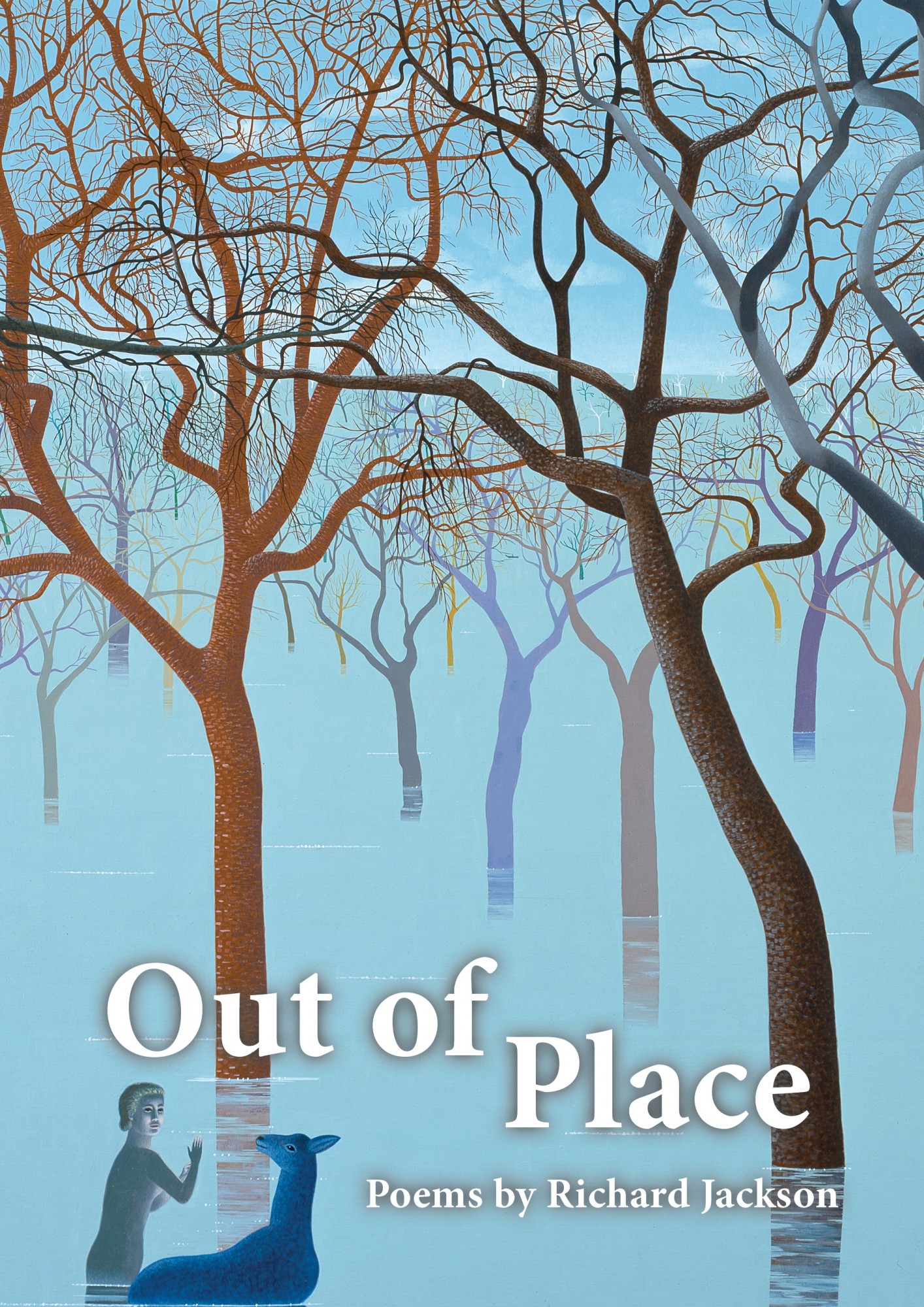
Out of Place.  Richard Jackson.  The Ashland Poetry Press.  Ashland University.  Ashland, Ohio.  2014.


Here's the thing that Today's book of poetry is only learning to accept, only learning to come to terms with.  There are so many fine poets out there it is impossible to know them all.  

To all you regular readers out there, we are doing our best to cover as much ground as we possibly can but we are not Kate Sutherland on the subway.  Sutherland of the beautiful Rhinos.  Bless her cotton socks.  We wrote about the brilliant Kate Sutherland and her book, How To Draw A Rhinoceros, last year.  You can look at that blog/review at the end of this paragraph.  Ms. Sutherland posts daily photos of a legion of unknown (to us) poets/poetry.  She doesn't do it everyday but it is something we here at Today's book of poetry look forward to.


All of that to clumsily say we know we are treading water in terms of the whole range of poetry out there.  But this is one of those cases where we feel a little guilt simply because we hadn't heard of Richard Jackson before.  Out of Place is Jackson's eleventh book of poetry, and as you will see in his biography below, he has won every award and prize but the Selke Trophy.

Bob Gainey has every right to feel nervous in his old Hab's sweater because Jackson might just start piling up those as well - this writing is that good.

There is a very good reason Richard Jackson has rolled up the awards and kudos.  This poetry is so good it is alarming.

About This Poem

          At the beginning...which is to awaken you to the right kind of joy
                        in serious times, we must list all those who have been killed
                                                                               since I last wrote......
                                                              - Bonhoeffer, 1942, Germany

It has to account for its untied shoelaces as well as its Extermination
Camps. Sitting among all those languages in the Munich beer garden.
Hitler's first speech a few blocks away. A masked ball where
the costumes are all switched around. Those carnival grab bags
filled with joy or remorse. Above me the clouds are paralyzed.
I have to wipe the dust from my soul. The wind holds its breath.
Bosnia, 1994: one group of men forced to bite off the testicles
of another group. Others to stand in the snow till their feet rot.
These things orbit now like a planet too far to see. Even the bee
can't figure a way out of my stein. Light staggers through the trees.
Every moment is filled with other moments. According to Bell's
Theorem whatever happens to this bee influences a history yet
to be written. Like the seed stars that smudge the trail of Mira as
it slips across the sky. All my maps are smudged with atrocities.
There are so many voices that are our own voices. Rhythm is just this
oscilloscope of the soul. We come from a place that has always
been inside us. Our words migrate helplessly. The world reflects
only itself. Which is why we have to create our own memories.
The paths from here spread out like shattered glass. The man
across the table's from Krakow. He doesn't want to talk about
the occupation and its lives turned to smoke. One the mechanical
Trumpeter in his church spire. The song stops where his real
ancestor was felled by an enemy's arrow. In the silence that follows
don't we all have to begin again? At the end of a line, the door
left open for a moment where you can fall in love, remember
what you wanted to forget, forget what you wanted to remember.
Why do you think our metaphors will save us? The world is only
itself. Time is just our way of imagining it. At least the bee has
ultraviolet vision to see everything we can't.  We have to light
our dark spaces with the sputtering matches of our words.
We have to follow wherever they lead us. There's this little
hole in existence we all pass through. Someone is always entering.
He's the one who invents me while I think I am writing about him.

...

Today's book of poetry has mountains of admiration, respect and awe where Richard Jackson's Out of Place is concerned, add in a little jealousy.  Jackson seems to have a simple formula, he picks a subject, writes about it with encyclopedic knowledge, dharma bum charm and whimsy and some sort of special poetry detectives trained eye.  This is cherse stuff.  There are no details left behind that we will need later, there is nothing extra to carry.  Jackson is thorough, candid and hard as nails/soft as clowns tears.

Day after day Today's book of poetry shares books of poetry we like with you, best job on the planet, but we are not about to index our poets or their books with scores -- but if you minions are paying attention this guy Jackson is in David Lee, Sue Goyette, David Clewell, Sharon Olds, territory.

Out of Place really is a remarkable book filled to bursting with remarkable poems.  It may even be a little unfair, Jackson having so much good poetry in him.  Somehow Richard Jackson is able to write about exactly what it is that you want to know about.  This is essential voice territory.  As in, the next time Today's book of poetry is asked "who should I read?", Richard Jackson will be part of that conversation.

Belief

                                 after the freeing of the West Memphis Three

Deep in our own inner caves the heart's canary sounds a warning.
On the other side of speech is a language that dreams us.
Echoes hide out in abandoned words. The air hardens.

A home invasion, a meth lab, a father killing his family.
It Had To Be You, Les Paul played on his guitar with seven
crippled fingers, but who is never named, or is us.
                                                                                 These
clouds begin to picket the horizon. Pine sap leaks from 
a wounded tree. Even the flowers seem to take on
the color of night.
                           There are times when it is better
to close your eyes to the world.

                                                  I have been watching
a fledgling drop from its nest, flutter a few feet, and again,
until it flew not back, but into another tree. The wind tests
itself against my torn screen. A few thorns of light jab
out of the darkness on the far hills.
                                                        Who are you
if your dreams are dreamt by somebody else? In a dream
of freedom we return to a place that is not the place.
                                                                                    Orpheus'
poems could not create the world he needed. How
many times do our words become cells? How do we
remove those splinters of memory and remain ourselves?
Most of our dreams are the seeds in sidewalk cracks.

By now my fledgling has its own dream.

        
                                                                 Tonight's clouds
will cover the meteor shower. I remember the fog in
the valley slipping forward like a glacier. At other times
a whole world rippled in the river.
                                                       It was David Hume
who said we had not a single reason to believe in reality,
but we must act as if we do. Even when a whole life
seems mothballed.
                             Now we know that our moon collided with
another moon whose remnants we can't see on its far side.
Moonglow is how Les Paul would have played it. And us?


Who are we if someone else's dream is really ours?

...

Today's book of poetry's morning read was spectacular.  You can blame Richard Jackson.  Many of our staff are becoming old hands in the reading game, at this reading poems aloud, and bless their cotton socks, they've taken a shine to the process.  Milo, our head tech, led the charge this morning while shaking his head with both wonder and the obvious.  Milo already knows his next assignment will be to find us the rest of Richard Jackson's books.  If they hold a candle to Out of Place Today's book of poetry knows they will be essential reading.

This is how the masters do it.  Solid.  Bold.  Beautiful.

That orange fugging fog that is over America is temporary and the poets tell us so.  This title from Jackson is from 2014 and has nothing to do with POTUS.  But it has everything to do with America and it gives us hope.  Jackson writes poems of reflection, inner examination, outer understanding and tolerance.  

Prophecy

                                                    You exist in the delirious illusion of language.
                                                                                                    - Robert Penn Warren

What I want to say to you has already disappeared like the flashlight
beam I aimed at empty space years ago. If Augustine was right
it will hit the edge of the universe in 15 billion years. If Einstein was
right then it will never get to the end of it. My own life is orbiting
a word I don't want to land on. Heisenberg said you can only know
where you have been. Freud said that where we are is the terror
of what we were. He was terrified by sex which he saw as a kind
of impalement. Polls say the happiest people are those in the middle
of sex. So tell me, why have you paused to listen?

                                                                                 Most of our words
come with dress codes to hide the world we never want to see.
Some march to the rhythm of goose steps. All I need to do is
throw another stone at the stars to know how far from any center
we are. Even Charon can't say which shore is which.

Every word here tries to pronounce something that has no name.
The words we don't hear are the words that control us. The words
I want to say edge over the horizon like a sunset sail. Every breath
disturbs the next. Every word erases another word. Nathan, the first
prophet, said no one would come after him. So what did he know?

I don't even know what the end of this sentence says because
while the clock is taking its time to decide, the homeless man
in the cemetery blows a few random notes on a dented trumpet,
a few cigarette butts in the flowerpot have a story they refuse to say,
the wounded day limps home alone, a few more protesters are shot
in Bahrain, a few mothers and children slaughtered in Mexico
in the middle of some drug war.

                                                   Isn't everything we say just some
bit of breath we can't hold any longer. Doesn't every word draw
a picture that hides what it really means. How did all those painters
know what the Apocalypse looks like? The bombed church
in Baghdad thought it was today. The man shot on his porch in East
Chattanooga thought it was another day.

                                                                Sometimes the moon rises
full of hate. Clouds scramble over distant peaks, the wind broods
in a ravine, the flycatcher, perched along, waits for darkness.

In truth, what I want to say to you are these trace elements
lingering in the spaces between words. In truth, nothing we say is
worth the way the hawk slides through the invisible air from
the top of the skeleton of a dead tree.

                                                           In a few years you'll decipher
how these words will create a whole world I never meant to say.
Our windows have their own prophecies. Birdsong crinkles the air.
Everything we say is a self-portrait. The radio preacher says
that flowers can't bloom in hell. I have it on good report that

you can fit 1,737 angels on the head of a pin, excepting fat angels.
Salvation comes before creation, writes Agamben, which is why
we have to say whatever words, however dark, puddle at the end
of each sentence.

                             And isn't what we can't say exactly what attracts us?

And you, would it have made any difference if I said what I wanted
to face back at the beginning, that we have to learn to love whatever
truth will say itself, oh, not at the safe distance words create, but
unconditionally, like the woman who cannot understand why she is
impaled on the branch in the Ivory Coast like one of Goya's
Disasters of War discovering words she never knew would lead her there.

...

Out of Place is another clear lesson for Today's book of poetry.  America remains full of greatness if you know where to look.  Poets like Richard Jackson give Today's book of poetry hope.

Remarkable, remarkable poetry.
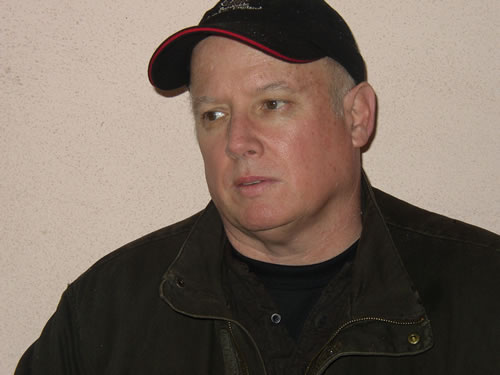
Richard Jackson
Richard Jackson

ABOUT THE AUTHOR
Richard Jackson is the author of eleven books of poetry, Out of Place (Ashland Poetry Press, 2014) most recently, two books of criticism, and two translations, one from Slovene and one from Italian. He is a winner of Guggenheim, Fulbright, NEA, NEH and Witter-Bynner Fellowships, five Pushcart appearances, as well as prizes from Prairie Schooner, Rattle and Crazyhorse. Jackson's poems have been translated into 15 languages. He was a recipient of the Slovene Order of Freedom Award for Humanitarian and Literary work in the Balkans and recipient of the 2009 AWP George Garrett Award. Jackson has taught at the Iowa Summer Festival, Prague Summer Program, Bread Loaf and other venues, and teaches at UT Chattanooga and the Vermont College of Fine Arts low residency program, winning teaching awards at both schools.

BLURB
His lines are clouds of love, piercing the sky with enormous empathy, rolling in the azure, torrents of passion, and are arrows at the same time, reaching a peak where they break, crying, cleansing the air, becoming ether. It is impossible to describe this in discursive language. With a melody that is unmistakably his own, his poems seem to come to us in Europe from the heart of the heart of America, the totally open (and hidden) center from where the power of the continent sprouts. He is a kind of Scorzese in poetry, but where Scorzese almost succeeds in his films, then stops, seals and terrifies us, Jackson adds a tender, vulnerable voice that blossoms and transforms us and that is so unique and great, great in its truest sense in Richard Jackson's poems.
    - Tomaž Šalamun

Richard Jackson
Poetry@Tech
Video: poetry@tech

ashlandpoetrypress.com

628


DISCLAIMERS

Poems cited here are assumed to be under copyright by the poet and/or publisher.  They are shown here for publicity and review purposes.  For any other kind of re-use of these poems, please contact the listed publishers for permission.


We here at TBOP are technically deficient and rely on our bashful Milo to fix everything.  We received notice from Google that we were using "cookies"
and that for our readers in Europe there had to be notification of the use of those "cookies.  Please be aware that TBOP may employ the use of some "cookies" (whatever they are) and you should take that into consideration




Thursday, June 15, 2017

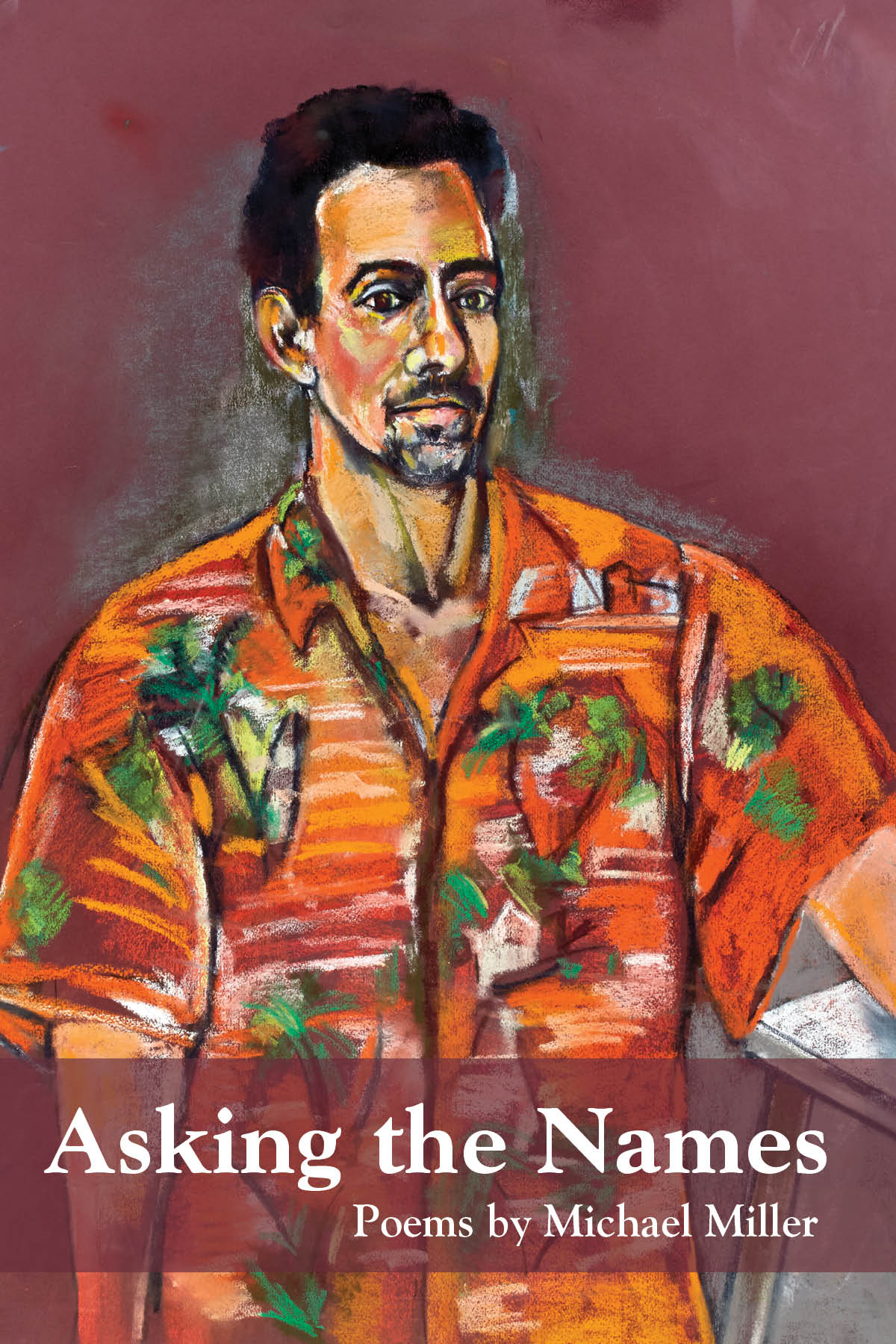
Asking The Names - Michael Miller (The Ashland Poetry Press)

Today's book of poetry:
Asking The Names.  Michael Miller.  The Ashland Poetry Press.  Ashland University.  Ashland, Ohio.  2017.


Michael Miller writes time machine poetry.  These poems are completely in the present, poignant, powerful and in the best sense of the word; pretty.  At the same time these poems are about the passage of time and what is endured, what is learned, what is savoured, what is mourned.

Miller also has the rare capacity to write openly about enduring love without ever sounding overly romantic or trite.

Silence

In the wordless void between us
The domain of silence
Is greater than anything we can say.
This is where love becomes
A meadow blossoming,
This is where I can hold you
Beyond the ephemeral touch,
Beyond the unfolding petals of desire
Which must always close.

...

Miller's short poems have the qualities of fine crystal, they are transparent so any flaws would be immediately obvious.  

If you were to ping one on the side with your finger, the resonance you hear will be a fully formed tone, abundant in colour regardless of it's brevity.

Devotion

Prepared at exactly five o'clock,
Placed carefully before her
On their immaculate table,
The meals he makes
For his paralyzed wife
Are the language of enduring love.
With spotless silverware
He feeds her with every morsel
Of his patient tenderness.

...

Asking The Names made for a contemplative morning read at the Today's book of poetry offices.  It's another beautiful sunny day so we have all the doors and windows open.  It shouldn't come as any surprise that this morning's office music is a mix of Dexter and Pharoah.

Mr. Miller supplied his robust poems and his delicate voice.  These are intensely personal and studiously carefully poems that remind Today's book of poetry of the best of Wendell Berry and Robert Bly.  Poems like these require a mature voice and considerable time in the saddle, wisdom like this only comes with time and experience.

Keeping Alive

Beethoven and biopsies,
How they keep me alive,
How making love with you
Keeps me alive,
How I want to make love
For as long as I can,
How I want your body
To cover mine
As I take that final breath.

...

Asking The Names wanders through the fields and adventures of youth, the horrors and memory scars of military service, battle and loss but it is Miller's unabashed tenderness when talking about his love that has won the day for Today's book of poetry.

As Dexter Gordon's Dale Turner says in the great Bertrand Tavernier film Round Midnight, "Lady Francis, there's not enough kindness in the world."  Today's book of poetry is happy to report that Michael Miller is helping to improve that balance.

Michael Miller

ABOUT THE AUTHOR
Michael Miller's first book The Joyful Dark was the Editor's Choice winner of the McGovern Prize at The Ashland Poetry Press. His poems have appeared in The Sweanee Review, The Kenyon Review, Raritan, The New Republic, The Southern Review, and The Yale Review. Darkening The Grass, his third book, was a "Must Read 2013" selection of The Massachusetts Book Award. His poem, "The Different War," was the 2014 First Prize winner of the W.B. Yeats Society Poetry Award, and anthologized in Yeats 150 (Lilliput Press, Dublin). Born in 1940, Michael Miller served in the Marine Corps from 1958 to 1962. He lives in Amherst, Massachusetts.

BLURBS
I read Michael Miller's poems with great pleasure in their accurate seeing, their assured phrasing, their true and proportionate feeling.
     - Richard Wilbur

Michael Miller's poems are finely tuned meditations on nature, war, city life, and growing old. The recurring theme of love, the cycles of light and darkness, of fear and hope, of life and death, echo from poem to poem. One realizes reading these poems that one must climb to get into the light, that certainty is uncertain.
     - Gary Lee Entsminger

Michael Miller's poetry addresses the nuances of this contradictory world. In Asking The Names his empathy embraces the pain of soldiers and the poignant lives of the elderly. Most moving, perhaps, is when he writes about enduring love. Miller's poems, each expertly wrought, are radiant.
     - Nikia Leopold


584


DISCLAIMERS

Poems cited here are assumed to be under copyright by the poet and/or publisher.  They are shown here for publicity and review purposes.  For any other kind of re-use of these poems, please contact the listed publishers for permission.

We here at TBOP are technically deficient and rely on our bashful Milo to fix everything.  We received notice from Google that we were using "cookies"
and that for our readers in Europe there had to be notification of the use of those "cookies.  Please be aware that TBOP may employ the use of some "cookies" (whatever they are) and you should take that into consideration.


Tuesday, February 21, 2017

Life as IT - Daneen Wardrop (The Ashland Poetry Press)

Today's book of poetry:
Life as IT.  Daneen Wardrop.  The Ashland Poetry Press.  Ashland University.  Ashland, Ohio.  2016.

Winner of the Richard Snyder Publication Prize


Buddhas and Beethovens populate these provocative prose poems like a flutter of rose petals drifting under your precarious passage.  Today's book of poetry got carried away with that opening line, but the Buddhas and Beethovens part is true.  They are in Life as It along with possible saints and Roy Orbison.

What turned our crank here at Today's book of poetry was Daneen Wardrop's gaze.  Once she puts her eye on a subject she renders it new vision.  We've all been these places before, we've all listened to Paul McCartney, but never like this.  Never the old way again.  We've encountered mystics before but Waldrop's modern Carmelite St. Teresa pops in and out of these texts like a Whac-a-mole.

Lie

I've read that aphasics watching a presidential debate laugh at every lie, like
snow reads a landscape. It's a watcher's game, laughter is foil crinkling. Must
I give up even my small bit of talk? (I admit it is me, despicable truth of
elegies, whom I miss). Sometimes snow finishes the punchline, I suppose our
bones sparkle inside like that. A friend once told me my mother's
stubbornness kept her alive, told me into her stethoscope. Meticulous sparks
move by standing still in the storm, they look like tell me again.  They look like
tell me again, just a little at a time.

...

Life as It is a book of elegant meditations that are each as crisp as a Sonny Rollins solo, brash with subtle mystery.  Wardrop brings her own sense of timing but the beat is clear.

Truth be told Today's book of poetry didn't understand every subtle or saintly clue/cue but Daneen Wardrop writes relentlessly interesting poetry.  These compelling little monsters are tight, tight, tight prose poems salted up like a treat you can't stop eating.

Life as It

They say Buddha called many animals to him but not the cat. Surely the story
is lax on this one. Surely no one was watching on this one. After looking a
while at an upward spill of incense smoke the cat disappeared along a mouse-
flicking path. Some Buddhists say it's important for the breath to wander in
the belly. When I see a palette's paint wet and deep with colors I want to kiss
it. How complex what passes for ready. The breath can do what it wants.
Dragons roast meatloaves with their breaths, oxen hump in the fields, snakes
unfinish circles. The cat walks through grassblades strumming.

...

This morning's read here in the Today's book of poetry offices was organized by Kathryn, our Jr. Editor.  She told us she knew exactly how these poems should be read.  She had props that included a small but rotund and smiling Buddha.  It bore a striking resemblance to the one from the Today's book of poetry garden (which is currently under about four feet of snow).

Daneen Wardrop's Life as It made for an energetic morning read by our cast of miscreants.  These poems have their own source of power, they are internally driven, we just get to go along on the ride.


If Never the Why then at Least the How

This dawn, if a stranger stands outside our house, the panes will grow as
stamps, par avion. Windows may settle by noon, but now they wish for sex
straight out of sleep. A cupola of wild geese launches a mansion. He sleeps
turned from me, pang of light on his forehead. Too jealous for coherence, we
spoke last night in interjections, every tooled puncture of his belt slit past
what I can't accept from a silver morning, as a hand finds aqua lines tense at
the back of a knee. Then, what I can accept. The amazing thing about skin,
that it's continuous.

...

Life as It tasted fresh as new snow.  It went down like the coolest, cleanest spring water.  Absolutely refreshing.

Christine Gelineau
Daneen Wardrop

ABOUT THE AUTHOR
Daneen Wardrop has authored two books of poetry, The Odds of Being and Cyclorama, as well as several books of literary history. She is a recipient of the National Endowment for the Arts Fellowship and the Poetry Society of America Robert H. Winner Award. Wardrop teaches American literature at Western Michigan University.

BLURBS
Life as It proves Daneen Wardrop's mastery of voice. In these pieces, the past, present and future coalesce in bright bursts, and, through juxtaposition and accumulation, the connections become ever more compelling, and beautiful, and edgy, and interesting as they unspool. This is poetry of both narrative and musical accomplishments, and a book one won't forget.
     - Laura Kasischke, author of The Infinitesimals

These poems are a diary of exquisite attention. Daneen Wardrop's mind is meditative in pacing yet poetic in the way it creates a new way of seeing. "A cupola of wild geese launches a mansion" is equally accurate and miraculous, and just one example of her gentle yet transformative focus. She's adept at mining a moment for what it naturally contains, rather than forcing it into predetermined avenues of feeling or thought. This a poet who possesses that rare human quality - a gracious consciousness.
     - Bob Hick, author of Sex


554

DISCLAIMERS

Poems cited here are assumed to be under copyright by the poet and/or publisher.  They are shown here for publicity and review purposes.  For any other kind of re-use of these poems, please contact the listed publishers for permission.

We here at TBOP are technically deficient and rely on our bashful Milo to fix everything.  We received notice from Google that we were using "cookies"
and that for our readers in Europe there had to be notification of the use of those "cookies.  Please be aware that TBOP may employ the use of some "cookies" (whatever they are) and you should take that into consideration.


Sunday, September 25, 2016

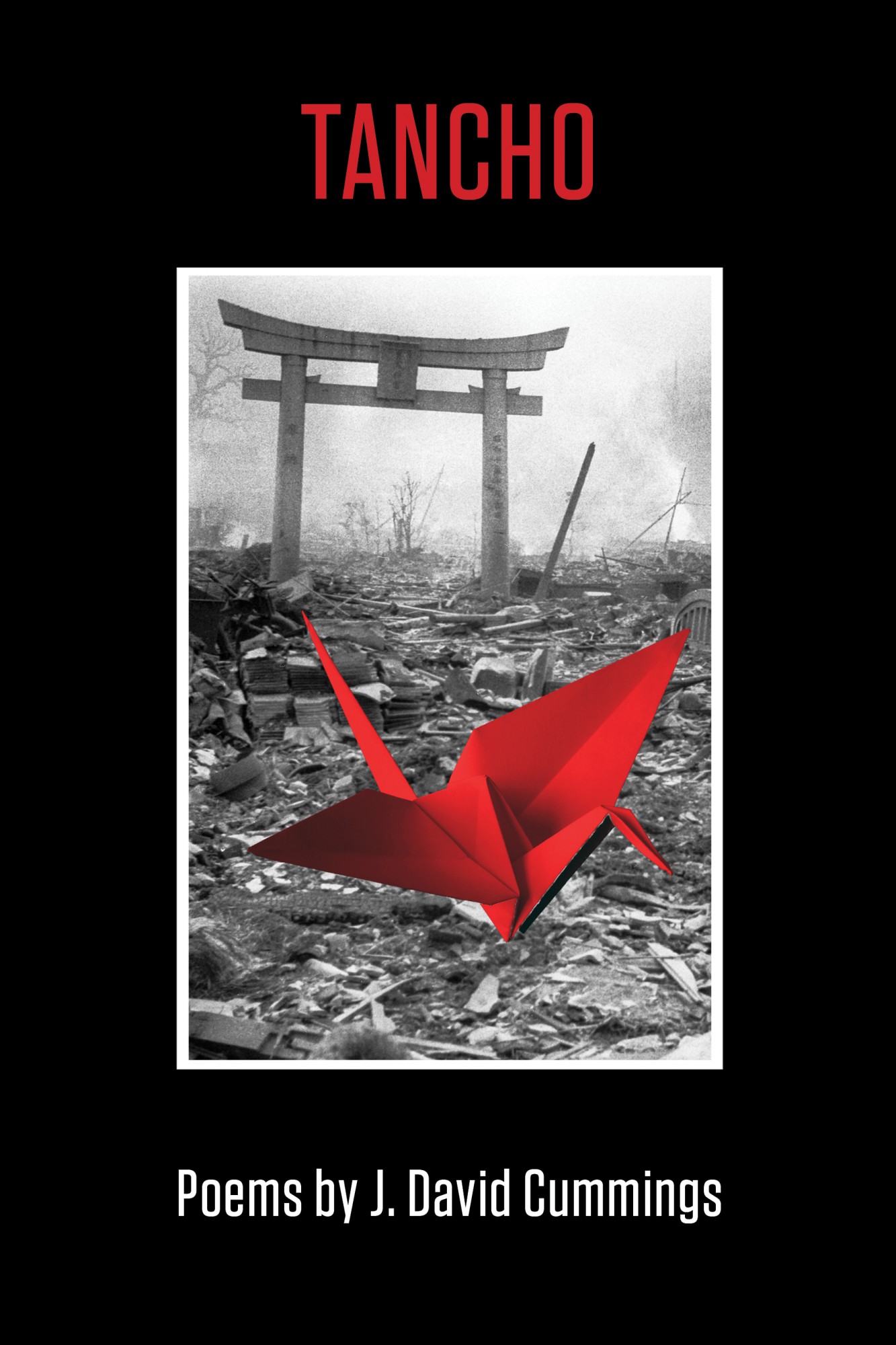
Tancho - J. David Cummings (The Ashland Poetry Press)

Today's book of poetry:
Tancho.  J. David Cummings.  The Ashland Poetry Press.  Ashland, Ohio.  2014.


Today's book of poetry agrees with Elizabeth Biller Chapman when she evokes Yeats "terrible beauty" in describing these hauntingly beautiful poems by J. David Cummings.  

Hiroshima and Nagasaki are sometimes fading memories from the consciousness of the contemporary world.  Cummings brings our very recent past to the forefront by putting us there.  Cummings puts us at ground zero in 1945 Japan in order that we may better understand, remember.

Were He a Boy, Sleeping

At first you don't see him,
and you don't see the slender trees outside,
the close-in-brush, the overturned wood crates
buried in the wide rectangle of afternoon light--
too bright a brilliance, sharpened
in the black frame of house timbers,
all of it defining a passage not there before.

But gradually your eye adjusts, the glare softens,
and you begin to make out interior shapes:
intact cedar beams, the remnants
of a sliding door, a slight clutter of debris...
you see him last.

                                  He lies flat
on his stomach, head turned from the light,
the side of his face resting on the floor,
left arm bent just in front, and his bare legs
stretched out straight, feet in extension,
the tops of his toes touching wood, pointed
perfectly, like one diving into water. He seems
a youth of ten or eleven. He seems to be sleeping,
and the light dapples him.

                      There are butterflies
                   warming in broken sunlight--
                         wake up, child, wake up.

...

Canadian Saint Al of Purdy tackled some of this same murky water with his arresting Hiroshima Poems (The Crossing Press, 1972).  John Hershey's Hiroshima (Alfred a. Knopf, Inc., 1946) tells the stories of several survivors in both harrowing and haunting terms.  J. David Cummings Tancho
bravely enters the same horrible and sacred ground.  Tancho shows compassion and respect as he makes his ghostly traverse.

These poems are a damnation of, and a treatise on, our infinite human capacity to inflict pain on our brothers and sisters.

The Gift of Memory and Forgetting

Looking back all these years later, how easy
to remember the gift: the children of the park,
playing at their invented games, the bounty
of paper cranes, those colors indeed a music,
and the bell's deep sounding that led me
from station to station, as if I were
once more in the church of my childhood,
and too the savvy pigeons, chased and lifting,
just out of reach of the smallest ones
still a bit unsteady as they run,
and their parents gathering them in
for picture taking, smoothing those bright energies
for that moment of stilled time, then
letting them go again.

                                      --Why remember grief,
what can it redeem?

                                      *

I came to believe in a fierce remembering,
thinking that if hibakusha were invited
into the mind each day and seen as they are--
             scar and anguished soul and us--
then, I thought, every obscenity of war,
would come flooding in and for a day,
             that day, war would die.

In time, I perceived the error: to live
so deep in the past, August sixth cast
across the waking hours, hibakusha dreams
defining the night, our children bent
to those sorrows,
              the present, the future stolen--
there's no healing there, no safety

                                     *

Year after year, word by word
Hiroshima evaporated into the silence.
People got on with their lives, children dreamed,
and I thought, This is how it happens.
All the words of remorse and remembrance,
the screams that lies beneath,
will have no suasion.

I want for some other way of memory,
one that holds a bit of forgetting, a bit of hope.

I suppose the Park is a good remembering, the bell is,
               each year the offered poem--
never enough, Koji-san, never...

                                       *

                    The bell stands silent--
                 in the grass crickets quiet--
                     summer evening, late.

...

Today's book of poetry believes that J. David Cummings believes in redemption through remembrance.  It is essential not to forget our victories or the costs, the moral failures history disguises as war.  Tancho serves to remind us of how easily we forget, Tancho is a tender epitaph to the ghosts of Hiroshima and Nagasaki.  

There are no small lives in J. David Cummings poetry and no small deaths, you can feel their weight, the heft of every lost soul.

Grus japonensis

In Japan she is called tancho,
a word that means red crown and crane.
Her crown is more skull cap than crown,
but in the north sea island winter
dull red brightens at mating time,
and then she's the most graceful mistress
of the pas de deux. And she is
neither solitary nor many,
though time was she lived everywhere
among them, even as they warred.
Whatever struggle had been their lives,
they had always believed in her;
but then they lost their faith, and she
was hunted for her flesh and feathers.
The eating made them no less fierce;
the lavish feathers no more artful.
What had changed in them that they should
exchange the dream of peace for gain,
these malign one hundred years since?

...

Today's book of poetry thought Tancho crawled overs some dark territory with much grace. Cummings reminds us of the terrible costs of imagining we are Gods and reigning/raining fire on the world.  We need reminding of the horror lest we repeat it.

J. David Cummings
J. David Cummings

ABOUT THE AUTHOR
J. David Cummings was employed as a theoretical physicist at the Lawrence Livermore National Laboratory for more than ten years. He resigned his position in 1973 out of the conviction that he could no longer work in nuclear weapons development, and never returned to defense work or physics research. In the early 90s he traveled to Japan, which afforded him the opportunity to visit the Hiroshima Memorial Peace Park. Later, meditating on his experience at the Park, and in response to the controversy over a planned Smithsonian Institution exhibit commemorating the 50th anniversary of the bombings of Hiroshima and Nagasaki, he began the nearly two-decade project of writing the poems that culminated in his book, TANCHO (Ashland Poetry Press, 2014).

BLURBS
Tancho is a book that needed to be written and needs to be read. Its account of terrible beauty is itself beautiful, speaking of "hope and despair, the promise of each to other." Nagasaki, Hiroshima, "ruined human beings," a peace park, a sounding bell, a thousand paper cranes. Does the arc of history bend toward hope? One of the many haunting poems in this book describes the body of a boy in one of Yamahata-san's photographs of Nagasaki after the bomb, and concludes with a haiku:

There are butterflies
warming in broken sunlight
wake up, child, wake up.

Perhaps we all humanity are that child.
—Alicia Ostriker, final judge of the Richard Snyder Publication Prize


Perhaps we can never take adequate spiritual and moral measure of the first use of atomic weapons at the end of World War II, but that doesn't mean we shouldn't keep trying. J. David Cummings' TANCHO is a book of what he calls 'fierce remembering,' and I would add that these poems are also a fierce imagining of that world-historical event and its long aftermath. A former nuclear scientist himself, Cummings journeys to Hiroshima and Nagasaki, and in both Japanese and English poetic forms, he takes us with him in a sustained meditation on the most bewildering of human sufferings. Like Sadako-san's colorful, folded paper cranes, these poems present us with a deeply moving and much-needed prayer for peace.
—Fred Marchant

"This impressive and moving collection rings with the 'terrible beauty' Yeats wrote about. David CummingsTancho is a work of conscience whose language, like the red-crown crane of the title, flies through the darkest night, with the wind of grace at its back."
—Elizabeth Biller Chapman, author of Light Thickens(Ashland Poetry Press)


"These are careful poems, full of care. These poems remind us how (and why) we must observe devastations from which we might otherwise turn away. These are graceful poems, full of grace. I am grateful for the scope of their vision."
—Camille Dungy, author of Smith Blue (Southern Illinois University Press)


506

DISCLAIMERS

Poems cited here are assumed to be under copyright by the poet and/or publisher.  They are shown here for publicity and review purposes.  For any other kind of re-use of these poems, please contact the listed publishers for permission.

We here at TBOP are technically deficient and rely on our bashful Milo to fix everything.  We received notice from Google that we were using "cookies"
and that for our readers in Europe there had to be notification of the use of those "cookies.  Please be aware that TBOP may employ the use of some "cookies" (whatever they are) and you should take that into consideration.

Tuesday, March 1, 2016

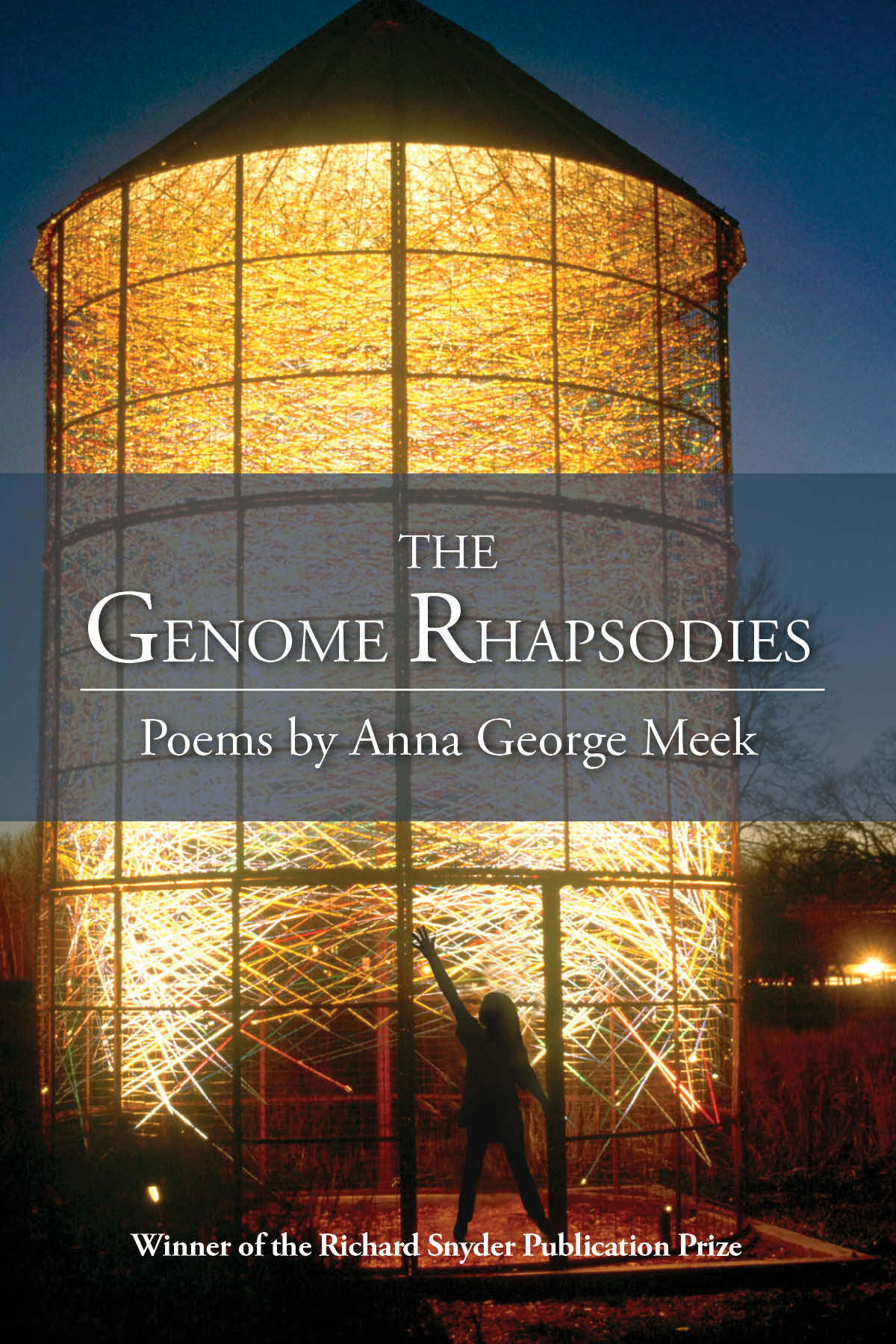
The Genome Rhapsodies - Anna George Meek (The Ashland Poetry Press)

Today's book of poetry:
The Genome Rhapsodies.  Anna George Meek.  The Ashland Poetry Press.  Ashland, Ohio.  2015.

Winner of the Richard Snyder Publication Prize


bri·co·lage
ˌbrēkōˈläZH,ˌbrikə-/
noun
  1. (in art or literature) construction or creation from a diverse range of available things.
    "the chaotic bricolage of the novel is brought together in a unifying gesture"
    • something constructed or created from a diverse range of available things.
      "bricolages of painted junk"

    Anna George Meek's The Genome Rhapsodies are a series of delightfully curious bricolage. She draws together the oddest coupling of sources and distills them with beautiful alchemy until they become epiphany.

    Meek provides her sources for some of the poems and they range from odd Wikipedia finds to Sigmund the Freud, Harlequin novels to patent applications. Even when the sources aren't listed you know Meek is distilling something that is going to turn into fascination.

    Meek tackles some big issues with her diverse range, the struggle families endure coming to terms with ailing and aging parents as senility and time steal their voice and reason. Meek travels back and forth in time to reach for the connections to her family that will make her continued existence possible, reasonable and palatable.

    Heirloom

I inhabit lace, and delicate folds.
On my wedding day, I wear my father's
Swedish blond and shy face, and the skin
of my mother's dress. And she, years before,

in her mother's, and her mother's. The body fits
against heavy silk faille, horsehair crinoline, gores
and flares. Corset of bone. Before the bobbin,
before the vote. In my adulthood, I have been given
the shape of women I've never known.

A terrible force gathers in Germany, the year
my young grandmother holds lilacs to her hip.
From her honeymoon balcony, she leans over the parade

to spit into Hitler's hair. Startling
and translucent stuff, in half-story's half-light. The drape
of weighty public event under family memory's
inscrutable lace: these are hems that touch those

who still live, and must care for them. I have yet to clean
the stains from the old dress, my wedding now years
behind me. But it's impossible. When Brahms dies,

my great-grandmother marries, and the electron
is discovered. Suddenly,
atoms fill her skirts, and the second symphony
becomes the sepulcher of a man. Consequences of fabric

and accumulation. Women collect in the dress
the alterations of their various body sizes;
I know precisely where I stop short of my mother.
And how her shape becomes me.

...

Today's book of poetry is impressed by the range Meek has at the end of her magical fingertips. This poem about her wedding dress, "Heirloom," tells the stories of several generations in one elegant swoop, and we get some spittle directed to towards that terrible man. Beauty.

Many of the poems in this collection are labelled as "Bricolage" but all of them draw on a rich well filled with vast resources.

Muscle Memory
My husband is bathing our baby
in the clawfoot tub. She rides its pleasures;
the porcelain ocean swirls and slaps.

Not water alone, uterine longing, such glistening
muscle; in my daughter, a nautilus
where mind lives. Its chambers open
deep, each quiet curl of her neurons. Her body
rocks and leans into the silver underworld.

From the next room, I watch her
as I play the violin; its music wanders
the hall, the bath, where my daughter
doesn't realize she listens. I study
the curious ventriloquism of my hands/
Their fingers strike down like diving birds.

No longer able to speak, my father listens
to the music, eyes closed, and swaying.
Under his lashes, tears brim. He cannot remember
my name from my daughter's, yet always,

when he embraces me, his hands fall just so
between my shoulder blades.

I can hear my father's breath lifting and falling;
hear the pads of my husband's fingers
massaging the baby's skull. One day her body
will remember his hands, just so, and who I may be,

no matter. For a moment,
I lift the bow from the strings; sound
dissipates; rosin atoms spin away in clouds as they will.

...

Today's book of poetry is breaking our own three poem rule today simply because we couldn't decide which poems not to use. There was heated debate in the TBOP offices and it was only after I agreed to use all four poems that cooler heads prevailed.

I couldn't not use "Dracula's Housecat" which you will see in a moment. Milo insisted on "Muscle Memory" because he has a soft, soft heart under all those black clothes. Kathryn insisted on "Heirloom", she read it twice during this morning's reading. "Haunted House" found its own way to the table.

Dracula's Housecat
More lithe I am, and living,
than he who also hunts by night.
We whisper the fields where titmice quiver;
we sip black water from the kills.
I leap the grass blades, the air unsheathed,
moon the shape of my eye. He's quick
for a little bat, but I feast first:
mortality coils in my haunches.
I eat and bare my belly in bloodroot
to tease the lean eagles who desire me.
And still, the bat is suckling his corpse.
I would rip off his wings and roll his soul
immortality between my paws,
but he alone lets me in before dawn
to climb the castle drapes. Later,
I rapture in sunlight while he sleeps
in his box--which I have only once
misused. I love my warm body thrumming.
I love my delicious short life.

...

Meek strongly believes in the interconnectedness of all things, it's apparent in the operatic range of her curiosity. Anna George Meek is questioning more than she is answering in The Genome Rhapsodies but they are such interesting questions. She wants to understand where language comes from and where language goes when her father can no longer make words.

Meek takes it all on, the good and the bad and she makes good music out of it. As a result our morning read here in the office was a spirited affair.

Haunted House
The last owner of this body
still creaks the floorboards,
makes books and dishes fly
and smash against the walls.
She turns the lights on and off
at odd hours of the night.
I wish I knew what she wanted,
wish she would show herself,
and then I would understand her
slow destruction
of the place.

...

Too good.

Today's book of poetry has to confess that some of the poems in The Genome Rhapsodies were above my pay grade, they made my research staff a little testy and caused us to open a few unopened pages of our dictionary. Yes, here at Today's book of poetry we still look stuff up in books.

But we don't mind being challenged and were enthralled from the the start. Anna George Meek has some serious poetry chops.
Anna George Meek Wins Snyder Prize
Anna George Meek

ABOUT THE AUTHOR
Anna George Meek has published in Poetry, The Kenyon Review, The Yale Review, Virginia Quarterly Review, The Massachusetts Review, The Seneca Review, The Missouri Review (where she was awarded the Tom McAfee Discovery Prize), Water~Stone, Crazyhorse, and dozens of other national journals. She is the recipient of a National Endowment for the Arts grant, two Minnesota State Arts Board Fellowships, and an Academy of American Poetry Prize. She has also been a finalist for the National Poetry Series (three times), the Minnesota Book Award, and the Yale Series of Younger Poets. Her first book, Acts of Contortion, won the Brittingham Prize in Poetry; her chapbook Engraved won the Snowbound Chapbook Competition and was published fall 2013. Meek lives with her husband and daughter where she sings professionally with the Vocal Essence Ensemble Singers, and is a professor of English in the Twin Cities.

BLURB
"The Genome Rhapsodies opens with Gregor Mendel’s question: 'What is inherited, and how?' Like strands of DNA, the syntax in these brilliant and moving poems intertwines with the infinitely recombinant moments and utterances that comprise our lives, revealing that what we inherit, first and finally, is language itself. … 'Try to Remember Before Language,' one poem urges us, but of course we can’t. These poems re-member us in language and reveal how the past becomes us, in every sense of the word; they are gorgeous, unforgettable works of art.”
     — Angie Estes, 2014 Snyder Prize Judge

"There are moments in our lives when a veil seems lifted and the interconnectedness of the world is revealed. The Genome Rhapsodies seems born from these epiphanic flashes. Lacing her own poetic voice together with a disparate array of voices and texts through bricolage, Meek’s poems explore the many forms of inheritance. As her poem built from her father’s lines, 'The Voice That is Mine and Not Mine,' points out: we become the words poured into us. Where we begin and end is not easily definable, after all, 'The boundaries of an organism are nearly always disputable.'"
    —- Matt Rasmussen, author of Black Aperture, National Book Award finalist

"What makes Anna George Meek’s The Genome Rhapsodies so impressive is its honesty about and alertness to everyday experience: 'Dear sachet, dear cherished household hooks / and torch and toys, I am coming back a stranger / to the materials of being alive.' Her musician’s ear is particularly keyed to the bare-boned contradictions of life, such as nature vs. nurture, and joy vs. grief. American poetry could use a good dose of her tenacity, wit, and spirit. Meek is that rare poet who wears her heart on both sleeves."
     — David Roderick, author of The Americans and winner of the APR/Honickman Prize.

"In Genome Rhapsodies we consider the basic components of the human body, the notes that make familiar music, and single memories composing the whole of memory itself. As the collection builds toward rhapsody, it is at first many other fine things: “The script/for an ancient story,” the verbal virtuosity and “dumb throbbing” of “derivations of grief” in violent times. Most often, Genome Rhapsodies is a linguistic bricolage in which meticulous focus on the micro juxtaposes with the macro to move us toward the hugeness of union. Anna Meek’s tone is intimate, erotic, and intellectual at once. Each body flows, she shows us, into the next body like “a plate of honey” both “sweet, and ominous.” We touch one another, whether we want to touch or not."
     — Heid E. Erdrich, author of Cell Traffic, New and Selected Poems

ashlandpoetrypress.com

444
DISCLAIMERS

Poems cited here are assumed to be under copyright by the poet and/or publisher.  They are shown here for publicity and review purposes.  For any other kind of re-use of these poems, please contact the listed publishers for permission.

We here at TBOP are technically deficient and rely on our bashful Milo to fix everything.  We received notice from Google that we were using "cookies"
and that for our readers in Europe there had to be notification of the use of those "cookies.  Please be aware that TBOP may employ the use of some "cookies" (whatever they are) and you should take that into consideration.


Sunday, October 25, 2015

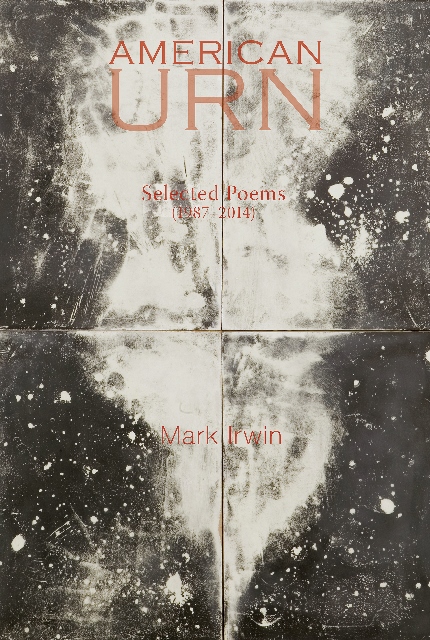
American Urn - Selected Poems (1987-2014) - Mark Irwin (The Ashland Poetry Press)

Today's book of poetry:
American Urn - Selected Poems (1987-2014).  
Mark Irwin.  The Ashland Poetry Series.  Ashland, Ohio.  2015.


"Oh Jesus!" I muttered out loud, it was late and I startled my almost sleeping wife.  "What is it?" She responded in that startled almost sleeping voice.  "This poem, it is so beautiful and so sad, this is why I love poetry."

I was talking about this poem:

Rider

As I carried my mother from the hospital bed
across the room toward the chair by the window,
she played with my gold watch as if it were a toy,
flipping the strap up and down, then singing Giddyup,
Giddyup, but as I looked at her she did not smile
so I nodded my head, snorted, then put a pencil
in my mouth, as bit, and cantered about the room
till I was out of breath, puffing, and she patted me, saying,
Good boy, Good boy, so I pawed the carpet, slobbering a little
like her, as she waved and I nodded my mane,
until this was how we said goodbye one spring
while the sun shrank to a white hot BB among a thousand
others receding in the jeweled, black sky as the rivers
galloped away with her breath through the dark green land.

...

Mark Irwin's American Urn gives us a tasting menu of twenty-five years of poetry from one of America's most honoured poets.  American Urn is James Taylor's "Steamroller" - Irwin is laying down a seamless path.  These poems are a rich and subtle accounting of our last century's terrible beauty.

On page after page, in poem after poem, Irwin explains some dark lesson that only required his light touch to illuminate.  Remember that word, illumination.

Passion is a word I usually reserve for my timelessly patient partner in crime, K.  But I'll bring it out for Irwin.  These poems are bursting with a fierce intelligent passion.

No, wait, I mean compassion.  American Urn is a passionate plea for compassion.  Mark Irwin's vision is intensely humane and American Urn can be seen as a new primer.  It should replace every Gideon's Bible in every motel and hotel in North America.

Elegy (with Advertisement)
Struggling to Find Its Hero

It was a century in which we touched ourselves in mirrors
over and over. It was a decade of fast yet permanent
memories. The kaleidoscope of pain

some inflicted on others seemed inexhaustible
as the positions of sex, a term
whose meaning is as hybridized as the latest orchid. Terrorism

had reached a new peak, and we gradually
didn't care which airline we got on, as long as the pilot
was sober, and the stash of pretzels, beer, and soft drinks

remained intact. On TV, a teenage idol has just crawled, dripping wet,
from the top of a giant Pepsi can, or maybe I imagined it,
flicking through channels where the panoply

of reality shows has begun to exorcise
the very notion of reality, for both the scrutinized actor
and the debilitated viewer who becomes confused and often reaches

into the pastel screen for his glass, while down Broadway
sirens provide a kind of glamorous chorus
for this script of history where everything is so neatly measured

in miles, pounds or megabits. How nice it would be
to drowse in the immeasurable. How nice
it would be to escape.

                                                  And there's a wobbly marble bench
                                                              beneath an out-of-focus tree on the Web
                                                                         I like to occasion my body with.

How brief we've become in our speed
I think. How fast the eternal.
How desperately

we need a clearing, a place
beyond, but not necessarily
of nature. And the rain

was so deep the entire forest smelled of stone, then the sun
broke, burying the long shadows
in gold. And the wounded

king woke in a book long since closed, and the princess
came to in a bed so large
she could never leave. How desperately

we need a new legend, one with a hero, tired
though he may be. One who has used
business to give up

business, one who has bought
with his heart what we
sold with ours.

...

Today's book of poetry is a big fan of hope, even when draped in despair.  Irwin's smart mirth elevates these poems to something closer to psalms.

Unfortunately for you readers, Today's book of poetry concentrated on only the first few sections of these Selected Poems, not because we didn't want to expand our horizon but simply because I got caught up in his most recent poetry and couldn't get out of it.  The poems from Irwin's two most recent collections, Tall If (2008) and Large White House Speaking (2013), both published by New Issues Press out of Western Michigan University, kept me fully occupied.

Irwin gets so much right it becomes hard not to see him as some sort of Illuminati, some sort of Minnesota bred Michel de Nostredame, Nostradamus.  Today's book of poetry gets the impression that Irwin sees back and forth into time.

American Urn

A wide prairie dotted with buffalo, finding some mountains.

A machine on a long track moving west: People in feathered

costumes. --Flags, a slaughter. Below, a war with this flag

and another that, as you turn the bronze, becomes a modern

riot. Now a metropolis and airport, a radio tower,

then a dead tree that resembles a cross as the images become

more cluttered--an ad for soap that will make you younger,

a tiny action figure staring into the distance, and an enormous

shine from I can't tell what, but could be the evening

with all its bright tons settling down over wheated fields.

...

There is rarely much in the way of total agreement here at our office but everyone was on board today.  American Urn - Selected Poems (1987-2014) is a must-have book for any poetry shelf or bedside reading pile.  This is must-read poetry.

If you don't like this book I will come to your house and read it to you until you do.

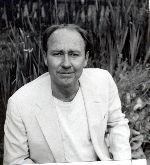
Mark Irwin

ABOUT THE AUTHOR
Mark Irwin was born in Faribault, Minnesota, and has lived throughout the United States and abroad in France and Italy. His poetry and essays have appeared widely in many literary magazines including The American Poetry Review, The Atlantic, Georgia Review, The Kenyon Review, Paris Review, Poetry, The Nation, New England Review, and the New Republic. A graduate of the Iowa Writer’s Workshop (M.F.A.), he also holds a Ph.D. in English/Comparative Literature and has taught at a number of universities and colleges including Case Western Reserve, the University of Iowa, Ohio University, the University of Denver, the University of Colorado/Boulder, the University of Nevada, and Colorado College.

The author of eight collections of poetry, including The Halo of Desire (Galileo Press, 1987), Against the Meanwhile (Wesleyan University Press, 1989), Quick, Now, Always (BOA , 1996), White City (BOA, 2000), Bright Hunger (BOA, 2004), Tall If (New Issues, 2008), Large White House Speaking (New Issues, 2013), and American Urn: Selected Poems (Ashland Poetry Press, 2015), he has also translated two volumes of poetry, one from the French and one from the Romanian. Recognition for his work includes The Nation/Discovery Award, four Pushcart Prizes, National Endowment for the Arts, Colorado and Ohio Art Council Fellowships, two Colorado Book Awards, the James Wright Poetry Award, and fellowships from the Fulbright, Lilly, and Wurlitzer Foundations. He lives in Colorado, and Los Angeles, where he teaches in the Graduate Creative Writing Program at the University of Southern California.

BLURBS

Large White House Speaking

“Large White House Speaking is a book of startling marvels . . .Mark Irwin is one of our best poets, and this is his best book yet.” 
     - LAURA KASISCHKE


Tall If

NOTABLE BOOK OF 2008 - Bloomsbury Review, International Poetry Review

“Even as individual lines and phrases achieve a luminous clarity, there remains a brooding circularity to Tall If, in part the apprehension of mortality at mid-life but in part something stranger.”
     - G. C. WALDREP, West Branch


Bright Hunger

“ . . . virtuoso performances . . . an intensity, an urgency about the evanescence of life and the various forces pressing on the human spirit and psyche.” 
     - PAMELA ALEXANDER, Field


White City

“Subtlety of ear, of phrasing, of language altogether, and a light-play of feeling, disguise the urgency and evocative range of Mark Irwin’s grave sensibility. The richness and evanescence of the moment surface repeatedly in his lines.” 
     - W. S. MERWIN

“This is a book one wants to taste again and again.” 
     - JOHN ASHBERY


Quick, Now Always

“ . . . a jagged, heartbroken, and ecstatic excursus on the late 20th century, a race through troubled paradise.” 
   - RANDALL WATSON, Chelsea


Mark Irwin
Poetry Every Day Project
"My Fathers Hats"
video:  Overlook Tutorial Academy


398

DISCLAIMERS

Poems cited here are assumed to be under copyright by the poet and/or publisher.  They are shown here for publicity and review purposes.  For any other kind of re-use of these poems, please contact the listed publishers for permission.

We here at TBOP are technically deficient and rely on our bashful Milo to fix everything.  We received notice from Google that we were using "cookies"
and that for our readers in Europe there had to be notification of the use of those "cookies.  Please be aware that TBOP may employ the use of some "cookies" (whatever they are) and you should take that into consideration.