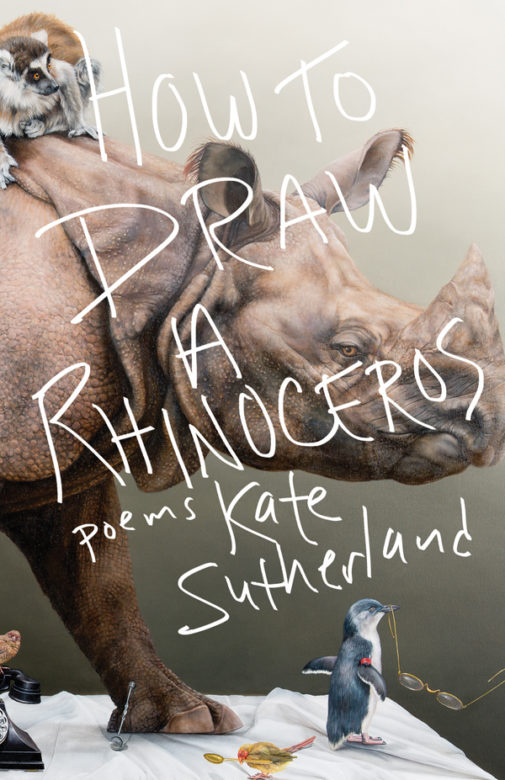
Out of Place. Richard Jackson. The Ashland Poetry Press. Ashland University. Ashland, Ohio. 2014.
Here's the thing that Today's book of poetry is only learning to accept, only learning to come to terms with. There are so many fine poets out there it is impossible to know them all.
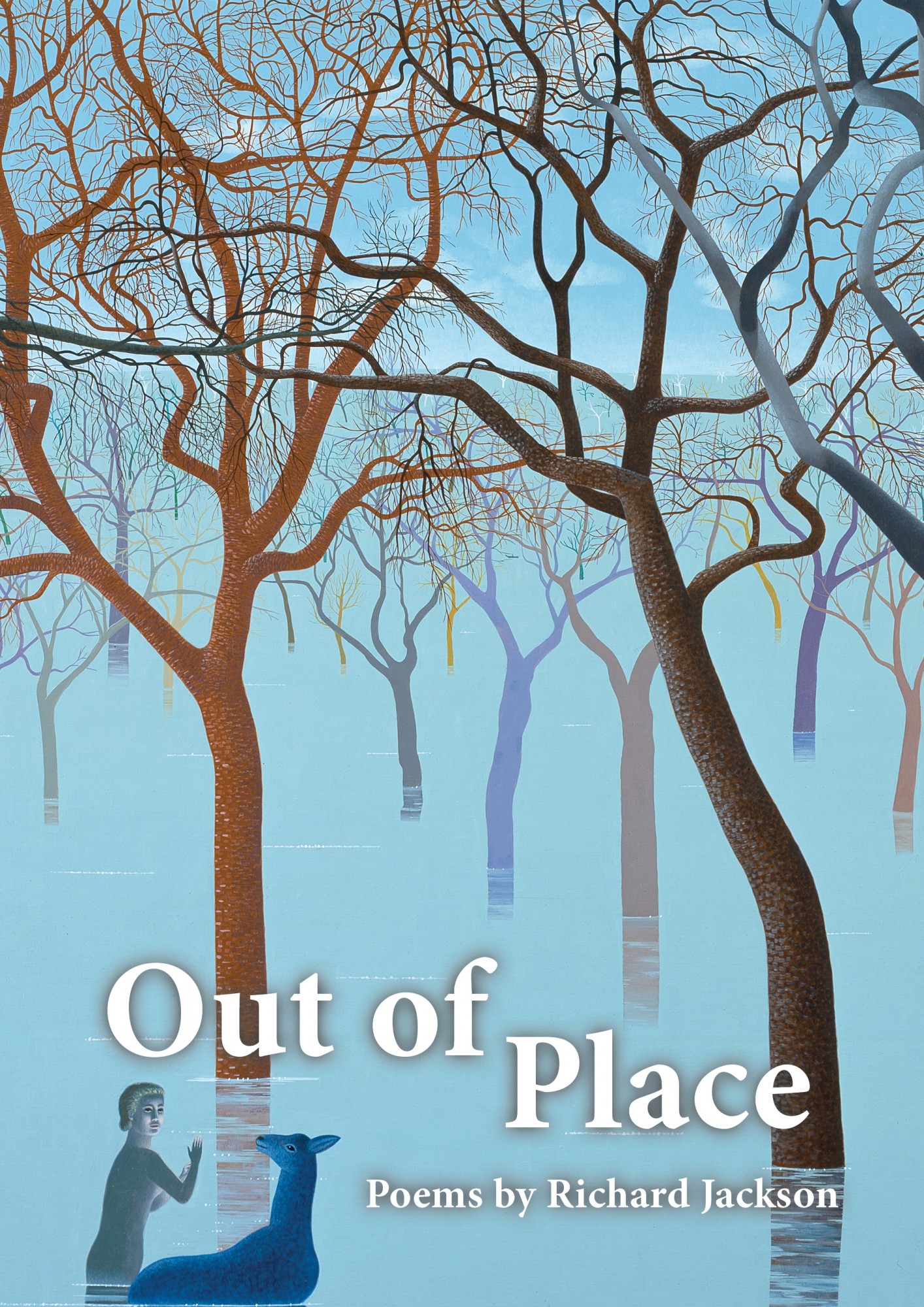
To all you regular readers out there, we are doing our best to cover as much ground as we possibly can but we are not Kate Sutherland on the subway. Sutherland of the beautiful Rhinos. Bless her cotton socks. We wrote about the brilliant Kate Sutherland and her book, How To Draw A Rhinoceros, last year. You can look at that blog/review at the end of this paragraph. Ms. Sutherland posts daily photos of a legion of unknown (to us) poets/poetry. She doesn't do it everyday but it is something we here at Today's book of poetry look forward to.
All of that to clumsily say we know we are treading water in terms of the whole range of poetry out there. But this is one of those cases where we feel a little guilt simply because we hadn't heard of Richard Jackson before. Out of Place is Jackson's eleventh book of poetry, and as you will see in his biography below, he has won every award and prize but the Selke Trophy.
Bob Gainey has every right to feel nervous in his old Hab's sweater because Jackson might just start piling up those as well - this writing is that good.
There is a very good reason Richard Jackson has rolled up the awards and kudos. This poetry is so good it is alarming.
About This Poem
At the beginning...which is to awaken you to the right kind of joy
in serious times, we must list all those who have been killed
since I last wrote......
- Bonhoeffer, 1942, Germany
It has to account for its untied shoelaces as well as its Extermination
Camps. Sitting among all those languages in the Munich beer garden.
Hitler's first speech a few blocks away. A masked ball where
the costumes are all switched around. Those carnival grab bags
filled with joy or remorse. Above me the clouds are paralyzed.
I have to wipe the dust from my soul. The wind holds its breath.
Bosnia, 1994: one group of men forced to bite off the testicles
of another group. Others to stand in the snow till their feet rot.
These things orbit now like a planet too far to see. Even the bee
can't figure a way out of my stein. Light staggers through the trees.
Every moment is filled with other moments. According to Bell's
Theorem whatever happens to this bee influences a history yet
to be written. Like the seed stars that smudge the trail of Mira as
it slips across the sky. All my maps are smudged with atrocities.
There are so many voices that are our own voices. Rhythm is just this
oscilloscope of the soul. We come from a place that has always
been inside us. Our words migrate helplessly. The world reflects
only itself. Which is why we have to create our own memories.
The paths from here spread out like shattered glass. The man
across the table's from Krakow. He doesn't want to talk about
the occupation and its lives turned to smoke. One the mechanical
Trumpeter in his church spire. The song stops where his real
ancestor was felled by an enemy's arrow. In the silence that follows
don't we all have to begin again? At the end of a line, the door
left open for a moment where you can fall in love, remember
what you wanted to forget, forget what you wanted to remember.
Why do you think our metaphors will save us? The world is only
itself. Time is just our way of imagining it. At least the bee has
ultraviolet vision to see everything we can't. We have to light
our dark spaces with the sputtering matches of our words.
We have to follow wherever they lead us. There's this little
hole in existence we all pass through. Someone is always entering.
He's the one who invents me while I think I am writing about him.
...
Today's book of poetry has mountains of admiration, respect and awe where Richard Jackson's Out of Place is concerned, add in a little jealousy. Jackson seems to have a simple formula, he picks a subject, writes about it with encyclopedic knowledge, dharma bum charm and whimsy and some sort of special poetry detectives trained eye. This is cherse stuff. There are no details left behind that we will need later, there is nothing extra to carry. Jackson is thorough, candid and hard as nails/soft as clowns tears.
Day after day Today's book of poetry shares books of poetry we like with you, best job on the planet, but we are not about to index our poets or their books with scores -- but if you minions are paying attention this guy Jackson is in David Lee, Sue Goyette, David Clewell, Sharon Olds, territory.
Out of Place really is a remarkable book filled to bursting with remarkable poems. It may even be a little unfair, Jackson having so much good poetry in him. Somehow Richard Jackson is able to write about exactly what it is that you want to know about. This is essential voice territory. As in, the next time Today's book of poetry is asked "who should I read?", Richard Jackson will be part of that conversation.
Belief
after the freeing of the West Memphis Three
Deep in our own inner caves the heart's canary sounds a warning.
On the other side of speech is a language that dreams us.
Echoes hide out in abandoned words. The air hardens.
A home invasion, a meth lab, a father killing his family.
It Had To Be You, Les Paul played on his guitar with seven
crippled fingers, but who is never named, or is us.
These
clouds begin to picket the horizon. Pine sap leaks from
a wounded tree. Even the flowers seem to take on
the color of night.
There are times when it is better
to close your eyes to the world.
I have been watching
a fledgling drop from its nest, flutter a few feet, and again,
until it flew not back, but into another tree. The wind tests
itself against my torn screen. A few thorns of light jab
out of the darkness on the far hills.
Who are you
if your dreams are dreamt by somebody else? In a dream
of freedom we return to a place that is not the place.
Orpheus'
poems could not create the world he needed. How
many times do our words become cells? How do we
remove those splinters of memory and remain ourselves?
Most of our dreams are the seeds in sidewalk cracks.
By now my fledgling has its own dream.
Tonight's clouds
will cover the meteor shower. I remember the fog in
the valley slipping forward like a glacier. At other times
a whole world rippled in the river.
It was David Hume
who said we had not a single reason to believe in reality,
but we must act as if we do. Even when a whole life
seems mothballed.
Now we know that our moon collided with
another moon whose remnants we can't see on its far side.
Moonglow is how Les Paul would have played it. And us?
Who are we if someone else's dream is really ours?
...
Today's book of poetry's morning read was spectacular. You can blame Richard Jackson. Many of our staff are becoming old hands in the reading game, at this reading poems aloud, and bless their cotton socks, they've taken a shine to the process. Milo, our head tech, led the charge this morning while shaking his head with both wonder and the obvious. Milo already knows his next assignment will be to find us the rest of Richard Jackson's books. If they hold a candle to Out of Place Today's book of poetry knows they will be essential reading.
This is how the masters do it. Solid. Bold. Beautiful.
That orange fugging fog that is over America is temporary and the poets tell us so. This title from Jackson is from 2014 and has nothing to do with POTUS. But it has everything to do with America and it gives us hope. Jackson writes poems of reflection, inner examination, outer understanding and tolerance.
Prophecy
You exist in the delirious illusion of language.
- Robert Penn Warren
What I want to say to you has already disappeared like the flashlight
beam I aimed at empty space years ago. If Augustine was right
it will hit the edge of the universe in 15 billion years. If Einstein was
right then it will never get to the end of it. My own life is orbiting
a word I don't want to land on. Heisenberg said you can only know
where you have been. Freud said that where we are is the terror
of what we were. He was terrified by sex which he saw as a kind
of impalement. Polls say the happiest people are those in the middle
of sex. So tell me, why have you paused to listen?
Most of our words
come with dress codes to hide the world we never want to see.
Some march to the rhythm of goose steps. All I need to do is
throw another stone at the stars to know how far from any center
we are. Even Charon can't say which shore is which.
Every word here tries to pronounce something that has no name.
The words we don't hear are the words that control us. The words
I want to say edge over the horizon like a sunset sail. Every breath
disturbs the next. Every word erases another word. Nathan, the first
prophet, said no one would come after him. So what did he know?
I don't even know what the end of this sentence says because
while the clock is taking its time to decide, the homeless man
in the cemetery blows a few random notes on a dented trumpet,
a few cigarette butts in the flowerpot have a story they refuse to say,
the wounded day limps home alone, a few more protesters are shot
in Bahrain, a few mothers and children slaughtered in Mexico
in the middle of some drug war.
Isn't everything we say just some
bit of breath we can't hold any longer. Doesn't every word draw
a picture that hides what it really means. How did all those painters
know what the Apocalypse looks like? The bombed church
in Baghdad thought it was today. The man shot on his porch in East
Chattanooga thought it was another day.
Sometimes the moon rises
full of hate. Clouds scramble over distant peaks, the wind broods
in a ravine, the flycatcher, perched along, waits for darkness.
In truth, what I want to say to you are these trace elements
lingering in the spaces between words. In truth, nothing we say is
worth the way the hawk slides through the invisible air from
the top of the skeleton of a dead tree.
In a few years you'll decipher
how these words will create a whole world I never meant to say.
Our windows have their own prophecies. Birdsong crinkles the air.
Everything we say is a self-portrait. The radio preacher says
that flowers can't bloom in hell. I have it on good report that
you can fit 1,737 angels on the head of a pin, excepting fat angels.
Salvation comes before creation, writes Agamben, which is why
we have to say whatever words, however dark, puddle at the end
of each sentence.
And isn't what we can't say exactly what attracts us?
And you, would it have made any difference if I said what I wanted
to face back at the beginning, that we have to learn to love whatever
truth will say itself, oh, not at the safe distance words create, but
unconditionally, like the woman who cannot understand why she is
impaled on the branch in the Ivory Coast like one of Goya's
Disasters of War discovering words she never knew would lead her there.
...
Out of Place is another clear lesson for Today's book of poetry. America remains full of greatness if you know where to look. Poets like Richard Jackson give Today's book of poetry hope.
Remarkable, remarkable poetry.
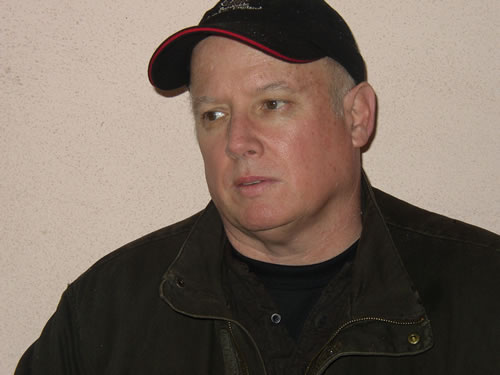
Richard Jackson
ABOUT THE AUTHOR
Richard Jackson is the author of eleven books of poetry, Out of Place (Ashland Poetry Press, 2014) most recently, two books of criticism, and two translations, one from Slovene and one from Italian. He is a winner of Guggenheim, Fulbright, NEA, NEH and Witter-Bynner Fellowships, five Pushcart appearances, as well as prizes from Prairie Schooner, Rattle and Crazyhorse. Jackson's poems have been translated into 15 languages. He was a recipient of the Slovene Order of Freedom Award for Humanitarian and Literary work in the Balkans and recipient of the 2009 AWP George Garrett Award. Jackson has taught at the Iowa Summer Festival, Prague Summer Program, Bread Loaf and other venues, and teaches at UT Chattanooga and the Vermont College of Fine Arts low residency program, winning teaching awards at both schools.
BLURB
His lines are clouds of love, piercing the sky with enormous empathy, rolling in the azure, torrents of passion, and are arrows at the same time, reaching a peak where they break, crying, cleansing the air, becoming ether. It is impossible to describe this in discursive language. With a melody that is unmistakably his own, his poems seem to come to us in Europe from the heart of the heart of America, the totally open (and hidden) center from where the power of the continent sprouts. He is a kind of Scorzese in poetry, but where Scorzese almost succeeds in his films, then stops, seals and terrifies us, Jackson adds a tender, vulnerable voice that blossoms and transforms us and that is so unique and great, great in its truest sense in Richard Jackson's poems.
- Tomaž Šalamun
ashlandpoetrypress.com
628
- Tomaž Šalamun
Richard Jackson
Poetry@Tech
Video: poetry@tech
ashlandpoetrypress.com
628
DISCLAIMERS
Poems cited here are assumed to be under copyright by the poet and/or publisher. They are shown here for publicity and review purposes. For any other kind of re-use of these poems, please contact the listed publishers for permission.
We here at TBOP are technically deficient and rely on our bashful Milo to fix everything. We received notice from Google that we were using "cookies"
and that for our readers in Europe there had to be notification of the use of those "cookies. Please be aware that TBOP may employ the use of some "cookies" (whatever they are) and you should take that into consideration