Showing posts with label carl dennis. Show all posts

Wednesday, January 25, 2017

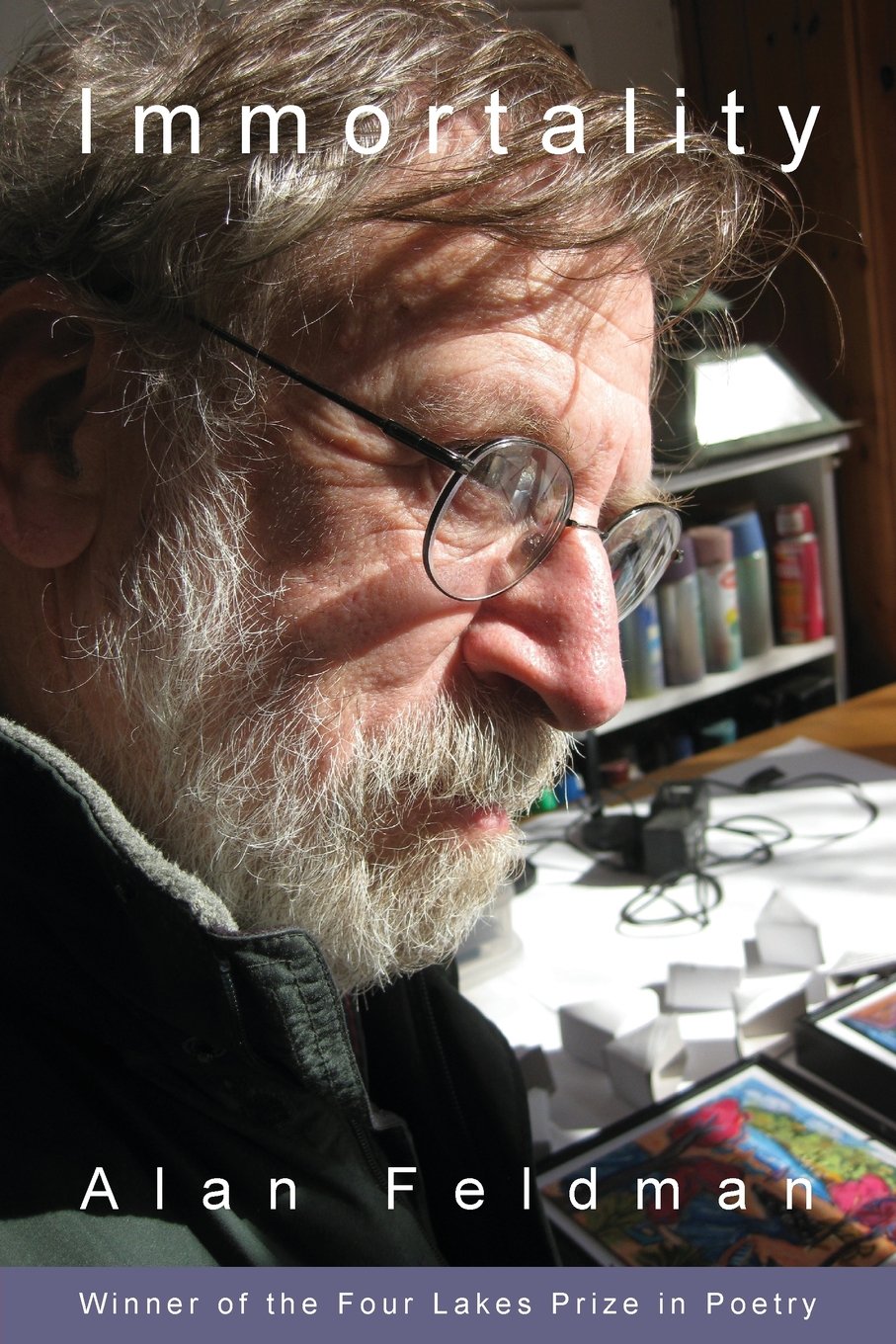
Immortality - Alan Feldman (University of Wisconsin Press)

Today's book of poetry:
Immortality.  Alan Feldman.  University of Wisconsin Press.  Madison, Wisconsin.  2015.
Winner of the Four Lakes Prize in Poetry


Alan Feldman reads like the gentlest of men but that doesn't stop him from taking you to the deep end of the pool.  Immortality is an emotional assault without aggression or violence.

Alan Feldman reads like the wisest of men.  These poems have that uncanny warmth you feel around a stranger whom you know is going to become a friend.

Alan Feldman reads like a poet bursting at the seams with loving reason and even seasoned hope.

The Afterlife

There's a lot of light in her apartment,
falling on the rented hospital bed.
I've been told the dying like to be held,
so, though we're just friends, I make myself
hold her hand, as if the conversation is final,
matters more than others, though most have mattered.

She's seen a couple of rabbis, who were helpful.
It seems there are Jewish angels. (Why argue?)
And she likes the story I brought her,
"The Death of Ivan Ilych," how before the end
he learns so much nobody knows about,
except the reader.

"So many faces," she says of the people who came
for the songfest yesterday evening, over a hundred
crowded into this little place. "Each face a flower.
Each face..." and here she pauses
(the medicines are affecting her word retrieval?)
"so full of memories."

It all makes a strange image in my head:
faces that aren't faces, but wide open,
as if she's discovering that she's lived
everything they have -- centuries
more than she thought.

"Our life in others," I remind her,
citing Pasternak, "that is our immortality."
But she knows that doesn't go far enough.

I'm glad she's thinking of her own afterlife,
since not being alive is, apparently, unthinkable
on the brink of it happening, a kind of shallowness
to imagine it's merely like going to sleep,
though lately her dreams have been so vivid:
an all-night argument with her sister about a dog,
over what color it should be, white or black.

Outside the weather appears to be changeable,
I'm dying to go out there, on the small terrace.

"Go out on the terrace," she says, "before you leave.
The view is wonderful."

...

Reading Immortality reminds Today's book of poetry of what it is we truly love about poetry.  We like to be moved by words.  We like our heart to pound in our chest when we read something we have just discovered but know to be true. 

These smart, smart poems avoid any melodrama or fuss, emotional or otherwise, with intelligent humour and a sensitive dash of pathos.  Whatever the emotional temperature called for, Feldman knows how to dial it in.

Feldman starts his conversation with the reader with his rejection of a suggested mantra, a plea from a friend to "drop the personal."  Today's book of poetry is familiar with that strident battle cry and is pleased to report that Feldman went the other way.

These are deeply personal poems full of universal good intent, maybe even a moral imperative. Today's book of poetry is never sure of anything but we're pretty certain about Feldman's Immortality.

Watch Battery

Who knows if my father ever thought
what Montaigne's father did: That every city
should have a place where people in need
could go to meet. How somewhere
a man is starving, and another with a surplus
would grieve if he only knew, and offer the man
a modest but reasonable living. That giving man
could have been my father. Not grieving, perhaps,
but regretful he couldn't be of more help --
a man you could trust to fix things.

Like the man who helped the watchmaker
fix my watch. How, when he couldn't decide
how to loosen the clasp that holds in the battery,
itself no bigger than a small coin,
without breaking it, he turned to someone
more experienced -- a Dutchman, actually,
who seemed happy to demonstrate this very skill,
and upload it to YouTube. Demonstrate it
with a camera in his lap, so we could see his two hands
familiarly, competently, and rapidly
opening the watch to replace the battery,
the way a father would automatically retie his son's shoes.

And there was also his calm voice with its accent,
like the woodcarver's in Pinnocchio,
telling the confused and despairing who were ready
to lose patience and snap the band holding the battery
and ruin the watch -- the watch that could keep running --
how to prolong its life by exercising patience,
the very quality my dad had in abundance,
that quality I always loved him for, of solving the problem
without getting exasperated. Though it's unfair
he didn't have parents like that himself.
Or that -- when the amount of pain rose to be greater
than any pleasure he'd be able to feel --
the little watch-sized defibrillator near his heart
wouldn't simply stop, and let him go.

...

Feldman's Immortality has travel poems for those that need to go somewhere and political poems for people who need to politicize.  There's a great kick at Walter Cronkite's can in a sailboat poem tart as the lemon and gin in a sunset cocktail.  

This morning's reading was attended by our bon ami Alexandre whose enthusiasm and energy gave us all a lift.  Immortality read like the best parts of a story you've been waiting to hear.  Odin, our quiet right hand man, made it clear he liked these poems and then he gave the room a solid once over, looked everyone in the eye.  Kathryn and Milo both read with warmth and grace, just like the poems asked for.

In November

When my daughter calls
and I can hear her baby
crying in the back seat
and she asks, "Dad, would you mind if I stop by
for a quick diaper change and feeding?" --

I'm so glad I picked up the phone,
glad I hadn't set off on my walk,
and quite soon I see her car rolling into the driveway,
and the baby is stretching open her little mouth
and wailing, as babies do --
so enraged not to be able to speak,
not even to be able to think this or that is wrong
except that the whole universe is wrong.

And when they're settled in the little bedroom off the kitchen,
and the baby is suckling noisily,
and then, contented once more,
rolling both eyes, not always in the same direction --
mother and baby in the bedroom
where my daughter herself was once diapered and fed --

I feel so thankful for never having strayed very far
into the wide world, never having served
in the foreign wars of my time, and grief for fathers
who do, the ones swaddled in flags --
maybe because yesterday was Veterans Day,
and though she says she's never done this before,
my daughter tells me she called up a soldier's family she knew
just to say she'd been thinking of them, just hoping
the war we have now will end soon.

And the thin November light is straining through the window curtains
we've never changed,
and I feel thankful for my years right here in this house
the way I imagine a tree might feel thankful
if it were given an opportunity to roam around the world--

how it might say, "So good of you, but no thank you,
where would the birds be without me here? --
the ones that fly back unpredictably
to perch in my thinning hair,
this and every November."

...

Ronald Wallace and the University of Wisconsin Press consistently send Today's book of poetry crackerjack fare.  Alan Feldman is a new discovery for Today's book of poetry and already we are a devoted admirer.
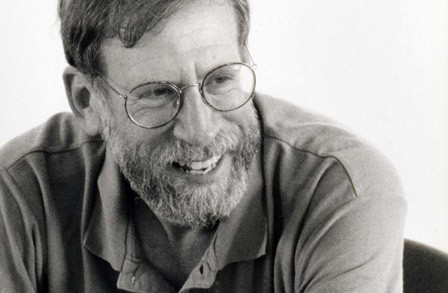
Alan Feldman

ABOUT THE AUTHOR
Alan Feldman is the author of several collections of poetry, including Immortality (2015), winner of the Four Lakes Prize; A Sail to Great Island (2004), winner of Pollak Prize for Poetry; and The Happy Genius (1978), winner of the annual George Elliston Book Award for the best collection published by a small, U.S. non-profit press. His work has appeared in the Atlantic Monthly, the New Yorker, and Kenyon Review, among many other magazines, and included in The Best American Poetry anthology in 2001 and 2011. Feldman's recent work appears in Hanging Loose, Cimarron Review, upstreet, Southern Review, Yale Review, Salamander, Southwest Review, Cincinnati Review, Catamaran, Worcester Review, and online in Boston Poetry Magazine and Cortland Review. His poem "A Man and A Woman" was featured in Tony Hoagland's 2013 article for Harper's, "Twenty Little Poems That Could Save America."

Feldman was a professor and chair of English at Framingham State University, and for 22 years taught the advanced creative writing class at Harvard University's Radcliffe Seminars. He offers free, drop-in poetry workshops at the Framingham (MA) public library near his home, and in the summer at the Wellfleet library.


BLURBS
“Alan Feldman is our greatest American poet of the household and family, as a loving, growing, struggling, and essential institution. He manifests the kind of love we rarely see in our poetry, and this familial love pours into the world around him. I am personally thankful every time I read an Alan Feldman poem, and Immortality, the book you are holding in your hands right now, makes us understand that immortality lies all about us, in everything we experience as a human being.”
     — Bill Zavatsky, author of Where X Marks the Spot

“A richly engaged, near flawless collection. Like those magic mineral waters pumped from deep in the earth, Feldman’s poems can cure emotional arthritis and ventilate the soul. Better poems than these cannot be written in this confiding, intelligent humanist mode.”
     — Tony Hoagland, author of Twenty Poems That Could Save America and Sweet Ruin

“These poems enact with grace and intelligence the process by which one comes to possess the life one is actually living. This is an enlarging journey that no reader of poetry will want to miss, offering the pleasures of discovery every step of the way.”
     — Carl Dennis, Pulitzer Prize–winning author of Practical Gods

“Alan Feldman’s poems offer the companionship of a witty, thoughtful, sometimes bewildered friend testing his life in language; telling it all. This is a heartening, deeply satisfying collection from a seasoned poet at the top of his game.”
     — Linda V. Bamber, author of Taking What I Like

Alan Feldman
reading In November
Video: Nan Hass Feldman


uwpress.wisc.edu

545
DISCLAIMERS

Poems cited here are assumed to be under copyright by the poet and/or publisher.  They are shown here for publicity and review purposes.  For any other kind of re-use of these poems, please contact the listed publishers for permission.

We here at TBOP are technically deficient and rely on our bashful Milo to fix everything.  We received notice from Google that we were using "cookies"
and that for our readers in Europe there had to be notification of the use of those "cookies.  Please be aware that TBOP may employ the use of some "cookies" (whatever they are) and you should take that into consideration.


Thursday, February 25, 2016

Blond Boy - Lucia May (Evening Street Poetry)

Today's book of poetry:
Blond Boy.  Lucia May.  Evening Street Poetry.  Dubin, Ohio.  2014.

Picture

"Forgiveness is the answer to the child's dream of a miracle by which what is broken is made whole again, what is soiled is made clean again."
                                                                - Dag Hammarskjold

Lucia May starts Blond Boy with this marvelous quote from Dag Hammarskjold about forgiveness and it is good to keep this in mind when reading through this murky pool of regret and hope.  

Blond Boy is May's poetic attempt to forgive her father and to forgive herself for crimes and misdemeanors large and small.  May's father was a young boy in Poland at the outbreak of World War II and came of age under a Nazi occupied Poland where he suffered great and unforgettable torment at the hands of German soldiers.  May's anecdotes make clear that her father saw things no young boy/man should ever see.

After the war May's father got to the United States and found May's mother, they married, May was conceived and new tragedies and drama unfold.

Luck Runs in My Family

In Poland
during World War II
a certain Nazi
liked to stand my father
against a wall,
walk back
and fire
his pistol
as close as possible
to my father's head
for sport.
My father didn't
feel lucky,
frozen against the wall,
but he'd live
to call it luck.

My brother Billy
died by shooting
himself. He didn't
know that luck
has nothing to do 
with Russian Roulette.

I am lucky
that my daughter is
lucky to be
recovering.
When she burst
into the house
with her eighteen
month medallion
I felt lucky
I didn't feel lucky
driving her
to those first
counseling meetings.
Her scabbed arms,
shaved head,
and scaly warts
made me look away
as if she were a snail
being torn
from its shell.

...

There's no reconciling May's father's tortured past and turning it into a reasonable present.  May's father becomes possessed by a religious furor and his obsessions alienate and eventualy shatter a tattered family.  Clearly haunted, the father is doomed.

There are poems set during wartime Poland, others in an American home in the late fifties, early sixties, and it is falling apart at the seams while May's father tries to fix the cracks with sermons.

These poems are a dysfunctional family's epitaph and it is clouded with ghosts that go unnamed. 
May wants to let go of the past and these poems may be her only shot at redemption, they certainly feel that way.  This is intense and compelling stuff.

For Any Abiding Place on Earth

                                                   after Carl Dennis

All my grandmother needed at her farm in Poland
was time to raise the crops of corn and cousins.

I met my grandmother when I was seven.
As our taxi from Warsaw came to stop in the dust
she sputtered and screamed around this barnyard
with the alarmed chickens. She tugged off her apron
and tucked her hair into her babushka.

I stand at the farm's grave and find only ceramic tile pieces
in the disemboweled earth where the kitchen once stood.

There are no abiding places on earth, unless memory is a place
and I doubt it. Gather all memories and they wouldn't fill
one square inch of this remembered ground.
They are lighter than dust and even less confined.

...

That last verse is gold.  Solid gold.

Luck can cast some pretty dark shadows and the Nazi occupation of Poland left scars beyond what Lucia May's father could rationally endure.  These scars were big enough to scar generations and whether or not May is out from under this horrid history depends on who she forgives.

These poems are, in spite of the father's faults, an apology for her father, to her father, and then to herself.

May is mining some awfully deep torment in Blond Boy.  It makes for some startling poetry.

Blond Boy and the Plan for Eastern Europe
                                  (Generalplan Ost)

Cattle wagons transported
children aged six to ten years
to temporary selection camps.
A sympathetic Nazi guard
could sell a Catholic child back
to its Polish family for 25 zloty.

The blond boy was twelve in 1939
when the Nazis invade Poland.
He is too old for Germanization,
too old to be desirable enough
to undergo racial exams by experts.

Some younger Polish gentiles live
and die as Germans, unsuspecting,
but he is too old to forget Polish
nursery rhymes and his Polish name.

Armed Nazis seize him from the family farm
and he is conscripted as a Zivilarbeiter--
civilian worker--forbidden to swim
in public pools, to ride public transport,
to own a bicycle, or under penalty of death,
to have sex with a German.

By law the blond boy's wages are lower than
German citizens', his nutrition substandard.
He chips stone seven days a week
in a German quarry. He may not attend
church and must wear a purple "P" badge.

His superiors encourage him to sign
the Deutsche Vaolksliste for benefits
like more calories and freedoms.
He refuses to sign and after the war
is spared being tried in Poland for high treason.

...

Blond Boy is full of brave poetry from the wounded heart of a survivor.  Nothing in Blond Boy is going to make you happy - but you are certainly going to glad you spent time with this riveting book of poems.

Picture
Lucia May

ABOUT THE AUTHOR
Lucia May is a poet and longtime arts advocate in St. Paul, MN. Her poems have appeared or are forthcoming in Main Channel Voices, the Evening Street Review, Hot Metal Press, Paperdarts, the Prose-Poem Project, Pemmican, Talking Stick, Tall Grass, Burnt Bridge, The Widow’s Handbook Anthology, The Awakenings Review, The Mom Egg, Verse Wisconsin, Kurier Polski Min-nesota, and the Little Red Tree Inter-national Poetry Prize 2010: Anthology. She has been nominated for a Pushcart Prize by Verse Wisconsin for her poem “Explain in an Essay.”

BLURBS
In Lucia May's inaugural poetry collection, Blond Boy, she records with gracious precision the personal horrors of the boy who would become her father. Taken from his home by the Nazis, the boy's humanity was forever scarred by his experiences. Of his torture, Lucia writes, "...the boys accepted their penalties/like cows on the farm before the knife." Lucia weaves his story into her own through poetry that is brutally honest while being "bathed in the light" of forgiveness. She manages well the difficult task of showing grief and loss unsentimentally, with a glance, a gesture, an image that glows vividly on the page. This slim book offers readers the chance to share in emotions as complex as Bach played with panache on a well-tuned violin. At the end, we are left with memories that are "lighter than dust and even less confined."
     —Linda Back McKay, author of The Next Best Thing and Out of the Shadows: Stories of Adoption and Reunion.

A man who suffered a wretched childhood extended bitterness and perverse misery to his own children. He became a religious fanatic, who in his distorted view deemed the music of Bach and Beethoven wholly unacceptable. Growing up in a nightmarish environment, his daughter, Lucia P. May, did not fall victim to depression, suicide, alcoholism or drug addiction. Miss May escaped the quicksand of her father's cruelty through art, music and literature. She writes exquisite poetry that shines light in the darkness.
     —Robert O Fisch, author of Light from the Yellow Star: A Lesson of Love from the Holocaust and The Sky Is Not the Limit

Lucia Piaskowiak May writes without any sentimentality whatsoever about her father's life in World War II Poland and about the shadow he cast over her own life. She compresses enormous emotion into tense spare lines to create poetry that is fierce and true.
     —Keith Maillard, author of The Clarinet Polka

A memoir in poetry, in Blond Boy Lucia May tells the tragic and amazing story of her father's survival in Nazi-occupied Poland, his marriage to her mother, her visit to Auschwitz, taking violin lessons and attending healing services at a Presbyterian church. This is a story well worth telling and it comes wonderfully alive in all its mesmerizing details. These memories will dance in our minds for a long time. May writes of them as 'lighter than dust and even less confined.' May we all be thankful that she has captured them for a moment.
     —Mary Logue, author of Hand Work and Trees

Lucia May's book, Blond Boy, is a tough, intense collection of poems. It's a book about what luck means. It's a book about a father, that blond boy who survived World War II, and where the luck of surviving led him. It's a collection that offers its readers portraits of a family, of how religion affected them, vignettes that allow us to see a family's suffering, and how pain and discord shaped their lives. We are given stories that cover many years, and we see how the lucky and unlucky in this single family lose or find their strength, their sense of purpose inside a family, inside history. This collection is blunt in its truth-telling, and ambitious in its range. I won't forget these poems.
     —Deborah Keenan, author of From Tiger to Prayer and so she had the world


To see the trailer for Blond Boy please click here:


442


DISCLAIMERS

Poems cited here are assumed to be under copyright by the poet and/or publisher.  They are shown here for publicity and review purposes.  For any other kind of re-use of these poems, please contact the listed publishers for permission.

We here at TBOP are technically deficient and rely on our bashful Milo to fix everything.  We received notice from Google that we were using "cookies"
and that for our readers in Europe there had to be notification of the use of those "cookies.  Please be aware that TBOP may employ the use of some "cookies" (whatever they are) and you should take that into consideration.