Showing posts with label holly golightly. Show all posts

Monday, February 4, 2019

Anatomy of an Injury - Myna Wallin (Inanna Publications and Education Inc.)

Today's book of poetry:
Anatomy of an Injury.  Myna Wallin.  Inanna Publications and Education Inc.  Toronto, Ontario.  2018.


Today's book of poetry isn't exactly sure what a chanteuse is but we know we want to call Anatomy of an Injury a Holly Golightly dirge and the voice of Myna Wallin something both sexy and dangerous.  Wallin is lamenting and celebrating some of the same things at the same time and in context it makes perfect sense.  Or: romantic life expectations rarely meet up with our real life propositions and the love life of our imagination is endlessly superior to our own life between the sheets.  

Myna Wallin knows all the delicate disorder of the modern Bo-Bo Dance.  Her poems, while entirely aware of the slings and sorrows of romantic love, precipitously both long for and scorn Cupid's attempts at breaking our tough modern skin with his pathetic arrows.

Anatomy of an Injury

I.
Pain, volatile and dangerous like faulty wiring.
Pain, turning on and off, at unexpected intervals,
like broken Christmas lights.
Pain, a rodent's teeth chewing
on my knee—its favourite treat.
Like quick-hardening cement poured
into my legs.
Pain, a belligerent visitor who won't leave,
drunk on Naproxen, Codeine, and Celebrex.
Pain streaking down in gullies,
obscuring a view of anything outside.

Pain that snakes its way
to the heart, weary and intolerant.
Pain as self-flagellation, as penance, as
persecution.

Why the knee—
what does the knee represent?

II.
I love you, said on bent knee, by a fiance
in a moment's sublime supplication;
a falling to the knees in wonderment
in the presence of a celestial being,
an extra-terrestrial. Kneeling in worship.

I can't bend or straighten my leg fully,
cut off at the shins, like a swift kick
life has given me, a stern admonishment
for being unwilling
to yield to love,
or the failure to kneel in prayer.

No deference, no stooping
to bow or clean; knees are for lending
service, for placing oneself underneath
something or someone, for picking
up pennies, touching the vestments
of the Pope—or for doggy style sex.

There can be no relinquishing of
power without knees, to either deity
or man. As woman, lacking this compliance,
I'm an aberration.

Stiff and leaning on a cane,
I resemble an old crone. Limping
and twisted, I cast terrible spells.

💫💫💫

Okay, weird digression.  Myna Wallin has a cat poem in this collection that gave me the heebie jeebies something fierce, right down to my memory of "Whatever Happened to Baby Jane?"  Wallin walked right into the middle of one of my reoccurring nightmares and brought a poem out of it.  What dark magic is this?

Myna Wallin loves love, loves amour and loves a good laugh.  These honest feeling, honest sounding poems are just good enough that they may be honest too.  Anatomy of an Injury knows that there are many paths to happiness, insight, love and contentment and that some of them pass through the funny bone first.

Fear of the Zombie Ex-Girlfriend

Fear the zombie ex-girlfriend,
her guts infested with jealousy.
If she had a conscious thought—
besides brains, human flesh, hungry now—
it would be, if I can't have you, I'll eat you.

Instead she'd say, "We should go have coffee,
no reason we can't be friends,"
And she'd wink demurely, like she used to,
with her undead eyes.

She wants to eat parts of you right in front of me,
digesting you like some ungodly sacrament:
your body and her body entwined,
roaming the earth together,
ravenous together.

But she hasn't got a thought in her hideous
drooling mouth, her gaping, half-broken jaw.
Why can't you see that?
She'd just eat her way through you
as if you were chocolate
unless someone stops her:
someone's got to stop her!

I'd better make a pre-emptive strike
and make it a good one.
Piano-wire right through her scrawny neck—
Otherwise she's liable to ruin everything.
And you, poor thing, won't see it coming.

💫💫💫

Another big snow in Ottawa this past weekend.  Our morning read was conducted in a room strewn with heavy coats, a small flock of gloves and mittens and scarves hanging over all the heating grates like colourful sleeping crows.  Drying mittens have a certain odour and it isn't erotic, just saying.  The read itself was crisp and clean as spring water.  Our new intern, Sally Ann, led the charge with her new-to-the-office enthusiasm.  The others were suitably impressed by Sally Ann's moxie and poetry smarts and the solid as you need them to be poems of Myna Wallin.  The reading was warm enough to heat the room.

Anatomy of an Injury is immediate.  Walling hasn't put a single thing between her so keen eye and honed voice, there are no filters and we can be grateful.  There are poems about loss and poems about pain.  And Ex-girlfriend Zombies.  Bless Wallin's cotton socks.

Myna Wallin knows all about the pain we dump on one another, share willingly, or not.  But this heart, this poet, is bigger than just pain, Wallin is buoyed by hope.  As fragile, futile and as far out of reach as hope may be.

Now Serving Date #2,775

Blue agate eyes skimmering surfaces,
light on her. After his set:
Can I buy you a drink?
In his stuff tuxedo, six-foot broad-shouldered,
He's got the look of a bridegroom.
Non-verbal, offstage
He's at a loss.

Marlboro lit, right hand tapping on the bar, rising,
falling. Dialogue—a foreign art,
halting, lurching.

Tell me about your gig in New York.
One-word answers.

Questions, a social reflex. When responses come
he's lost, smoke rings trailing pianissimo,
eyeing his options as women congregate,
oozing pheromones.

Drinks like a man in a hurry
to lose consciousness.
He won't be coaxed out of hiding, won't meet her
halfway. If his arms weren't so lean, tapered—arms
that gallop across vibes, smash cymbals.

If his eyes weren't jaded so blue, would she need
to laugh so musically, smile so widely? then off to a smoky
after-hours jazz joint. Over drinks
meets his saxophonist buddy
who talks enough for three.

Months later:
The same sax player wonders,
Are you still together?
She laughs, embarrassed,
Haven't seen him since.
Without missing a beat he asks,
Can I buy you a drink?

💫💫💫

Any poet who writes love poems to both Irving "King of the Canadian Poetry Hill for a good long while" Layton and Gordon "Bob Dylan is a fan of his work" Lightfoot, is so thoroughly Canadian that Today's book of poetry has an instant craving for pancakes with butter and maple syrup.

Today's book of poetry certainly wants more of Myna Wallin.

Image result for MYNA WALLIN PHOTO

Myna Wallin
ABOUT THE AUTHOR
Myna Wallin is an author and editor living in Toronto. She is the author of a novel, Confessions of a Reluctant Cougar (2010) and a volume of poetry, A Thousand Profane Pieces (2006). Her poetry and short stories have appeared in numerous literary journals and anthologies including Contemporary Verse 2, Existere, Descant, Literary Review of Canada, Matrix, Rampike, 50+ Poems about Gordon Lightfoot, and Where the Nights are Twice as Long: Love Letters of Canadian Poets.

BLURBS
"With her brilliantly chosen title, Anatomy of an Injury, Myna Wallin proceeds to examine a series of agonizing loves: Love for a mother lost at a young age to cancer, then, love for a lifetime of amours "because love and longing for it, is the only thing/ I’m really good at." In her disarming candor, she is a Canadian Anne Sexton, forthright, glamourous, savvy—and innocent. A feminist in a "sparkly dress," Wallin understands that vanity, too, has its desperate, daily discipline, even when "I've Reached the Age of I Don’t Care." But very happily someone the poet would "do anything to keep around" arrives by the end of this winsome book."
     —Molly Peacock, author of The Analyst and The Paper Garden

"Myna Wallin investigates, without fear, "this duplicity of meaning, of motive, of self" in poems that dive into the painful or awkward past and a youthful, continuous lust for men and clothes and life. Along the way, she bears in mind the kitsch of the high backed bondage chair or foot-damaging pair of Louboutins, while defiantly declaring she will curl up and sleep amongst the beige and brown spotted bodies of her domesticated family of bobcats. Wallin's arch style somehow convinces us we’ll always yearn for love and heartbreak."
      —Nyla Matuk, author of Stranger

"Effervescently centering each poem's surface is the universal solvent, love, in all its grand, minute, nebulous, recollected and misunderstood permutations. These deeply introspective, poignant, reflective, compelling, yet simultaneously life-affirming and humorous poems dance "across a trellis/ with such bravado, bold, ornate,/ luxurious to the touch/ their feet in the shade, their faces in the sun."
      —Michael Fraser, author of To Greet Yourself Arriving


Myna Wallin
 "The Self as Both Object & Subject" performed with jazz band, live @the NOW Lounge. Hosted by jaymz bee.
Video: PoetMynaWallin2014


735

Poems cited here are assumed to be under copyright by the poet and/or publisher.  They are shown here for publicity and review purposes.  For any other kind of re-use of these poems, please contact the listed publishers for permission.

We here at TBOP are technically deficient and rely on our bashful Milo to fix everything.  We received notice from Google that we were using "cookies"
and that for our readers in Europe there had to be notification of the use of those "cookies.  Please be aware that TBOP may employ the use of some "cookies" (whatever they are) and you should take that into consideration.

Tuesday, December 5, 2017

A Pillow Book - Suzanne Buffam (House of Anansi Press)

Today's book of poetry:
A Pillow Book.  Suzanne Buffam.  House of Anansi Press.  Toronto, Ontario.  2016.

A Pillow Book

A Pillow Book is a type of private diary.  Ambling around inside Suzanne Buffam's A Pillow Book is about as much fun as you are allowed to have with a book of poetry, it's as much fun as you are going to find.  Buffam makes splendid lists and you all know how much Today's book of poetry loves lists.  Buffam starts with lists, not literally, but her lists are the best.  How she got this much wit into one little pillow is remarkable.

The rest of the connect the dot compendium is a riotous assemblage of a particular Holly Golightly meets a hipster Zen chronologicalist.

Beautiful Names For Hideous Things

Chlamydia.
Concertina wire.
Orb Weaver.
White flight.
Night soil.
Crystal meth.
Kristallnacht.
Escargot.
Abattoir.
Apocalypse.
Ambergris.
Ectoplasm.
Stappado.
Lhasa Apso.
Celestial Seasonings Sleepytime Peach Tea.

...

Today's book of poetry simply loved following the flawless logic of Suzanne Buffam's musings about any and everything.  She is ahead of the pack.  She will make you laugh out loud and then make you catch your breath.

Dubious Doctors

Dr. Who.
Dr. No.
Dr. Zhivago.
Dr. Moreau.
Dr. Strangelove.
Dr. Feelgood.
Dr. Dolittle.
Dr. Spock.
Dr. Jekyll.
Dr. Faustus.
Dr. Pepper.
Dr. Dre.
Doctors who drink.
Doctors who don't drink.
All Doctors of Literature.

...

And Today's book of poetry is leading you astray, A Pillow Book is not at all centered on lists, we were simply enjoying them so much we put two together so you'd get the drift.  Most of this cornucopia of delight is held in the short prose passages Buffam peppers at us.  Somehow each is almost perfectly weighed and served with the right degrees of both glee and pathos.  Suzanne Buffam isn't making your everyday bed for her pillow book.  A Pillow Book is its own private universe and that Buffam has let us in is something we shall be grateful for.

...

     A Great Book can be read again and again, inexhaustibly, with great
     benefit to great minds, wrote Mortimer Adler, co-founder of the
     Great Books Foundation and the Great Books of the Western World
     program at the university where my husband will be going up for
     tenure next fall, and where I sometimes teach as well, albeit in a
     lesser, "non-ladder" position. Not only must a Great book still matter
     today, Adler insisted, it must touch upon at least twenty-five of the
     one hundred and two Great Ideas that have occupied Gread Minds
     for the last twenty-five centuries. Ranging from Angel to World, a
     comprehensive list of these concepts can be found in Adler's two-
     volume Sytopicon: an Index to the Great Ideas, which was published
     with Great Fanfare, if not Great Financial Success, by Encyclopedia
     Britannica in 1952.  Although the index includes many Great Ideas,
     including Art, Beauty, Change, Desire, Eternity, Family, Fate,
     Happiness, History, Pain, Sin, Slavery, Soul, Space, Time and Truth,
     it does not, alas, include an entry of Pillows, which often strike me,
     as I sink into mine at the end of a long day of anything, these days,
     as at the very least worthy of note. Among the five hundred and
     eleven Great Books on Adler's list, updated in 1990 to appease his
     quibbling critics, moreover, only four, I can't help counting, were
     written by women -- Virginia, Willa, Jane, and George -- none of
     whom, as far as I can discover, were anyone's mother.

...

These missives are written in English but Buffam's sensibility might actually be foreign, no, not foreign but perhaps like Claire Randall/Fraser in Outlander Buffam is travelling through time and collecting the goods on us mere mortals.  She may be a time traveller.  

What Today's book of poetry means is that to be able to focus and report on a culture with such accuracy you either have to be alien to it to see it in clear light or a time traveller like Buffam.  No other explanation will do.

Buffam moves past witty into another type of humour.  She is in Eva H.D. territory, Buffam has the same sort of universal clever and it's got a type of intoxication all its own.  

Ignore At Your Own Risk

Education.
A train whistle.
A knowing wink from a drunk.
Campus security update alerts.
Warming currents.
Vows made in the dark.

...

Buffam's A Pillow Book is a charmer.  Other women have ploughed this ground, Dorothy Parker may have got here first, Fran Lebowitz certainly claimed this ground with aplomb (we cannot possibly express how much we admire Lebowitz), and there was a woman I knew in university about forty years ago named Kristy Eldredge, she also lives in New York City.  It's a sophistication that is warm and welcoming but comes with the appropriate sharp knives.

...

     The skeleton of the stocky, sixteen-year-old Neanderthal boy known
     to us as Le Moustier was discovered curled on its die in the foetal
     position in the dim glow of a cave in Peyzac-le-Moustier, France,
     in 1908 AD.  Beside his dusty remains, over forty-five thousand
     years old, lay a small handaxe and the scattered bones of wild cattle.
     Miraculously intact, the boy's toothy skull, with its lumbering brow-
     ridge and sloping forehead, rested on a small, undisturbed cairn
     of ancient stones.  His bones were promptly sold for a handsome
     fee by an amateur Swiss fossil hunter and suspected German spy
     to the Museum fur Volkerkunde in Berlin, where all but his badly
     damaged cranial remains were destroyed in the flames of World War
     II.  Le Moustier's pillow, which as far as I can discover is the oldest
     one know on Earth, has not survived.  The foxes have their holes,
     the birds of the air have their nests, bu the Son of Man hath no
     place to lay his head, says Jesus in the Gospel According to Luke.

...

Our morning read was a great one.  Everyone in the office takes a turn in our read and so do any guests who happen to wander by and hang around.  We had a new mailman this morning and I invited him in.  He was old-school and having no part of any antics of any type, and he wasn't happy.  He dropped off several small parcels and said he'd be back with the truck for the larger boxes.  He was kind of grumpy so I didn't remind him that Suzanne Buffam pays his wages and if she hadn't come through the door along with all the other poetry he wouldn't have a job.  I don't think hearing that would have made him happy.  But I did want to shout "poetry pays your wages!"

You can see what kind of cloud of unreasoned turmoil I live in.  Books like A Pillow Book are problem solvers.  When I read poetry this smart it clears the air for me.  When I read books of poetry like this it is like that first big breath of fresh air when you open the door in the morning, all of a sudden - you know you are awake and in the world.

I stood on our stoop and debated saying more to our tired mailman but could see he wasn't having the sort of day where he'd appreciate further debate.  Back in our office the staff were passing Buffam's A Pillow Book back and forth like a giant burner at a Grateful Dead concert.

...

     The pillow has a certain sacredness, reports Lafcadio Hearn, also
     known in some circles as Koizumi Yakumo, in his 1894 account
     of life in the Far East, Glimpses of Foreign Japan. Only this I know,
     that to touch it with the foot is considered very wrong: and that if
     it be kicked or moved thus even by accident, the clumsiness must
     be atoned for by lifting the pillow to the forehead with the hands,
     and replacing it in its original position respectfully, with the word
     "gomen," signifying I pray to be excused.

...

Suzanne Buffam's A Pillow Book is more fun than any book of poetry has a right to be.  Brilliant, funny, illuminating, clever and so on.  If all poets were this smart we'd be running the world.


Image result for suzanne buffam photo

Suzanne Buffam

ABOUT THE AUTHOR
SUZANNE BUFFAM’s first collection of poetry, Past Imperfect, won the Gerald Lampert Memorial Award for Poetry and was named a Book of the Year by the Globe and Mail. Her second collection of poetry, The Irrationalist, was a finalist for the Griffin Poetry Prize. Her work has appeared in international anthologies and publications, including Poetry, Jubilat, Denver Quarterly, Colorado Review, Books in Canada, and Breathing Fire: Canada’s New Poets; her poetry has been translated into French, German, Spanish, and Slovenian. She lives in Chicago.

BLURBS
"A Pillow Book is one of the most finely controlled, subtly structured books of Canadian poetry in recent memory..." 
     - Globe and Mail


"Suzanne Buffam’s third poetry collection, A Pillow Book (House of Anansi), takes the reader into the haze-filled world of the insomniac, turning the half-muddled thoughts of sleepless-ness into irreverent, sharp and meditative poems." 
     - Maisonneuve


"Buffam’s pillow may not inspire sleep, but it does inspire smart, relevant writing." 
     - Arc Poetry Magazine


Suzanne Buffam
reads from The Irrationalist
Video: Griffin Poetry Prize


637

DISCLAIMERS

Poems cited here are assumed to be under copyright by the poet and/or publisher.  They are shown here for publicity and review purposes.  For any other kind of re-use of these poems, please contact the listed publishers for permission.


We here at TBOP are technically deficient and rely on our bashful Milo to fix everything.  We received notice from Google that we were using "cookies"
and that for our readers in Europe there had to be notification of the use of those "cookies.  Please be aware that TBOP may employ the use of some "cookies" (whatever they are) and you should take that into consideration

Thursday, June 16, 2016

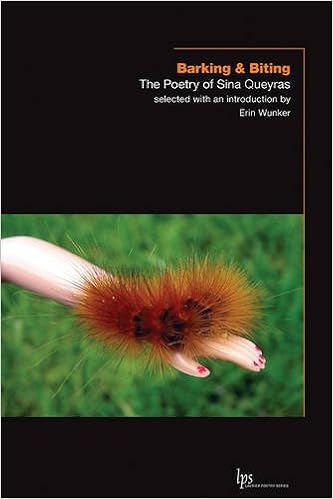
Barking & Biting - Sina Queyras (Wilfrid Laurier University Press)

Today's book of poetry:
Barking & Biting.  Sina Queyras.  Selected and with an introduction by Erin Wunker.  Laurier Poetry Series.  Wilfrid Laurier University Press.  Waterloo, Ontario.  2016.


"I am not interested in other words for honey. I am interested in honey."
      - Sina Queyras, "Water, Water Everywhere"

Queyras wants to be clear and she is.  This is a straight shot across the bow, full of intent.

Today's book of poetry likes a list poem and Sina Queyras gives us a lemon-tart sparkler with "If Only."  Poetry this smart is always going to turn heads and if Queyras has her way those heads will be more sympathetic, empathetic, reasonable.

If Only

If only men were more feminine. If only Judaism were
more feminine. If only industry were more feminine.
If only bridges were more feminine. If only trucks
were more feminine. If only airplanes were more
feminine. If only fruit were more feminine. If only
engines were more feminine. If only economics were
more feminine. If only test tubes were more femi-
nine. If only physicists were more feminine. If only
space were more feminine. If only Hollywood were
more feminine. If only America were more feminine.
If only farmyards were more feminine. If only the
weather were more feminine. If only Islam were more
feminine. If only engineers were more feminine. If
only city planners were more feminine. If only femi-
nists were more feminine. If only Catholicism were
more feminine. If only politicians were more femi-
nine. If only astronauts were more feminine. If only
corporations were more feminine. If only women
were more feminine. If only what was feminine were
firm. If only there were slots. If only things fit inside.

...

Barking & Biting is a tasting menu of sorts brought to you courtesy of the deft hand of Erin Wunker. Wunker's choices nip and tuck from some much longer works to bring us surprisingly self contained poetic essays on gender with both Holly Golightly and Virginia Woolf among the cast of luminaries.

And exactly as a tasting menu should, these bites leave us wanting more.

Sina Queyras writes poems that evolve in front of your eyes, they play with being short stories, novellas, epic.  Queyras has much to say about gender in these poems and her articulate charms add gravitas but never vitriol.

From Meanwhile, elsewhere, otherwise
     "Some other poets and the puddle"

          'When for no reason I could discover, every-
           thing suddenly became unreal.'
                                                              Virginia Woolf

She didn't notice the puddle. She was busy unravel-
ling the pavement. She clip-clopped past. She had
serious business. The words in her head were pleas-
ing her. She liked the sun. The smell of meat sizzling
called out to her. Language needed to be parted,
ordered. The children irritated her as they played in the
puddle. They were noisy. It was not her business.
There were no books in the playground, but there
were shapes to things. Sentences combusted. No
one recognizes. The words in her head grew cold.
They needed a rest. Her feet had an idea. She
thought they meant business. She saw herself in
everything and everything was good.

She saw the puddle as pewter. She swallowed it sweet
as figs. She saw it nestled in the cleavage of plum
girls. She held them over her head and cracked their
legs.

She saw the universe in the puddle. She saw a slide
show of organic compounds. She saw the key and 
the key fit. She saw the genital-less amoeba as a
hero. She put her ear to the puddle but she was no
naive child; she was listening for the rumble of
trucks, not the sweet musing of water beetles.

She waited until winter and when the puddle froze
over, she glided across it. She sat in the summer heat
and was content. She lifted the puddle and slid it
down her arm like pancake. She invited a girl gang
over and drank it. She had no puddles on her street.
She had no street. She leapt over the puddle on
horseback in pursuit. She saw streams of Nazis skim-
ming book black across the surface. She thought she
heard the apostles and so kneeled down to pee. She
dove in, scraping her nose. She had her father drain
all the puddles in the village. She splashed. She leapt
and bombed it with rocks. She floated and toppled
heads of Barbie dolls. She walked around. Then she
walked around again. She heard men flinging mud
and arranged a blanket of oak leaves across the
surface. She did a cartwheel. She knit a scarf out of
the letters R and E which she wound round and
round and round.

...

Queyras comes up with a phrase that Today's book of poetry has never encountered before when she says that "Lyric Conceptualism's goal is to create openings rather than closures."  This quote from the Sira Queyras poem Afterward: Lyric Conceptualism, A Manifesto in Progress is a succinct summation of the idea of these poems.  But it doesn't quite address the feeling that they create, this feels like a conversation that all are welcomed to listen to.  As robustly feminist as Queyras can quite rightly be, there is no matriarchal man-bashing, compassionate intelligence reigns here.

Kathleen, our Jr. Editor, took control of this morning's reading and made sure to include everyone.   Sina Queyras sailed around the room and over our heads like a wise hot-air balloon.

Proverbs of Hell

The body sublime, the heart SUV.
Fuel your plow with the blood of war.
Drive your car on the bones of the dead.
The road of CO2S leads to rising seas.
He who is preoccupied with the afterlife pisses on the present.
So the price of oil goes, so goes the number of wars.
A fool sees product; a wise man sees shade.
He who sullies the earth sullies himself; he who dulls the sun
     dulls his senses.
The future is the reversal of destruction.
Even a bee's too busy.
Profits are measure by the dollar, but read profit cannot be
     measured.
A wholesome food comes in fewer than sixteen pieces from
     seven states.

Prisons are built with the bricks of luxury items.

Let man wear the fell of the hemp see, woman the fleece of
     cotton.
The bird a thought, the spider a path, the mind the means.

What was once proved and known is now only rarely imagined.
What was once used to imagine now operates software.
The rat, the mouse, the starling, the squirrel; the lion, the
     tyger, the elephant, the whale -- only the useless, or root
     less, survive, otherwise; extinction porn.
The cistern pollutes, the fountain overflows, is of no use to
     itself.
Once thought filled immensity; now it purchases goods.
To speak your mind is to be unpatriotic; to be human, then,
     is to be unpatriotic.
All things imagined must be images of truth; all things
     created must be fragments of our imagination.

The eagle never wreaked so much havoc as when he
     submitted to the whims of profit.
The eagle provides for himself, but the air provides for the
     eagle.
Want in the morning. Buy at noon. Buy in the evening. Buy
     in your sleep.
He who has suffered you to impose on him knows the market.
As the plow follows the markets, so the market follows itself.
The tygers of the market are no wilier than the corporate dogs.
Expect poison form the standing mind.
The coals of Wall Street, the bricks of despair, the last drop,
     the last grain.
As the cat chooses the warmest place to curl her bones so the
     wise man seeks home.
To create a new kind of flower is the splice of genes.
The best wine is the oldest, the best thought is the first.
Cheerfulness is the hammer of the right.

The expressway is a straight line, but the crooked road
     remains the road of genius.

Where man is, nature is bereft.
Where nature is not man, is not known.
Where nature is not natural, man is not man.

As a dog returns to his vomit, so a citizen to his belief in
     separation.
More is destruction.
Less is the wisdom of the future.
Abundance is all context.
The end of thought is the end of man is the end of earth.
In absentia, in absence, in obsolesce, or obnoxious.
Where nature is, man is not enough.
Enough, or too much. Too much.

Go forth and undo harm.

Go forth and do.

...

How's that for a taste of the menu.  Queyras bounces around ideas like cartwheeling jackhammer.

Barking & Biting is the first poetry by Queyras that Today's book of poetry has encountered but we'll certainly be searching for her others now.

Sina Queyras

ABOUT THE AUTHOR
Sina Queyras is an accomplished poet and essayist. She edited the first anthology of Canadian poetry published by an American press (Open Field: 30 Contemporary Canadian Poets). Between 2005 and 2007 she co-curated the path-breaking feminist Belladonna* reading series in New York and was instrumental in bringing Canadian and American poets into conversation. She has published six books of poetry and a novel, Autobiography of Childhood (2011). She received the Pat Lowther Award and a Lambda Literary Award for Lemon Hound (2006). Her most recent book of poetry is MxT (2014).


ABOUT THE EDITOR
Erin Wunker is the chair of the board of the national non-profit social justice organization Canadian Women in the Literary Arts (CWILA) and co-founder, writer, and managing editor of the feminist academic blog Hook and Eye: Fast Feminism, Slow Academe. She teaches Canadian literature and culture at Dalhousie University. Her book The Feminist Killjoy Handbook will be published in the fall of 2016.

Sina Queyras

This video is from Fred Wah's Parlimentary Poet Laureate Series.


482
DISCLAIMERS

Poems cited here are assumed to be under copyright by the poet and/or publisher.  They are shown here for publicity and review purposes.  For any other kind of re-use of these poems, please contact the listed publishers for permission.

We here at TBOP are technically deficient and rely on our bashful Milo to fix everything.  We received notice from Google that we were using "cookies"
and that for our readers in Europe there had to be notification of the use of those "cookies.  Please be aware that TBOP may employ the use of some "cookies" (whatever they are) and you should take that into consideration.