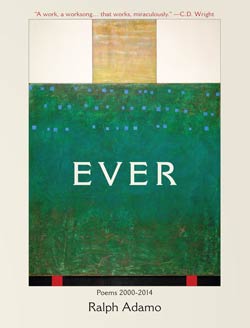
Ever - Poems 2000-2014. Ralph Adamo. Lavender Ink. New Orleans, Louisiana. 2014.
Ralph Adamo talks a damned good line in Ever. His long prose-poem "Solecisms" starts with this hammer throw:
"Although we have no right to hurt one another this poem yanks you out of your chair with
one hand and slaps you silly with the other all the while saying see it didn't have to come to
this we could have chosen justice over property, the heart's idea of what's right over the idea
formed when two heads or more get together and make a plan."
He says it right out loud, we don't mean to hurt one another but we do anyway. Adams tackles all the big subjects with vigour. These poems are searching for more understanding, more humanity.
Epilogical
The ruined body excites the ruined mind.
Or anyway that's today's de(layed) construction
of an old ache in which the bent form struggles
to reveal its cancelations (or conceal its
revelations), I'm all in, twisted to the core the other
being inglory, a retching from the center of my earth.
I dive divine into the end of things she dis-
plays, lewd an anterior lead is all, and then--
oh, I am over god, except for sentiment.
Begin again where things once thought
now rattle...you learn to tell yourself
be quiet, especially when you are
screaming...bad listener, you, hearing
it all. The form relays herself.
Each dying day recombines, a
light, breeze, you whom I am granted,
I'd break this face wide open if I could.
...
Today's book of poetry is fairly certain that Ever is Adamo opening up his rather rich veins in an attempt to understand war, wonder and the weary weight the world bestows on hope.
Adamo's poems have weight, literally, the books feels heavy and dense in your hands. The poems are easy to enter but hard to leave. His voice in these poems is always considered but never pompous enough to pretend to be clairvoyant. Adamo is strong enough to pose questions without necessarily having any answer. Adamo is searching for more, let us say that he is searching for the truth.
The Forgetting
The forgetting is ferocious and takes
all my time. In the whatevereth year
this is time stands me up as always
with a kick to the groin, as if I'd
made this plan in the beginning:
be lost in fullness, found without--
The words I carry now are so heavy
I fear that I will fall down and -- boom!--
will disappear, my moods in wild disorder
staring at the old goddamned moon again an equal--
forty years I had not read her inscription.
What was I waiting for?
Joy surprises the way love incorporates
there it is -- two colors muting, the sounding
interior shade, the loosened lip, shred
of the lost world the dream wakes up in.
Suffused in a glow of pre-happines,
I read my friend's book in bed, and
one night woke to a sky-full of geese honking
for the long time of being startled, then
amazed. You ask me even now I'll
admit I was worried, afraid, dread layered
on the ecstatic idea of happiness sus-
tained my new routines, but my heart
hurt deep in my chest, for real,
so I could feel each breath for weeks.
I wouldn't know how to live here
in a country like this where the sky
is everywhere like a flute below ground
unholy ticking, sharp sigh moistening,
stared down by an infant in a bakery,
I wonder where the string ends, my
luminous luck soft-headed as a teddy.
I throw up my hands light dripping,
a hundred books later, and after,
the song delight designed away again,
wanting to come to, wanting an end
to, coming to want for the love of it.
***
When S died I was beside myself
grieving, amazed, bereft, untouched.
When is it one learns to be careful?
almost from the first and never.
***
and now I've started repeating the names of the dead
to myself, in my mind, over and again, I think so
I won't forget which ones are dead and that they are,
not always starting from any beginning or with the same
name, but always a name -- the new ones sometimes first, so
Dusty, but then Russ, and Mary my own sister and Susan...
Robert who was crazy, Bob Woolf, imagined speaking
in my memory of him, Russ too, speaking, not Bob (Robert, in
this confusion of Bobs) who comes to me gazing,
a little wildly, as if in fatal knowledge sworn to
secrecy, Susan not speaking but always with a start somewhere deeper --
oh I haven't run out of them just sometimes they
repeat -- Maxine, and her Joe, wise from having had to let go
so long before, a young soldier in a giant war outliving, outliving
-- and so it is sometimes I know there's one I'm not recalling,
not the past -- Frank, or my father (Joe too, Joseph, whose people called
him Joey), go back too far and the other side of death appears, so
maybe I repeat and recall to keep the bloom clear death stalks...
did I forget yet, Everette whom all call Rette? who else
out there needs is or her name called? I am on duty until...
Brian! I forgot you! Others, speak --
***
We've all seen through everything by now haven't we?
Love, certainly, no matter how the residue stings. Death
we'd like to think, But work! oh, especially that --
I was startled thirty years ago to hear my father
on his deathbed, say -- a mix of irritation & awe here--
you and your friends, too smart to work...
***
still possible to overwhelm the odds
with oddities he thinks
***
The freight on waiting's heavy
The wait's a stretch, too long
to keep the garden thriving,
fish and fuel and song
arrival and depart(ure)
domestic to denature
such waiting wears a ring
fire can't climb, lives within
an estuary broken on a levee.
***
We have no way of explaining death, do we,
no protection from it, we who have understood
god's place as a romantic figure from
a foregone age -- no one to whom to drag
our broken bodies, no place to lie still
and wait --
...
Searching for the truth is one hard ask. Adamo is searching for more and that may be the most admirable reason to write poems.
Nancy Lemann, the author of Lives of the Saints had this to say about Ralph Adamo's Ever:
"Reading Ralph Adamo's poetry puts you in a country brooding world where the
truth comes driving through the gloom like elegance."
Like she said.
Pluralities
I hate that you are on the other side this evening
If I go somewhere to cry for you how will I stop
I hope this finds you well, It's been too long,
I typed when you were already gone.
Listening to you talk
over there is like
listening to water
I compose
you are here
music breaking whitely
one track crossing over another
to reach disaster
Shooed from the blues I stand
against one breeze
and feel the summer's cascade
buggy and wet in my blood
I a sunken man with an old nose and long eyes
wind-shredded
used to the way little becomes less
unprepared for bounty
whittling sorrow down to its toothsome size
***
The little house of my dead first wife
blows me a kiss as I go past
on wheels, the sidewalk cracks
one more lame joke to boot, and
then I am on the other side, again.
...
Sometimes Today's book of poetry has the best job in the world and sometimes it is the saddest. Reading Ralph Adamo's Ever is a visit to a sage uncle who has seen more of the world than you.
The answers aren't necessarily his domain, but oh, he asks a lovely question, muses with saintly illumination.
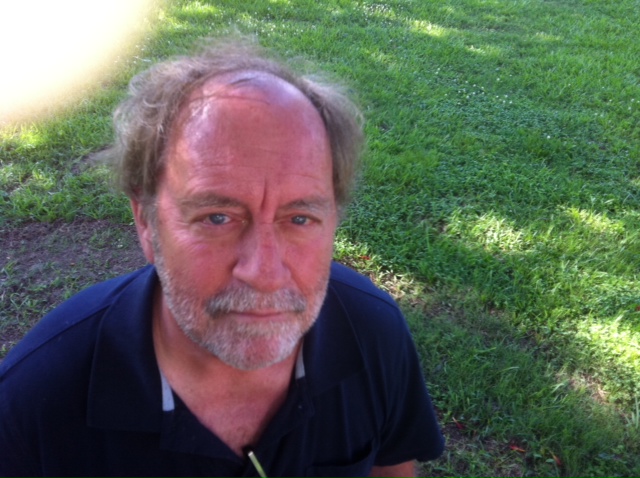
Ralph Adamo
Photo: Camille Bullock
ABOUT THE AUTHOR
A lifelong resident of New Orleans, Ralph Adamo has published six collections of poetry, most recently Waterblind: New and Selected Poems from Portals Press (2002). His book Sadness At the Private University was among the first six published by Lost Roads Publishers in 1977; his book-length poem Desire, Death, All of Them (formerly titled The Bicameralization) is seeking a publisher. Adamo edited New Orleans Review at Loyola University for most of the 90s; he teaches at LSU and Tulane Universities and at the New Orleans Center for Creative Arts Academy. He and his wife Kay have a two-year old son, Jack, and an infant daughter, Lily. - See more at: http://arts.gov/writers-corner/bio/ralph-adamo#thash.CmbITq3c.dpuf
BLURBS
An I relays the story in its not-story way. With traces of story. The sound is uniquely of its city in a nearly, not-named way. Attuned to its humidfied breezes and the fan blade’s indispensable turning. Home is the sole locale, the nucleus, ever so. The voice struggles ‘to end its own noise,’ not to inventory only regrets and losses, rattled and battered; cycling through the dead, friends and kin, pictures, ‘the stalactites of memory’ and bars in which years must have passed, stumbled through, a survivor, “godly,/of one mind, learning too late whatever/was on offer, outlasting fabulous destinies…” A work, a worksong, not of an illusory life, but of a life, in a body, a family, on wheels, rubber-side down, that works, miraculously.
—C.D. Wright, author of One With Others, National Book Critics Circle Award winner.
Ralph Adamo has lived his three-score-plus years in New Orleans. To say that the poems in Ever are about that city of the dead, the dying, and the coming-to-be would be a great disservice. These are the poems of man who has become his city. To be sure, the jazz, the floods, the drunks, and the turbulence of despair are here, but they exist in the words of one who has absorbed them into himself. If “the blinked-smile the non-survivor wears / toward peace” describes one overwhelmed by it all, Adamo, ever looking forward, brings comfort, like words whispered in the ear of a drowsy child.
—R.S. (Sam) Gwynn, author of No Word of Farewell: Poems 1970-2000.
Reading Ralph Adamo’s poetry puts you in a courtly brooding world where the truth comes driving through the gloom like elegance. You picture him “standing absolutely motionless at a slight angle to the universe,” as E.M. Forster described Cavafy.
—Nancy Lemann, author of Lives of the Saints and Ritz of the Bayou.
For more than forty years, while “arguing words against / The constant threat: forgetting,” Ralph Adamo has published poems as original as any I know. In his seventh collection, Ever, in which sometimes “a word is as far from a fact / as fever can burn it,” a speaker whittles “the little lies down to / The nuance of perfect teeth in a closed mouth.” Another speaker whispers to his young children, “My children are exhausting” and “’riddle’ means ‘dark language’” in order to help spirit them to bed. In another poem, retrospection makes a speaker “sag like an old bookshelf and sigh like the door beyond it.” And in another, a speaker prays for adolescent boys in their lostness—“world without hearing, amen.” Such phrasings hint at greater recognitions to come—for instance, that poetry is “just listening to the world.” What may be most original and satisfying about the thirteen years of poems in Ever is that reading and rereading them is to experience the art and diverse craft of a master, one who would wince at the accolade and never accept it.
—Randy Bates, author of Rings: On the Life and Family of a Southern Fighter.
In Ever, Ralph Adamo has focused his poetic lens on the small moments that make life bittersweet and profound. Whether he is describing the banter of children at play or words uttered on a deathbed, Adamo puts the reader in the room and hands him a magnifying glass. The poet is asking us to watch life closely as it swiftly passes.
He gives very specific metaphors of pain, familiar to any New Orleanian “like stinging caterpillars down from ghostly cocoons en masse to prey on the bare feet of us all.” The book contains many precisely chosen words and well-considered passages. But he also offers some less concrete, more esoteric and slightly sardonic observations “Some things have always fallen through time and space to land god knows where.”
Adamo writes confidently about the value in dysfunction and skeptically about pure redemption. “I was going to get older someday. I was going to blame somebody.” Sometimes the work seems so personal that it should be reworked in the reader’s mind. In “Visiting the Marker, After the Flood,” the narrator asks “What did you expect to happen clawing through the chicken wire at the top of the 20th century.” To understand this poem about death and life, the reader must step back and watch the words flow past.
Adamo’s narrator laments the people who have disappeared without ceremony. He names them in a list broken by undisguised feelings – among them that he cannot properly remember all the names. But the spirits of the dead emerge and disappear throughout the book, allowing readers the experience of tangible and fleeting memories too.
Written in dense beautiful language, Ever is about temporal, conscious and self-conscious experiences. UnderlyingEver is a question of whether we will find the perfect afterlife. This is a book without any neat, simple answers. Still, Adamo seems to be telling us that happily ever after, our Ever, is here.
—Fatima Shaik, author of Melitte and On Mardi Gras Day.
Ralph Adamo has lived his three-score-plus years in New Orleans. To say that the poems in Ever are about that city of the dead, the dying, and the coming-to-be would be a great disservice. These are the poems of man who has become his city. To be sure, the jazz, the floods, the drunks, and the turbulence of despair are here, but they exist in the words of one who has absorbed them into himself. If “the blinked-smile the non-survivor wears / toward peace” describes one overwhelmed by it all, Adamo, ever looking forward, brings comfort, like words whispered in the ear of a drowsy child.
—R.S. (Sam) Gwynn, author of No Word of Farewell: Poems 1970-2000.
Reading Ralph Adamo’s poetry puts you in a courtly brooding world where the truth comes driving through the gloom like elegance. You picture him “standing absolutely motionless at a slight angle to the universe,” as E.M. Forster described Cavafy.
—Nancy Lemann, author of Lives of the Saints and Ritz of the Bayou.
For more than forty years, while “arguing words against / The constant threat: forgetting,” Ralph Adamo has published poems as original as any I know. In his seventh collection, Ever, in which sometimes “a word is as far from a fact / as fever can burn it,” a speaker whittles “the little lies down to / The nuance of perfect teeth in a closed mouth.” Another speaker whispers to his young children, “My children are exhausting” and “’riddle’ means ‘dark language’” in order to help spirit them to bed. In another poem, retrospection makes a speaker “sag like an old bookshelf and sigh like the door beyond it.” And in another, a speaker prays for adolescent boys in their lostness—“world without hearing, amen.” Such phrasings hint at greater recognitions to come—for instance, that poetry is “just listening to the world.” What may be most original and satisfying about the thirteen years of poems in Ever is that reading and rereading them is to experience the art and diverse craft of a master, one who would wince at the accolade and never accept it.
—Randy Bates, author of Rings: On the Life and Family of a Southern Fighter.
In Ever, Ralph Adamo has focused his poetic lens on the small moments that make life bittersweet and profound. Whether he is describing the banter of children at play or words uttered on a deathbed, Adamo puts the reader in the room and hands him a magnifying glass. The poet is asking us to watch life closely as it swiftly passes.
He gives very specific metaphors of pain, familiar to any New Orleanian “like stinging caterpillars down from ghostly cocoons en masse to prey on the bare feet of us all.” The book contains many precisely chosen words and well-considered passages. But he also offers some less concrete, more esoteric and slightly sardonic observations “Some things have always fallen through time and space to land god knows where.”
Adamo writes confidently about the value in dysfunction and skeptically about pure redemption. “I was going to get older someday. I was going to blame somebody.” Sometimes the work seems so personal that it should be reworked in the reader’s mind. In “Visiting the Marker, After the Flood,” the narrator asks “What did you expect to happen clawing through the chicken wire at the top of the 20th century.” To understand this poem about death and life, the reader must step back and watch the words flow past.
Adamo’s narrator laments the people who have disappeared without ceremony. He names them in a list broken by undisguised feelings – among them that he cannot properly remember all the names. But the spirits of the dead emerge and disappear throughout the book, allowing readers the experience of tangible and fleeting memories too.
Written in dense beautiful language, Ever is about temporal, conscious and self-conscious experiences. UnderlyingEver is a question of whether we will find the perfect afterlife. This is a book without any neat, simple answers. Still, Adamo seems to be telling us that happily ever after, our Ever, is here.
—Fatima Shaik, author of Melitte and On Mardi Gras Day.
373
DISCLAIMERS
Poems cited here are assumed to be under copyright by the poet and/or publisher. They are shown here for publicity and review purposes. For any other kind of re-use of these poems, please contact the listed publishers for permission.
We here at TBOP are technically deficient and rely on our bashful Milo to fix everything. We received notice from Google that we were using "cookies"
and that for our readers in Europe there had to be notification of the use of those "cookies. Please be aware that TBOP may employ the use of some "cookies" (whatever they are) and you should take that into consideration.