Showing posts with label sixteen rivers press. Show all posts

Monday, March 4, 2019

The Language of Forgetting - Lynne Knight (Sixteen Rivers Press)

Today's book of poetry:
The Language of Forgetting.  Lynne Knight.  Sixteen Rivers Press.  San Francisco, California.  2018.


The Language of Forgetting is the second book by Lynne Knight that Today's book of poetry has had the pleasure of introducing to our loyal readers.  Back in January of 2017 today's book of poetry wrote about Knight's The Persistence of Longing (Terrapin Books, 2016).  You can read about that here:


In The Language of Forgetting Lynne Knight gives us four distinct groupings of her poems.  In the first of these the trauma and tedium of an alcoholic father, bellicose with grand dreams but never able to manage the climb out of the bottle, haunts Knight's childhood.  In another section of poems Knight bares witness, watches slowly while her mother loses her mind.  Knight wrestles with the relationship she has with her mother, the relationships she has with her sister, with the past and so on.

Closing out this ferocious gathering of formidable poems, in the fourth part of The Language of Feeling, Lynne Knight trods happier geography, losing herself in the canvases and intrigues of great painters, great paintings, and an almost pastoral beauty.

My Father's House

I was one of the black-hearted ones, my father said,
a Protestant whom they would try to proselytize,
thumping his dictionary like the Bible it was
to him, warning me not to be seduced by the robes
and glories, the incense and beautiful words.
But the gold and smoke, the brocade the murmurs
as penitents knocked at their hearts to open
the door to mercy, forgiveness—who could resist
such pageantry? The chapel walls were painted mauve,
and during Lent, with all the saints and the Virgin
draped in purple cloth, it seemed some elaborate
fashion show was about to begin. Heretical
to think, my father said. No doubt the nuns saw
my dereliction [more thumping] and were contriving
immediate conversion. I was not to let my guard down.

But God was my guard, and the hosts of angels
ready to descend and save my wayward soul,
I would think on my way to school, bantering
like a normal girl on the five-mile bus ride,
but all the while thinking this might be the day
the chapel wall opened and Christ stepped through
in a blaze of light to save me, and everybody
would see, and fame would come, and the dirt
floor under the sofa where I sat while my father
explained the world would vanish into carpet
walls, heat: the finished house of my father.

But my father's house was all words. Make a bed
of words to lie down in. Make a floor of words
to stand on. Make a faith of words that nothing
would betray—not his drunken promises,
not his blueprints untouched under ash and dust.
Make a hope of words, the start of forgiving.

πŸ’«πŸ’«πŸ’«

Knight knows how to pull the line tight, wring out the water.  Her memory may be eidetic.  Each and every detail dovetailed and polished until the truth gleams.  The reader is quenched and then curious again as The Language of Forgetting reveals that it is all about memory.

Every word.

What a Shame

As my mother lost more of her mind, shame
stood at the door like a beggar or prince:
she couldn't distinguish. She knew only Hide.
So she hid, turning her face into a mask,
shoved her hearing aid into a sock shoved
far back in a drawer, burying her leg brace
under fallen skirts in her overcrowded closet.
Those thieves, she said from behind the mask
while I searched for the hearing aid, brace.

Then disdain fled with the crows she'd seen
on the counter when she went to make her lunch.
You don't make your own lunch, I would say. You go
to the dining room. She sat: scared rabbit mask, now.
Don't let it hurt me! her shallow breath pleaded,
though she made no sound approaching words.

I pretend none of this was happening to her.
To me. Then one day I came to visit and opened
the door to the stink of shit. In the night
she'd had an attack of diarrhea but couldn't find
the bathroom. She'd run everywhere, hunting.

It's all right, I said after cleaning the mess,
bathing her. It's all right. I was tying her
shoes, kneeling before her. She leaned close.
In the two or three seconds she was herself again,
she whispered, Liar. So I saw what I owed her.
Shame, whether beggar or prince, had no claim
to her door. What was happening to her could be
happening to anyone. And was. And is.

πŸ’«πŸ’«πŸ’«

Today's book of poetry would like to take this opportunity to thank Nick Hesslier and Tina St. John for hosting a reading for me and Deanne Young in their home last weekend.  Their home in Vanier lends itself so comfortably to both the reader and the audience.  Reading to a crowd in a private home lends a different sort of intimacy to both the poem and the audience.  The very warm response Deanna and I received was enough to restore ones faith in the power of poetry.  Nick and Tina made us and everyone else feel at home and I can't thank them enough.

One more sidebar.  Today's book of poetry (me, Michael Dennis), just finished a project many years in the making.  Today's book of poetry joined forces with the most excellent Stuart Ross and after several meetings over several years we finally finished our manuscript 70 Kippers.  We took turns writing the lines and the result is dangerous whimsy.   Any publisher interested in seeing the manuscript can contact either Stuart Ross of Michael Dennis through this blog.

Back to Ms. Knight.  Today's book of poetry is happy to have an encore performance by Lynne Knight.  She has heart, her poems are clean and ring true.  That combination is always going to produce fine poems.  The poems in both of Knight's books that Today's book of poetry has read are instantly engaging, inviting even.  Knight doesn't speak down to the reader, but looks the reader right in the eye.

After Seeing Wolf Kahn's
"Sundrenched Barn IV"

Just to say the words, sundrenched barn,
makes me long for those summers when
all we did was be young, untroubled
by identity, the body just the body
the way the barn was just the barn,
forbidden because it might combust
those hot July days when we climbed in
anyway through the small back window
to leap and leap into the choking hay.
But I don't want to reproduce my story.
It's anybody's barn. It's almost on fire,
the sun's so bright, like the body
walking a country road, the orchard
sweet with fruit, the barn rising suddenly
on the horizon, a second sun, and night
nowhere to be seen—the whole idea
of dark so beautifully, hotly impossible.

πŸ’«πŸ’«πŸ’«


Today's book of poetry is looking for some new staff and are open to suggestions.  All we do all day is lounge around and read poetry, argue about poetry, read some more.

Lynne Knight is getting to be a known name around these parts and for all the right reasons.  The Language of Forgetting will taunt, tickle and torment.  Perfect.


Lynne Knight

Lynne Knight

ABOUT THE AUTHOR
Lynne Knight’s previous collections are Dissolving Borders (Quarterly Review of Literature), The Book of Common Betrayals (Bear Star Press), and Night in the Shape of a Mirror (David Robert Books) and The Persistence of Longing (Terrapin Press, 2016), plus three award-winning chapbooks. Her cycle of poems on Impressionist winter paintings, Snow Effects (Small Poetry Press), has been translated into French by Nicole Courtet. Knight’s work has appeared in Best American Poetry 2000, and her awards include a Theodore Roethke Award from Poetry Northwest, a Lucille Medwick Memorial Award from the Poetry Society of America, and an NEA grant.

BLURBS
Lynne Knight’s mindful, lyrical book reads like a heart-and-soul video, Season One. Her poetry thrills and intrigues, warns and shares, always in language that catches.
     —Al Young

The Language of Forgetting
is inspired by a fascination with the accumulated secrets lying under the many stories of a lived life. This is thriving, memorable poetry. 
     —Forrest Hamer


Poetry at the Albany Library - Lynne Knight - April 11, 2017
Video: AlbanyKALB


741
DISCLAIMERS

Poems cited here are assumed to be under copyright by the poet and/or publisher.  They are shown here for publicity and review purposes.  For any other kind of re-use of these poems, please contact the listed publishers for permission.
We here at TBOP are technically deficient and rely on our bashful Milo to fix everything.  We received notice from Google that we were using "cookies"
and that for our readers in Europe there had to be notification of the use of those "cookies.  Please be aware that TBOP may employ the use of some "cookies" (whatever they are) and you should take that into consideration

Wednesday, November 15, 2017

This Sweet Haphazard - Gillian Wegener (Sixteen Rivers Press)

Today's book of poetry:
This Sweet Haphazard.  Gillian Wegener.  Sixteen Rivers Press. 
San Francisco, California.  2017.


These remarkable poems seem to do two things at once, they gently reassure you that all will eventually be okay, until it's not.  Gillian Wegener's This Sweet Haphazard plays both ends against the middle as though she were a rationalizing mall-mom, but dressed like a gun-slinger underneath.

Or we can approach This Sweet Haphazard this way.  How does Wegener know what she knows?  The precision of her approach, how a neighbour who doesn't want to rock the boat by telling her firework-crazy neighbour that she hates fireworks.  Only to find herself pleasurably lost in the beauty of same, the final spectacle spectacular and Wegener finds the beauty.  And then to fold that like taffy, Wegener twists to the real end of the poem where accuracy takes over and the smoke and the dust from the fireworks obscure the real beauty of the night sky, all those stars burning bright.  Wegener pulls off this sort of savvy machination repeatedly, seemingly at will.

America by Train

America passes by the window like a set of slides being shown too fast.  Here are
the desert scenes with long stretches of blank landscape, but you know that it's 
all in the details. How the gray-green cactus will open up the most beautiful pink
flower for just one day, but you'll never see that flower from this train window.
How the lizard will wait on its rock for the unfortunate cricket to land and
become a tiny meal. You won't hear the screech of the hawk welcoming sunset
or see the startle of the mouse in hearing that cry. What you can see is brown
and gray and vaguely green, with the wide, darkening sky overhead, and it's like
holding a book you know will be a good read but that you aren't allowed to open.
      But here are the passengers, their unchosen details out for display. The
man and wife who argue about every little thing in hard whispers and then
in loud voices, not quite shouts, not much softer, but not really meant for
the entire car to hear. She has something to say about how he shaves. He has
something to say about the way she cooks turkey. She is wearing a yellow hat
fifty years too late for yellow hats with small cloth daisies, and he has a cane
that he whittled himself, and they are going from Bakersfield to Kansas to see
her sister. He has something to say about that, too. Another passenger peels
an orange, and another says he was attacked by dogs in Indonesia and is going
home to get treatment, but the sores on his arms and face don't speak of dogs,
and the gloss of fever means everyone for the most part leaves him alone, and
what he wants most is a mug of tea, but because he is so tired, he decides to wait
it out. Another passenger walks ahead for a smoke. A baby sleeps on her father's
shoulder. The conductor reads a magazine and wishes he were elsewhere.
      And America passes by like that in the night, when the windows show
nothing but passenger reflections. It becomes New Mexico. It becomes
Oklahoma. It becomes a train moving through a world made up of nothing
but darkness punctuated by the little comma moon overhead. It becomes
a train standing still as the world moves past. The arguing couple grows
quiet, her head on his shoulder. The feverish boy sleeps and murmurs
with feverish dreams. The baby is awake and watching her own reflection
in the window, waving at her sweet new self as the night folds around us.

...

Well crafted almost sounds disparaging these days but Today's book of poetry still thinks that's how things should be done.  Gillian Wegener's poems are air-tight.

Frequent readers of Today's book of poetry will remember that we are suckers for a good list poem and Wegener obliges in fine form with a dandy, "The Old Mill Cafe."  Today's book of poetry would normally use it for fodder but frankly we were so smitten with Wegener's particular disposition that we were drawn to several other poems.  You meet women like Wegener every day, smart, decisive and decidedly kind and gentle (when she wants to be).  The wrong assumption that is often made is that these attributes reveal a weakness of some kind.  But the real lion doesn't always have to prove herself to be a lion.  She just is.  She can be as kind and gentle as needed.  Until she has to be that other kind of lion.

The Dyerville Giant

When a tree falls in a forest,
a tree like that, anyway,
with all those years ringing it,
having sprouted out of the soft earth
before Jesus was even a spark
in his Father's bright eye --
when a tree like that falls,
it cracks and echoes so that
even the gnats careening
in the sun near the creek
take pause. And when this tree
fell, the crash was like trains colliding.
The ground inhaled and held
its breath, waiting for impact.
The sound rolled through the forest
and made salamanders hide
in their damp burrows. It thundered
like a train wreck, and so
the townsfolk drove out
to the trestle to see the havoc,
while the fine silt of redwoods
rose and then settled
in the forest behind them.

...

Today's book of poetry's morning read was a slightly more subdued event than some of our recent escapades.  Milo, our head tech, and Kathryn, our Jr. Editor, apparently drank all of the Scotch in Vanier last night.  Their little wounded souls are being dragged around the office today like corpses with open wounds.  Neither of them appreciated this morning's Ornette Coleman concert over the office box.  His ground breaking saxophone and disharmonic reverberations were beyond their reason.  They didn't enjoy it at all.

Our reading was without musical accompaniment and Gillian Wegener's particularly humane kick at the proverbial can helped Milo and Kathryn see some light on the horizon through their caked and crusty eye-slits.  If for no other reason than they could see kindness still existed in the world at large.

This Sweet Haphazard

No one calls this town pretty.
Not with the dusty oleanders off the freeway
and the ragged fence boards of backyards
propped up with two-by-fours, and
the canals with their twin likes of slow and safe,
and the ash trees, dead branches dangling, and
the large, pale no-one's-home houses and
the foreclosed houses and the small houses
with their carefully tended geranium borders,
with the plum trees gone overripe and sticky.
No one calls this town pretty, with the heat
rippling of the parking lots and the sighs
of aunts and uncles sitting in the shade of garages
filled with cars that were once meant to go places,
and the church marquee scolding that
Jesus Did Not Read Porn, and the swarms
of mosquitoes buzzing the standing water
from the leaking sprinkler heads in the park.
And yeah, no one calls this town pretty
as the creek laps at its share of shopping carts,
and the untended grasses bleach dry by April,
and the public pools are mostly closed,
but the sky here turns indigo on summer nights,
and the hummingbird chases the sparrow
from the feeder, and the kids on the soccer field
run as fast as kids anywhere, oblivious
to the town around then, because after all,
it isn't so bad. It's an okay town.
We know where all the roads go,
and we know where to get good coffee,
and we know what time the train pulls through.
We know too we're more than soil, more than sky,
more than what you've read in the news,
and no, it isn't pretty, but we still live here, and
tonight the moon will rise, almost full,
over this sweet haphazard of home.

...

Gillian Wegener's long poem "Neighborhood" sounds a bit like every neighbourhood on earth from Minneapolis to Moscow, and from Houston to Helsinki.  Today's book of poetry felt a bit like going home when reading This Sweet Haphazard.  Not a home we've ever had but a place we'd like to be.

Gillian Wegener cooks.  Her sound reason gives us hope.

Gillian Wegener

ABOUT THE AUTHOR
Gillian Wegener is the author of three books of poetry: a chapbook, Lifting One Foot, Lifting the Other (In the Grove Press, 2001), and a full-length collection, The Opposite of Clairvoyance (Sixteen Rivers Press, 2008), and her new collection, This Sweet Haphazard (Sixteen Rivers Press, 2017). Widely published, she has won several awards for her work, including the Dorothy Sargent Rosenberg Poetry Prize in 2006 and 2007, and the ZΓ³calo Public Square Prize for Poetry of Place in 2015. Wegener, a junior high teacher, lives with her husband and daughter in Modesto, where she coordinates and hosts the monthly Second Tuesday Reading Series. She is a cofounder of the Modesto-Stanislaus Poetry Center and has served as the poet laureate for the city of Modesto.

BLURBS
“In This Sweet Haphazard, Gillian Wegener turns her well-tuned ear, her sharp eye, and her considerable intelligence and humor to the California of lightning fires, bulldozed almond trees, and murky rivers with unpredictable currents, as well as that of clear desert night skies, foggy coastlines, and the green light that filters through the sequoias. She sees the beauty and melancholy all around her, and she approaches it with tenderness and without aesthetic pretension. This is a beautiful book of powerful poems.”
     —Jane Mead, author of World of Made and Unmade


“‘Place, to the writer at work, is seen in a frame,’ writes Eudora Welty. ‘Not an empty frame, a brimming one.’ Everything is brimming in Gillian Wegener’s fantastic new collection of poems: rivers, bees, the Old Mill Cafe, forest fires, churches, Neville Bros. Service, the ghosts of Humboldt County, the streets, shops, and citizens of Modesto, California, and most importantly, the unmapped geography of the human heart. Candid and creative, Wegener charts past and present, interior and exterior, in order to create a poetic landscape we never want to leave.”
     —Dean Rader, author of Works & Days

Gillian Wegener
Sacramento Poetry Center
Video: Tim Kahl


629


DISCLAIMERS

Poems cited here are assumed to be under copyright by the poet and/or publisher.  They are shown here for publicity and review purposes.  For any other kind of re-use of these poems, please contact the listed publishers for permission.


We here at TBOP are technically deficient and rely on our bashful Milo to fix everything.  We received notice from Google that we were using "cookies"
and that for our readers in Europe there had to be notification of the use of those "cookies.  Please be aware that TBOP may employ the use of some "cookies" (whatever they are) and you should take that into consideration

Sunday, June 18, 2017

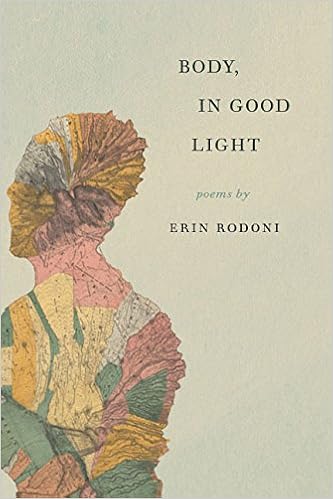
Body, in Good Light - Erin Rodoni (Sixteen Rivers Press)

Today's book of poetry:
Body, in Good Light.  Erin Rodoni.  Sixteen Rivers Press.  San Francisco, California.  2017.


"...bliss, like a memory, can be unearthed by scent."
                                                                                                 "The Body Lathe"
                                                                                                  Erin Rodoni

Erin Rodoni's Body, in Good Light has enough light to charm your eyes open wide but there will be tears enough before the end.  Rodoni has poems built on sustained intensity but without any anxiety, passion without pontification.

Today's book of poetry is a bit distracted today as our associate Odin is putting in his last days with us.   Odin has been presented with a bigger and better playground and is unable to say no.  We understand that and are proud of the work he has done here, we are sorry to see him go.  Odin never talked all that much but we sure listened when he did.

Body, in Good Light is just the sort of book Odin likes best, unapologetic intelligence, open-hearted wit and kindness.

The Ninety-Year-Old Woman On My Table

is speaking into the lavender-spritzed air
between us. Her muscles Braille another
story. She's telling me about her niece,
who lives with a man she'll never marry.
It's complicated, you see. There's so little
between her bones and mine, a thumb's
pad, a tendon's frayed twine. You see,
he has a wife. Sometimes it seems these
bodies just appear under my hands. She has
some kind of condition. They all touch
their own shoulders, their lower backs
to show me where the pain is. Sometimes
they want to touch mine (right there) as if
we don't all inhabit the same sad pockets
of skin. Can't move, can't speak. I imagine
there are people hired just to wash her
where her husband can't. Certainly can't
have sex, and I suppose he has all he wants
with my niece. Our muscles are toned to transfer
gentleness. From lover to child. From stranger
to self and back again. Sometimes the weight
of a toothbrush seems too much when I remember
I must lift it twice a day until I no longer can.
They have children together. I've kissed my own
grandmothers into smaller and smaller beds,
fixed their hair -- all wrong I'm sure. I suppose
he must have loved her. Now he tends her
like a houseplant. Or maybe she's a ghost
orchid in a greenhouse in a snowed in city.
Probably still does, in his way. The globe
unshaken, shelved in one of these little rooms
where hands polish it with love
so unconditional it's cruel.

...

Erin Rodoni talks about cancer and childbirth and chemotherapy and the impending death of a younger brother and when she is doing this she is covering some damned sad territory, sweet and profound.  As a reader you'll feel compelled to turn to the next page, Rodoni keeps the iron under your feet suitably red.

Today's book of poetry also wants to warn you.  Rodoni moved us to real, running down the cheeks, tears more than once.  As much of a crocodile as I can sometimes be those were real emotions running down my old face.

You Kept My Summer Dresses

when I died, and jewels worn closest to my skin.
You warmed them in a fist, watched hemlines swish

dust, once my thigh. When you lie
beside your new love now, do you miss

the little nicks not on her shinbone,
the mole your little finger doesn't brush?

Hush, I know about darkness, how it funnels
a sort of light we see as flesh

through our sealed lids. I know about rooting
toward comfort's infrared.

I only meant to say I can't forgive you.
I'm not God, just a voice inside your head.

You remember, don't you, what I said
about the heart? To do the things it tells you?

Soon she will jump at necklaces curled like cobras
in your sock drawer. Soon it will be time

to wash my dresses, leave them slapping on the line.
All I ask is, just once more at dusk, stand

in the life we shared, let night gather
behind the dresser, beneath the bed.

Let shadows press open the closet and breathe
the last moths of my scent.

...

Our morning read was a tempered emotional affair this morning.  We were all on edge because of Odin's bon voyage.  Every time Rodoni crossed an emotional bridge one of us jumped out of our skin and to be pulled back from the ledge.

Odin calmed us all down, as he always does, kissed everyone, left.  A class act all the way.

When I got back to my office there was a short note from Odin on my desk.  He said "that Rodoni woman is built from strong stuff, first rate poetry from an intelligent woman's voice.  Remember that you grew up under the care of a strong, intelligent woman.  Stay the course."

We Chop Onions, Listen To Billie Holiday

The windows fogged. Our eyes. My brother slides the knife from his
wife's fist, dances her around the room. Her body already out of breath,
he folds her to his chest. They revolve in one place: teenagers during 
the last song of prom. My husband stands behind me. I lean into his
weight. And for a moment I let myself conjure a child with her smile
and my brother's green eyes, a child who will never run through this
house playing tag with the child I don't yet have. Beyond the steam on
the windows, fall's first frost sharpens the marsh grass, and the arced
maps in the stars tick past without us until we are already ghosts.

...

Erin Rodoni's Body, in Good Light is flat out excellent.  You should give a copy to every woman you know.  Wouldn't hurt any of the menfolk either.

Erin Rodoni

ABOUT THE AUTHOR
Erin Rodoni is the author of Body, in Good Light (Sixteen Rivers Press, 2017) and A Landscape for Loss, which won the 2016 Stevens Manuscript Prize sponsored by the National Federation of State Poetry Societies and is forthcoming later this year. Her work has appeared in Colorado Review, Cimarron Review, Drunken Boat, Ninth Letter, Spoon River Poetry Review, Tupelo Quarterly, and The Adroit Journal, among others. Her poems have also been included in the Best New Poets anthology, featured on Verse Daily, nominated for a Pushcart Prize, and honored with an Intro Journals Award from the Association of Writers and Writing programs. She currently lives in the San Francisco Bay Area with her husband and two young daughters.

BLURBS
“I walk toward you barefoot,” writes Erin Rodoni, a poet who can speak with the same ease of private elegies and public journeys, of childbirth and of changing trains in Krakow, of grief on losing a loved one to cancer, and of ‘borrowed countries / where bougainvillea scales balconies // like a romance language.’ Here is a book that journeys out into the world, and also inward—into the mysteries of private life, of the body, where ‘bliss, like a memory, can be unearthed by scent.’ I love how wisdom enters the moment of passion in these poems, where we see ourselves living here, on this earth, ‘believing // in these bodies.’ This is a marvelous debut.” 
     —Ilya Kaminsky, author of Dancing in Odessa 

“The aesthetic that courses throughout Erin Rodoni’s sumptuous debut—tender and bittersweet, but also clear-eyed and unflinching—recalls Rilke’s ninth Duino Elegy, in which the earth’s dream is ‘to resurrect / in us invisibly.’ That ache of regeneration and rejuvenation is made manifest in Body, in Good Light. In the section entitled ‘A Sort of Light We See as Flesh,’ the poem ‘The Chapel’ brings us to a woman’smemorial service, where Rodoni faces ‘an altar draped in fabric / that belongs to no faith.’ At the end, though, she says: ‘We praise/ the faith of whatever machine // keeps the warmth in her hands.’ By extension, that warmth extends to the poet, to those she holds dear, and, thankfully, to us.”
     —Thomas Centolella, author of Views from Along the Middle Way


sixteenrivers.org

585
DISCLAIMERS

Poems cited here are assumed to be under copyright by the poet and/or publisher.  They are shown here for publicity and review purposes.  For any other kind of re-use of these poems, please contact the listed publishers for permission.

We here at TBOP are technically deficient and rely on our bashful Milo to fix everything.  We received notice from Google that we were using "cookies"
and that for our readers in Europe there had to be notification of the use of those "cookies.  Please be aware that TBOP may employ the use of some "cookies" (whatever they are) and you should take that into consideration.


Monday, December 5, 2016

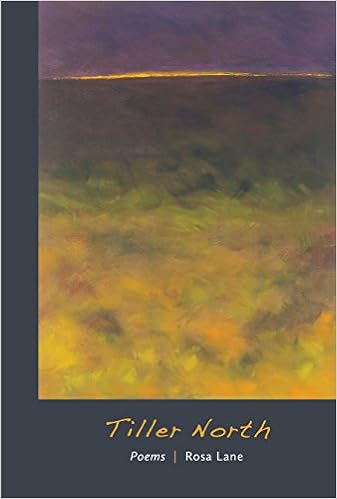
Tiller North - Rosa Lane (Sixteen Rivers Press)

Today's book of poetry:
Tiller North.  Rosa Lane.  Sixteen Rivers Press.  San Francisco, California.  2016.


Rosa Lane's Tiller North makes Today's book of poetry think of Alistair MacLeod's short stories in marvels such as The Lost Salt Gift of Blood and As Birds Bring Forth the Sun and Other Stories if they were written by a woman of equal power and persuasive gifts.  Or Michael Crummey's stunning novel Sweetland.  These poems feel like they are familiar, like they take place on or near the same water.

Today's book of poetry says this because these poems are big, they feel like stories, fill up the space and imagination just like a big novel.  These poems situate you in a rural/remote fishing community surrounded by sea and brush.  You are in the kerosene lit kitchen, you are in that death-watch bedroom.

But most certainly, you are there.  

The natural path Rosa Lane pushes you down in these poems is strewn with hard work and calloused hands, hard living and some hard luck.  Yet there doesn't seem to be much complaint, this is reportage using memory rendered poetic.  Lane isn't asking for any empathy, her heart is full to bursting with memory.

June Bugs

Electricity buzzes the yellow bulb
in Maine's humid heat. June bugs bomb
the porch light with spiny legs -- date-colored
and oversized.
                        Spring peepers pin the night,
pitch a universe in my mother's kitchen, except
I have not yet occurred to her. She is sixteen,
and I will be hers in less than a year.

Supper's on the table for the boy who will be
my father, his nineteen-year-old body big
and husky. He rinses dried splashes
of work from the day's ocean into a small
blue basin, enameled and filled
with hand-pumped water drawn from the well.

Fireflies light the field aflame. Conceived in the heat
of summer, I appear a small spark of night
planted in the deep crevice between them.

...


Lane takes the reader to a time and a specific place in these poems.  We'll never truly understand the life of a small and remote fishing village but we certainly understand more now.  We can't smell the kerosene or the fish but Lane gets us there, we are on the coast of Maine gazing west towards civilization.

Today's book of poetry was terribly enamoured reading Tiller North, Rose Lane has that steady Andrew Wyeth gaze and hand, and it would appear some of his same ideas about story, narrative and how to make the heart arc.  Many of Wyeth's paintings seem stark but in fact they never are, Rosa Lane has that trick finessed. There are some hard moments in Tiller North but a warm and tempered heart is leading the way.  Tiller North is coming of age poetry writ large over the working class background of a young woman in a remote place.  

Tiller North

Take Route 130 nine miles
where it dead-ends at the coastal tip,

keep your eye on the spire,
how it peaks above ragged pines

torn from a small length of ocean:
shingled shacks drunk with fog,

the mouth of John's River, a bar
of khaki sand, a stand of piers rusted

in salty air, Dora's cow pasture blurred
with brutes down meadow. How the fog

dampens fisher boats wedged at the wharf,
arched glass stained with light on the hill.

~

Households begin at the Point,
where fisher boys drive

their cars fast to the cliff,
test their brakes, scare

their girls, who squeal and dive
for safety into dangerous

arms. Tongues of the bell buoy
bang a rhythm of ocean in backseats,

when sixteen-year-old bodies grow
pregnant, birth armloads that suck

tiny breasts, unready. The young stumble
along a path of church bells calling them

to kneel Protestant pews and swallow
white wafers of a single mind.

~

Fisher boats named women wait in the cove,
anchor lines tied at the nose, nets piled

in the hold. Our father stands there waving
across the salt air, our mother at the shore

squinting the sun, seaweed floating
her black hair across the surface ahead

of winter already moving in. The three of us
run to the school bus each morning.

Our father's fingers, cracked with cold, count
singles laid on the kitchen table at night,

our porch lights lit proof of survival at the edge
of the harbor we are damned to leave.

... 

No guests for this morning's read as Ottawa was covered in snow this morning.  A number of our staff didn't make it to our digs on Dagmar.  I was out shovelling snow for over an hour earlier this morning and will go back out when it stops snowing altogether.  Milo, our head tech, and Kathryn, our Jr. Editor, both made it through the snow, they live close by and walked.  The three of us batted these poems around until we reached shore.

Today's book of poetry really liked the tone Lane establishes from the start, she has such confidence and is so self-assured that you feel like some of it might rub off, a little osmosis through hard living.

Bingo

Lucy's shack sat on cinder blocks
pressed into peat near the bog,
a piece of real estate
no one wanted. Saturday night
down at the hall,
she laid navy beans
on numbers, played six cards,
won a few coins
on the left straight.
                                She drives
headlights up the throat of driveway
pounded hard by the last rain. Trees
crawl across the face
of the house. Her porch light
burns a small hole at the door.
Her boyfriend can't wait up,
he said -- her daughter's silhouette
in the upper window riding horseback
on a horse she never sees.

...

Rosa Lane's Tiller North is the 37th title from San Francisco's Sixteen Rivers Press.  Lane joins a fraternity that includes Nina Lindsay, Stella Beratlis, Ito Naga and Beverly Burch, very fine company.

Today's book of poetry thinks you should join Rosa Lane on her journey back to the Maine of her youth.  Lane's Tiller North imparts a portrait of family and community, loss and found, in one elegant nostalgic yawp.

Rosa Lane

ABOUT THE AUTHOR
ROSA LANE is a native of coastal Maine, with familial and ancestral roots steeped in lobster fishing. She earned her MFA from Sarah Lawrence College and is the author of the poetry chapbook Roots and Reckonings(Granite Press, East, 1980). Her work has appeared in numerous journals, including The Briar Cliff Review, Crab Orchard Review, New South, and Ploughshares. After earning her second master’s and a Ph.D. in sustainable architecture from UC Berkeley, Lane works as an architect and divides her time between coastal Maine and the San Francisco Bay Area, where she lives with her partner.

BLURBS
“Tiller North ends with the word sing, a final act in a volume of poems that narrates sorrows and pays tribute to the Maine people Rosa Lane comes from. She offers scenes looked over carefully, as everyone takes their place at the table. She tells of making it through a sense of unbelonging, imprinted by rejection based on class and cut-off dreams mitigated by fierce love, hard work, and constant relation to family, place, and the rules of the season.”
     —Beatrix Gates, author of Dos and In the Open

Rosa Lane’s poems in this remarkable volume are reminiscent of Elizabeth Bishop’s in the author’s fierce dedication to craft….Lane’s poems build through the architecture of the image; the texture of physical detail; and a sparse, understated language that resonates a profound love of humanity, an embrace of the people around her, and a deep, inward movement of the poet’s imagination.”
     —Stephen Haven, author of The Last Sacred Place in North America and Dust and Bread

“In Tiller North, Rosa Lane gives us a world—not just one compass point, but all of them. In poems as lyrical as they are narrative, she presents a family and a landscape with precision and compassion. Her writing is as sharp as her heart is full. Tiller North is a moving and accomplished book.”
     —John Skoyles, author of A Little Faith and Permanent Change

Rosa Lane’s poetry reminds us why, at a certain time in our lives, we’ve had enough of innocence. Here is a compendium of those so crucial, chronology-defying self-revelations that we only know through our skin….Each poem is a skiff sculling through sounds almost Hopkinsesque, each measure of music anchored by the ground base we feel more than hear.”
     —Jeffrey Levine, author of Rumor of Cortez and Mortal, Everlasting

532


DISCLAIMERS

Poems cited here are assumed to be under copyright by the poet and/or publisher.  They are shown here for publicity and review purposes.  For any other kind of re-use of these poems, please contact the listed publishers for permission.

We here at TBOP are technically deficient and rely on our bashful Milo to fix everything.  We received notice from Google that we were using "cookies"
and that for our readers in Europe there had to be notification of the use of those "cookies.  Please be aware that TBOP may employ the use of some "cookies" (whatever they are) and you should take that into consideration.


Sunday, August 7, 2016

Because - Nina Lindsay (Sixteen Rivers Press)

Today's book of poetry:
Because.  Nina Lindsay.  Sixteen Rivers Press.  San Francisco, California.  2016.


Nina Lindsay writes beautiful poems.  In Because Lindsay may be simultaneously contemplating the end of days and the proper mix for scone batter or the theft of a stuffed animal from the Oakland Public Library and how that might be a gesture of love.  Where we find Lindsay is far less important than what Lindsay finds for us.

These poems have a particularly fine glow to them, polished but lived in, precise not pedantic.  Lindsay writes some entertaining verse.

Because

After Brodsky

The song was there before the story
The clay in veins before the vessel

The ideal before the double-cross
The destination before the crash

The path worn down before the road
The pattern before setting stone

The urge was there before the flower
The wave before anything went under

The crystal formed before the snow
The embrace before the word for cold

...

Joy is a rare commodity in poetry, but it is readily available in the pages of Because.  Today's book of poetry suggests that Nina Lindsay is a pragmatic realist most the time and yet she has found a way to give these poems considerable and optimistic light.  

This morning's reading was held in the garden just outside our office.  Bright sunshine filled the sky this morning in Ottawa and these suckers rang out like welcomed birdsong even though there were still a few wine bottles left on the table from last nights revelry.  

Last night while K and I were inspecting wine glasses a wasp crawled around the neck of one of the bottles of red and then had gone in for a drink.  It was an almost full bottle so we decanted it and the wasp into a wide-mouthed glass.  The wasp hadn't gone under yet and although he was wobbly he was able to hang onto the offered garden shears of life.  Set him up on the wide wooden railing and let him drink/dry off.  After a few moments he kind of shudder stepped to his belly and dropped off his feet.  We thought he might be a goner.  Ten minutes of hard sun later he scampered to his wasp knees and startled to air his wings.  A few minutes after that he took off like a helicopter, like an elevator, flying straight up.  And that's how these poems work, a little wine, and then flight.

Poetry Is That

Prayer is that which conveys a message to God, who is either known or knowing, more or less
by definition. Poetry is that which conveys a message to a stranger.
--G.C. Waldrep

Put God aside, your glass of wine: someone is knocking at the door.
The late light is pressing them against it,

late, for April, and warm--
after a week of storms it came out falteringly, then stronger,

like a mezzo-soprano reaching full throttle.
So: the sun, the stranger, and there are birds

singing over supper, wisteria hanging full and drawn to earth,
neighbors crouched in shadows planting annuals from plastic 
     containers.

And if you like to pretend to be impervious to the advances of 
     spring,
at least take joy in the pretension

and joy in the declination of the dark
and the richness of dream that the dark produces.

It has something, still, to impart,
the part you most need, the dark part that spins,

so that the light spins off it, the minutes, the heat,
the nectar, nasturtiums, pollen, fennel,

steam from hung laundry,
blossoms blocking gutters,

loved ones doing dishes, chopping ginger,
bartenders paring gem-like ribbons of peel,

bus drivers pulling levers, bandmates returning amplifiers,
carpenters writing thank-you notes on yellow legal pads,

fathers clipping nails, jewelers crimping gold,
judges tending reservoirs of doubt,

children breaking sticks in the last of the light,
the unconsoled coming home,

and the stranger at the door:
still knocking,

soon to be either known or knowing,
and you: who are present, who are with them, who answers.

...

Lindsay contemplates post Katrina New Orleans by channeling Li Po, offers us up a poem about one house looking for another house with matrimonial interest, insists on upending our expectations by giving us "mistranslations" at whim, even a series of "Mistranslations of Animal Riddles," and writes the loveliest love poems to/about her husband.  This is a good thing.  Poetry should open doors we had yet to perceive.

Today's book of poetry was made enthusiastically happy by reading Because.  If you had any idea of what a miserable old contrarian I was you would see the magic in that statement.  

In Our Warm Tree House of Evening, You Stood
Before the Undone Dishes and I Answered the Door

Until I answered the door,
rain blew against the house.
I answered its perplexing questions, and it left.
We imagined the dishes done. We imagined our meal again.
Unguarded,
the single pair of us in our floating house.
I sat and watched you stand before the undone dishes.
I flattered you with familiar phrases, I put my hands in your back
     pockets.
We uncomplicated the quilts. We stacked the beams. You sat by me
and unlaced my three levels. We understood, unbuilt,
repaired ourselves from spine to elbows. We lay back to back.
Unseated, in our unaccomplished,
unfamiliared, familiar bodies.

...

Nina Lindsay speaks so lovingly about love that everyone here at Today's book of poetry is jealous of her Oakland husband.  Kathryn, our Jr. Editor, and Milo, our head tech, were all lovey-dovey after this morning's read.  I told Kathryn that TBOP would need our copy of Because back for the office collection.  Almost certain I heard her mutter something like "not likely" but that couldn't be true for she is not the insolent type.  Besides, I know where Kathryn and Milo have their poetry bookcase.  

Because was thoroughly enjoyed here at Today's book of poetry, apparently enough to warrant theft because I just saw Kathryn leave with it under her arm.

Nina Lindsey jpeg
Nina Lindsay
(Photo by Aya Brackett)

ABOUT THE AUTHOR
Nina Lindsay’s work has appeared in the Kenyon Review, Ploughshares, Poetry International, the Colorado Review, Fence, Rattle, and many other journals, and has been awarded the Dorothy Sargent Rosenberg Prize. Nina also writes children’s literary criticism and reviews for Kirkus, The Horn Book Magazine, School Library Journal, and others. She grew up in Oakland, California, where she lives today, and works for the Oakland Public Library.

BLURB
Nina Lindsay’s Because is beautiful work. The poems pick through the things of the world, her world, exposing the unseen and intensifying the seen. They question what she calls “our multifrond uncertainties and errors” and “hesitant happiness.” She negotiates with great poise the push-pull of darkness and light, presence and absence, waking consciousness and the dream life. The familiar becomes, in her telling, unfamiliar and fraught. “February’s dust is rapturous,” she says. The poems, too, even in their melancholies, are rapturous.”
      –W. S. Di Piero


496

DISCLAIMERS

Poems cited here are assumed to be under copyright by the poet and/or publisher.  They are shown here for publicity and review purposes.  For any other kind of re-use of these poems, please contact the listed publishers for permission.

We here at TBOP are technically deficient and rely on our bashful Milo to fix everything.  We received notice from Google that we were using "cookies"
and that for our readers in Europe there had to be notification of the use of those "cookies.  Please be aware that TBOP may employ the use of some "cookies" (whatever they are) and you should take that into consideration.


Monday, September 28, 2015

I Know (Je sais) - Ito Naga (Sixteen Rivers Press)

Today's book of poetry:
I Know  (Je sais).  Ito Naga.  A bilingual edition translated by Lynne Knight.  Sixteen Rivers Press.  San Francisco, California.  2013.


31.  I know that, unlike human beings, trees don't
       heal their wounds. They grow around them,
       leaving holes here and there.

31.  Je sais que, contrairement aux etres humains,
       les arbres ne guerissent pas de leurs plaies. Ils
       les contournent et vivent ainsi avec des trous
       ici et la.

...

(Today's book of poetry apologizes profusely for being unable to use the proper accents when reproducing French text.  I can only offer up that I am old and a moron.)
...

Originally published in France in 2006 under the title Je sais (Cheyne editeur), Ito Naga's I Know has lost none of its vitality in the ensuing decade.  Je sais is currently in its seventh edition in France but it is new to us.

I Know is made up of 469 short aphorisms, no titles, numbered, each one sentence long.  We could call them truisms.  An aphorism can be defined as "a concise statement of a scientific principal, typically by an ancient classical author."  As it turns out Naga is a scientist, an acclaimed astrophysicist, Ito Naga is a nom de plume.

Nom de plume or not any cat who ruminates about Yukio Mishima, Antonin Artaud and Marco Polo has my curious attention.

210.  I know that if I were a mailman, I wouldn't be
         able to stop myself from reading postcards.

210.  Je sais que si j'etais facteur, je ne pourrais
         m'empecher de lire les cartes postales.

...

Naga's fierce noggin' never stops.  He is constantly interested in what is at the edge of the frame, the figure in the shadow that gives the entire thing meaning.

Ito Naga makes a point of tipping his hat to Joe Brainard's I Remember, he even draws a hopeful comparison.  Now this should make my dear friend Stuart Ross flip - Ron Padgett wrote a memoir about his childhood friend Brainard called Joe.  I Know is full of much of the same hopeful naivete that Brainard is known for but never at the loss of real life, real experience, understanding.

241.  "I know that for thirty-five years, my hands
         have been working but my brain's been at a
         standstill," someone leaning on the counter said.

241.  "Je sais que, depuis 35 ans, mes mains travaillent
         mais mon cerveau est en panne!" dit-il accoude
         au comptoir.

...

I Know is an inventory of the everyday from the perspective of a generous mind that misses nothing. The world from sun-up to sun-down and all night long, Naga is on the job deconstructing and explaining all these things we know and need to be true.  He has a generous heart.

468.  I know that, urged to confess that he had lied,
         Marco Polo answered that he hadn't told even
         half of what he'd seen on his journeys.

468.  Je sais que presse d'avouer qu'il avait menti,
         Marco Polo a repondu qu'il n'avait pas raconte
         la moitie de ce qu'il avait vu cours de ses
         voyages.

...

And like Marco Polo on his death bed with plenty of tales yet to tell - I am certain that I Know only scratches the surface of Naga's deep well.

Today's book of poetry has always had a soft spot for "list" poems and this is assuredly one of the best.  Joe Brainard would like this book.  I'm pretty sure Ron Padgett would like it.  I'm hoping Stuart Ross will like it.

469 missives, Naga's humour and smarts are endless.

I Know was translated by the poet Lynne Knight, Today's book of poetry will be looking at her excellent book of poetry, Again (Sixteen Rivers Press), in the near future.

...

ABOUT THE AUTHOR
Ito Naga is the nom de plume of a prominent French astrophysicist living in Paris. He is the author of three books, all published in France by Cheyne Γ©diteur: NGC 224 (2013); Iro mo ka mo, la couleur et le parfum (2010), now in its third printing; and Je sais (2006), now in its seventh printing. He also contributes regularly to the Italian journal Sud.

sixteenrivers.org

386

DISCLAIMERS

Poems cited here are assumed to be under copyright by the poet and/or publisher.  They are shown here for publicity and review purposes.  For any other kind of re-use of these poems, please contact the listed publishers for permission.

We here at TBOP are technically deficient and rely on our bashful Milo to fix everything.  We received notice from Google that we were using "cookies"
and that for our readers in Europe there had to be notification of the use of those "cookies.  Please be aware that TBOP may employ the use of some "cookies" (whatever they are) and you should take that into consideration.

Thursday, April 23, 2015

Alkali Sink - Stella Beratlis (Sixteen Rivers Press)

Today's book of poetry:
Alkali Sink.  Stella Beratlis.  Sixteen Rivers Press.  San Francisco, California.  2015.


These are some mighty fine conversational poems.  Beratlis hits the ground running, these poems read like your best, smartest, friend telling you all the latest.

Alkali Sink is jam packed with beautiful and intelligent poems - but the kicker is the tone Beratlis sets - she assumes the audience will be sharp enough to read along.  Actually she probably does no such thing and I'm projecting.  But the tone is right, sharp and tight, witty.

Crop Rows in Autumn

This is how faces fall apart:
our eyes fixed to a point

somewhere on the flat horizon.
We walk in furrows of rich soil

for years, for a lifetime--
then start following the furrows

to the clouds. This is how lives
fall open: a man loves and hopes

while his wife shrinks
one acre per year; how love

weaves out: a cotton rope tensing
then raveling into many frayed strands,

its shining moments leftover gourds
strewn by the road after harvest.

But we forge ahead like physics,
until longing dissolves

the face, until systems
of measurement are obsolete

and we fix our eyes
on the vanishing point.

...

Beratlis is machine-shop precise at every step as she maneuvers between worlds, she purveys our ordinary world with extraordinary vision, let's us see a glimpse of her private world.  These are intimate poems that speak universal.

Today's book of poetry hates the expression "down to earth".  Stella Beratlis is so down to earth you can feel it in her fingers, the smudges on the page.  Not Bukowski, drunken rant down to earth, more Anne Tyler down to earth, Sharon Olds earth.

I Heard On The Radio

they are blowing up the sugar plant, so
we drive north to a town of old sharp smells.
The nose tells us we've reached Manteca,
olfactory curiosity, but also the clean rows of
a Greek farmer's vines. In this town, owl decoys

perch on buildings, vigilant with glass eyes.
Airstream trailers peek out behind eucalyptus teeth
and bid hello to the truck drivers who are always
just passing through. We plow

through it all, ferment-stink as
sugar beets roast on slow-moving belts --
and behind that odor, the oil burn of gears that turn efficiently
twenty-four hours a day. But today, all this has given way

to a man saving his place at the chain-link carnival
that surrounds this temple,
and a barker who announces the winner
of a contest to push the plunger
that detonates the charge
that begins the demolition
we've come to witness.

The ceremony starts: a collective twitch
as staccato charges snap the air --
loosening creaky spines and unlacing steel ribbons.

But those old towers hang in the air, stubborn,
releasing dust and exhaling possibility --

then they fall and spill upon the earth.

When the dust clears, we wander back,
desolate, looking for a place,
like people wondering
where to get their next meal,
like the silver pigeons
who have lost a good home.

...

I felt at home reading these wonderful poems, as though Beratlis was someone I knew and I'd heard versions of these stories, over a glass of red, many times before.  That is a compliment.

Alkali Sink is an enormously entertaining read as Beratlis has a sharp sense of humour.  You all know how we like a laugh her at Today's book of poetry and Alkali Silk is full of chuckles.

Nature vs. Nurture

In those days, we had no idea
our father was a drug dealer, not really.
Inside his house in a small briefcase
by the kitchen table

were little white packets of cocaine,
baggies of pot. One day, in our early teens,
my sister and I sat alone on the front porch
while our father was at work

butchering meat at the local Safeway.
His neighbor, who stood on a small ladder
trimming his crape myrtle,
exposed himself to us.

When we saw his penis swinging loose
in the space of his open fly,
we ran inside the house
where we debated briefly

before calling the police.
As we waited for the cops to show,
we sat at the Formica table
trying to make sense

of the whole situation,
wondering if we'd made
the right decision, if a man could
knowingly trim shrubs with his penis

dangling there, in the open,
if a father could really keep
a loaded gun behind the front door.
How easily danger becomes

part of the household,
a silly joke about poking
some whores, a favorite uncle--
no one thinks to shield your eyes.

...

Today's book of poetry was seriously impressed with Stella Beratlis' strong, strong debut Alkali Sink.

If this were the standard for first books the majority of the rest of them would vanish, evaporate, slink down the drain like something washed off in the water.

Stella Beratlis

ABOUT THE AUTHOR
Stella Beratlis grew up in a Greek-American family in Northern California. Her work has appeared in Quercus Review, Penumbra, Song of the San Joaquin, In Posse Review, California Quarterly, and other journals, as well as in the anthology The Place That Inhabits Us: Poems from the San Francisco Bay Watershed (Sixteen Rivers Press, 2010). She is coeditor of the collection More Than Soil, More Than Sky: The Modesto Poets (Quercus Review Press, 2011). Beratlis is a librarian in Modesto, where she lives with her daughter. Alkali Sink is her first collection of poems.

BLURBS
“Stella Beratlis writes unforgettable poems that stir inside you long after you’ve finished reading them. Alkali Sink is simultaneously domestic and wild, urban and rural, full of surprises and wisdom. Your axis may shift after reading this remarkable book. Beratlis is a fierce talent whose beautiful mind encompasses the land, the open road, the kitchen window, and the heart’s inconstancies. Her first full-length collection is one of the best debuts I have read.”  
 —Lee Herrick, author of Gardening Secrets of the Dead

“In her poem ‘Vitreous Detachment,’ Stella Beratlis asks ‘How do I know?’ In Alkali Sink, a book that is at once sly and precise, honest and unique, Beratlis’s faith in both the interior and exterior worlds can be trusted enough to believe she can answer: with ‘the names of things and their pulpy centers.’ This is a poet in love with the dirt and the lamb, the armored car and the terrible sadness, with chaos and linear thought—everything that might ‘illuminate the several darknesses of the heart’ and the ‘multiplicity of the selves’ within a soul.                                                                                  —Julia Levine, author of Small Disasters Seen in Sunlight
“Alkali Sink reads like ‘a locomotive / speeding through a native West / changing the scale of my earth.’ Central California races toward Greece, memory races toward reality, old age races toward youth, but the poems take their time, too, the way trains do, and I can peer into backyards and orchards and used-car lots as I go. At first I was here and now I am there, and the world I see is different because of how these poems moved me. Stella Beratlis has written a beautiful book.”         —Camille T. Dungy, author of Smith Blue
330
Poems cited here are assumed to be under copyright by the poet and/or publisher.  They are shown here for publicity and review purposes.  For any other kind of re-use of these poems, please contact the listed publishers for permission.