Tuesday, June 10, 2014

On the Flyleaf - Herbert Woodward Martin (Harmony Series/Bottom Dog Press)

Today's book of poetry:
On the Flyleaf.  Herbert Woodward Martin.  Harmony Series/Bottom Dog Press.  Huron, Ohio.  2013.


Herbert Woodward Martin is a poet and acclaimed academic, On the Flyleaf is Mr. Martin's ninth book of poems.

On the Flyleaf is made up of poems written in response to poems by others and I thought it might be instructive to take a look at the list of works that offer Martin his springboard.  The following is the list of poems/authors/books that Martin uses in this excellent collection.

Absolute Trust in the Goodness of the Earth  -  Alice Walker                         
Alliance, Illinois  -  Dave Etter
Angle of Ascent  -  Robert Hayden
The Answers Are Inside the Mountains  -  William Stafford
April Galleons  -  John Ashberry
Atlantis  -  Mark Doty
Autobiographies  -  Alfred Corn
Blacker the Berry  -  Wallace Thurman
The Bluest Eye  -  Toni Morrison
Blessing the Boats  -  Lucille Clifton
The Book of Light  -  Lucille Clifton
Brutus's Orchard  -  Roy Fuller
By the Light of My Father's Smile -  Alice Walker
Carnival Evenings  -  Linda Pastan
Cold Comfort  -  Wanda Coleman
Collected Poems  -  James Wright
Crow  -  Ted Hughes
The Errancy  -  Jorie Graham
Everyday and Prophetic  -  Nick Halpern
Fate  -  Ai
Firekeeper  -  Patti Ann Rodgers
The Flashpoint  -  Jane Cooper
50 Contemporary Poets  -  Alberta Turner
From A Person Sitting In Darkness  -  Gerald Barrax
The Gospel of Barbeque   -  Honoree Fanonne Jeffers
Homage to Mistress Bradstreet   -  John Berryman
Hunger  -  Lucie Brock-Broido
Hush  -  David St. John
In Mad Love and War  -  Joy Harjo
The Invention of Zero  -  Richard Kenney
The Last Lecture  -  Randy Pausch
The Last Uncle  -  Linda Passan
Leaves of Hypnos   -  Rene Char
The Lives of The Heart  -  Jane Hirshfield
Looking For Luck  -  Maxine Kumin
The Man of Letters  -  William H. Pritchard 
The Master Letters  -  Lucie Brock-Broido
My Mother's Body   -  Marge Piercy
New and Selected Poems  -  Donald Justice
90 Miles   -  Virgil Suarez
No Other World   -  Robert E. McDonough
Notes From The Divided Country  -  Suji Kwock Kim
The October Palace  -  Jane Hirshfield
Opened Ground  -  Seamus Heaney
Plenty  -  David Hare
Poems 1957-1967  -  James Dickey
Poems 1965-1975  -  Seamus Heaney  
Poems 1968-1999  -  Paul Muldoon
Poetry: A Pocket Anthology  -  R.S. Gwynn
Rain   -  William Carpenter
Roots and Branches   -  Robert Duncan
Rough Music  -  Deborah Diggs
Routines  -  Robert Duncan
Saints of South Dakota   -  Katherine Whitcomb
Selected Poems   -  W.S. Merwin
Selected Poems   -  James Tate
Selected Poems   -  C.K. Williams
Shadow Train  -  John Asberry
The Silent Singer   -  Len Roberts
Small Congregations   -  Thylias Moss
Split Horizon   -  Thomas Lux
Steal the Bacon   -  Charles Martin
The Subterraneans  -  Jack Kerouc
Swan's Island  -  Elizabeth Spires
These Days  -  Frederick Seidel
This Body Is Made of Camphor and Gopherwood  -  Robert Bly
This Time   -  Gerald Stern
To The Lighthouse   -  Virginia Woolf
To Urania   -  Joseph Brodsky
Two by Two  -  Denise Duhamel
The Vigil  -  C.K. Williams

The poems in Martin's On The Flyleaf are the poems written in response to these collections, presumably on the flyleafs.

An exercise like this requires that the reader be familiar with a wide body of work that he or she may not have encountered — Martin solves that dilemma with thoroughly illuminated poems that stand on their own merit.  

On the Flyleaf of April Galleons

The terror in my heart is like a Russian schoolyard.
Grief is a part of the song the Russian mothers sing.
A black mother, a continent away, says:
Our children are supposed to bury us;
what is it that forces us to lay them in the earth?
I hear the blood as it thunders in my ears;
it drowns the words of powerful men who tell us lies.
We now in our skeletons that they cannot be trusted.
I shall gather up all my black dignity
along with all of my reserve and resolve,
and strut carefully, head erect, eye forward
looking squarely at that bier:
which contains what once was promise,
which was cheered at birth and now we mourn,
which demands we understand our faulty grief.

...

These poems have a clear, clean, crisp voice.  They do not fuss, but move forward sharply, with great purpose.  You don't have to know John Ashberry's poem to admire Martin's.

On the flyleaf of Atlantis 1

A Yellow Jacket skirts the dangerous rim of a cup of hot tea.
He, no doubt, is aware of his hypnotic reflection, and like
Narcissus before him falls in love with his hopeless image.
He does not recognize his face; he is intrigued beyond
ordinary investigation. The steam of water anticipates a
dizzying and untimely death, a casting off of skin and tea.
It is the image that invites one toward the havoc of a kiss,
and no matter how blissful the embrace, death ends in
paradise. A similar death has occurred with a Humming Bird
feeder, when no hand was able to reach the excess of this
accidental fatality. So the body of one bee floats as if it were
preserved in amber. The yellow and black dazzles in sweetened
formaldehyde, although I am told that pure water will begin the
arduous task of peeling away the body, layer by layer, as if it were 
an onion ready to reveal its marvelous inner secret of making tears.

...

Mark Doty must be tickled pink.  Certainly the Gods of poetry are dancing at every turn of the page.

I would have comfortably picked any poem from the collection for this blog.  On the Flyleaf exudes excellence.  You want to show someone how to write fine poems — make them read this book, regularly.

Hebert Woodward Martin writes with an honesty and certainty that leave me breathless.

This isn't an academic exercise in any way but a call and response to many of the great voices of our time by a poet who frankly is their equal.  It is marvelous dancing, a sparring duet of eloquence and we get to hear the song.  I love these poems

On the Flyleaf of The Subterraneans III

In Birmingham,
in the forties, the old women swept
their front porches, then swept
the yard of unnecessary debris.
They must have felt they had to keep
everything clean, even though they did
not possess the accurate implements
to work with, their cleaning was executed
with the fervor of the religious, and the prayer
and the song of the devout. In this way they kept
the dignity of their neighborhoods stable and radiant.

...

I would highly recommend this book to anyone, everyone, any day, everyday.  Herbert Woodward Martin is my new favourite poet.


Herbert Woodward Martin (video courtesy of UDstories)

ABOUT THE AUTHOR
Herbert Woodward Martin was Professor of English and Poet-In-Residence at The University of Dayton for more than three decades where he taught Creative Writing and African American Literature. He is the author of eight previous volumes of poetry.  He has devoted an equal number of decades to editing and giving performances of the works of the Dayton poet and novelist Paul Laurence Dunbar.  For is scholarly work Martin has been awarded four Honorary Doctor of Humane Letters.  Martin is noted for his wide range of interests in music and art.  He has closely collaborated with a number of American composers among whom are: Joseph Fennimore, Adolphus Hailstork and Philip Carl Magnuson.  He has written texts and librettos for two operas, one cantata and one Magnificat.  A significant number of his poems have been set to music as well.  He is the recipient of The Ohio Governor's Award.  Most recently Martin has found himself a narrator for a number of symphonic works including a new recording of William Grant Still's Symphony #1 The Afro-American with The Dayton Philharmonic Symphony as well as Aaron Copland's Lincoln Portrait.


COVER BLURBS
"The ingenious conversational mode of On the Flyleaf yields many variations of style and mood, yet Herb Martin's wit and wonder shine through them all.  Martin is as generous as any poet I know, and this book is exacting, troubling, and exhilarating in its tracings of the human predicaments that force us to "believe in the catastrophe of love."
     —Jeff Gundy, author of Spoken Among the Trees

"It isn't easy to write with a gentle voice that's also stiletto sharp, but Herb Martin has done it.  He is a national treasure.  On the Flyleaf is filled with gems, one you'll want to share with loved ones."
     —Ralph Keyes, author of The Courage to Write

"The poems gathered in On the Flyleaf reprise the individual books with Herb Martin gathers in his arms at bedtime.  Filling the initial "page left empty," these well-distilled, historical, and personal meditations and their anecdotal responses map Martin's reading, expand his dignified grasp of an often grave world, and quietly reprise the muted echoes and salvage of memory, affirming the poets and writers who nightly compose his dreams."
     —Joel Lipman, Emeritus Professor of English, University of Toledo & Lucas County Poet Laureate

smithdocs.net

210

Sunday, June 8, 2014

Galaxy - Rachel Thompson (Anvil Press)

Today's book of poetry:
Galaxy.  Rachel Thompson.  Anvil Press.  Vancouver, BC.  2011.


Rachel Thompson channels Margaret Laurence's idea of "emotional biography", as the back cover of this Anvil Press title would tell us, she chooses to "tell it slant" as Emily Dickinson might implore.

Telling the truth isn't always about getting the facts right.

Ms. Thompson gets the emotional centre right, dead on in fact.  These poems avoid the screaming siren of the gender wars and get on about their business.  Thompson's Galaxy is familiar territory emotionally, it is wonderfully authentic poetry.

Coriander

Your kiss hello is a bee sting.
Both of us would rather you hit me
to complete the violence
of your gesture.

An elbow grazes my face—
sharp lurch—
during the ride from the airport
as you change the station.

We prepare chickpea curry
with your favourite daughter.
You eye the sharp knives
just behind me.

You hate the taste of coriander
so we have it on a side dish.

My jaw held tight
in light conversation,
I sprinkle the smooth leaves
over my plate.

Down they float like maple keys
we once called helicopter
delicately stick
to the steaming food.

...

I feel compelled to address the "queer" content of these poems. I guess there is some gender stuff happening in these poems and of course it's important, but I would argue it is quite secondary to the poetry.  This is fine poetry with gender content, not a polemic dressed up as poetry.

Good poems, the best poems, don't worry about anything, they just tell their story.

Galaxy, which won the national First Book Competition sponsored by the Writer's Studio at Simon Fraser University, tells us fine stories about love, loss, family, sexuality and twin beds in Prague.

In Prague After the Iron Curtain Has Fallen

The printed sheets paint the twin beds
a vulgar swirl of colour,
the only brightness
in this hostel-cum-dorm.

The dullbrown radiobox
stern on the wall
matches the furnishings.

We take turns barking soviet dictates,
giggling, pretending
our rasped orders are crackling
from the carpeted speakers,
imagining a burly comrade
in beige skirt suit
listening in
as we push together
two wobbly beds.

I stretch over you
and wham!
we connect
I reach one arm up
to switch off the bright bulb
that bears down on us
plunge my other arm
into the right mattress
beneath you.

Your voice
is reckless
as you move your hips
in a revolution
that bangs the cheap
bed frame bang bang
bang against the wall.

Overthrown,
into the rough pillowcase
I muffle my manifesto.

...

Rachel Thompson has all of the things I most like in poetry - the good story, passion, humour and the ability to laugh at oneself.

The reader never has to see from the same eyes as the poet to recognize a true landscape.  The emotional terrain Thompson climbs all over is familiar to all of us, that she has broadened that horizon can only be a good thing.

Galaxy

If I were to write to persuade you of anything
first I would need to pull apart the night-sky curtain
of years so we could step gently over the ledge
as from a shower, careful not to slip on the braided
mat, holding our towels tight and tiptoeing across
the cold floor. The steam drifting like stardust in the room
would somehow show us outside of time,
in a changing room of sorts. At the mirror, overhead
lights would burn off the mist like suns and I would use
my free hand to caress your face with soft cotton and white
cream. The fans of mascara under each eye would slip off
to reveal every spot on the speckled solar system of your cheek.
A string of tangles, your hair would wave down your back,
eclipsing its curve. If I were writing so, I would mention
the tips of your nipples, the soft hairs around your areola
like the path of a satellite orbiting our planet,
the chasm of scar that starts at the crater of your belly button
and ends below. If I were to write you, it would be crouched
at your feet, making words with water on the black stone floor.

...

Today's book of poetry apologizes for being unable to find video of Rachel Thompson.

ABOUT THE AUTHOR
Rachel Thompson grew up in Dauphin, Manitoba, located at the foot of Riding Mountain National Park, aka the Galloping Goose of Margaret Laurence's books. She went to the University of Winnipeg, majoring in English and International Development Studies. After moving to Vancouver in the early 2000's, she took part in the award-winning Writer's Studio program at Simon Fraser University. She completed Galaxy at the Banff Centre's Wired Writing Studio program. Her poetry has appeared in journals in Canada and abroad.

COVER BLURB
"A truly wonderful collection of poems. Wonderful and clear imagery as well as a "real" and "true" sense of place, love, longing, family, and the constant struggle and re-negotiation of self and experience.  Galaxy possesses a simple but sensual approach to language and tone."
     —Gregory Scofield, author of kipocihkan: Poems New and Selected

anvilpress.com

209

Friday, June 6, 2014

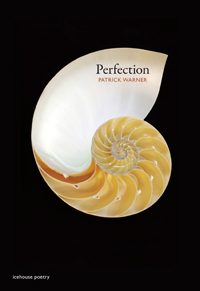
Perfection - Patrick Warner (Icehouse Poetry/Goose Lane Editions)

Today's book of poetry:
Perfection.  Patrick Warner.  Icehouse Poetry.  Goose Lane Editions.  Fredericton, NB.  2012.


Waxing

it began when I hit the snooze and slept in late,
           got worse when I perched on the edge of the bed
and in one fluid motion attempted to pull
           my still fastened shirt down over my head.

It was that kind of morning, a broken button
           I had once thought neat as a crescent moon
lodged with force on the bridge of my nose
           and cut into my flesh, a sickle. Blood trickled,

dripped from my nose to my lip to my lap,
          thereby waking a sleeper cell
in the form of a newly cut key which the guy
          at the key shop hadn't properly sanded.

In no time at all it turned into a breadknife,
          quietly sawing a hole in my pocket,
unbeknownst to me until the moment I reached
          for the gas pump and felt the spill

of coins down my leg. One lodged in my shoe.
          while several more scattered out in the slush
where they seemed to refresh themselves,
           turned silvery in the pavement's salted wet.

Like sparrows around a heated bird bath
           those coins seemed—if I can say such a thing—
to be enjoying themselves, seemed to be saying
           that every cloud has a nickel-alloy lining.

They said ignore the fact that bad things
           always happen in threes. Look up, they said,
and there above the park I saw a falcate moon,
           and felt again the pull of mysterious forces,

the magnetic coming together of pieces
           in a meaningful way—Professor,
let me explain: it's where the rule of three
           meets Murphy's law, it's the moment when

the number of things the average mind can recall
           is exceeded by one, but the spirit drawing
on unstable power—not Strong-Cobb units of forces,
           but Olivia Newton Joules of laughter—

invents an on-the-spot order. And so it was
           I took in the grin of that cracked -Aspirin moon
aligned above the bust of Winston Churchill,
           an unusual bust sawn off at the nipples,

and placed on a chest-high plinth in the
           eponymous park in such a way
that it looks as though he has stepped behind
           that polished granite block to take a piss,

his bulldog scowl revealing not only is
           bloody-mindedness but perhaps a waxing trouble
with his flow, much like that pump clocking
           five cents at a time in the early morning ten below.

...

Patrick Warner eases through the misery of the mundane we all endure as humans.  Sure, pathos and those other Mousekateers show up, but these tongues are looking for cheek.  Perfection is a hearty breath of grit.

The Therapist

In just five minutes she gave us our narratives:
you were the smoother-over, the peacemaker,
while I was the perfectionist, and together
we had passed these traits to our daughter,
given her food for her eating disorder.

"Do you want to be right or be happy?"
she asked. "That's too simple," I said,
"it doesn't need to be one or the other.
I feel happy when I'm right and right
when I'm happy. They can go together."

In just five minutes she gave us our narratives:
you were the smoother-over, the peacemaker,
while I was the perfectionist, and together
we had passed these traits to our daughter,
given her food for her eating disorder.

This was the pattern to be broken,
the second nature that usurped our natures,
but only if we admitted the problem:
that was fifty percent of the cure, the rest
would come from time in her care.

"Do you want to be right or be happy?"
Who doesn't want to be happy all the time?
Who doesn't want to believe in that fable?
She said she could fit us with flexible tools,
I thought about hardware. We nodded like fools.

In just five minutes she gave us our narratives:
you were the smoother-over, the peacemaker,
while I was the perfectionist, and together
we had passed these traits to our daughter,
given her food for her eating disorder.

She told us we each had the power to choose
not to let others take over our lives,
then she covered herself by means of disclosure:
"I myself was something of a perfectionist.
I myself was the great smoother-over."

This was the pattern to be broken,
the second nature that usurped our natures,
but only if we admitted the problem.
She showed us the root and solution.
I squirmed in my seat, a retrograde symptom.

"Imagine you're old," she said, "at sixty-five.
What then will you think about having been angry
for the best years of your children's lives?"
I nodded my head while plotting murder,
"I'll do anything," I said, "to help my daughter."

...

Warner doesn't make it easy for the reader.  This is romp amok poetry.  There is no line Warner won't jump into, onto, over and out.  Warner is riffing redolent and with a roue's regard.  This is fun, articulate stuff.

Patrick Warner's "Valentine's Day" poem is the best take on chocolates and hearts since Tom Waits plowed that field blue.

These poems prod like a finger poked in the chest of the reader.  Warner likes to play but he is a pragmatic grump and he never lets play get in the way of a harder lesson.  

The Owl

The vole's pink foot clattering through dark
sends decibels binging off the owl's disc face
to root in her tufted ears.

Her oscillating head's a radar beam
covering three quarters of the pie.

This owl's crepuscular. Her cryptic
plumage blends with dusk. Her serrated
flight feathers muffle wing beats.

There's nothing there but disturbed air.

Another poem for the great philosopher
who will eat three thousand in a season.

Leave behind a grey-brown pellet,
a fur and bone scroll for school kids.

...

These poems worked for me.  Warner's poems are rooted to an oral tradition that splashes words against the rocks of reason just to watch the rainbow in the mist and spray.

ABOUT THE AUTHOR
Patrick Warner is the author of three collections of poetry: All Manner of Misunderstanding; There, there, and Mole.  His work has appeared in numerous magazines and journals, and he has twice won the E.J. Pratt Poetry Prize.  Born in Claremorris, County Mayo, Ireland, Patrick Warner immigrated to Canada in 1980 and since then has lived mostly in St. John's, Newfoundland.

COVER BLURBS
"Warner's poems can be comical, tender, brutal...they are always enlightening in their implied connections, sublime in their musical inventiveness."
—Sunday Independent

"And there you have it: Warner's gift for casting a spell with the sure-wristedness of an experienced fisherman."
—Ruth Roach Pierson, author of Aide-Memoire and Contrary

"A complex poet, capable of seriousness and thought as well as whimsy and play."
—PN Review

www.gooselane.com

208

Wednesday, June 4, 2014

Pluck - Laisha Rosnau (Nightwood Editions)

Today's book of poetry:
Pluck.  Laisha Rosnau.  Nightwood Editions.  Gibsons, British Columbia.  2014.


Sometimes when you open a book of poetry and start reading there is a moment where you feel you are entering another universe.  The reader who enters Laisha Rosnau's world is welcomed to a new panorama where Rosnau leaves no doubt as to who the master of this universe is.  This is a fully developed canvas where every nuance is essential, every detail revelatory.

The universe Rosnau takes us into is familiar, it looks just like our world, except that Rosnau now gives meaning to those moments of wonder and suspense that linger just beyond our ken.

Fissure & Flood

Little fish, big fish, swimming in the water,
Come back here & give me my daughter.
—PJ Harvey/traditional

Whatever you do, don't picture a tight mouthed
sergeant demanding you push so hard that you launch

round offspring into the cut-banks that girdle the city. Don't
           think of salmon swimming upstream,

bloody and ragged, hooked on the confluence;
how the current forms clouds out of streaks of blood.

Instead, imagine women. They are everywhere, scrubbed
and name-tagged or walking the streets, legs thin as pins,

heels into each day like a needle in your arm, saline drip
           to replace what the baby will pull from you.

They'll beat pans to flush those babies out
as a bear looks up from the dumpster behind the hospital,

waves its snout in wide rhythmic arcs,
           a priest swinging incense.

The space between vein and blood is all there is
between you and her,
                                and then there is more—

*

Each time I give birth, my husband waters the garden
in response, plumps the front yard with pots of tomatoes

as I turn myself inside out, reveal
          how rosy we all are — our skin, theirs.

...

Laisha Rosnau tells us haunting stories about the way we live in the world.  Not haunting as in Stephen King scary — but haunting as  — how could she know what she knows.  Where does this uncanny ability come from, why does Rosnau get a sense the rest of us seemingly are deprived of.  How does she render the clear moment of understanding and comprehension simultaneously with the slack-jawed seconds of awe?

"Pluck", the title poem of the wildly good third book of poetry by Rosnau, is a longer episodic poem about the struggle to make family and to make sense of family.  These are universal struggles and as Rosnau says:

"We are all on our own here".

We Were Reasoning Wildly

What is reasonable art
to hang above one's marriage
bed? You thought shelter—an image

of a cabin glowing in snowy woods,
the oil paint thick and ridged, the frame
white, a little campy. We found it

in the basement along with other things.
The wire to hang it seemed sturdy
then busted one day but it didn't crash

down, instead balanced on the headboard.
You suggested we repair it
but I prefer to stumble

on objects whole, hope
all remains intact.
Back in the basement,

I found two paintings of owls, one snowy,
one great horned, perched on forked branches,
each looking either stoic or calm or both.

I hung the white one over my head, the one
with horned tufts over yours. Not to be too symbolic
but there are reasons to hang wild things

over us, two birds in different frames
on the same wall. So many reasons, one
being we should call out in the night more often.

A real owl, counterpart to your painting, startles
us out of sleep and we roll into each other,
lap at the heat of our paired skin, then dive

into our own worlds of sleep, talons out, ready
to plunder the whorled nests that will feed us,
keep us flying, silently towards each other.

...

I often read poetry late at night, in bed, with K sleeping beside me.  It is a quiet and sublime pleasure. That is until I read books like Pluck and find myself yelling out loud, grand squeals of agreement, shouted curses in surprise, screaming out exclamations of pure joy.  This happens when a poem is either so bad it makes me angry — or so good I can't help myself.

Guess which category the supremely gifted and oratorically blessed Laisha Rosnau falls under.

It was after midnight when I was writing about this last night, I yelled out "HOLY CRAP" at one point simply because Rosnau had made a cow jump over a moon in my mind.  Woke up my wife.

Kick A Small Moon

This is ours, and not ours, pass it on.
—Damian Rogers

Kick a small moon into the grass.
Giggle. Toss coins, lawn darts, desire
before they pin you to something.
Tear blank pages out of creased palms.

Be prepared for ignorance, teasing,
wounds, all exacted by you on you.
The future is an orphan, the dulcet
voice of radio tells you about its plight.

All the crayons are broken, the top
shelf of the cabinet is festooned
with tiny pills and sticky syrup
to make it okay, anyway.

There's a bear on the patio
and cubs curled into the tomato poets.
It takes us two days
to leave the house then

the sun presses down, crowns
our heads, knocks us on our arses,
forces light down our throats
till we're gutted by splendour.

Each season, we forget
the others, think this is it, this is
how it will be. We let go of the string
and the balloon floats away.

...

Pluck simply glows.  From one smart poem to the next, Laisha Rosnau carves through your imagination like she were a hot knife, you were butter.

ABOUT THE AUTHOR
Laisha Rosnau is the author of the best-selling novel The Sudden Weight of Snow (McClelland & Stewart) and the Nightwood Editions poetry collections Lousy Explorers, nominated for the Pat Lowther Award, and Notes on Leaving, which won the Acorn-Plantos Prize.  Rosnau lives in Coldstream, BC, where she and her family are resident caretakers of Bishop Wild Bird Sanctuary.

COVER BLURBS
"The subtlety with which Rosnau evokes the range of human emotion is striking. Ambition, vulnerability, thoughtlessness, desire—so much is laid bare by the smallest of details... In language assured and eloquent, Laisha Rosnau offers an edgy, big-hearted plunge into those moments of shift that show us at our most human. And reminds us that how one accommodates oneself to change, how one embraces and lives inside it, is a mark of one's humanity."
     —Marnie Parsons, Globe and Mail

"Exposed, expanding, these are poems on the verge of eruption..."
     —Jennifer Still, Winnipeg Free Press

"As imagery goes, it is difficult to recall someone I have recently encountered as talented as Rosnau...it is impossible to read one poem without instantly jumping to the next. The straightforward, pure beauty of these poems will resonate with you long after your first (and second, and third) reading."
     —Rhiannan Rogstad, The Goose

www.nightwoodeditions.com

207


Monday, June 2, 2014

How to Love a Lonely Man - Rhonda Douglas (Apt. 9 Press)

Today's book of poetry:
How to Love a Lonely Man.  Rhonda Douglas.  Apt.9 Press.  Ottawa, Ontario. 2013.


"What is language but a habitable grief."  —Mark Strand

Rhonda Douglas opens the doors with this little quote from Mark Strand.  It would seem that Douglas has dealt with her own share of habitable grief, and maybe a bit of your share as well.  How do we love any man/woman?  Douglas tries to tell us.

Song for July 1

I give praise to my country
if by country I mean the man
lying over me now, his white shoulder
lit by Ottawa streetlights.

Instant ceremony:
your palm to my hip, my hand hiking the westward plain
of your nose, your urgent mouth driving me onward.
Everything between us Pre-Cambrian now—
let's say this means we haven't quite peaked
yet my love, let's say this iambic echo of breath signifies [    ],
slide of skin over skin some manifestations of what happens
in the middle, round about Manitoba. Touch me here and
invoke the three seas. Oh, I never thought I could love
Moose Jaw like this. Do you also feel eighty-million years old,
like geology is just beginning? Talk me down the Laramide
orogeny, crumpling of continental plates, eventual erosion—
someday soon we'll need a quiet place to retire.

...

Would it be wrong to say these poems have "pop"?  Douglas is staking a claim to the treasure to be found late at night, she's trying to find a use for men.  And she is writing taut poems that remind us how beautiful the strings sound when properly plucked, how sour when someone is just carelessly strumming.

How to Love a Lonely Man

Take it as imperative, the must assumed.
Email often, every evening, even after
just to say hey, or be forsaken. Surely there are instructions.
Take notes on cue cards - now cut and cue to you in the Yaris
driving yourself home to East Coker again. Shift
into manual, stroke and soothe with lotion, don't
linger, know how to want but to have or to hold—
cuddle, coddle, nuzzle, nudge...Nope. Stroke
the greying temples of the head on your lap, don't say
Christmas, don't imply there are weeks to come. Love leaps to lonely
so quickly, late-night reading locked in your lovely condo,
books in the bed, along in the glow. Oh man, mad men are
in fashion and we, we are the hollow men, hollowed out, inviting no one in.

...

I like the pace of a Rhonda Douglas poem.  I like the precision and I like the playful ease with which she navigates down the page.

Apt.9 Press continues to make beautiful hand-made books and continues to find excellent poetry to fill the pages.

A Few Uses for it When It's Done

Letters can line the catbox, or (catless?) compost—
where every last promise shape-shifts to useful mush.

Miniature painting from Iran - couldn't its inlaid frame hold
up the leg of that abandoned coffee table? Make a snow-dome

for your desk, shake it up now and then to watch snowflakes
settle at the base. there are statues on Major's Hill: stick your

loss next to Laurier, then leave it alone. Robins returning
to the March melt will ring this stone sentinel with their leavings.

Aren't you done looking for Reason in the park? by now
you'll have rubbed off tarnish: set your toy idol in the window

so the next one passing can see how it shines, this intermittent
trinket, tchotchke of tossed and lost Scrabble tiles.

Write it off, that boy you used to know, used to love, used to
pardon my Biblical reference. This is the art of lost and found.

...

"This is the art of lost and found" - great line.

I liked this collection a great deal.  Douglas has the line that I like - clear as a clarion bell, but never as intrusive.  Her hard won wisdom sneaks up on the reader as though it were their own idea.


Tree Reading Series - Ottawa - Featured Reader 08 December 2011 - Rhonda Douglas

ABOUT THE AUTHOR
Rhonda Douglas is originally from Newfoundland but has lived in Ottawa with her daughter Emma since time out-of-Memorial. She is the author of Some Days I Think I Know Things: The Cassandra Poems.  Her poetry has won awards in the Newfoundland and Labrador Arts and Letters Competition, the Far Horizons Award from The Malahat Review and the Diana Brebner prize from Arc Poetry Magazine. Her short fiction has been published in literary journals across Canada and won first prizes from both Room Magazine and Prairie Fire. Rhonda completed her MFA in Creative Writing from UBC in 2012. She spends too much time on airplanes and always intends to change that, right after she obtains SuperElite status again.


apt9press@gmail.com

206