Monday, April 25, 2016

Tiger Heron - Robin Becker (Pitt Poetry Series/University of Pittsburgh Press)

Today's book of poetry:
Tiger Heron.  Robin Becker.  Pitt Poetry Series.  University of Pittsburgh Press.  Pittsburgh, PA.  2014.


Today's book of poetry is heartened by the moments of quiet celebrations Robin Becker finds again and again in Tiger Heron.  It is hard to deal with aging, the dead and the dying but Becker takes it head on and renders some peace out of the harrowing process.  

Tiger Heron covers some big ground in short order.  There are Yiddish lamentations to consider, unwanted dogs roaming the pages, an unwieldy horse sculpture being dismantled for transport and a Civil War re-enactment with cross-dressing scouts and friends, that is just the tip of the perverbial ice-berg.

Late June Owl

          They say it's a bad
summer for ticks, a good summer
          for day lilies

(Quality control likes
          to measure and evaluate
with continuous monitoring)

          They say my friend
has a few weeks, maybe a month
          but you never know

As the raptor people know
          how to keep the orphaned
screech owl before release

          may his keepers
open the airy nets of their patience
         when he tries them

They say the screech owl's trill
          has more than four
individual calls per second

          They say they can
barely hear his voice, more like wind
          than words

They say the owlet will leave
          the open cage when fully flighted
and capable of hunting

          They say the dying
will sometimes wait until everyone
          has left the room

...

Becker laments ecological with eloquence and subtle power in poems about mushrooms and flying squirrels and these are poems worth knowing.  Becker is laying some very deep tracks with Tiger Heron, and once you've read it you realize that the biggest strength is consistency, making you laugh or cry is easy but having these poems roll across the page as steady as cars on a train makes you take notice.  These poems are big and strong, solid like they were built of iron.  You can almost hear them rumble.

Becker is full of surprises, she is quite happy to make you smile before she drops the hammer.  She does not lack for humour.

The Weight
          for Jill Morgan

If some true measure of my mother's
          sorrow lay in each ounce of vermeil and gold,
then I could, bracelet by bracelet,
          account for years of sadness.

and so I took the box
          to the floor, to hold and smell
each piece, invoking the plate glass jeweler's
          windows and then the jolt of possession

when my father pointed to a ring or
          necklace pinned to a velvety cushion.
Sometimes, aboard a cruise ship, he'd get the urge;
          sometimes, flushed, after winning at the track.

She never went for the most expensive
          things like some girls do, he said after she died.
I sat there, cupping in my palms the stories,
         my hands sinking with the weight.

...

It's easy to get weighed down with family melancholia but Becker deftly avoids that trap by never becoming sentimental.  And besides, there are scuba diving in the Dominican Republic poems one minute and a climb towards a mountain summit poem the next, lovers get left behind or they leave.
It's all in the same fine tone as Becker sifts through our emotional dance in her search to give it words.

Today's book of poetry is convinced Becker is doing an exceptional job.  The best poems make the personal universal, speak to us all, we think Becker nails it.

Threesome Interval

That summer my cooking exceeded
          all expectations.
I excelled in tagine of chicken with olives
          and a curried Thai soup.

We biked to yoga at six a.m.,
          biked home virtuous
and clarified. Was it the Prozac? The new
          puppy glorious in red curls?

Your new man, the Scrabble champ? Even
          the wild blueberries astonished.
In Shelburne Falls, from the viewing platform
          we admired the glacial potholes

ground from granite by snowmelt and gyrating
          stone. Swirls marbled
the rock with a natural patina. We kept
          our composure,

despite hundred of millions of years
          whirlpooling abrasion.
Arriving at the Walt Whitman party, in great spirits,
          I wondered: might we try a trip to Rome?

At the tag sale, he found a first edition
          of Frost, and you snagged
a Henckels knife. We didn't deserve such
          good luck, but luck found us anyway.

...

Robin Becker knew long before the experts, long before they made it public, luck accounts for a big slice of the pie.  We are all one second, one false move away, from a new and different life.  We are riding a narrow and precarious ledge.

Tiger Heron made for a spirited read this morning here at Today's book of poetry.  Milo, our head tech laughed and then he cried.  Kathryn, our new intern, cried and then she laughed.  Robin Becker made them do that.

Robin Becker

ABOUT THE AUTHOR
Robin Becker, Liberal Arts Research Professor of English and Women’s Studies at the Pennsylvania State University, is the author of seven poetry collections, includingDomain of Perfect Affection, The Horse Fair, Giacometti’s Dog, and All-American Girl, winner of the Lambda Literary Award. In 2002 the Frick Art and Historical Center in Pittsburgh published Venetian Blue, a limited-edition chapbook of Becker’s art poems. She is the recipient of fellowships from the Bunting Institute, the Massachusetts Cultural Council, and the National Endowment for the Arts. In 2000 she received the George W. Atherton III Award for Excellence in Teaching from Penn State, and from 2010 to 2011 she served as the Penn State Laureate. For the Women’s Review of Books, Becker edits poetry and writes a column on poetry called “Field Notes.”

BLURBS“Becker's Tiger Heron, rich with animal life from the flying squirrel and prairie dog to inhabitants of the coral reefs of the Caribbean, expresses outrage and grief over the ongoing destruction of these ecosystems. A moving poem deals with homophobia, another celebrates Yiddish, ‘a mongrel, Middle High German.’ These vivid, self-confident lyrics ranging from villanelle to couplet deserve close reading.”
     —Maxine Kumin, Pulitzer Prize winner

Robin Becker looks straight at the failures of our human species, yet never loses her compassion or reduces the complexities and paradoxes to easy conclusions. Deftly, precisely, these poems express their wisdom in lines that surprise and delight. They are clear as open windows through which we see our lives.”
     —Ellen Bass, author of The Human Line

“Robin Becker’s poems have the limpid clarity of an early Flemish painting, the crisp details always fusing into a larger illumination. Complicated loss, unsparing truth, animal grace, small comforts—her deft and daring language yields them all up fresh, the paint still wet.”
     —Alison Bechdel, author of Fun Home

“The surprise of this book is that the poems are actually stories—about devotion and death and decay—but somehow they’re not sad stories. Because in all of them, Robin Becker reaches into the shadowy corners of love and pulls out feelings I didn’t even know I wanted named. I didn’t know you could sneak so much life into poems about death.”
     —Sarah Koenig, producer, This American Life
Robin Becker
"Solar," a poem by Robin Becker, 2010-11 Penn State laureate
Video: Penn State University


464


DISCLAIMERS

Poems cited here are assumed to be under copyright by the poet and/or publisher.  They are shown here for publicity and review purposes.  For any other kind of re-use of these poems, please contact the listed publishers for permission.

We here at TBOP are technically deficient and rely on our bashful Milo to fix everything.  We received notice from Google that we were using "cookies"
and that for our readers in Europe there had to be notification of the use of those "cookies.  Please be aware that TBOP may employ the use of some "cookies" (whatever they are) and you should take that into consideration.

Saturday, April 23, 2016

Fortunate Light - David Bergman (A Midsummer Night's Press)

Today's book of poetry:
Fortunate Light.  David Bergman.  Body Language 09.  A Midsummer Night's Press.  New York, New York.  2013.


You might want to know that A Midsummer Night's Press tell us that the 'Body Language' series is "devoted to texts exploring questions of gender and sexual identity."

For our purposes here at Today's book of poetry we want you to know that David Bergman's Fortunate Light burns with the best of them.  These poems are the bright kid in the class showing you how it is done.  These are Orca poems, top of the food chain stuff.

Bergman is firing tender lasers.

In Nordstrom's

Anything could be written on this face --
he is that young and unmarked
by imperfection, the skin smooth, the green
eyes grass at dawn. He finds my toes
in the shoes that are too long. He brings
out a size smaller. "Walk on them," he says.
"Hows do they feel?" he asks. In the presence
of such beauty, one forgets one's age and then
grows painfully aware of it. "They look good
on you," he nods, smiling. And for the first time
I notice all his clothes are wrong,
that any clothing would be wrong on the fine
light structure of his bones that was built
only for wings. Just wings.

...

Bergman is certainly writing poems that explore his sexual identity.  Beautifully gay.  Fortunate Light is a boutique museum with room after room of marble David's that Michelangelo would be proud of.  These poems are pretty much flawless, smooth as marble and solid as a rock.

Today's book of poetry loved the abiding tenderness in Bergman's ideals of intimacy and we loved the haughty horny virility of an older man's lusts.

But mostly Today's book of poetry greatly admired how flat out lovely Bergman's poems are.  These poems are nuanced without any gilding of the lily, they are clean as glass and splendidly, intensely erotic.

The Body Remember

The body remembers what the mind forgets.
Actors know this, and when their parts require
long-forgotten rage, they make a fist
and anger arrives just as they desire.
Pianists, too, rely upon their hands
to recall a piece they haven't played for years
and marshal the keyboard under their command
before the music rises to their ears.
And lovers who have long remained apart
because of argument or circumstance,
will feel, before it builds up in their heart,
pressures along the arm, then their embrace
releases from lips an unexpected grace,
words that they'd forgotten how to start.

...

This morning's read was another barn-burner.  Milo, our head tech, thought Bergman was the bee's knees.  Kathryn, our new intern, thought Bergman was hilarious in all the right ways.

Bergman is clearly a man with a sophisticated palette and an unlimited literary canon on his formidable shoulders but there is never any showing off.  These gems are as easy to access as opening the page and digging in, the rewards are immediate.  Smart doesn't necessarily have to mean impenetrable.

The Distractions of Beauty

Right after my reading, he appeared
so I could sign his book and talk. He was
seventy-five or so, small and thin,
with a well-trimmed arc of snow-white beard.

His wife of nearly fifty years had died
a year before, he told me, and he'd been
faithful to her even to the end, but now,
now he felt he wanted to be gay.

He always knew that he was gay,
but somehow -- times were different then --
he settled for a family and got
two sons, good boys, who now lived far away.

While he spoke, I noticed another man,
twenty-five I'd guess, who smiled at me,
then turned to show his bubble butt, the kind
that begs to be pricked so you can see just how

it would explode with pleasure. He told his sons
what he was up to, and one -- the one who lived
in San Francisco -- confessed that, like his dad,
he, too, was "a little gay," but later wed.

As for the other one ... The bubble butt
clenched tight and then released his cheeks; they flexed
again and again like a pulsing sea anemone...
The brother? What of him? I made a vexed

attempt to retrieve my mind, which had gone adrift.
Well, he was much too busy to listen and put
the news away like an unwanted gift
he'd unwrap someday when he had time for it.

At last he said, "I must be boring you."
O those words stung! Callous and rude,
I'd been unbearably distracted
by an ass that had, alas, since left the room.

Forgive me, I should have known better
than let mere youth steer me blind,
for age must always go first, with beauty,
(if it comes at all) following close behind.

...

Today's book of poetry can't even begin to tell you how much we admire the chapbooks produced by A Midsummer Night's Press.  These perfect-bound little pistols are pocket sized dynamos.  And David Bergman's Fortunate Light punches way above its weight.  This beautiful, tiny, little book is a heavy-weight champ and as tender as your favourite lover.

David Bergman

ABOUT THE AUTHOR


David Bergman is the author of three previous books of poetry, Heroic Measures, The Care and Treatment of Pain and Cracking the Code, which won the George Elliston Prize. His poetry has appeared in The Paris Review, The New Republic, Poetry, The Yale Review, among many other journals. He is poetry editor of The Gay and Lesbian Review Worldwide. He is winner of the Lambda Literary Prize as the editor of Men on Men 2000. He has published two studies, The Violet Hour: The Violet Quill and the Making of Gay Culture and Gaiety Transfigured: Gay Self-Representation in American Literature, which was selected as an Outstanding Book of the year by Choice and the Gustavus Myers Center for Human Rights. He is the editor most recently of Gay American Autobiography. With Katia Sainson, he translated the Selected Poems of Jean Sénac. Educated at Kenyon College and The Johns Hopkins University, where he earned a Ph.D., he is a professor of English at Towson University. He lives in Baltimore with his partner of many years, John Lessner.

David Bergman
 Smartish Pace poetry reading at Fraizer's, Baltimore, MD on Feb. 27, 2009. AWP fundraiser organized by the wonderful 2009 AWP President Ron Tanner.


462
DISCLAIMERS

Poems cited here are assumed to be under copyright by the poet and/or publisher.  They are shown here for publicity and review purposes.  For any other kind of re-use of these poems, please contact the listed publishers for permission.

We here at TBOP are technically deficient and rely on our bashful Milo to fix everything.  We received notice from Google that we were using "cookies"
and that for our readers in Europe there had to be notification of the use of those "cookies.  Please be aware that TBOP may employ the use of some "cookies" (whatever they are) and you should take that into consideration.


Thursday, April 21, 2016

Furs Not Mine - Andrea Cohen (Four Way Books)

Today's book of poetry:
Furs Not Mine.  Andrea Cohen.  Four Way Books.  Tribeca, New York.  2015.


Andrea Cohen just blew my mind -- as well as the doors off.  Furs Not Mine hums from the beginning to the end with excellence.  These poems hit you like jolts of pleasure electricity, they hit your poetry receptors like joy machines.

Whether Cohen is telling us about the nature of peaches, the childish pleasure of hiding in a cherry tree or inviting her dead mother to come dance at her side at Cohen's own wake, these beautiful monsters delighted.

Moment of Truth

A matador imagines he has
many moments of truth, those

moments before his final sword
play, before he and the bull part ways.

Then one evening, in the sky
above the arena, he sees a reddish-

yellow streak that mimics his cape,
and a cloud that mirrors

his likeness precisely. It's a momentary
distraction above the crowd

that calls for blood, as the bull
is upon him. This is the critical

moment for the toreador: seeing
the airy man he might have been.

...

Those of you who follow us here at Today's book of poetry, today is our 462nd post, know we almost always choose three poems for each blog.  Furs Not Mine presented us with a dilemma, pushed that envelope, gummed up the selection process.  

This is my first list for today's blog: 3,4, 19, 29, 36, 38, 39, 45, 48, 49, 51, 53, 59, 63, 73, 75, 78, 79, 85, 86, 87,88, 89.  Those are the page numbers of the poems I felt it was essential to share.  The numbers in bold are poems we thought were instant classics.

So after this morning's read we voted for today's poems.  The problem was that everyone liked everything, Milo and Kathryn were eating this stuff up like hot-buttered popcorn.  Everyone had lists that were too long.

In the end, as Editor-in-Chief and Dictator of Poetry Operations here at the Today's book of poetry complex, I went with my gut.  It was a a no-lose game, Andrea Cohen is a braggart's worst enemy because she has all the tools, puts it down with understated precision.

Gravy Boat

I've got one foot
in the gravy, one
in the gravy boat.

It's the same foot.
The other one?
I cut it off.

Otherwise it would
have stood its one
foot in the grave.

I balance easily now
in the gravy boat
on my good foot.

I got the boat cheap,
when Bolivia lost its coast
and auctioned off its navy.

Where am I sailing?
Who can say?
Goodbye Bolivia, hello gravy!

...

Enchanted.  That's today's word from Today's book of poetry.  That's the word from me.  Andrea Cohen's poetry is like spring after a hard winter.  These poems will break you out of your funk, they break over the page like the sun after a long, dark night.

Smart, smart, smart.

I'm not going to say that Today's book of poetry has been reduced to mere cheerleading status by Furs Not Mine but I did break out the plaid skirts, mega-phones and pom-poms this morning.
Today's book of poetry will happily champion Furs Not Mine, an early front-runner for the prestigious KITTY LEWIS HAZEL MILLER DENNIS TOURBIN POETRY PRIZE.

Bargain

We paid him next
to nothing -- less than the little
he'd asked for -- to lead us

at dusk from the pyramids
on camels into the desert.
Such slim wages

to take us, without
complaint, all that way --
so far, without a star.

We were in the middle
of nowhere, or at its edge.
Friends, he asked, from

inside that blackness,
what will you pay me
to take you back?

...

This is some fine, fine stuff.  On days like today Today's book of poetry loves his job and loves all of you.

Furs Not Mine can't come any more highly recommended.

(c) Francesca G. Bewer
Andrea Cohen 
(Photo (c) Francesca G. Bewer)

ABOUT THE AUTHOR
Andrea Cohen’s poems and stories have appeared in The Atlantic Monthly, The New Republic, The New Yorker, Poetry, The Threepenny Review, and elsewhere. Her previous poetry collections include The Cartographer’s Vacation, winner of the Owl Creek Poetry Prize, Long Division, and Kentucky Derby. She has received a PEN Discovery Award, Glimmer Train’s Short Fiction Award, and several residencies at The MacDowell Colony. She directs the Blacksmith House Poetry Series in Cambridge, Massachusetts, and the Writers House at Merrimack College.

BLURBS
"Who says true wit should be read its last rites? Andrea Cohen's deft lyric gift makes short work of that dire thought, cutting to the quick of all that casts a spell or a pall. In Furs Not Mine, she's come into her own by mastering the disarming arts of the pithy epiphany and the mordant lament, the bittersweet testament that takes but three steps from feathers to iron, the beguiling Metaphysical trope with a hard-bitten American twist. Her wily ways with the mother tongue are equal to every curve the world throws, showing over and over how the soul of wordcraft can run rings around 'the central O / of loss and going on.'"
     -- David Barber
"Furs Not Mine is a book full of completely new form and tone. To call this work 'intricately crafted' is an understatement, but needs to be said. Reading these poems, one feels a little afraid to breathe, that to shift a comma or change a line break would be to blow down the cathedral that's been built out of grains of sand. This is craft, but it's also infused with mystical moments, sacred intuitions. Delicate and difficult, there are some of the most memorable poems I've ever read. Period."
     -- Laura Kasischke

Andrea Cohen
reads from Furs Not Mine
Video: Merrimack College


462

DISCLAIMERS

Poems cited here are assumed to be under copyright by the poet and/or publisher.  They are shown here for publicity and review purposes.  For any other kind of re-use of these poems, please contact the listed publishers for permission.

We here at TBOP are technically deficient and rely on our bashful Milo to fix everything.  We received notice from Google that we were using "cookies"
and that for our readers in Europe there had to be notification of the use of those "cookies.  Please be aware that TBOP may employ the use of some "cookies" (whatever they are) and you should take that into consideration.

Sunday, April 17, 2016

Decline of the Animal Kingdom - Laura Clarke (ECW Press)

Today's book of poetry:
Decline of the Animal Kingdom.  Laura Clarke.  ECW Press.  Toronto, Ontario.  2015.

Decline of the Animal Kingdom - ECW Press

Laura Clarke is hilarious.  She is hilarious in all of the right ways.  Decline of the Animal Kingdom is a bestiary gone delightfully awry.  These poems will bring out the animal in you.

Did You Know? Fun Facts About Mules

Mules are sterile and cannot reproduce. However they are anatomically
normal and males must be gelded.

There was a boy who fed apples to the Shetland ponies just so he could
wrap his hands around the electric fence. Kind of like when your
cousin slit his wife's throat open and locked himself in the garage with
the gas on.

Mules are a"made-to-order" breed of livestock. These fine animals can carry
you safely on a trail, pack in the high country, compete in the show ring or pull
logs and other equipment.

He didn't manage to kill either of them. And those fine black hairs will
never fully come off your grandma's hand-knit-shawl. Wet cloths don't
work. Vacuums don't work. The preciseness of your hands doesn't
work. Might as well weave them in.

Mules are popular for many reasons. Pleasure riders find that mules are
smooth to ride, sure-footed and careful.

There was a woman. No, she wasn't pretty. Pretend I'm Nick Cave
or a male poet or a female poet--there's nothing like a serial killer's
eloquent voice and moonlight and the trunk of a car and a winding
road. The sound of middle-aged neighbours arguing about terrariums
will drive you crazy in a sunlit apartment on the third floor. Sorry, him
crazy. In any season.

The mule combines the best features of both of its parents.

Do regurgitated greens strangle your appetite? Do you only eat when
you're hungry? Do you abuse laxatives two to three times a week? Do
you think the people and animals you murder in your dreams will
haunt you, not figuratively haunt your thoughts, but haunt you like
real ghosts?

From the donkey sire, the mule gets intelligence, ease of keeping, sure-footedness
and longevity. The mare usually determines the size of the mule, its length of
stride, style and conformation.

I killed my neighbour with a chainsaw in a dream. I didn't mean to.
Still, I had to gather up the body parts in my own small hands and
bury them, and that changed me, both in the dream and in real life.

...

Haunting allegory and plenty of ghosts, Decline of the Animal Kingdom is a mule-train that you want to get on.  Clarke takes anthropomorphism to dazzling new places as she prances through the animal kingdom with both emotional elasticity and a certain moral flexibility.

If these aren't the questions that need to be asked they certainly are entertaining.  When Today's book of poetry was re-reading these poems they still barked, growled, howled and grrrr'd with velocity the second and third time round.

Extirpation

Geography never repeats itself.
The Tasmanian tiger live-tweets its extinction
from the Hobart zoo in 1933;
aurochs fling feces with their Holocene horns
across centuries, get dirty looks from HR.
Popular opinion shifts ever-so-seismically.
Good pets with bad press are still fucked;
terms of venery mean the world to me.
Everyone stops calling -- epochs beget epochs
between Friday night plans.
I murder your white hens, eviscerate
shell and feather indiscriminately,
smear blood all over your white chicken coop.
My eyes are beady. I ate your Greek yogurt
from the communal fridge.
I net only four percent of the Who Wore It Better vote,
the wolves having accessorized the blood
more elegantly by dragging their snouts
across fresh snow. I heard it
from the school of cod I used to hang with,
saw rumour vibrate from shell to shell
among the zebra mussels.
I've only ever eaten my share and then some.
Similar to the last known passenger pigeon,
I was last sighted in a flock of regular pigeons,
fitting right in.

...

Decline of the Animal Kingdom is Laura Clarke's debut but it comes with fangs fully bared, claw's out and a hungry raptors' dark and fearless heart.  The humour in these poems often comes with some blood left on the tracks.  

These poems have a swagger in their brash and gleeful arrogance, Laura Clarke can burn.  Today's book of poetry didn't know whether to spit or swear they made me giggle so much.

Architeuthis

When I finally saw the giant squid, I was like,
it's not that big. My dog pissed a heart shape
on the sidewalk and it was bigger than that.
I wanted the squid to go on forever, elephantine
subspherical suckers with finely serrated rings
of chitin, lively tentacles circling space and emerging
in the future, waving, eyes like soulful car tires,
ecstatic ink clouds enveloping birch trees and bridges.

Scientists brought the eye to my house
to demonstrate its close proximity in size
to a dinner plate, explaining only an extinct
aquatic reptilian predator matched the diameter
of its unblinking pupil, 9 centimetres or 3.5 inches.
Predictably, they placed it on an actual dinner platter,
and it looked right past me. In my own house.

Dear squid eye / dinner platter combo:
once my ex-boyfriend was hired to transport
plumbing supplies in Ottawa, becoming
so hopelessly lost in his oversized vehicle,
he was fired by end of day. The warehouse
was 20 minutes away, but he drove that truck
straight into the province of Quebec.

...

Today's book of poetry wants to read whatever juicy morsel Laura Clarke has planned for the future because this stuff was cherse.  Clarke has announced her arrival and made an instant fan out of me.

Decline of the Animal Kingdom is excellent coming out of the gate stuff.  You will never look at animals the same way again.

Laura Clarke

ABOUT THE AUTHOR
Laura Clarke's work has appeared in a variety of publications including PRISM International, Grain, the National Post and the Antigonish Review. She is the 2013 winner of the Bronwen Wallace Award for Emerging Writers from the Writers' Trust of Canada. She lives in Toronto, Ontario.

BLURBS
“Clarke’s mischievous, fabulist debut collection blurs the lines between the literal and allegorical as she employs a lens of anthropomorphism, an edge of misanthropy, and the slow unravelling of personae into disparate states evoking something between grace and madness. The stark, spare language of her poetry, which utilizes a variety of forms, belies its complexity . . . Clarke’s successful balancing of calculated loathing and euphoria makes for a fierce piece of performance art.” 
     — Publishers Weekly, starred

“The poems in Clarke’s debut collection appear deceptively simple at first glance, with the pop sheen of YouTube videos and movie reviews, but are in fact nuanced examinations of the relationships between people and animals, domesticity and the wild.” 
     — National Post

Laura Clarke
2013 Poetry Winner
RBC Bronwen Wallace Award for Emerging Writers
video: Writers Trust of Canada


461


DISCLAIMERS

Poems cited here are assumed to be under copyright by the poet and/or publisher.  They are shown here for publicity and review purposes.  For any other kind of re-use of these poems, please contact the listed publishers for permission.

We here at TBOP are technically deficient and rely on our bashful Milo to fix everything.  We received notice from Google that we were using "cookies"
and that for our readers in Europe there had to be notification of the use of those "cookies.  Please be aware that TBOP may employ the use of some "cookies" (whatever they are) and you should take that into consideration.

Friday, April 15, 2016

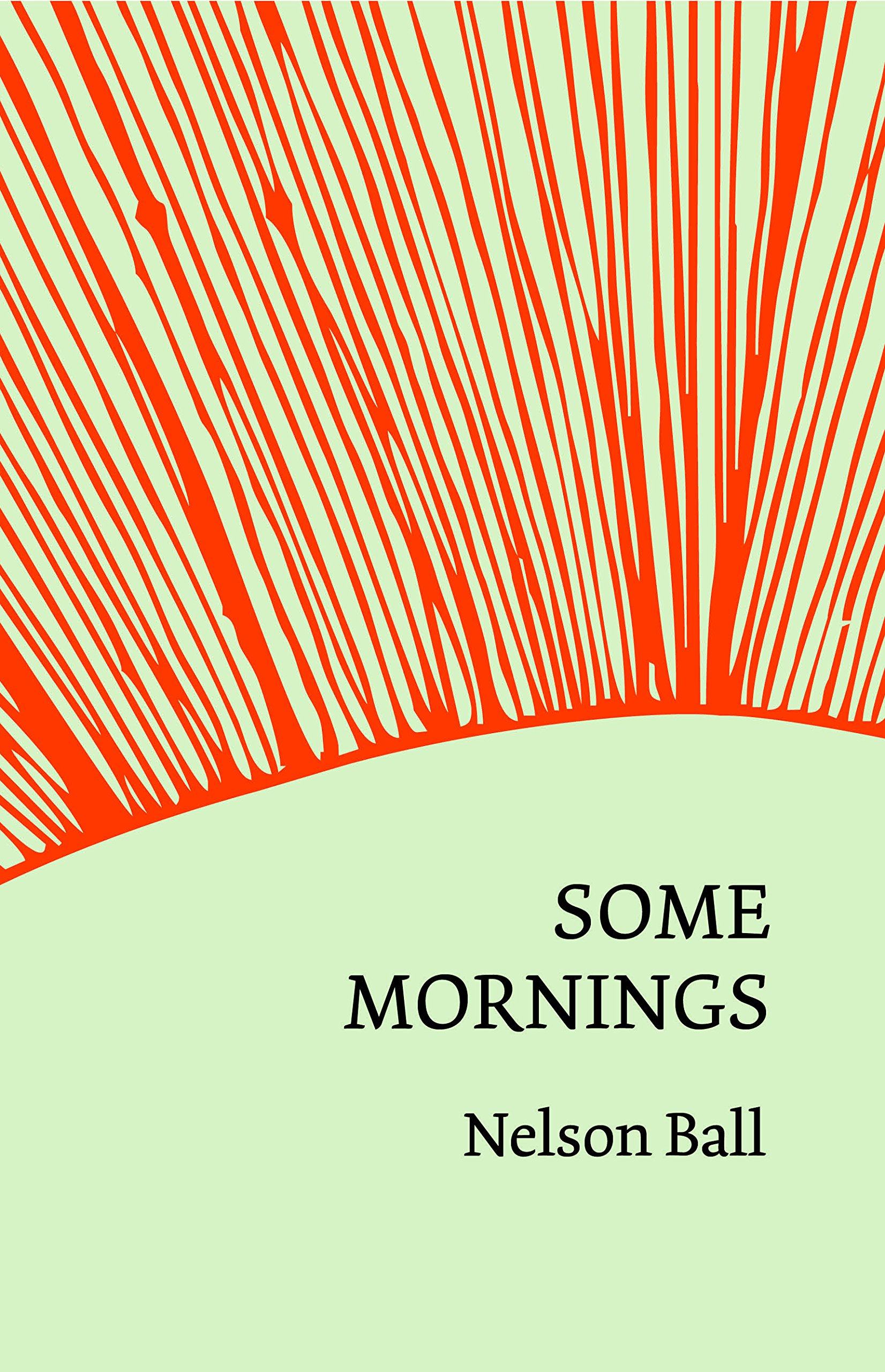
Some Mornings - Nelson Ball (Mansfield Press)

Today's book of poetry:
Some Mornings.  Nelson Ball.  Mansfield Press.  Toronto, Ontario.  2014.


Nelson Ball is becoming an institution here at Today's book of poetry.  Some Mornings is the fourth title from the Paris, Ontario poet to grace our pages.  Previously we have admired Minutiae (Apt . 9 Press), A Gathering (Book Thug), and In This Thin Rain (Mansfield Press) and you can find a link to those blogs below.

Nelson Ball continues to astound with his particular type of minimalism.  These poems hit the reader's ear as complete conversations, quicksilver and well-honed observations.

A Form of Grief

     In memory of Barbara
     and our friend bpNichol

Barbara and I
when we learned

of the death
of our friend

engaged in passionate
prolonged lovemaking

desperately
clinging to each other

asserting life
clinging to it

...

Even though Some Mornings is tinged with its share of grief, reading Nelson Ball is like fresh snow falling on Christmas Eve, it is always welcomed.  These poems are so clean and crisp on the palate that they make your mouth water.

Some Mornings reminds us of how beautiful the world can be when we slow down and consider what is before us, sometimes it reminds us of how beautifully sad the world can be.  There is all the beauty and sadness of the world in here.  

Much like the Nobel Prize winning Master of Japanese literature Yasunari Kawabata, author of Beauty and Sadness, In The House of the Sleeping Beauties, The Master of Go, Ball, a Master himself as far as we here at Today's book of poetry are concerned, uses a very deft brush in order to say more with less.  Kawabata wrote: "Put your soul in the palm of my hand for me to look at, like a crystal jewel, I'll sketch into words..." and Nelson Ball sketches with the best of them.

You Must Look Hard To See What's There

     In memory of David UU (David W. Harris)

He read
a poetry manuscript

several
times

at different
times of day

in different 
locations

David UU
told me

that's
what he did

now
that's what I do

...

You all know about our morning read here at the offices of Today's book of poetry.  Since Nelson Ball is the poet who has appeared most often on our pages we decided to do something a little different for today's reading.  For the very first time we dedicated a reading, this morning it was dedicated to Barbara Caruso.  Caruso, who has passed away, was Nelson Ball's other half and continues to be both his muse and the frequent subject of his poetry.

These poems are filled with hope and kindness and that is a good rare thing.

East of Plattsville

On the regional highway east of Plattsville
is a metal fabricating plant

it used to be
a pickle factory

every time I drive past now
coming from either direction

my eyes well up
as I think of Barbara

this happens
every time

always 
unexpected

until
now

...

Elegant grief and beautiful hopeful joy both abound in this tidy and robust little emotion machine. Today's book of poetry doff our collective hats once again to Nelson Ball and his ever so sublime Some Mornings.  You really don't have to look any further for anything.

Nelson Ball

ABOUT THE AUTHOR
Nelson Ball is a poet and bookseller living in Paris, Ontario. He has worked as a labourer, chauffeur, clerk, seasonal forest ranger, record store clerk and janitor. From 1965 to 1973 he ran the legendary Weed/Flower Press, publishing mimeo editions of early books by Victor Coleman, Carol Bergé, David McFadden, bill bissett, bpNichol and many others. He is the author of 25 poetry books and chapbooks.

BLURBS
He understands not only how to leave space for poems to breathe but also how to leave space for our brains to breathe. The rhythm of these poems are tailored to the way the contemplative mind works…”
     — Mark Sampson, Free Range Reading

“He sees what we all see, the small transitory moments that make up our lives—but there is nothing ‘small’ about his conclusions or observations.”
     — Michael Dennis, Today’s Book of Poetry

“From his seat at the pond’s edge, the poet learns to hear the language of its elements, and then teaches the reader to do the same.”
     — Nita Pronovost, Matrix

“At his best, Ball proves that short can be eloquent, and small beautiful.”
     — W. J. Keith, Canadian Book Review Annual
LINKS TO OTHER NELSON BALL BOOKS AT TODAY'S BOOK OF POETRY:

460
DISCLAIMERS

Poems cited here are assumed to be under copyright by the poet and/or publisher.  They are shown here for publicity and review purposes.  For any other kind of re-use of these poems, please contact the listed publishers for permission.

We here at TBOP are technically deficient and rely on our bashful Milo to fix everything.  We received notice from Google that we were using "cookies"
and that for our readers in Europe there had to be notification of the use of those "cookies.  Please be aware that TBOP may employ the use of some "cookies" (whatever they are) and you should take that into consideration.