Showing posts with label the hugh maclennan poetry series. Show all posts

Friday, October 20, 2017

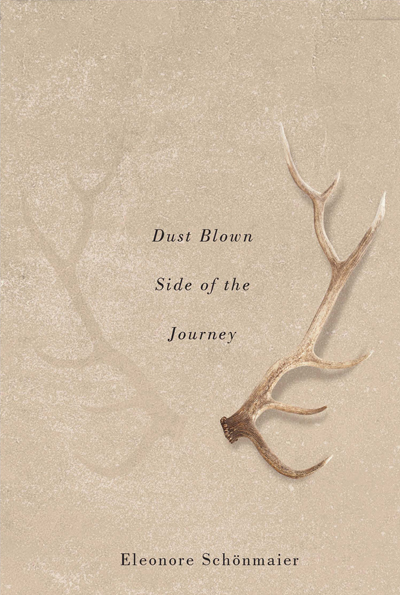
Dust Blown Side of the Journey - Eleonore Schönmaier (McGill-Queen's University Press)

Today's book of poetry:
Dust Blown Side of the Journey.  Eleonore Schönmaier.  Hugh MacLennan Poetry Series.  McGill-Queen's University Press.  Montreal & Kingston, London, Chicago.  2017.

Today's book of poetry comes to you from the waiting room of a CMA Clinic where Today's book of poetry is having x-rays of everything but our memory.  Bless those kind and wise men and women who established a medical care system in Canada that will allow me to leave this building without paying a cent.

I've been here less than ten minutes and already I am in a hospital gown and awaiting my first x-ray.  All of this to explain my recent absences.  That and Today's book of poetry purchased a new computer yesterday, it was needed.  Our steampunk wonder system was an RCA Victor - Westclox hybrid machine that was still running, technically, but it was getting difficult to find a watchmaker-video technician with the right set of brass tipped tools.

Eleonore Schönmaier is such a needed tonic.  Today's book of poetry has been down the remarkable   Eleonore Schönmaier  poetry road before.  You might remember that Today's book of poetry took a look at her back in July of last year.  Wavelengths of Your Song was a pleasure to read and you can see our post here:


Dust Blown Side of the Journey is more of the same wonder.  Schönmaier is a perfect mix of Nelson Ball's wonder and brevity along with the breadth and wisdom, experience and vision of a Lorna Crozier or a Sharon Olds.  That is some fine company and Schönmaier is right at home.

Today's book of poetry has been stuck in a poetry whirlwind, tunnel vortex lately and the only person I can blame is the genius Albert Goldbarth.  I've been reading Goldbarth's The Kitchen Sink as though it were a bible and I had discovered religion.  Our Southern Correspondent, the Twangster, has infected me with Goldbarthism and I'm not sure any other poetry will ever work quite the same way again.  But no.  Eleonore Schönmaier is the perfect antidote/bookend.  Both of these monstrously good poets write poems that stop us with wonder.

But while Goldbarth, bless his cottons socks, is writing long brocaded tapestries that have gold and silver thread and may possibly contain the secrets of the world, Schönmaier, although never terse, is writing with an economy that sustains and winnows to the very heart of things.

Risk

The doorbell has been cut
and the only way to gain entrance is
to stand in the middle of

the bridge jumping up
and down, but this futile
until you begin to sing

and from the upper-floor
window our friends looks
down and lets us in. We sit

at the window and touch
the seashells in their bowl
and our friend picks up

the conch, leans out
the window and lets it sound
so the canal boat captains

travelling below search
for the unseen and
in their confusion they

risk colliding with
the visible. Another
friend arrives and we

wine and dine and play
the Steinway as the storm
quavers against the roof

and the wind and jets flying
low overhead sound
alike as we journey closer

into our true selves
and you talk about
the wind quintet

you're composing
where the clarinet
will sound off stage

and you say all of us
are in your music
along with our missing

friend and walking home
I say, "I've had other
devoted friends before

but this evening's circle
are my soulmates"
and you say, "It's the

soulmates and not
the others who will
break our hearts."

...

Ok.  Today's book of poetry is at home, it is twenty-four hours later.  The clinic visit was just fine, at least they don't pincushion you.  Got home and started to look at the elegant work of Eleonore Schönmaier again and then there was a knock at the 11:30 a.m. door.  Today's book of poetry was expecting guests from out of town but was not expecting them to arrive six hours early.  Now these are world class guests, always arrive with wine and a variety of gifts.  They also always demand to take K and I out to dinner, last night it was Pizzarro's (We've been regulars there for over twenty-five years, I remember writing a poem for the head waiter when his first son was born.  A couple of months ago his first born was our waiter.  We've never had a meal there we didn't enjoy.)  Before our guests left this morning I was the owner of a brand new pair of winter gumboots.  Like I said, world-class guests.  But six hours early and in need of our complete attention.

Eleonore Schönmaier is a worker.  You only have to look at one of her poems to recognize the craft.  These poems are worked on, shaved here, strengthened there, and then a perfect coat of clear varnish has been applied.  These poems are weather-proof epistles aimed right at your reasonable heart and your emotional head.  

Take a hard look at this tidy effort, "Vertebrae of Humans and Art Animals."  It's all in there, Schönmaier shows us how it's done.

Vertebrae of Humans
and Art Animals

the breeze against my back
            as I cycle through narrow
                        streets were tattooed

men stroll and when
            I make a wrong
                        turn I'm face to

face with a sculpture
            of Mandela and the real
                        Desmond Tutu stepping

down from the podium
            photographers swarm
                        but I'm unable to stop

since I'm racing
            against time to a stretch
                        of beach where I film

the strandbeest
            small sails as wings
                        and multiple legs

the skeletal animal
            all plastic bone
                        races forward

frangible
            how easily
                        it topples

on my route home I watch
            an old man place a metal
                                   ladder against

the barbed wire fence
          he hangs a bird feeder
                     up as high as he can reach

in the center a young friend
            (attacked by a mob) undergoes
                                                         surgery

vertebrae, scapulae,
                          phalanges
                                       osteo-sculpture

which bones
              fit where
                           ossicles of

ear
    tympani
                  a wave a wind lifted leaf

under a tree a woman shows
                       her children how to read
                                               the tally marks

and tells them this is
            how many thousands of 
                                     days Mandela

had to wait to hear
                       bird song
                                   when his

captors knew
     exactly how
                 fragile bone is

...

Schönmaier isn't yelling about anything, this poet has far too much class for that.  But you read her and you see the strength, you see that she is a strong voice for women against the systemic in justices they endure.  You'll see that she is political but never proselytizing.  Reading Dust Blown Side of the Journey is like that first long cool and quenching gulp of fresh spring water after a long hike.

Considerable upheaval here at the Today's book of poetry offices these days.  Our morning reading was interrupted several times to continue negotiations.  It didn't matter much, Eleonore Schönmaier's crisp poems settled the room as we each took our turn and read them like prayers.  Of course we threw Wavelengths of Your Song into the mix.

We Are Alone

and lost along
the shore
the gentle slope
of the hill upwards
and we are found
again only when we
recognize the war
memorial where
resistance fighters
were shot and buried
in the sand of the dunes
you were imprisoned
in your youth for being
at the wrong place at the
wrong time, for trying
to make a better world
darkness falls upon
us and there is no
better world, only
the calls of the
nameless birds
in these brief
moments when
the birds still
exist for us: the bell
in the dunes tolls
once a year to
remind us of what
we still have
to lose

...

It doesn't get any tidier.  As long as poetry as fine as Eleonore Schönmaier's keeps arriving at the door Today's book of poetry will continue to want to tell you about it.

Today's book of poetry is hoping to return to regular programming as soon as possible.  Please stay tuned.

Eleonore Schönmaier

ABOUT THE AUTHOR
Eleonore Schönmaier is the award-winning author of Wavelengths of Your Song. She divides her time between Canada and coastal Europe.


"Knot"
by 
Eleonore Schönmaier
Video:  Eleonore Schönmaier


mqup.ca

618


DISCLAIMERS

Poems cited here are assumed to be under copyright by the poet and/or publisher.  They are shown here for publicity and review purposes.  For any other kind of re-use of these poems, please contact the listed publishers for permission.


We here at TBOP are technically deficient and rely on our bashful Milo to fix everything.  We received notice from Google that we were using "cookies"
and that for our readers in Europe there had to be notification of the use of those "cookies.  Please be aware that TBOP may employ the use of some "cookies" (whatever they are) and you should take that into consideration.




Tuesday, March 8, 2016

But For Now - Gordon Johnston (McGill-Queen's University Press)

Today's book of poetry:
But For Now.  Gordon Johnston.  The Hugh MacLennan Poetry Series.  McGill-Queen's University Press.  Montreal & Kingston, London, Ithaca.  2013.


At the heart of it Gordon Johnston's But For Now is a celebration of each new day, each new breath. Johnson's But For Now is a declaration of faith and hope.

Johnston has many questions about faith, about the very existence of God,  that counterbalance the certainty of his own belief, yet underneath it all the reader can see that Johnston's God is omnipresent.

A New Psalm, of Uncertainty

How shall we speak of you, O God?
  Is the thunder crack your angry voice?
    Are we children huddled under a blanket of faith?

We are needy, O God, and we need to tell you so.
  We need plants to grow, and come to grain or fruit.
    We need animals to offer their milk, and themselves.

We need a roof or tarpaulin, a blanket, a cup.
  How shall we speak to you, O God?
    If we beg, do you listen to us?

Hear us, O God, in our neediness and fear,
  And in our uncertainty, here,
    In our threadbare faith.

...

These are careful poems, each of them constructed with some inner musical ear that gives them all a quiet power.  Johnston tempers his certainty with a gentle and experienced knowledge that questions his own belief.

Johnston is suggesting that the way we look at God and faith may need to be rethought and he is doing it with charming eloquence.  But For Now is never proselytizing, which is a good thing for this heathen, he is always on topic and that means he is always searching for a better understanding of our time on this mortal coil.  Johnston is never trying to muddy the water, quite the contrary, But For Now is Johnston distilling faith into reason with music.

Factorem Caeli

from CREDO

Most days don't need heaven; here's enough.
Don't even like the sound of it, what I've heard:
all those people, and me not good in crowds.

Why would anyone want to be immortal?
What would you do every day all day, if they call it
day there? And rest eternal sounds the same, but night.

When I dream of reaching to hold you, my arms go through
   you;
I hear your voice, but it comes from too great a distance;
you appear in a crazy story, then you vanish.

What I want heaven for, more than anything,
is to see you again. I need to see you again.
In heaven I want to hear you, and see you, and hold you.

...

Factorem Caeli translates as "maker of heaven".

Reading But For Now was a treat, underneath everything is a feeling of quiet certainty that exudes a calming joy.  Johnston has finessed faith into a questioning beauty with this work and the resulting poems have a tight logic that is all their own.

When I tell you that there is a lightness to these poems do not think I mean they are slight, rather that they are illuminated from within by Johnston's hope.  Too much?  Today's book of poetry stands on every word -- you won't be able to read But For Now without experiencing it.

Finally The End of Poetry

Finally,
  the end
    of poetry.
No more
  poems, or
    the need for them.
We shall write to each
  other now
    from the heart
with the best
  words we
    can find
in the full light
  of everything we know.

...

At least one of our staff had the pleasure of being a student in a Gordon Johnston poetry class at Trent University, and look at where we are now.  Today's book of poetry was honoured to read But For Now and sends a big dip of our hat to its author.

Gordon Johnston's profile photo
Gordon Johnston

ABOUT THE AUTHOR
Gordon Johnston lives in Peterborough where he taught poetry for forty years at Trent University.


447

DISCLAIMERS

Poems cited here are assumed to be under copyright by the poet and/or publisher.  They are shown here for publicity and review purposes.  For any other kind of re-use of these poems, please contact the listed publishers for permission.

We here at TBOP are technically deficient and rely on our bashful Milo to fix everything.  We received notice from Google that we were using "cookies"
and that for our readers in Europe there had to be notification of the use of those "cookies.  Please be aware that TBOP may employ the use of some "cookies" (whatever they are) and you should take that into consideration.

Tuesday, November 3, 2015

Trio - Sarah Tolmie (McGill-Queen's University Press)

Today's book of poetry:
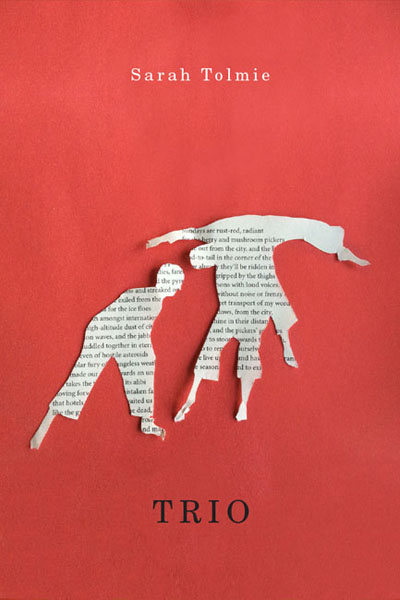
Trio.  Sarah Tolmie.  McGill-Queen's University Press.  The Hugh MacLennan Poetry Series.  Montreal & Kingston, London, Ithaca.  2015.


Back on May 14, 2015, Today's book of poetry wrote about Sarah Tolmie's excellent chapbook Sonnet in a Blue Dress and Other Poems from the also excellent Baseline Press.  Today we have the distinct pleasure of sharing Tolmie's first full-length collection - Trio.

This is another collection of sonnets, 120 of 'em.  You have to know by now that Today's book of poetry is not a big fan of the formal, but we do try to keep a polymorphous and evolving mind.  This is a good thing for the dance that Trio invites us to.

5

Touchy, touchy, beauty boy. And you say
You have no ego. The slightest hint of
Disapproval and you get plaintive
Or your hackles rise. You don't really
Know what you want from me. Fortunately,
I do. Reinforcement: you've long been short.
You need a constant bath. This phase may pass,
But I don't think so. Fine. Come right back
With a stung retort. Yet women pet you.
Do we not? Why? Not because you're cute.
Because it is what you're looking for. Mama's
Hurt boy cries out, help; helpless, we answer.
No fair, you say, I suffer. I agree.
I hear. Men like you need women like me.

...

Our female protagonist is strung out on a very tight high-wire where desire and reason are the anchors at each end of the rope.  Of course she tries to keep it all balanced but with the weight of two younger lovers it becomes a precarious perch.

Tolmie puts it all out there, she's on a delicate precipice yet continues to sing electric.

28

Experimenting with unusual grips
I get the soft gift of your equipment
Resting briefly on my leg. These liquescent
Parts of us that we hide away, as if
Shameful, are just in another state,
One not quite solid. Breasts that we have to
Pour into cups to carry, hanging
Testicular sacs, ridiculous, they
Pose a challenge to the rest of us.
We are not all hard, all made, cooked to
The max. Just as our breath is gas, so too
Are we these trembling yolks, delicate
Skinned fluids. Amid your solid strength
Is change of state, always being born again.

...

These poems reach past the simply carnal, they are sad Marlon with his butter in blue, blue Paris.  These elegant poems dream and cry in the same breath.

Tolmie knows exactly how long each light in the darkening sky will last.

115

We think love can beat death and entropy.
It can't. Best you can do is have it age
And change with you, capably. Holding
A new penny in your hand doesn't make
You any younger, and only richer
By one cent. The youth and beauty of
Another does not mean yours in not spent.
What did you buy with yours? Of that love,
What is left? What interest has accrued?
And how much would you lose, only to
Start again with a single penny? Not
Even yours, but merely lent? A sum
So small you hardly see it in your palm,
Just a glint for which you would trade all.

...

Sarah Tolmie's Trio is a marvel.  Clearly Tolmie is a lover of a more formal poetic tradition, and she honours it, these poems are submarine tight - but for someone who loves the form she sure delights in rendering it invisible.

Trio reads more like a romantic and sad pillow book.  A few brisk kicks to the heart and a somewhat lusty frisk.  Tolmie uses these sonnets like bullets from a poetry gun.  She is trying to navigate the bloody journey that runs between her heart and two others.  But make no mistake, Tolmie's the boss.
It is a strong woman's journey.

Today's book of poetry will follow Tolmie anywhere now.

Sarah Tolmie

ABOUT THE AUTHOR
Sarah Tolmie is associate professor of English at the University of Waterloo. Her books include the novel The Stone Boatman and the short story collection NoFood.


402

DISCLAIMERS

Poems cited here are assumed to be under copyright by the poet and/or publisher.  They are shown here for publicity and review purposes.  For any other kind of re-use of these poems, please contact the listed publishers for permission.

We here at TBOP are technically deficient and rely on our bashful Milo to fix everything.  We received notice from Google that we were using "cookies"
and that for our readers in Europe there had to be notification of the use of those "cookies.  Please be aware that TBOP may employ the use of some "cookies" (whatever they are) and you should take that into consideration.