Showing posts with label gary geddes. Show all posts

Thursday, September 14, 2017

Belly Full of Rocks - Tyler B. Perry (Oolichan Books)

Today's book of poetry:
Belly Full of Rocks.  Tyler B. Perry.  Oolichan Books.  Fernie, British Columbia.  2016.
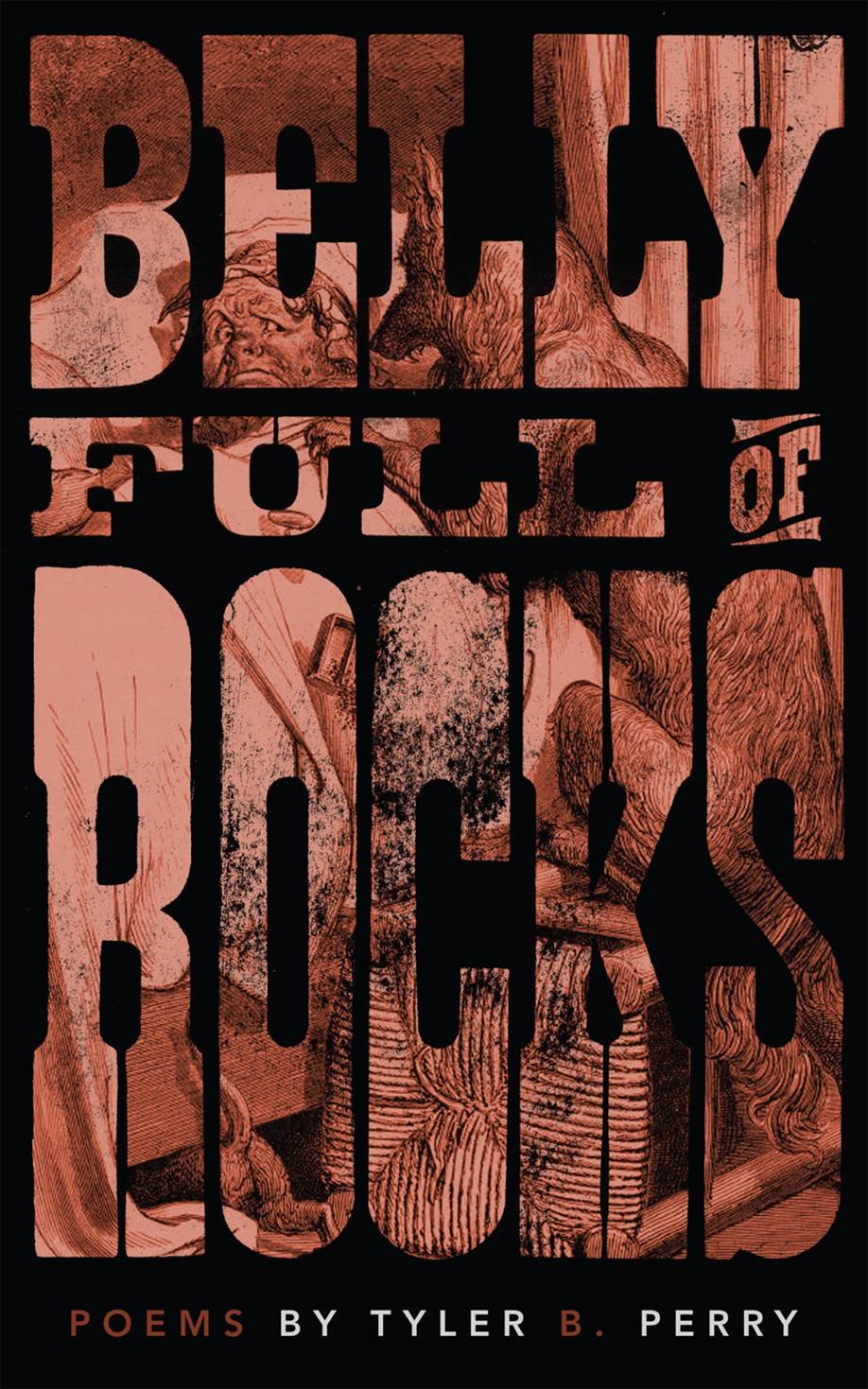

Tyler B. Perry inhabits fairy tales like Wayne Gretzky handled the puck, with utter disregard for tradition, the other players and a few of the essential laws of gravity.  Perry's poems offer us up an entirely new world or unearthly charms.

How much fun are the poems in Belly Full of Rocks?  More than you thought possible.  Because we all know the earlier versions of these stories Perry has a known template to dive off of, but when he begins to show his marvelous romp skills all hell breaks loose.

Once inside the fairy tales of our youth Perry delights in the helter-skelter reconstruction of an entirely new set of rules.  Perry establishes a new paradigm.  Our dark fears join our dark intentions and Perry almost dares us to peer into the foreboding new light:  Perry is casting light into the dark corners our heroes never admitted to.  Maybe we had the wrong heroes.

So, the wolf has had his bad day, tried to move on, but...

Wolf in the city

I've acquired a small house in the suburbs.
In the city, but close enough to the outskirts
that I can roam the river valley, prowl

the yards of cottages in the foothills.
I don't go into town much, except to buy
groceries and stroll the streets

after dark. At first I was self conscious,
but soon realized I could go
pretty much anywhere incognito.

A heavy pea jacket and a tuque,
fur sticking out from my collar,
snout tucked in. Mostly

I walk. I'm patient now, knowing
I'll have to learn the ways
of the city before I start

to hunt. I snuggle up
to street lamps, run my tongue
along two rows of teeth: shredders

and bone crushers. One day
the girl with the red hood will pass by,
and this time I won't forget to chew.

...

Belly Full of Rocks is a beautiful case of sustained magic.  We know after reading the first delightful poem in this collection that we are not in Walt Disney World fairy tale territory; Perry is more closely and easily aligned with The Brothers Grimm.

Red Riding Hood and the Three Little Pigs have never shared this much venomous rage nor been more like you and I.  On the surface the poems in Belly Full of Rocks play fast and loose with the fairy tales we all know and love.  It's clear to Today's book of poetry that there is ample sub-text at every turn.  There are primal urges vying the limelight right along with with primal fears, these fairy tale creature might be searching for salvation but Perry is reaching for illumination.

Tyler B. Perry deserves our admiration for the consistency of his conceit and how his new universe is such an eerie parallel to our own.

And that damned wolf, he doesn't know when to quit...

My story doesn't end

and I never seem to win.

I've been sliced, stuffed, drowned, skinned,
boiled and eaten, and yet I come again,
slinking with my trickery,

wicked about the eyes, meaning
to spring down upon you
and devour you in the darkness.

You can kill me and kill me and kill me,
but I will feed on your hate
and when the shadows
are their darkest, you will see my eyes:

two lanterns coming towards you
in the night.

...

This morning's read here at the office was a celebration, these poems ripping off of the tongue like bon-bons for the brain.  They only taste like candy, the reality is far more substantial, nutritious.

Belly Full of Rocks was such a pleasure to read that Today's book of poetry is starting to feel spoiled but in truth we read a fair bit of chafe here at TBOP before we find gems like this.  Tyler B. Perry is not the guy want reading to your children before they retire for the night - not if you ever want them to sleep.  This is for the grown-ups.

Tyler B. Perry goes that extra step, he even arranges for you to feel empathy for that notoriously evil old wolf and his sad lanterns.

I want to hunt

but the rocks slow me down,
my claws too loud on city sidewalks.
Streetlamps dampen the glow of my eyes.

Those pigs with their soft flesh and keen snouts
seemed to smell me before I even knocked,
heard the panting of my hungry breath.

By the time I'd reached the clever third,
he was waiting for me. He might as well
have left the door ajar and set out a pot of tea.

I still drip from the broth, my flesh
torn and bones bruised, chewed to a pulp.
My wounds throb, call to the moon.

Even the alley vermin aren't afraid
of me as I collapse and curl against the curb.
They crawl into my folds for heat.

When the white van pulls up I barely notice
until I feel the snare around my neck
and a sharp sting on my haunch.

I hear the trotters on the pavement,
the scurry of mice, feel soft arms
around me and sleep.

...

Today's book of poetry says to jump into this water head first.  Belly Full of Rocks is what we want from a book of poetry here at Today's book of poetry: it's amusing, arresting and alarming in all the best possible ways.  Perry has woven us into these myths, given them back to us to consider once again.  

Fine, fine, fine stuff.

Tyler B. Perry

ABOUT THE AUTHOR
Tyler Brendan Perry graduated from the optional residency Creative Writing MFA program at the University of British Columbia, and teaches high school in Calgary Alberta, where he lives with his wife, two kids, and a dog. He was captain of the 2010 Calgary poetry slam team, and is one of the organizers of the Alberta provincial high school poetry slam, Can You Hear Me Now? This is his second book of poetry.

BLURB
"You now what stories do, with their subliminally charged plots and scary messages, but do you wonder where they come from and what happens to those characters afterwards? Stay tuned, as Tyler Perry is about to reveal that you carry your stories within you, like stones in the wolf's belly, that you are both reader and author, puppet and puppeteer. Perry's Huntsman, standing outside his daughter's door listening to her breathe and toss in bed, senses the 'thin skin / of glass between her and the forest.' He also understands the gossamer that separates dream from reality. Setting out to carve children from whitebark pine, he finds them already there, ingrained in the wood, having 'seeped into the living / tree from the earth... his hands the engine of their release.' Hold your breath, step inside."
     - Gary Geddes, author of The Resumption of Play

oolichan.ca

608

DISCLAIMERS

Poems cited here are assumed to be under copyright by the poet and/or publisher.  They are shown here for publicity and review purposes.  For any other kind of re-use of these poems, please contact the listed publishers for permission.


We here at TBOP are technically deficient and rely on our bashful Milo to fix everything.  We received notice from Google that we were using "cookies"
and that for our readers in Europe there had to be notification of the use of those "cookies.  Please be aware that TBOP may employ the use of some "cookies" (whatever they are) and you should take that into consideration.

Monday, August 14, 2017

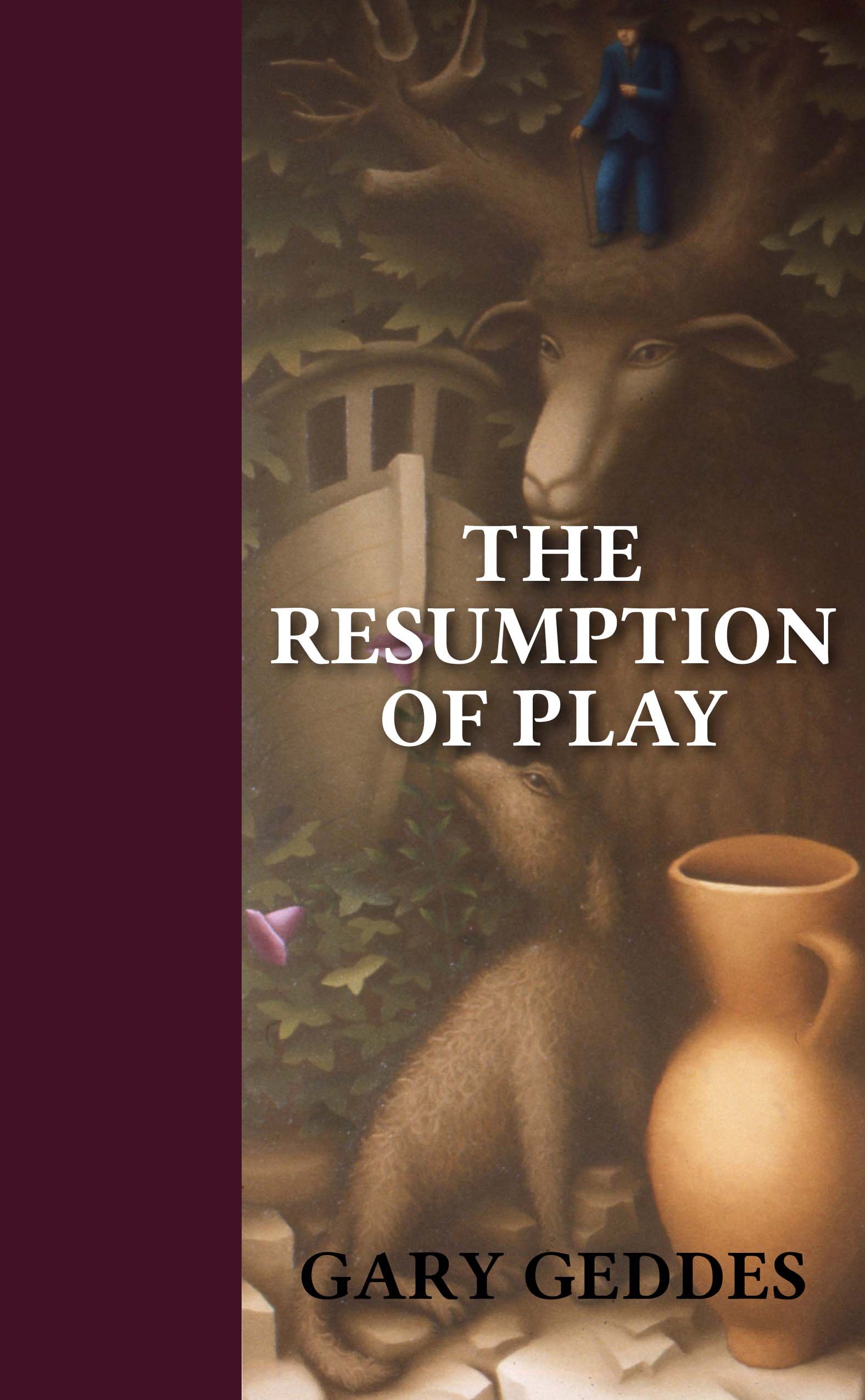
The Resumption of Play - Gary Geddes (Quattro Books)

Today's book of poetry:
The Resumption of Play.  Gary Geddes.  Quattro Books.  Toronto, Ontario.  2016.


Gary Geddes starts his most recent book of poems with this line from Friedrich Nietzsche,

     "We have art in order not to die of the truth."

And then goes on to fill our cup to brimming with nothing but the truth.  

Today's book of poetry feels as though we have been conducting a conversation with Gary Geddes since we first moved to Ottawa in the early 80's.  One of my first jobs in Ottawa was working for Saint Rhys of Knott at his Avenue Bookshop.  Avenue Bookshop was in a cluster of fine secondhand bookstores on Bank Street in the Glebe. The Avenue Bookshop specialized in Canadian Literature and it was a gold mine.  It was heaven, and that is where I discovered Gary Geddes.

When I say conversation, I have to confess that it has been entirely one sided.  I've never had the pleasure of meeting Mr. Geddes but I've had ample opportunity to get to know him.  Today's book of poetry send Milo, our head tech, to the stacks this morning and he came back with the following Geddes titles:

rivers inlet, 1972
Letter of the Master of Horse, 1973
Snakeroot, 1973
War and Other Measures, 1976
The Acid Test, 1980
The Terracotta Army, 1984
Hong Kong Poems, 1987
Light of Burning Towers, 1990
The Perfect Cold Warrior, 1995
Active Trading, 1996

It's hardly a complete list but Today's book of poetry isn't finished in that department.  

The Resumption of Play joins an esteemed body of work with more of the same clear, clean line that Geddes has almost always embraced.  The Resumption of Play opens with a long poem of the same name and it is a steam-roller, a longer poem, a poem of haunting truths and brutal realities.  Geddes goes inside the horror of residential school experience and no one comes out clean.

In other parts of the world other sorrows echo and the truth seeking Geddes cuts a wide swath.

Blues for Kony

I told the nuzungu my story, a reporter
I presumed. He wanted all the details
I could remember. Okay, I said. Yes,
there was pain, but that's not the worst

part. Besides these holes in my face
there is a vast hole in the universe
called the future, with no place
for the mutilated. Without my ears

I can still hear. Cutting off my nose
did not affect my sense of smell. Lips,
I discovered soon enough, are not made
to kiss, but to hold food in the mouth

while it's being chewed. A hand clasped
over my face serves two purposes:
enables me to eat and covers the shame.
Unlike the sister seated on my left,

I was not forced to kill my husband
in front of the children or serve as whore-
de-camp. Pregnant, I survived, God
knows why. Perhaps they had orders,

a logic that escaped me. The severed
parts, a bloody pulp thrust in my hands,
disgusted me, but I couldn't bear to toss
them in the bush. Human rights, that

was the phrase the reporter used
before slipping the ballpoint pen in a vest
pocket and closing his blue ring-binder
like a schoolboy anticipating recess.

As he unravelled his legs from the chair
and rose to leave, he asked a final
question, still unable to look at me:
What's needed to stop this carnage,

bring Kony's monsters to the courts?
Ah, justice. A quaint abstraction. Abducted
boys in posh jail cells in The Hague,
clutching a remote control instead of

an AK-47, watching vehicles blow up
in Kinshasa, Kandahar, London, Abidjan?
Bring them home, let the healing begin,
discharge a tender reconciliation.

...

Geddes hasn't limited his scorn for residential schools and the dignity stripping madness of cultural genocide in Canada.  Geddes has made a life's work of humanism in his poetry, he forces us to come face to face with the abundant injustices and indignities.

The Resumption of Play visits Somalia, there is a brief tribute to Virginia Woolf, a nod to the excellent poet Bronwen Wallace and more.  These poems visit the grave of Ezra Pound and "Tintoretto's version of The Last Supper." 

The one thing Geddes poems share in common is they are accessible because in Geddes world it seems clarity and honesty are always the high cards.

Monkey Business

What did we know of mythology
out there in the desert? Coyotes,

ravens, trickster figures, how
they take pleasure in havoc,

screw up the best-laid plans,
turn a clear stream blood-red,

and transform a friendly booze-up
into butchery? Scott's monkey

looked innocent enough, leather
collar, eyes closed, soft brown fur,

and one small paw clutching his
dog-tag, half obscuring the tattoo

on Scott's chest. What was going on
behind those smooth, pale lids?

Before the moon had paid its dues
a prowling teen lay bludgeoned

and dead, a string of bloody
spittle drying on his lips,

his last words, Canada, Canada,
still hanging in the air.

...

Our morning read was a little longer than usual.  Kathryn, our Jr. Editor, read the title poem "The Resumption of Play" in its entirety.  The staff rumbled through the other ten Geddes titles strewn about the office table and read from each of them, in sequence.

And then Kathryn read "The Resumption of Play" again because she was sure it deserved a second reading and she was right.  The only reason Today's book of poetry doesn't share this particular monster is because of the length.  But reading the poem "The Resumption of Play" is worth the price of admission to The Resumption of Play.  The rest of the book is good gravy.

A Song of Recall

And so it is with longing, you extend a hand
into the mist expecting to take hold of something
lost, perhaps the very thing you'd yearned for

but could not claim, a dream-shape, an unwritten
melody, insistent, that flitted in and out of your days
leaving its residue on your pillow, the faint smear

on an otherwise blank page, a colophon of desire.
You glimpse an apron, blue, with a pale, stitched
hem, a smudge of flour near the generous pocket,

enough to hold for a moment that lost mother
disappearing into the night who might, just might
be yours, wisps of her long dark hair surviving

cancer, surviving the flames, making a mockery
of memory itself, that insatiable canvas needing
to be filled, framed, needing to have occurred.

...

Today's book of poetry was very pleased when The Resumption of Play arrived at our offices several weeks ago.  We are honoured to have the opportunity to tip our hat in the direction of one of Canada's best poets.  Mr. Geddes has been sharing his fine poems with Canada and the rest of the world for more than five decades and we are happy to tell you that the song DOES remain the same.  The Resumption of Play is as contemporary as tomorrow's news.

Every poetry shelf in Canada should have some Gary Geddes on it.

Geddes author photo
Gary Geddes

ABOUT THE AUTHOR
Gary Geddes has written and edited more than 45 books of poetry, fiction, drama, non-fiction, criticism, translation and anthologies and won more than a dozen national and international literary awards, including the Commonwealth Poetry Prize (Americas Region), the Lt.-Governor’s Award for Literary Excellence and the Gabriela Mistral Prize from the government of Chile, awarded simultaneously to Octavio Paz, Vaclav Havel, Ernesto Cardenal, Rafael Alberti, and Mario Benedetti.

Gary Geddes
Attic Owl Reading Series
Video:  Lee Thompson


597


DISCLAIMERS

Poems cited here are assumed to be under copyright by the poet and/or publisher.  They are shown here for publicity and review purposes.  For any other kind of re-use of these poems, please contact the listed publishers for permission.

We here at TBOP are technically deficient and rely on our bashful Milo to fix everything.  We received notice from Google that we were using "cookies"
and that for our readers in Europe there had to be notification of the use of those "cookies.  Please be aware that TBOP may employ the use of some "cookies" (whatever they are) and you should take that into consideration.

Monday, December 1, 2014

The Trouble With Beauty - Bruce Rice (Coteau Books)

Today's book of poetry:
The Trouble With Beauty.  Bruce Rice.  Coteau Books.  Regina, Saskatchewan.  2014.


The Trouble With Beauty is Bruce Rice's fifth poetry collection.

These poems are entirely down-to-earth missives, without artifice.  Those of you who follow Today's book of poetry will know that these are the books I like best.

Glossary of Hills

There should be a glossary of hills
                       if only to say golden afternoon light on a butte
             weathered down to the clay is not old,

though these hills are old.  There should be a sign for the breath
                                    taken in the space between one hill and another,
             a notation for a voice on a ridge.

We need a name for one slope disappearing
                                   into the mist of the next and the faint green hyphen
joining ourselves to distance, to the deep memory

                                                          of how once we studied hollows for life,
                                  knapped blades from a flint core, learned
and remembered it all as if our lives depended on it - and they did.

Then we would know how ancient we've become
                                    watching the shallow brown river
            that seems not to move, all the while cutting away the time we have left.

There would be no apostrophes
                                   in the Book of Hills, no possessive form.
                       To open the cover would be like looking

                                                into the mirror
of our own faith, all the lost translations,
                       the songs at the end of the wind.

...

Rice is having a gentle conversation with the land itself.  These poems invite us to participate in that conversation.

Rice, I think, would argue that there is beauty almost everywhere in spite of what we humans have done to the planet.

Advice

I should do a better job of taking my own advice.
I am just getting the things my poems
knew all along.  Sometimes it's messy;
I peer into the chest of Patient 19, his pink ribs
retracted.  I am the sleep-deprived intern,
not to be trusted with brutal and delicate instruments,
so I take notes, the teacher disappointed in yet another
average student.  I wonder if the Apostles had it this bad
as they stood in line at the table.  Was the bread sweet?

These ecstasies we imagine - saints' eyes turned upward,
arrows dripping like leaves, the yellow-grey smudge
of a pyre - cannot compare with an empty road
and all the ghosts on it.

I trust the instincts of birds, oceans of grass
rushing up slopes - see a thing tremble
and I want to put it safely where it belongs.
I cannot choose what is already in me.  I feel nothing so heavy
as the great ennui of carrying on, though I am saved by the fact
I cannot see a horizon without going over it.

...

Rice has hope to share with us.  But it would be misleading to think about these poems as nature poems.  Human folly and human achievement, bravery, courage, failure, they are all in here.

At our offices we like poetry that is accessible - but that doesn't mean easy.  Rice asks some hard questions, muses poetic with the resolutions.

Origins

Where nothing is, small desires
have consequence.

In our night harbour, the indifference of the ocean is benign.
Its slender breath pushes us to shore for hours.

The colour of every inlet is different yet water cupped in the hand
is transparent.  Memory is like this.

A child knows our home is a starfish, dangling its arm in the millennial tide.
Further out nebulae curl crimson as tubeworms, a shy luminescence:

Which abyss did we come from?
Riding a planet-sized rock.  Yahoo.


When we hunt we must travel.  To forget is to die.
Every bay has an echo so name it.

These islands move, evolving into themselves, a dictum on survival -
seeds in a mudball, a million lives in trust of the feet of birds.

The most natural thing is to want to know where weather comes from, the ways
beaches differ -- ropy and treacherous, or a midden of shells,

a place to inhabit a week or a season, the sea's floating skin
measured in microns on which we sail.

...

Bruce Rice celebrates beauty and I see much truth.  What more does a poet aim for?

 Bruce Rice

ABOUT THE AUTHOR
Bruce Rice has published four books of poetry, including Coteau’s Descent into Lima (1996) and Saskatchewan Book Award-winner The Illustrated Statue of Liberty (2003).
Bruce’s first collection, Daniel,(1988) received the Canadian Authors Association Award, and his most recent title, Life in the Canopy, was a finalist for Book of the Year in the Saskatchewan Book Awards. He received Grain magazine’s 2002 Anne Szumigalksi Award for the best poem or sequence published in Grain that year. His work has been broadcast on CBC radio and he has collaborated on several poetry performances and excerpts which were performed in Globe Theatre’s “On The Line” series. Born in northern British Columbia, Bruce Rice grew up in Prince Albert and spent a decade in the Canadian Maritimes before settling in Regina where he continues to live and write.

BLURBS
"Bruce Rice's poems ripple across the land like light slanting through clouds, tender and relentless by turns.  He is equally adept at surprising us with crisp details -- the track of a coyote imprinted in mud, the blank-faced stare of a cow -- and at probing the shadows for wisdom.  The Trouble With Beauty is down-to-earth, immensely pleasurable and highly recommended."
      Candace Savage, author of A Geography of Blood: Unearthing Memory from a Prairie               
                                                  Landscape

"In "Self Portrait As Landscape," Bruce Rice's speaker confesses: "These meditations feel like signs/
in a language not fully mine."  It's the modesty, the reluctance to overstate, that appeals so much here, that draws us into the poems.  No theatrics, no preening of the ego, but full attention to the land, the language, and the "dark line" inside that seeks out the battered, reluctant beauty in things.
     Gary Geddes, author of Falsework and What Does A House Want?


273