Tuesday, May 15, 2018

Poems for New Orleans — Edward Sanders (North Atlantic Books)

Today's book of poetry:
Poems for New Orleans.  Edward Sanders.  North Atlantic Books.  Berkeley, California.  2008.


Edward (Ed) Sanders is our third favourite Sanders in the world.  Pharoah Sanders will always win that race and Bernie Sanders is an ace example of how the best of us comes to live in one hard working soul.  Third place doesn't sound like much of a prize but Today's book of poetry has long admired Mr. Edward Sanders, the poet.

Edward Sanders wears a lot of hats.  You've probably heard of his culture crashing musical group The Fugs.  Sanders opened the famous Peace Eye Bookstore in New York, and was on the ground in San Francisco when Beat met Hippie.  His bibliography is longer than my arm.

So I was disappointed when Milo came back from the stacks with only one Edward Sanders collection.  Today's book of poetry has a first printing of Sanders first publication, Poem From Jail (A City Lights Publication, 1963), but that was it.  Milo, our head tech and book scout, has been tasked with filling in those huge Sanders gaps in our library.

Poems for New Orleans continues Sanders long history of investigative poetry and it is a Katrina induced HOWL.  Poems for New Orleans is full of Sanders encyclopedic research and tempered by a lengthy residence in situ in the Big Easy.

Today's book of poetry thinks we should all agree that pound for pound, there may be no more famous town on earth.  New Orleans is a town that has inflamed the imaginations and compelled discovery for generations.  From a swamp-stop-tent-town to a modern metropolis.  And into that Sanders brings William Blake for a look around, has Mark Twain twang and Lee Harvey take a stroll, mourns the loss of a beloved Magnolia tree, hates FEMA and sings wildly into the chorus we all know, songs for the everyman.

Marie Lebage and Huey Long

Her name was Marie Lebage
She was a school teacher
and she worked in the campaign of Huey Long
                                                                       in 1928

At first she didn't really know why
but then she just got swept up

She was the great granddaughter of Lemoine Lebage
who fought alongside Andy Jackson in the Battle of New Orleans

Marie had young kids
and the State of Louisiana charged money for textbooks

but when Huey Long became governor
he not only made the textbooks free
he started giving black teachers the same money as whites

Could it be that Huey was a savior?

She was sick of the generations of
post-slaver whites who always had one tune to sing:

"Don't give those black folk, not a dime
That will come another time"

It's hard to pick a fight with greed
when greed is such a seed

but in the middle of the Depression
she watched the right wing

rise up with hatchets of hatred
as only the right can do

Ask the Gracchi of ancient Rome

Marie already knew about hatred
She'd faced up the klan
ever after they put death fliers
on her porch in the Lower 9th

But the slavers really hated Huey
They snarled he was a pawn of Marx
but Marie Lebarge was totally certain
that Huey Long's slogan "Share Our Wealth"
came from the sermons of Jesus
and Jefferson's love of revolution.

She took the bus to Baton Rouge
on a stark September day of '35
She was part of a choral group that was singing
the anthem Huey had written
                                             "Every Man a King"

by the front steps of the capitol
when the Kingfish was gunned to the stone
even though he was surrounded by bodyguards

A dead savior is a dead savior
and nothing was left but a cash-starved machine
and a president headed for war

            (chant)

It's hard to pick a fight with greed
When greed is such a seed
for Greed loves bullets
like water loves pullets
and down dives luck and pluck
like a Pontchartrain duck

...

Poems for New Orleans offers up some alternative views as to what the true history of the magic town could be.  Sanders is willing to imagine a different and a better future for New Orleans but sometimes he needs fantasy to do it.  

Edward Sanders has a honed, hair-trigger sense of humour, a sense of duty in honouring history, and a bigger sense of responsibility than most about the hubris of those responsible for the human tragedy during and after Katrina.  That's a lot to put into one book of poems and Sanders knows it.  But clearly Sanders has paid the price of admission, spent double-time on his homework.

Today's book of poetry was never quite able to figure out the lyrics to the Tragically Hip song "New Orleans is Sinking" but I thought we should play it on the morning rotation along with Don McLean's "American Pie."  McLean knew about the levies and more.  Arlo Guthrie sang about "The City of New Orleans" so he had to be included as well.

Then we thought Dixieland, then Zydeco, then all hell broke loose.  Kathryn, our Jr. Editor, and Maggie, our new intern, were both dancing with Milo.  Max opened his office door and a blue wall of what looked like a heavy fog rolled out behind him, he waltzed over to the gyrating threesome and put down some John Travolta moves that jaw-dropped the room.  Then, he spun around, returned to his office murmuring something about emptying the swamps, history of evil, alligators not being the worst beast that slithered, and his door shut with a blue wisp halo around the edges of his office door.

Edward Sanders studied Greek in university and isn't shy about bringing in some of the Greek gods to stir things up, Greek historians too.  Sanders knows that New Orleans is bigger than any one tragedy, it has endured a million sorrows and if the soil had memory it would be weeping blood.  Yet Poems for New Orleans remains a celebratory incantation to the future to remember; and it is a bit of a prayer.  As Heraclitus said: "No man ever steps in the same river twice, for it's not the same river and he's not the same man."

Echoes of Heraclitus

Four days I sat in the attic
with 27 cans of beans
we were going to use on Labor Day
and some coca cola I drank very slowly
                                                       to make it last

Finally I bashed and bashed
with a can
till I created enough of a breach
to pry open the smallest slit in the roof

O my God!
one of my neighbors was floating with
her hair entangled in a tree limb

A helicopter flew me away
I wound up in Utah
where I'm waiting for Jesus
or anybody

to help me home.

That's what my mother always said:
The rivers always pours toward poverty
You can't lose the same house twice

but once you get to heaven
the water makes God's bread to leaven.

...

Our morning read here at Today's book of poetry was tempered by my poor sleep last night.  Today's book of poetry's biggest fan and supporter is in Montreal for a few days and the place feels empty without her.  But the crew gave Poems for New Orleans a good rally around the flag and that cheered me immensely.  Sanders encouraged a vibrant reading with his splendid narratives and tender heart.

Today's book of poetry would be remiss if we didn't extend an extreme bow to Edward Sanders along with a "Thank You Sir" in the robust and genuine style of one of Rob McLennan.  Sanders has been on the poetry beat for a long, long time and his poetry still feels fresh, immediate and necessary.

Ironing Board

They took a picture of Gandhi's personal possessions
at the time of his killing
a pair of glasses, a robe, sandals
                                       & maybe a water jar

Not much more.

I feel the same way most of the time now
that all my stuff has washed away in the flood
I'm Free of those toilsome burdens
free of my doormouse diaries
free of my kitchen cabinet
                          & its ancient hippie tea from 1969

but I can't help it—
I miss my ironing board

and the letters you used to send me
                                           after we were beaten in Selma

...

Edward Sanders has been publishing his brand of anarchy and beauty to appreciative audiences for over half a century.  It hasn't gotten old yet.

Today's book of poetry is proud to introduce Sanders to some of you younger readers.  For any of you old enough to remember "I Love Lucy" Sanders will be a poet you know like an old friend you can depend on.  Edward Sanders was present back in the day, he remains a vibrant people's poet, a necessary voice.

Image result for ed sander poet photo

Edward Sanders

Image result for ed sander poet photo

Edward Sanders
Back in the day.

ABOUT THE AUTHOR
Edward Sanders was a founding member of the seminal bohemian rock band The Fugs and a prominent figure in the 60s counterculture. He is the author of numerous books of poetry, fiction, and nonfiction, including the bestselling study of Charles Manson, The Family. The winner of a number of writing awards, including a Guggenheim and an NEA fellowship, he lives in Woodstock, NY.

BLURBS
"Ed Sanders—poet, Pentagon levitator, classics scholar, founding member of the Fugs—is a political force in Woodstock, New York."
—Hendrik Hertzberg, The New Yorker

“No poet today writes history better than Ed Sanders. From the Duke of Orleans’ fragile grouping of houses in 1718, to wealth and heights with Mardi Gras and fun without guilt, to the storm of Katrina, the bard of our continent gives us the truth with these poems and songs.”
—Joanne Kyger, author of About Now: Collected Poems

“Sanders the poet-maestro of American history excels his own lyrical genius with the truth beams he sends flashing in Poems for New Orleans.”
—Michael McClure, author of Scratching the Beat Surface

“A magisterial suite of poems tracing the Crescent City from its founding in 1718 through the ravages of Hurricane Katrina, Poems for New Orleans is a vertical history in verse, recalling Charles Olson’s Gloucester and William Carlos Williams’s Paterson."
—Nina Shengold, Chronogram Magazine

“The bad handling of Hurricane Katrina is a central point of this book, but more importantly, Sanders also sheds light on the after-effects and the suffering it imposed on those who were displaced. This type of ‘investigative poetics’ is not new territory for Sanders… [H]e has put his best foot forward to cover one of America’s greatest tragedies. The book is interspersed with sharp, quick-witted shorter works that glue the larger poems into a taught fabric; the shorter poems represent an alternate poetic frequency and outlook that allows the larger, more musical poems to mesh exceptionally well.… Poems for New Orleans provides a much-deserved helping of poetic justice.”
—Darrin Daniel, Rain Taxi

“Ed Sanders, in his Poems for New Orleans, leads us at one point to imagine the goddess Athena reappearing to intercede for yet another place where ‘something has shamed justice.’ The work is, as he says, ‘a prayer for the victims’ of this injustice. But it is also a Prophetic Book, an eloquent cry of righteous indignation. And it is an Apologia for the Polis, a celebration of the Queen City, the Fertile Crescent, with its richness of culture, history and humanity. In producing this extraordinary work, Sanders has combined the patient labors of the engaged historian with the creative inspiration of the poet.  The Poems enlighten the reader about the thick particularities of real, lived history, especially through the narrative ribbon of the deeply moving Lebage family history that runs through the work. At the same time, they enchant the reader with the magic of the place, so that one can well imagine the visionary Blake crossing paths with the Voodoo Priestess Marie Laveau. Sanders brings to the scene of the crime and the dramatic landscape diverse skills, ranging from those of an Investigative Poet to those of a Rhapsodic Historian.  The Poems reveal that he has gained a deep and empathetic knowledge of the city's history, its people, and its complex personality, that he has intently ‘listened to the whispering of its secret mind.’ ”
—John P. Clark, Gregory F. Curtin Distinguished Professor in Humane Letters and the Professions at Loyola University New Orleans


Edward Sanders
Poems for New Orleans
"The Battle of New Orleans"
Video: ParisRecordsVideo

northatlanticbooks.com

687

DISCLAIMERS

Poems cited here are assumed to be under copyright by the poet and/or publisher.  They are shown here for publicity and review purposes.  For any other kind of re-use of these poems, please contact the listed publishers for permission.
We here at TBOP are technically deficient and rely on our bashful Milo to fix everything.  We received notice from Google that we were using "cookies"
and that for our readers in Europe there had to be notification of the use of those "cookies.  Please be aware that TBOP may employ the use of some "cookies" (whatever they are) and you should take that into consideration

Saturday, May 12, 2018

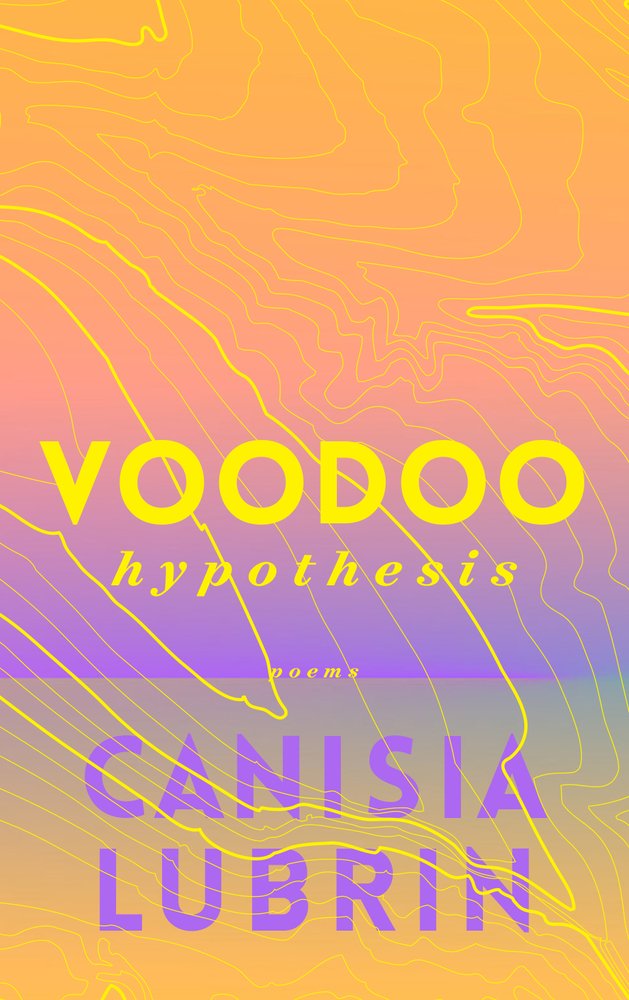
Voodoo Hypothesis — Canisia Lubrin (A Buckrider Book/Wolsak & Wynn)

Today's book of poetry:
Voodoo Hypothesis.  Canisia Lubrin.  A Buckrider Book/Wolsak & Wynn.  Hamilton, Ontario.  2017.

SHORTLISTED FOR THE RAYMOND SOUSTER AWARD


Today's book of poetry does not like to admit that we were wrong, about anything.  Canisia Lubrin's Voodoo Hypothesis has proved Today's book of poetry to be as wrong as we could possibly be.  We have been supping on our own words.

On our first reading of Voodoo Hypothesis our reaction was luke warm.  But not warm enough to get excited enough to write about.

And then, contrary to our belief system about readings and how they relate to the printed page  —  Today's book of poetry heard Canisia Lubrin read.
                                                                                Damn.

It has never felt quite so good to be so wrong.

Today's book of poetry remembers seeing Allen Ginsberg on stage with the CeeDees back in 1980's Toronto.  I even got to shake the hand of the great man.  Saw Irving Layton when he was still close enough to his prime to be a walking God.  I heard Earle Birney read, he came to our home and had tea.  Saw Al Purdy a few times too.  Today's book of poetry read with Milton Acorn once and he was a true giant.

But Canisia Lubrin reciting her title poem Voodoo Hypothesis with nary a page in sight was one of the more prodigious poetic feats I've ever encountered.  Griffin nominated poet Sandra Ridley was in the audience.  Today's book of poetry is a big fan of Sandra Ridley and we listen any times she speaks.  After the reading Sandra and I were talking about Lubrin and agreed, one of the monster readings we'd ever witnessed.  Hands down.

It was stunning to behold.  Lubrin was somewhat sheltered from the view of much of the audience, reading from a well lit corner of the Manx Pub, so not everyone got to see exactly what was happening, but I was front row center.  I saw the lightning bolt she shot across the room.

Voodoo Hypothesis

Before sight, we imagine
that while they go out in search
of God
we stay in and become god,
become: Curiosity,
whose soul is a nuclear battery
because she'll pulverize Martian rock
and test for organic molecules
in her lab within a lab within
a lab. She doesn't need to know our fears
so far too grand for ontology, reckoning.

Did you not land with your rocket behind
you, hope beyond hope on the tip of your rope
with the kindness of antigravity slowing you down,
you, before me, metal and earthen. But I am here to
confirm or deny, the millions of small
things that seven minutes of success were hinged upon
when I was little more than idea and research,
in the hypnotic gestures of flame and Bunsen burner,
and into parachute
no one foresaw, the bag of rags at the end
of the tunnel - all memory now,
this Paraclete.

Where else is a pocket
of air more deadly than the atomic bomb?
Would this only happen on Earth?
Has Mars run out of tolerance for the minutiae

of air pockets, fingerprints and worry?
Aggregates of metal, Curiosity
and her clues to calm our fears for what's coming.
Mars and her epic storms, her gargantuan
volcanoes have long ceased their trembling,
her crazy flooded planes, frozen and in cinema.
Martian life now earth and revelation's phases:
Earth problem,  not Mars problem.

But why
should I unravel over all this remembering?
            Great thing about landing
            is that I've arrived

at your service, at your sand, at your valley
and unsentimental magma.
Before me screams planes like Mojave Desert, Waikiki, Nagasaki,
nothing too strange to keep Curiosity off course.
Even though the Viking missions found no conclusive pulse
and we declared you dead, O Mars,
never mind that we named your heights and depths
from orbit. And from your spheres of minerals
where oceans once roared - we've learned little
of your lenience for empire.
Forgive us what Spirit uncovered in the silica of your ancient hot springs.

Ah, yes, we've come back home.
Phoenix told us we inherited the numberless
stories of your hydraulic pathologies
but I am Curiosity. If I kill the bitch right,
she'll take us deeper and convince us to send earthlings
to set up Earth colonies on your deserts. They won't ever
come back, but that's not so bad when we trade in
the grander scheme.
As though the colonials, the Tribe Traders
and all the pharoanic masquerades of gone times
were not fair threat. That we won't know the depth
of our homeward seas
is nothing when

the sun's still got our backs.
And while waters still vaporize before us
Curiosity will keep on until the organic secrets
of that Martian puzzle become as household to us
as carbon. Oxygen wasn't the only disaster to befall Earth,
to bless her with life.

Apollo drilled on the moon and got stuck
and the harder we've drilled down here
the more we've loosened our screws.
Perhaps there'll be no one left to give
a damn about the death of our privates

unless we prove ourselves enigmas,
the alien we think we know is the alien we only dream
up starting from the bottom
of the Curious.

We wake and die through
the crowns and thorns and craned chapters,
we move too quick for understanding.
Still, through the decades we predict,
Curiosity confirms the cold-slain dust.

Then come her conches blown
in the hard-won postcards travelling
on space dust faster than a bullet
to say:

hey,
I'm here. I safe. Wish you were here.
See Gale Crater, Mount Sharp, just as you've said.
Come bask with me in the wonders of a Martian. Good afternoon,
you of flowering faith. Set sail for home,
because we will all wear the consequences of this choice.
And you never should have said
goodbye.

...

So, Today's book of poetry went back to the poetry drawing board and started over with Voodoo Hypothesis.  Happily we were able to see what we'd foolishly over-looked on our first reading.  Lubrin's engines were running a little faster that what we were used to.  With some slight adjustments, a mental kick in the ass reminder, so to speak, Today's book of poetry was finally able to slip into the correct gear.

Luckily for us and luckily for you too.  

Canisia Lubrin is a poet you are going to want to stay in tune with, her voice is the next generation of strong Canadian women.  This is a vibrant voice keening with history, richly tempered by the lessons of systemic diaspora and frantic with love disguised as hope and reason.

Bjork and PJ Harvey are blasting from the office box, a complete re-invention of the Stones classic "Satisfaction" and it seems to be complete synchronicity.

Today's book of poetry thinks Bjork and Harvey would be down with the Lubrin train.  Voodoo Hypothesis invokes zombies, St. Lucian folklore, the ghost of Saint Derek of Walcott, Creole dynamism and more.

Even more.  Today's book of poetry is going into the future with a word we will borrow from Lubrin.  Frequent readers will recognize that in Today's book of poetry language to "burn" is one of the highest compliments we can manage.  Lubrin introduces Today's book of poetry to the Creole word Bwile.  Bwile/burn, also means lust.  Lubrin has improved our vocabulary and our mood.

Epistle To The Ghost Gathering

Dregs have formed us
molten inside. Here, a road, the core
this earth, a single-celled fire
a break in the vein: no exact archipelago
to dream what sealed its original shape.

Still we hail a fire that buzzes us in,
our swat-genes: still, our song
our burden beyond sanity: don't be afraid.
This may not have been the only home
reshaped by our before-selves- 
Scarlet alphabets breaking the chains
of this age. Music not dialogued
in the cosmic blues.
A castoff in that short fuse, these
dogged admissions in asteroidal jazz.
Even loss can love what we mimic
in tanglewood, found summers in us - 
A dance extinction loves, us until a great
height forms that almost-slay in us: come home.

...

Our morning read had Alexander, our historian, chain smoking and shaking his head.  "This is a deep river" he said, shaking our reading copy of Lubrin's Voodoo Hypothesis, "and we're going to have to all jump in."  

Today's book of poetry did not waltz into Voodoo Hypothesis on first reading and it was our fault.  Our primary reading skills need some honing from time to time.  Canisia Lubrin provided the perfect platform for us to stretch our sympathies as we stretch our understanding, reminding us once again of how much we have to learn. 

Kathryn, our Jr. Editor, and Maggie, our new intern, both adored Lubrin from the get go and looked at me like I were stupid when I passed it by the first time.  Kathryn and Maggie were right, and I was wrong.  (I had to promise to print that)

Up The Lighthouse

Think you are apart from the name
             that stuck, apart from relics of
supersun, vulva and misnomer
   garden and virgin and beast.
   You must know, black isn't always the void:

to be a living fossil, light-years old
perhaps, the bougainvillea must think itself
aloof. that its fruitless state by twilight recalls
the bloom of suns. Small suns considered
suns because they remain, vibrant
no matter how barren the winter - how dark.

Think yourself manly as tiers of black pyramids
you mark, golden with vomit. Think the ancestral
footsteps in that spring-rushed courtyard, a stooled help.

Think yourself womanly as the one-eyed tower,
with patience to turn a thousand years of rancid
butter into a mountainscape
of nigger dreams, ascending - 

black isn't always a void.

...

Canisia Lubrain can burn, burn, burn.  Today's book of poetry never likes to be wrong, but even worse is not learning the lesson.  Voodoo Hypothesis is the next book of poetry you should read.

 Photo credit: Anna Keenan

Canisia Lubrin

ABOUT THE AUTHOR
Canisia Lubrin was born in St. Lucia. She has had work published in literary journals including Room, the Puritan, This Magazine, Arc, CV2 and The City Series #3: Toronto Anthology. She has been an arts administrator and community advocate for close to two decades. Lubrin has contributed to the podcast On The Line, hosted by Kate Sutherland for The Rusty Toque. She studied at York University where she won the President's Prize in poetry and the Sylvia Ellen Hirsch Memorial Award in creative writing. Lubrin holds an MFA from the University of Guelph and teaches at Humber College. She lives in Whitby, Ontario.

BLURBS
“In Canisia Lubrin’s debut collection of poetry, she pointedly observes that ‘the alien we think we know is the alien we only dream up.’ Voodoo Hypothesis is an imperative invocation of black dreams, an invitation for the living and the dead to define themselves. With poems at once epic and intimate, Voodoo Hypothesis requires a reverence for the individual word, to bear witness to Lubrin’s ‘brilliance indistinguishable from magic.’”                                                                                                    – Vivek Shraya, author of even this page is white and She of the Mountains
“Canisia Lubrin’s lush, winding poetic lines are the incantations of a furious imagining. Lubrin’s speakers seem to have lived in generations of bodies of the African diaspora, and through centuries of migrations, slavery and neo-capitalism. Yet hers is still one single, contemporary vision – grieving, mongrel-cultured, exiled from the Caribbean archipelago’s sun. Here is a brilliant new Canadian voice, in the lyric lineage of Dionne Brand and M. NourbeSe Philip, raising up language like a shield against European histories and sciences, raising up poetry like a sacrifice of sweat and blood.”                – Sonnet L'AbbĂ©, author of Killarnoe and Sonnet’s Shakespeare
“Voodoo Hypothesis is an interior in motion: a gorgeous, searching intelligence. It is a womb/tomb of luminous inquiry. A semi-permeable ship where your mind is in concert with Lubrin’s forward propagating lineation, a participatory dreamscape that leads you back to your own culpability. This is a work that reads you, too.”                                                                                                                           – Liz Howard, author of Infinite Citizen of the Shaking Tent and winner of the Griffin Poetry Prize
686
DISCLAIMERS

Poems cited here are assumed to be under copyright by the poet and/or publisher.  They are shown here for publicity and review purposes.  For any other kind of re-use of these poems, please contact the listed publishers for permission.
We here at TBOP are technically deficient and rely on our bashful Milo to fix everything.  We received notice from Google that we were using "cookies"
and that for our readers in Europe there had to be notification of the use of those "cookies.  Please be aware that TBOP may employ the use of some "cookies" (whatever they are) and you should take that into consideration



Thursday, May 10, 2018

Earthquake Daily — Jacqueline Lyons (New Michigan Press)

Today's book of poetry:
Earthquake Daily.  Jacqueline Lyons.  New Michigan Press.  University of Arizona.  Tucson, Arizona.


Jacqueline Lyons is trying to shake things up by tying us to an earthquake binary.  Earthquake Daily isn't necessarily going for the funny bone but Lyons keeps banging that funny bone spot with a deliberate accuracy.  Of course that all comes in a distant second place to the emotional fireworks Lyons exposes to the air with her calliope of chthonic wonders.

The crack in the surface of things allows for Lyons to give splendid free reign to her free associations, revelations and encapsulations.  Earthquake Daily is a poetry almanac, a poetry bestiary, of earth splitting reason and then the subtle undulations of Lyons' myriad mystical after-shocks.

Saturday's Quake

Saturday the earth shook and was going to shake

The quake centered in heat, and a vision of paper as wood,
wood as rock, and the rock on fire, according to the USGS

A seismologist's palms sweated against a sandwich transported
by Styrofoam made of heat

Small fires broke out across the region from diaries too hot to
handle, reported LA police and other officials, "not only the tiny
gold locks," they said "but the syllables themselves conflagrate"

One resident who couldn't stop shaking said, "I can't stop
shaking"

Another resident surrounded by air and light described a
process by which green plants and some other organisms use
sunlight to synthesize foods from carbon dioxide and water,
generating oxygen

The quake was unusual for how keenly it illuminated the
distance between gold and silver, silver and bronze, bronze and
lead

The quake likely would be studied by non-believers who
believed in many things, like water and trees as analogous to
heart and lungs, and how a landscape's beauty is determined by
the rock (bone) beneath

Near the epicenter, crews searched the ground for slight
depressions suitable for curling up and lying down in

New agencies received scattered reports of people voluntarily
inverting, "to make the ground become the sky, and to replace
the sky with ground"

Scientists traveling in a van toward the hot horizon observed
the road turn to water, and the water evaporated into air.

...

If this were batting practice; Lyons hammers another and another, and so on, solid and for distance.  If this were my poetry kitchen we'd have to report that Jacqueline Lyons can burn.

Earthquake Daily reads like a Tim Burton film where you don't need a glossary to understand the action but you certainly have to suspend your disbelief.  Lyons is simply marvelous.

Seismologists from Iceland to Ireland and all points to and fro will think of Earthquake Daily as an important new text in their lexicon.  Earthquake Daily will be the new standard for all poetry measurements of seismic activity from this point on.

Half Quake

If today were a quake it would center in unable
     to mirror the color of no trouble

If today were a color, coral
     of hot sunrise in September, dog days gone on too long,
     feeling like forever

If today's heart were a dog's, it would beat erratic

If today sustained an injury, it would be on the spine
     preventable, inevitable, straight out of the earth in
     a bruised time

Today's plan — in the skeletal stages

In today's bony hand a sign: Prepare to Stop

If today were a string it would be attached
     by barbed wire or barbed threads and with thready pulse
     to the past's tarnished glass.

...

Our morning read was earth shaking.  Little did we know that there was a "rumbler" flattening some ground in a lane way nearby.  We assumed, for a short moment at least, and because Ottawa sits over an active center of earth shifting activity and is prone to quakes, that we were experiencing a sympathetic earthquake.  Seismic poetry to be exact.

Everyone on the team pitched in with enthusiasm as Lyons poetry takes everything in the world seriously while not taking itself terminally grim.  Serious enjoyment is abundant on these pages.  Every poem offers you price of admission returned plus a bonus.

Unconditional Love Quake
                                              for Macchia
                     
An early morning quake vibrates the earth west-southwest of
     the bed's shoreline
caused by the dog's first-thing-in-the-morning-dance

the sea calls her
the ocean calls louder
the full moon tugs at her collar

inside her third eyelid an incoming tide washes up a vision of
     bed and bacon-flavored treats, of low couches made of wool
     and fleece scattered with peanut-butter treats, cushions to
     laze upon and run in place while asleep

in washes a thought: live long enough to tire of couches, surpass
     sand and salt
and put bare belly to the duck-flavored waves

this is what she says with her two-steps-forward-one-step-back
     and cresting whine
this and that she needs to go outside

morning has arrived, and brings with it an open door, a full
     bowl
so she waltzes her ebb and flow

the sea swells in her wet nose
the tide ripples through her spine
the moon fades fast in the west

she sends me a message in a bottle
by pressing her seal-fur-forehead to mine
"Wake up and taste the salmon-colored sky."

...

Jacqueline Lyons is a Hieronymus Bosch with photocopying skills.  Jacqueline Lyons is a delightful Peter Bruegel the Elder.  Jacqueline Lyons is a genuine earth-shaker and not even a scatalogically musing George Kennedy, and his fiercely gentle character in Cool Hand Luke, could say it truer.


Jacqueline Lyons

ABOUT THE AUTHOR
Jacqueline Lyons' first collection of poetry, The Way They Say Yes Here, was published by Hanging Loose Press as part of their 2003-2004 series. She has won a National Endowment for the Arts Literature Fellowship, and her work has been nominated for a Pushcart Prize. Her poems and essays have appeared in numerous journals, such as Barrow Street, Bellingham Review, Beloit Poetry Journal, Chattahoochee Review, Florida Review, Hanging Loose, Permafrost, Phoebe, Puerto del Sol, Quarter After Eight, Sonora Review, Turnrow, and others. She earned her MFA in Poetry from Colorado State University, and is currently working on a PhD in Literature and Creative Writing in Salt Lake City, Utah, where she also serves as nonfiction editor for Quarterly West.  She lives on the souther segment of the San Andreas fault.

BLURB
"Highly inventive, these poems feel driven by emotional and cultural urgency, as earthquakes shock every part of the system, personal and collective.  This is a world where the U.S. Geological Survey monitors catastrophes of mind and heart, where a quake strikes "during 47% of our waking hours when we were thinking about something other than what was actually happening."
     — Dana Levin


Jacqueline Lyons
reading her poem "The Miner's Wife"
Video:  AskewPoetryJournal


685


DISCLAIMERS

Poems cited here are assumed to be under copyright by the poet and/or publisher.  They are shown here for publicity and review purposes.  For any other kind of re-use of these poems, please contact the listed publishers for permission.
We here at TBOP are technically deficient and rely on our bashful Milo to fix everything.  We received notice from Google that we were using "cookies"
and that for our readers in Europe there had to be notification of the use of those "cookies.  Please be aware that TBOP may employ the use of some "cookies" (whatever they are) and you should take that into consideration


Tuesday, May 8, 2018

Excitement Tax — John Emil Vincent (Punchy Poetry/DC Books)

Today's book of poetry:
Excitement Tax.  John Emil Vincent.  Punchy Poetry/DC Books.  Montreal, Quebec.  2017.


Today's book of poetry was only eight or nine poems into John Emil Vincent's Excitement Tax and we knew that Vincent should drop his other misadventures and write poetry full time.  Of course it won't feed the cat, but.  But, Vincent can seriously burn.

Excitement Tax starts off sprinting and never pauses for breath.  We get introduced to "Weaselbird" who seems both a symbol and a foil, but mostly a tool for the spontaneous glee that comes bounding out of every line in these poems.  Weaselbird is quite the character.  So was Gulley Jimson.

“Nothing like poetry when you lie awake at night. It keeps the old brain limber. It washes away the mud and sand that keeps on blocking up the bends.
Like waves to make the pebbles dance on my old floors. And turn them into rubies and jacinths; or at any rate, good imitations.”
― Joyce Cary, The Horse's Mouth 

John Emil isn't showing all of his cards all of the time, no good gambler would.  Today's book of poetry isn't suggesting Vincent is borrowing anything from Mr. Cary but rather his Weaselbird is a bird cut from the same cloth as Mr. Gimson.

At Breughel Elementary

Here everyone does their part to maintain the punctuated
equilibrium: The kid facing the wall, thinking: how
innocent whoever invented hell. Then that kid: a knot
attracting other knots. The kid hung italic on her shoulders.
The girl who will build a toy empire. The boy who will
rule it badly. Two friends whose peculiar brand of grace
is to be wholly forgotten. Two, who, coy, hunker in the
gutter of the gathering. They will be sculpted in butter.
One who points like a duke trying to point like a proverb.
One whose very face says: my pappy gave it me. One who
smiles wisply to forestall the ink lines of the meat chart.
One fogged with breath.

A good two feet below eye level, they wield their glossy
shields against self-esteem. Young the way eloquence
outlasts insight. Each so easily imitated as to be one of
a kind.

The mystery: which will have sweetness beat out of him,


and which in.

...

Erudite is a word that Today's book of poetry has to look up in the dictionary every time we use it.  John Emil Vincent is the Vincent Black Shadow of gloriously glib glottis glee — Mr. Vincent is Erudite.  This poetry compels you to turn the page just so you get to hear more of John Emil Vincent's engine running.  Today's book of poetry thinks Vincent jazzes it up like a 60s French cellar full of Chet Baker, Anita Baker and a rumbling Studebaker Avanti.

Today's book of poetry had some special guests stop by our office yesterday.  Larry R. Cowan of Monk Press fame came and sat on our porch and drank cold beer along with his much better looking partner.  Mr. Cowan wanted to see how our operation ran, even threatened to copy some of our office organizational hardware.  Today's book of poetry was tickled that they wanted to come by, delighted that they brought beer, and everyone here in the office thoroughly enjoyed their stay.

Vincent isn't shy about graphic exploration of sex, sexuality, sex acts.  As Elizabeth Bachinsky said of John Emil's poems:  "like a box of candy," "sweet surprises."  Of course some of these sweet surprises are bittersweet, some of them might even sting.  Vincent is talking about gender straight up and with a clear voice, a matter-of-fact resonance to it all.  Vincent knows that pandering always reads fake and there is not a false moment in Excitement Tax.

Marlon Brando's Thermos

I love it when movies give tips. 25 yrs ago, Betty Blue: an
incidental friend of the tortured couple enters to describe
how one must wet the filter before ! adding coffee; like
watching one very small uncoordinated boy teach a smaller,
less coordinated boy to shoot baskets. As if an elderly
relative sidled up, said: something I'd like to give you.

All about the soft focus foxing of the Polaroid. I see, starts
Weaselbird. Don't forget to mention the way an echo gets
gentler and gentler til it comes back for one last turn as a child
in the 50s trying to quietly nudge a sibling awake in a bunk
bed for a detective caper with a giant silver flashlight, a stub of
golf pencil, and a pocketful of kibble.

You see, indeed! I titled this for you, sweet critic of my
choosing. You can stay skinny for a while on reds but blues
will find you eventually and you prolly oughtn't mix them in
whiskey, but do: and call it the "Abraham and Isaac." And
it seems glam, a trailer at the shoot, but really it is just
an RV with a plastic toilet seat and wrapped utensils and
blocks of squeaky cheese. Deliver line, throw on blanket.

sit 'pon fold-down steps of shitbox and never will you
recall this day without demonstrative pronouns til some
gothic, letter-boxed edition of it blows across the land and
you're as surprised as anyone else, which is how you've
avoided vanity, and possessive pronouns, because you never
really did that in the first place. Or rather, like Calvinism:
your feigned ignorance is a sure sign that you really did
do that and o boy Isn't It Good. The ultimate lesson of
all things:


better to own, but richer to rent.


...

Regular readers of Today's book of poetry will know how much we admire smart.  The first thing I said out loud to K when reading some of Vincent's Excitement Tax was that this cat can seriously burn, he's a freaking Julia Child.

Today's book of poetry recently read Julia Child's My Life In France.  The result was a huge crush on the brilliant cook, the beautiful chef, and more admiration than we can express for Dame Julia. 

John Emil Vincent throws Marlon Brando and Sylvia Plath into the pan, stirs in some vibrato with Mr. H. the Bosch, and Bob is your uncle.  Vincent likes to keep his oil hot.

Our mourning read was splendid and made all the more so by a prank from our most excellent mail carrier, Jean-Marie.  In the end Today's book of poetry did get two poetry packages containing five books, but not before Ms. Canada Post made us dance a little.

Existential Tips From Our Studio Chef

Within the closed circuit, there's always risk of erotic
target location error and it's best to wipe down surfaces
completely, almost ecstatically, before we begin. Remember,
you're effacing, not polishing!

If your narcissism whinges too much, try counterclockwise.
Reality's resilience is a bonus, just don't come to count on
it. Think of it as habit, not reflex. If necessary to buck your
tic toward collapsing sequence to category, close your eyes.
Press the lids. The little supernova light blob will come,
then go. You may notice some elegant branch-shaped
veins. Come to suspect everything is a lesson. Be, however,
Always Skeptical of Absolutes.

Anticipate the double bind but don't try to outsmart it
by underthinking! Remember that most wrongs later in
need of redress will be racked up in your profitless research.
Success, then, second order: by comeuppance once
removed. Resign yourself a little. Guilt's a great healer!
Then feel proud of your resignation and make yet another
gigantic categorical error that will set you back years. That's
okay. Really, it's the fire you need under your ass and in
your 50s will be just the thing. One trick I like is the bad
people are their own punishment defense. Use that liberally.

it really is like aspirin, an oldie and a goody. Analgesics
from another better simpler time still working their magic.
And of course, your worst enemy, and your best friend, is
Mister I told you so.


But I'm getting ahead of myself.

...

John Emil Vincent's Excitement Tax comes in at a tight and tidy eighty pages or so.  Today's book of poetry wants more.  Vincent is that gentleman at the other end of the table at a dinner party.  Everyone is leaning in hard, straining to hear, because experience tells us that is is going to be wicked good and perfectly bad.  Vincent is a poet who is comfortable under the full gaze of the most diligent reader, his bad engine purring.

JohnEmilVincentAuthor

John Emil Vincent

ABOUT THE AUTHOR
John Emil Vincent is a Montreal-based poet, editor, and archivist. He’s taught literature, queer theory, and poetry writing at Concordia and Queen’s in Canada and at Wesleyan, Haverford, and University of Miami in the US. He and his partner, Luis Loya Garcia, emigrated to Montreal in 2010 to get married and escape anti-immigrant laws and sentiment in the US.

Vincent earned his BA in Religion and Literary Studies (French) from Williams College where he worked with Louise GlĂ¼ck. We went on to earn an MFA from Warren Wilson College (in North Carolina) where he worked with Heather McHugh and Larry Levis among others. Toward the end of his MFA he started his PhD in English across the state at Duke University where he studied under Eve Kosofsky Sedgwick and Michael Moon. He was among the earliest cohort to graduate specializing in Queer Theory. While at Duke he published an essay on Swinburne and whipping in Eve’s collection Novel Gazing and co-authored an article on Latinamericanism and “My Own Private Idaho” with JosĂ© Estaban Muñoz.

He recently earned his Masters Degree in Library Science (Archives) from Simmons College (in Boston). He has worked doing preservation work for John Ashbery in his home in Hudson, New York, and has worked helping organize James Tate’s papers and books after his recent death.

He served as Editor-at-Large for the Massachusetts Review, where he edited a double “especially queer issue” packed with queer literary luminaries and a special issue celebrating the 50th anniversary of the UMass-Amherst Program for Poets and Writers. He’s served as poetry editor for the now-defunct Swink magazine and issue editor for tinywords (a web-based haiku journal).

He has published poems in jubilat, Denver Quarterly, BlazeVOX, Slope, Spork, failbetter, Drunkenboat, and many other journals. A number of his poems appeared in an anthology of new gay poets, entitled This New Breed, edited by Rudy Kikel (Windstorm Creative 2003).

With Factory Hollow Press he recently published a chapbook Cheshirization containing 9 poems from Excitement Tax.

dcbooks.ca

684
DISCLAIMERS

Poems cited here are assumed to be under copyright by the poet and/or publisher.  They are shown here for publicity and review purposes.  For any other kind of re-use of these poems, please contact the listed publishers for permission.
We here at TBOP are technically deficient and rely on our bashful Milo to fix everything.  We received notice from Google that we were using "cookies"
and that for our readers in Europe there had to be notification of the use of those "cookies.  Please be aware that TBOP may employ the use of some "cookies" (whatever they are) and you should take that into consideration

Sunday, May 6, 2018

Wherever We Mean To Be / Selected Poems 1975 - 2015 - Robyn Sarah (Biblioasis

Today's book of poetry:
Wherever We Mean To Be / Selected Poems 1975 - 2015.  Robyn Sarah.  Biblioasis.  Windsor, Ontario.  2017.


Shadowplay  -  1978  -  (Fiddlehead Books)
The Space Between Sleep and Waking  -  1981  -  (Villenuve)
Anyone Skating On That Middle Ground  -  1984  (Vehicule Press)
Becoming Light  - 1987  -  (Cormorant Books)
The Touchstone: Poems New and Selected  -  1992  -  (House of Anansi)
Questions About The Stars  -  1998  (Brick Books)
A Day's Grace  -  2003  (Porcupine's Quill)
Pause For Breath  -  2009  -  (Biblioasis)
Digressions: Prose Poems, Collage Poems, and Sketches  -  2012  (Fitzhenry & Whiteside)
My Shoes Are Killing Me  -  2015  (Biblioasis)

Two things. 

First thing:
Any poet in Canada would kill to have Robyn Sarah's list of publishers behind their names.  Okay, I wouldn't kill, but I might maim.  

Second thing:
The K seal of approval will start this production.  As I sometimes do, I read some poems to K last night after we'd retired to our reading stations in bed.  I read K Robyn Sarah poems.  The first clue was that K didn't say stop.  K loves poetry, but she doesn't love it all.  Robyn Sarah passed the very difficult K standard with flying colours. 

It shouldn't come as a surprise, Robyn Sarah has been writing about those moments that make up a life, a relationship, a childhood, with candor and a firm tenderness since she first crossed Today's book of poetry radar back in the late seventies.  

There are no strange animals in Sarah's poetry forest, but you'll recognize the beasts and the fauna.  

Broom at Twilight

Some climbs end nowhere.  Like the unplanned climb
I took this evening.
                               I'd gone down the beach
some little way, and though the sun was low,
I thought that it would see me round those rocks
to the next cove, with time enough to watch
the tide come in (and maybe make it back
without getting my feet wet.)
                                              No such luck —
beyond that stretch, the tide was in already,
and there was nothing to do but climb the cliffs
up to the road, and walk back home that way.

Dark doesn't wait, this time of year.  I climbed,
and the sun went down as I went up.  Went right on
falling beyond the unseen edge faster
than I could find my holds.  (Footholds in clay,
handholds on anchored roots.  And all the while
the sky fast darkening out from above.)

                                                               Near water,
the grey hour's luminous.  And by the beach
I should have had no trouble finding my way.
Where I came up, though—something blocked the light.
It was the sameness that surprised me.
                                                              Broom:

a forest of it.  Higher than my head.
And not in clumps, the way it seems to grow
by day—but in a sold wall.  An army
bristling with strange intent.  The broom I knew
grew in tall waving tufts like uncut hay
to wade through at high noon.  This broom stood up
like earth's raised hackles in the failing light —
a massing of ominous spikes against the sky

and stems that wouldn't give way.  I couldn't find
the mouse-paths children make to get to the sea—
but had to plunge (broom closing over me)
into a tangible edgeless element,
banking on where I thought the road must be.

...

Today's book of poetry thinks that "Broom at Twilight" would safely pass as the life story of most of us.  The best laid plans leading to an ominous turn of events, none the less we plunge ahead with hope.  

In Robyn Sarah's Wherever We Mean To Be /  Selected Poems 1975 - 2015, Sarah understands that the dramas in our small lives are our operas, our movies, the real played out screenplays of our lives.  The choices we make depending upon where our hearts and our heart's commitments reside.  In her poem "Riveted," Sarah makes her mission statement clear:

                                             "—riveted, as it were;
      spellbound by our own imperfect lives
      because they are lives,
      and because they are ours."

Today's book of poetry is a little muddle today for a variety of reasons.  Almost all of them good ones.  Our hero/mentor/buddy Stuart Ross has taken up residence in the Today's book of poetry guest room.  It should have his name on it.  Yesterday Today's book of poetry got a package in the mail from our St. Louis correspondent David Clewell.  Campbell McGrath and David Hilton arrived in such bounty that we are blushing.  

Today's book of poetry is also rushing a little.  K and I are heading to Peterborough in a few minutes to see some family and look after some business, maybe have a northern route road trip on the way back tomorrow.  It is always good to see family and we will both see our sisters and that's just about the best trip you can take.

Looking forward to seeing family and thinking about my friendships with Stuart Ross and David Clewell make me all poetry sentimental and now I want to throwout my Robyn Sarah notes and tell you that Today's book of poetry was compelled to write about Wherever We Mean To Be.  

***

A few days have passed.  We looked after our Peterborough business and made it back to Ottawa.  Stuart Ross has left but we are expecting a visit from Larry Cowan today.  Today's book of poetry and Mr. Cowan have never met in person so we are excited about that.  Mr. Cowan's Monk Press is going to do a chapbook for us in the not too distant future.

Sarah's poems have been swirling around in my head for the last week.  Usually Today's book of poetry is on to the next thing, the next poet, the next blog.  Robyn Sarah has lingered like a much welcomed house guest.

Once Desire

Once, desire was a soft roaring
between us, like white water,
and we adjusted our voices
to be heard above it
till it seemed to us
that we whispered: as any sound,
heard long enough, becomes silence.

I would like to go back to that time,
when the power was still outside of us
and we were as if asleep, cocooned
in the white rush of it.  Unharmed
and unarmed.  When we were a
dream of wings.  Before this
perilous flying.

...

Our morning read was orchestrated by our new intern, Maggie, and she did a splendid job.  Maggie could have been a conductor for music or for a train, she's a talented young woman.  Maggie assigned each of us particular poems, using Maggie logic, and it seemed to work out just fine.

Robyn Sarah had a great deal to do with that.  Sarah, much to my great delight, doesn't build any walls around her poems, they are all the same, they all pull you into her narrative as though you'd been there all along.  Robyn Sarah writes solid poems that you can depend on.

Stormblue

     "You're rich, and you want to be loved like a poor man."
                    —Les enfants du paradis

The way a woman loves a man
without money: for the holes
in his socks, for the tilt
of his eyebrows, for his voice
singing a song or murmuring
behind a door, for the fragrant
smoke of his pipe bluing the air
in the small old cozy cluttered room,
for his patched elbows, his
tweedy jackets from the Nearly New,
for the blind intelligence
of his body in love, for his hands,
quiet on the table, their dance
in the air when he speaks,
for the mole
on the back of his neck, for a few
old jokes that he likes to tell,
for his laugh,
for the way his hair sticks up
in the morning, for the cleft
in his chin, for a dimple
(seldom seen) in his left cheek,
for his dreams, and the light
that they put in his eyes
evenings of dreamy talk—

For the blue of his eyes
that she calls
his baby eyes
that grow stormblue
in anger at being loved
for the foolish things
she loves him for,
because they are all he has
to give her,
because he knows
that she knows
he will never
have more.

...

Today's book of poetry has been reading Dame Robyn Sarah since the late 70s and almost always with a hint of jealousy.   It takes a lot of polished brass to hit the mark and keep on hitting it.  Sarah has been consistent all these years.  Wherever We Mean To Be is a beautiful comfort and Robyn Sarah remains a clear investment.

Spending time with Robyn Sarah's Wherever We Mean To Be will be poetry time well spent.


Image result for robyn sarah photos

Robyn Sarah

ABOUT THE AUTHOR    
Robyn Sarah is the author of eight poetry collections, two collections of short stories, and a book of essays on poetry. Her most recent poetry collection is Pause for Breath (Biblioasis, 2009). Le tamis des jours, selected poems in French translation with parallel English text, was published in 2007, as was Little Eurekas: A Decade’s Thoughts on Poetry. Her writing has appeared widely in Canada and the United States, and her poems have been anthologized in Fifteen Canadian Poets x 2 and x 3, The Bedford Introduction to Literature, The Norton Anthology of Poetry and in Garrison Keillor’s Good Poems for Hard Times. She lives in MontrĂ©al.

BLURBS
“A poem by Sarah could fit into the palm of your hand … Wherever We Mean To Be showcases [her] gifts: her visual clarity, no-nonsense voice, compressed language, rhythmic prowess, and metaphoric agility. These qualities speak from a long-cultivated focus and bespeak a writer who pays fierce attention to the basic fact of being in the world.” —Anita Lahey, The Walrus

“This city, read by a kind of hidden code, seems lost in time; lives lived in its outmoded rooms have a timeless quality…the voice remains utterly its own, in pursuit of what Sarah calls “the lost soundtrack of daily life.” —Canadian Jewish News


Robyn Sarah reads from Questions About The Stars (Brick Books)
Video:  Brick Books


683

DISCLAIMERS

Poems cited here are assumed to be under copyright by the poet and/or publisher.  They are shown here for publicity and review purposes.  For any other kind of re-use of these poems, please contact the listed publishers for permission.
We here at TBOP are technically deficient and rely on our bashful Milo to fix everything.  We received notice from Google that we were using "cookies"
and that for our readers in Europe there had to be notification of the use of those "cookies.  Please be aware that TBOP may employ the use of some "cookies" (whatever they are) and you should take that into consideration