Today's Book of Poetry

Michael Dennis

Pages

  • Today's Book of Poetry
  • Books
  • About Michael Dennis
  • About This Blog
  • Contact

Sunday, January 25, 2015

Today's book of poetry: Publishers. (You should look up their books)

Today's book of poetry:
These are the presses who have sent books to Today's book of poetry, bless their cotton socks.

  1. Above/Ground Press  -  http://abovegroundpress.blogspot.ca/
  2. Airlie Press  -  airliepress.org 
  3. Ampersand Books  -  http://ampersand-books.com/ 
  4. Anaphora Literary Press  -  anaphoraliterary.com 
  5. Angel House Press  -  https://www.angelhousepress.com/ 
  6. Anvil Press  -  http://www.anvilpress.com/ 
  7. Apt. 9 Press  -    https://apt9press.wordpress.com/ 
  8. Arsenal Pulp Press  -    http://www.arsenalpulp.com/home.php 
  9. Arte Publico Press  -  https://artepublicopress.com/ 
  10. The Ashland Poetry Press  -  ashlandpoetrypress.com  
  11. Austin Macauley Publishers  -  austinmacauley.com 
  12. Baseline Press  -  http://www.baselinepress.ca/ 
  13. Bellday Books  -  http://www.belldaybooks.com/ 
  14. Biblioasis  -  http://www.biblioasis.com/ 
  15. Black Goat/Akashic Books  -  http://www.akashicbooks.com/catalog-tag/black-goat/ 
  16. Black Lawrence Press  -  http://www.blacklawrence.com/ 
  17. The Bitter Oleander Press  -  http://www.bitteroleander.com/ 
  18. Black Moss Press  -  http://blackmosspress.com/ 
  19. BOA Editions  -  http://www.boaeditions.org/ 
  20. Book Thug  -  http://bookthug.ca/ 
  21. Bottom Dog Press  -  http://smithdocs.net/ 
  22. Brick Books  -  http://www.brickbooks.ca/ 
  23. Burning Books  -  http://burningbookpress.com/ 
  24. Buschek Books  -  http://www.buschekbooks.com/ 
  25. Bywards Publications  -  http://www.bywords.ca/ 
  26. Caitlin Press  -  http://caitlin-press.com/ 
  27. Chaudiere Books  -  http://www.chaudierebooks.com/ 
  28. Chocolate Chili Publishing  -  http://www.likeonepoetry.com 
  29. Chickory Blue Press  -  http://www.chicorybluepress.com/ 
  30. Cinco Puntos Presse  -  http://www.cincopuntos.com/ 
  31. Coach House Press  -  https://www.chbooks.com/ 
  32. Coffee House Press  -  http://coffeehousepress.org/  
  33. Colonus Publishing Poetry  -  https://www.colonuspublishing.com/ 
  34. Cormorant Books  -  http://www.cormorantbooks.com/ 
  35. Coteau Books  -  coteaubooks.com 
  36. Counterpoint Press  -  http://counterpointpress.com/ 
  37. Createspace  -  https://www.createspace.com/ 
  38. Crisis Chronicles Press  -  http://www.crisischronicles.com/ 
  39. Curbside Splendor  -  http://www.curbsidesplendor.com/ 
  40. DC Books  -  http://www.dcbooks.ca/ 
  41. Dialogos  -  http://www.lavenderink.org 
  42. ECW Press  -  ecwpress.com 
  43. 8th House Publishing  -  http://www.8thhousepublishing.com/ 
  44. Ekstasis Editions  -  http://www.ekstasiseditions.com/ 
  45. Evening Street Press  -  http://www.eveningstreetpress.com/ 
  46. Farrar, Straus & Giroux  -  http://us.macmillan.com/publishers/farrar-straus-giroux 
  47. Fernwood Publishing  -  http://fernwoodpublishing.ca/ 
  48. Fitzhenry & Whiteside  -  http://www.fitzhenry.ca/ 
  49. Frog Hollow Press  -  http://www.froghollowpress.com/ 
  50. Frontenac House  -  http://frontenachouse.com/ 
  51. Gaspereau Press  -  http://www.gaspereau.com/ 
  52. Gival Press  -  http://www.givalpress.com/ 
  53. Goose Lane Editions  -  https://www.gooselane.com/ 
  54. Great Weather For Media  -  http://greatweatherformedia.com/ 
  55. Grow and Grow  -  growandgrow@yahoo.ca 
  56. Guernica Editions  -   http://www.guernicaeditions.com/ 
  57. Harbour Pubishing  -  http://www.harbourpublishing.com/ 
  58. Hobblebush Books  -  http://www.h obblebush.com/ 
  59. House of Anansi  -  http://houseofanansi.com/ 
  60. Inanna Publications  -  http://www.inanna.ca/ 
  61. Insomniac Press  -  http://www.insomniacpress.com/
  62. Invisible Publishing  -  http://invisiblepublishing.com 
  63. Jacar Press  -  http://www.jacarpress.com 
  64. Lavender Ink  -  http://www.lavenderink.org
  65. Leaf Press  -  http://www.leafpress.ca/ 
  66. Liquid Light Press  -  http://liquidlightpress.com/
  67. Litmus Press  -  http://www.litmuspress.org/ 
  68. Mansfield Press  -  http://mansfieldpress.net/ 
  69. Mayapple Press  -  http://mayapplepress.com/ 
  70. McGill-Queen's University Press  -  http://www.mqup.ca/ 
  71. Miami University Press  -  http://www.orgs.miamioh.edu/ 
  72. Moon Tide Press  -  moontidepress.com 
  73. New American Press  -  http://www.newamericanpress.com/ 
  74. New Star Books  -  http://www.newstarbooks.com/ 
  75. Newest Press  -  https://newestpress.com/ 
  76. Nightwood Editons  -  http://www.nightwoodeditions.com/ 
  77. North Atlantic Books  -  http://www.northatlanticbooks.com/ 
  78. Now or Never Publishing  -  http://www.nonpublishing.com/ 
  79. Oberlin College Press  -  http://www.oberlin.edu/ocpress/ 
  80. Oberon Press  -  http://www.oberonpress.ca/ 
  81. Odourless Press  -  http://odourless.c a/ 
  82. Oolichan Books  -  http://www.oolichan.com/ 
  83. Orchises Press  -  http://mason.gmu.edu/~lathbury/ 
  84. Origami Poems Project  -  http://www.origamipoems.com/ 
  85. Palimsest Books  -  http://www.palimpsestpress.ca/
  86. Parallel Press  -  http://parallelpress.library.wisc.edu/ 
  87. Pedlar Press  -  http://www.pedlarpress.com/ 
  88. Peepal Tree Press  -  http://www.peepaltreepress.com 
  89. Persea Books  -  http://www.perseabooks.com/
  90. Pleasure Boat Studio  -  http://www.pleasureboatstudio.com/ 
  91. Porcupine's Quill  -  http://porcupinesquill.ca/ 
  92. Proper Tales Press  -  http://bloggamooga.blogspot.ca/ 
  93. Publishing Genius Press  -  http://www.publishinggenius.com/ 
  94. Puddles of Sky Press  -  http://www.puddlesofskypress.com/ 
  95. Quattro Books  -  http://quattrobooks.ca/ 
  96. Rain Mountain Press  -  http://rainmountainpress.com/ 
  97. Ronsdale Press  -  http://ronsdalepress.com/ 
  98. Rose Metal Press  -  http://www.rosemetalpress.com/ 
  99. Sarabande Books  -  http://www.sarabandebooks.org/ 
  100. Sheep Meadow Press  -  http://sheepmeadowpress.com/ 
  101. Sight/For/Sight Books  -  jmoody@berklee.edu
  102. Silenced Books  -  http://silencedpress.com/books/ 
  103. Silverfish Review Press  -  http://www.silverfishreviewpress.com/ 
  104. Sixteen Rivers Press  -  http://www.sixteenrivers.org/ 
  105. Split Lip Press  -  splitlippress.com 
  106. Sunnyoutside  -  sunnyoutside.com 
  107. Sybertooth Inc.  -  sybertooth.ca 
  108. Talonbooks  -  http://www.talonbooks.com/ 
  109. Tender Buttons  -  http://www.tenderbuttonspress.com/ 
  110. Theytus Books  -  theytus.com 
  111. Tightrope Books  -  http://tightropebooks.com/ 
  112. TSAR Publications  -  http://www.tsarbooks.com/ 
  113. Turnstone Press  -  http://www.turnstonepress.com/ 
  114. Ugly Ducking Presse  -  http://www.uglyducklingpresse.org/ 
  115. University of Alberta Press  -  http://www.uap.ualberta.ca/ 
  116. University of Chicago Press  -  http://www.press.uchicago.edu/ 
  117. University of Iowa Press  -  http://www.uiowapress.org/ 
  118. University of Wisconsin Press  -  uwpress.wisc.edu 
  119. University Press of Kentucky  -  http://www.kentuckypress.com/ 
  120. Unsolicited Press  -  http://www.unsolicitedpress.com/ 
  121. Vallum Contemporary Poetry  - http://www.vallummag.com/ 
  122. Vehicle Press  -  http://www.vehiculepress.com/ 
  123. Washington Writer's Publishing House  -  http://www.washingtonwriters.org/ 
  124. Whitepoint Press  -  http://whitepointpress.com/ 
  125. Wild Leaf Press  -  http://www.wildleafpress.com/ 
  126. Wilfrid Laurier University Press  -  http://www.wlupress.wlu.ca/index.shtml 
  127. Wolsak & Wynn  -  http://wolsakandwynn.ca/ 
  128. The Word Works  -  http://wordworksbooks.org/ 
  129. Write Bloody Books  -  http://writebloody.com/
  130. Yes Yes Books  -  http://yesyesbooks.com/ 
All of the above have sent books to Today's book of poetry and I cannot thank them enough.  All of these publishers have been more than generous with their time, energy and their beautiful books.  Today's book of poetry has been astonished.

For you, Today's book of poetry reader - check out these presses, each and every one of them have catalogues of incredible books.  You'll be astonished by the beauty that is out there.

There are so many book of  poetry out there swimming around that is hard to know what shore to swim towards.  The really scary part is that I'm only skimming the surface, but fun skimming it is.  Check out these presses and all of their incredible books.


Michael Dennis pontificating...

Statistics Update for Today's book of poetry:
Poetry blogs/reviews to date:  295
Publishers:  130
Readers:  79,879 - sometime Sunday, January 25, we will hit 80,000 readers (I would like to thank each and every one of you.)
Posted by Today's book of poetry at 6:14 AM No comments:
Email ThisBlogThis!Share to XShare to FacebookShare to Pinterest

Friday, January 23, 2015

Inheritance - Kerry-Lee Powell (Biblioasis)

Today's book of poetry:
Inheritance.  Kerry-Lee Powell.  Biblioasis.  Windsor, Ontario.  2014.


Kerry-Lee Powell is Winner of the 2013 Boston Review Fiction Contest and the 2013 Malahat Review Far Horizons Award.

Damn it all to hell if she isn't the best thing since sliced bread.

Inheritance could be the best book of poems I've read since my own father died.  Inheritance starts as an elegy to a dead father.  It doesn't stop there.

If this book doesn't show up on every "best of" list, every award nomination list, there is nothing I can do about it - but it should.

These harrowing poems could only venture forth out of a deep and abiding love for truth,  It is a scourging, searing swat of emotional intensity.

The Last of the Hitlers

The storm tore a pier off Long Island Sound,
unearthed a row of oaks and a Mafioso corpse
from the grounds of the Federal Reserve.

New York at dusk is neo-classical,
all coloumns and wingless silhouettes
crowding the high windows.

Down here it's sewage and hazard warnings,
sirens shrieking like bereaved women
and the last of the Hitlers on his daily walk,

holding the frail vial of his body taut
because he's vowed to spare the world his blood
and let the ignominious line die out.

If he spills a drop the taint will spread,
infect the causeway and the flooded marsh.
Last of the Hitlers, last of the Patriarchs.

Although in this gloom he could be you or anyone,
a Canute who seeks to command
the engulfing waves with a stay of his hand,

while a fresh storm on the Atlantic gathers force.
Let the Greats smash
their pianos in resounding finales,

lash the air with salt and applause
for this lone man at the land's drowned end,
as if he was the last monster, the last god.

...

Powell is searching for all those lost souls caught adrift and sinking.

She looks around those corners and sheds light towards the all encompassing darkness as though she were an usherette, flashlight in hand, in an old theatre while Bela Lugosi lit up the black and white screen.

Malefic

What isn't clear is how she keeps breathing
in the locked trunk of his car, mouth and nostrils

taped or how he steers the slack heap
of her body up the stairwell to the unlit

place he often dozes in while shady figures
on the screen steal off with other bundled shapes

in loosely strung narratives but where also he lies rapt
staring up through cracked plaster

to where his secret star throbs like an ache
in the temples, spelling out the nightly pattern

and pace of the recurring thoughts that spur him
to become at first a dimly felt presence

between streetlights and entrances
but every now and then a face, blurring amid

stunned winces and repeated blows in the unkempt
room that shifts in and out of focus,

ink spraying in all directions, because she
is a bird in a chimney

fingers smeared with soot, reaching for her one
chance for escape, when the grabbed fabric

drags behind her in that ordeal from the window
to the bathroom where he is a looming angel

to whom she falls in sudden worship, across slicked
tiles and into fragments in black plastic,

back in the trunk and again when the officials
dredging the canal look up to guess which high rail

he has leaned from, the unknown perpetrator
to see his own ill-defined silhouette in the water

and the weighted sack shatter that brief mirror.

...

Kerry-Lee Powell is fearless in the way fearless people can be -- her laser purpose would seem to be to illuminate that unseen moment.  There are human interactions we recognize only after the fact, if ever, if at all.

Powell sets her poems out to feed off of these moments, she mines the internal conflict, makes it public.

Inhuman

They called from the hospital to say
this time you were really dying.
I was fifteen, late home from the movies,
mouth bruised from kissing.

I'd seen so many deaths on the screen,
with knives and guns, capes and fangs.
Death didn't drain off into an armchair
as monotonous as your laboured rasp.

Twice I stood by you, shifting from one
leg to the other, my kindnesses stolen
from soaps, from stars with skin like milk,
their breasts over the flattened soldiers.

At the hospital I couldn't pretend
I wanted to lean into you as the others leaned
to heave their grief out into kisses. I backed off,
tried to look like a loved one, a human.

It's no wonder that your face
visits my face in the mirror the least often.
My neglected grandfather, I would like you to have seen
that string of teenage suck-marks around my neck.

Your blood, my first romance.

...

Pity the dead, pray over the dying.

Kerry-Lee Powell uses her personal history like a spring board.  Watch as she jack-knives into your thoughts.

These poems stay with you.  The jack-knife in this case isn't the dive.  Powell actually cuts into you, leaves a mark.

Kerry-Lee Powell

ABOUT THE AUTHOR
Born in Montreal, Kerry-Lee Powell has lived in Australia, Antigua, and The United Kingdom, where she studied Medieval and Renaissance literature at Cardiff University and directed a literature promotion agency. Her work has appeared in journals and anthologies throughout the United Kingdom and North America, including The Spectator, The Boston Review, and The Virago Writing Women series. In 2013, she won The Boston Review fiction contest, The Malahat Review’s Far Horizons Award for short fiction, and the Alfred G. Bailey manuscript prize. A chapbook entitled “The Wreckage” has recently been published in England by Grey Suit Editions. A novel and short fiction collection are forthcoming from HarperCollins. Inheritance is her first book.

biblioasis.com

295

Poems cited here are assumed to be under copyright by the poet and/or publisher.  They are shown here for publicity and review purposes.  For any other kind of re-use of these poems, please contact the listed publishers for permission.
Posted by Today's book of poetry at 4:59 AM No comments:
Email ThisBlogThis!Share to XShare to FacebookShare to Pinterest
Labels: biblioasis, boston review, inheritance, kerry-lee powell, Malahat review Far Horizons Award, michael dennis

Tuesday, January 20, 2015

A Thin Line Between - Wanda Praamsma (Book Thug)

Today's book of poetry:
A Thin Line Between.  Wanda Praamsma.  Book Thug.  Toronto.  Ontario. 2014.


a thin line between by Wanda Praamsma

Wanda Praamsma uses short narrative events from her life to encapsulate moments as though they were short sequences from dreams we are familiar with.  There are often two narratives and two voices juxtaposed, but because they ring true, as personal and universal, so "family", they resonate, hard, with the reader.

Praamsma is a citizen of the world and regardless of where she is in her narrative, in the world, the reader feels comfortable under the spell of these poems.

Praamsma uses that "thin line" for balance.  She is emotionally precise like a surprise entrance of a character in one of those dreams.

A Thin Line Between is one long poem broken into sequences, sections, moments, and they are untitled.

...

michiel     I see saskia in the way you move, the way you stand there with your
hands out to the side (like a penguin, a gracious penguin)

          a woman
          graceful in every step
          walks along the road
          a bag of rice balanced on her head

are you sleeping with our cousin?                            the girl in the bakery asks

          a motorbike races by and a woman's shawl blows turquoise into the wind
          a bloated truck rumbles past, overloaded with coconut shells

we laugh
we sleep in different houses
simone's on the canal
and I'm by the vondelpark

but our heads are so similar
our teeth so similar
our minds so up and down
our worries so in tune

we might as well be in the same bed
instead we are at festina lente on the looiersgracht

we say, with this generation
ours
it is all on the surface
you squeeze yourself into these profiles
on linkedin on facebook on twitter

I am this one long list of accomplishments
I smile in every photo
that's what I am showing to the world and that's what people are seeing and
then they get

               JEALOUS                        that I am here and they are there and
                                                        we are all longing for somewhere else

...

"longing for somewhere else".  Today's book of poetry loved this section.

A Thin Line Between is a photo-album of a family.  An old 16mm. camera clicketty-clacking away at your memory.  Family frolic blinking your memory.

These untitled sequences roll by as familiar as your long-time neighbour, you've never heard them before, but you know them and it is reassuring.

A Thin Line Between also functions as an abiding and loving tribute to the Dutch poet Lambertus Roelof (Bert) Schierbeck (1918-19960),  "Bert" Schierbect was active in the Dutch resistance during WWII, in later years he was very active in the Dutch literary scene.  (Bert Schierbeek was also part of COBRA, an internationalist artistical movement that intended to renew and modernise the postwar visual arts and poetry (with members like Karel Appel, Hugo Claus, Corneille and Lucebert WIKIPEDIA ). 

These poems don't rely on location, as in geography, Praamsma goes everywhere, but instead Praamsma's ability to constantly place the reader in the present of each poem renders every country, every settting, home.

...

IN THIS SEGMENT THE SECTION "DOOR" IS IN FACT A POEM FROM BERT SCHIERBERT'S BOOK OF THE SAME NAME

...

the idea of association
bert wasn't interested in historical novels, making this whole complex thing
pasting all the parts on a bulletin board to help your mind sort it out
that was boring
but people read them, people like them, michiel says

bert wanted prose he wanted poetry he wanted interconnectivity
the Oneness of all things, dancing on a page

                        the door

                        a door is open
                        or closed

                        a door that's open
                        is a hole toward
                        space

                        a door that's closed
                        part of the wall
                        marks off space

                        if it moves
                        it is a door

                        so I am
                        a door

bert looked own at me, those eyes
the kind your mind grabs onto
hold melts marks

me in my pink pagamas
a huge sombrero on my head
you can have it, he said, take it home to canada
in the photo I look past the great brim and my eyes zoom into his
and perhaps that is it

the One moment I had with him

...

A Thin Line Between is fragment after jigsaw fragment of a giant puzzle.  The fragments flow into one another, but it is all being revealed at pace, remembering the dreaming?  In-situ it all makes sense, it is all necessary.

Wanda Praamsma's book is a non-linear portrait of family and Praamsma's place both in and outside of its bounds.

India, Canada, Croatia, Amsterdam and the inside of your head -- Praamsma is seemingly at home wherever she goes.

...

in the yellow house
listening to jazz on french radio
(the french play better music and laugh a lot more, says dad)

you hear that baritone sax
you hear that steady beat
swishing
swishing

sietze is making soup and roasting pumpkin seeds
making the stove
making a fire
stirring the pot

they are getting along again           S & S
after the argument over glazes
sometimes we have these big flare-ups, mom says
you just want to throw in the towel

______________

thirty-eight coloured umbrellas
tracking towards on flight of stairs
it's amsterdam weather in an upper canada town

all the light drifts away and yet
the stones around me begin to pop
darker pigments heaving relief

I look up from the page, and
in one swift moment
all the umbrellas disappear
closed up, back inside, to hide

...

Praamsma constantly juxtaposes her world and the whole world for dramatic effect, illuminates our world in the process.

Wanda Praamsma

ABOUT THE AUTHOR
Wanda Praamsma grew up in the Ottawa valley in Clayton, Ontario. Her poetry has appeared in Ottawater, 17 seconds, and Feathertale, and several literary non-fiction pieces have appeared in the Toronto Star, where she worked for several years as an editor. She has worked, studied, and lived at various points in Salamanca, Spain, Santiago, Chile, and Amsterdam, The Netherlands, and has travelled to many places in between and beyond, including Cuba, India, and the Balkans. Praamsma currently lives in Kingston, Ontario, and is working on an MFA in Creative Writing through the University of British Columbia. a thin line between is her first book of poetry. Find Praamsma at www.whywandawrites. com, or connect with her on Facebook https://www.facebook.com/wpraamsma.

BLURBS
Few books are so gracefully themselves: a thin line between accomplishes an atmosphere that seems enigmatically familiar, complex and unassuming. It is, in part, an intimate and oblique portrait of a major Dutch poet, but even more so, it’s an exploration of how we should live. The doors in this poem lie between inner and outer worlds, family members, places, life and art – and the speaker’s curiosity and candour leave them wide open.
– Sadiqa de Meijer

Mixing shapes, genre and line break into a multi-layered poem (long poem and dozens of little poems), a thin line between is within and without, it opens like a door, and moves through family, love, “the mysterious he,” language, and all those other lives we have lived. It conveys the beauty of crafting our own selves, edits and all, and asks the questions: “What is this place i come from?” “Where is it i am going?” and most importantly, “How am i going to write about it?”
– Katherena Vermette

Conversational, associative on many levels, Wanda Praamsma’s long poem pulls a reader in to what is both said and unspoken. a thin line between probes the dualities of resemblance and difference, here and there, leaving the door of her heart ajar in its testing of interconnections within this highly creative Dutch family.
– daphne marlatt

a thin line between balances the intimacy of personal narrative and memory with a sweeping meditation on experience and language. By reflecting on the relationship and inherent tensions between “without” and “within,” it locates the hidden pause within even the most fleeting, seemingly ordinary, moments.
– Johanna Skibsrud

A thin line between lives up to [its] promise — it has plenty of fizz.
– Toronto Star

It is [a book] about following lines — of heritage, of thought, of desire — and where those lines might lead.
— The Kingston Whig-Standard

Wanda Praamsma reading from 
A Thin Line Between
at the 2014 Book Thug Launch

bookthug.ca

294

Poems cited here are assumed to be under copyright by the poet and/or publisher.  They are shown here for publicity and review purposes.  For any other kind of re-use of these poems, please contact the listed publishers for permission.
Posted by Today's book of poetry at 10:24 AM No comments:
Email ThisBlogThis!Share to XShare to FacebookShare to Pinterest
Labels: a thin line between, bert schierbrect, book thug, daphne marlatt, festina lente, johanna skibsrud, katherena vermette, looiersgracht, michael dennis, sadiqa de meijer, vondelpark, wanda praamsma

Sunday, January 18, 2015

Throw Yourself Into The Prairie - Francesca Chabrier (Sarabande Books)

Today's book of poetry:
Throw Yourself Into The Prairie.  Francesca Chabrier.  Sarabande Books.  Louisville, Kentucky.  2014.


You want to know what the internet is, how to write a novel or to build a net?  Francesca Chabrier will give you the necessary answers, instructions, information.

It might arrive air-mail on the misty wings of a flying fish - but arrive it will.

Whimsy can be a waste of time or a portal to a better understanding.  Whimsy can be that moment of childhood clarity disguised as delight when your best friend explains the universe and it makes sense, even if only for a brief moment.  Clarity, certainty and knowledge can be that fleeting.

Throw Yourself Into The Prairie is an incandescent delight.

The End Of The Lonesome Era

The internet means I want to touch you.
I write to you on  the internet to say hello,
why don't you try and touch me too.
I found a lettuce growing machine on the internet.
I found tiny cans of oatmeal, and a replica
of a painting that I printed out and hung on my wall.
The internet feels like almost being someplace.
It feels like doing a pretty normal thing
somewhere strange, like playing fetch in a graveyard.
Behind a veil of clean glass, there are so many eyes.
I thought mine were hazel, but it said they are brown.
The internet never sleeps. It is millions of spiders.
Big spiders and little spiders. Spiders whose bodies feel like linen.
Spiders that look fierce. Spiders that are harmless.
Spiders that move in the dark and behave like the sea.

...

These utterly charming poems work at the speed of a whip cracking but leave no scar, instead, a knowing smirk.  The reader is not just amused -- but amused and newly informed.

Canadian wunderkind Kayla Czaga casts a similar spell -- and I am left to wonder where these young poets are coming from that know so much more than their years?  This is a newish sort of wisdom, artfully articulate, deftly adroit, funny as hell and sprinkled with a knowing certainty.

The Beautiful Poem

Beautiful Australian girls wearing pinafores under the umbrellas
of Business Executives in the rain

Beautiful Antarctic girls riding on the backs of dorados, holding
fish heads in their cold, dusty, curving arms

Beautiful Hawaiian girls swimming in circles

Beautiful girls from Shangri-la, all Capricorns, all left-handed,
chartering helicopters to the Memphis skyline

Beautiful Taino girls giving birth to babies that sleep in glass cradles

Beautiful Swiss girls climbing Mont Blanc in Phys. Ed.

Beautiful Lithuanian girls with blonde hair and golden thighs
pencil diving into the Baltic Sea

Beautiful Irish girls playing house on an island otherwise
entirely populated by subversive politicians

Beautiful Antiguan girls playing cricket near Galley Bay

Beautiful Earth girls are easy

Beautiful Irish girl, you are crunked in a totally green dress,
you are paranormal, you have a headlamp in the grass, you are
digging and can see China

Beautiful Korean girls snapping pictures of the dam

Beautiful fed-up, hard-up, knocked-up, locked-up, stuffed-up,
worked-up, beat-up girls

Beautiful girls from Brixton who admire all that is gilded and
excessive, with a passion for luxury, and a love of Oriental clothes

Beautiful Fijian girls drinking high-quality, reserved, silver
needle tea

Beautiful Italian girls working in a factory near Siena that
produces mahogany torture racks with platinum chains

Beautiful girls from Zanzibar walking across raffia beams
holding handfulls of counterfeit cash Natural Disasters and then:
dancehalls with natural lighting, where natural beauties with
natural haircolor & natural instincts play Russian Roulette

Beautiful Spanish girls of Moorish descent, longing to hear music,
active in the pursuit thereof, digging for musettes in arenas

Beautiful Romanian girls stretching before breakfast, mounting
a single, chalky beam, dismounting perfectly into their coach's
arms

Beautiful girls on experimental diets flying without cargo on a
biplane over the coast of Normandy

Beautiful Arab girls sewing puppets of djinns

Beautiful Argentinean girls with clear skin, glossy hair, sound
teeth, bright eyes & experience fornicating in all British overseas
territories.

Beautiful American girls, completely unmagnificent, holding
themselves together by the ends of their braids

...

These poems, given the chance, fall like the first snow of a new winter.  Big, white, welcomed beautiful flakes, each as original as the first hands on the first clock, sundial ancestors.

Francesca Chabrier is that sort of poet, has that sort of voice.

In The Valley On A Hill

a Ferrari zooming
and agape
coming down
the big hill I live on
red and speedy
I wait for you
to invent a new gear
and ask Chelly
if who I want to be
is okay
because my brain is sharp
today and when it is
like this like a blade
I take my weaponry
into the tent I pitch
as high as the voice
I want to use
to sing to you all my friends
I know what people mean
when they say:
"I do not condone violence"
and hand you tiny deer
to put in your hair
but I'd like to crush you
nonetheless

...

Throw Yourself Into The Prairie sings itself, resonates like that pop song you always thought you knew.

Francesca Chabrier -- you won't have any problem remembering that name -- you are going to see it again.

Francesca Chabrier

ABOUT THE AUTHOR
Francesca Chabrier is the author of the chapbook The Axioms (Pilot Books, 2013). Her poems have appeared in Action Yes, jubilat, notnostrums, Sixth Finch and Sink Review. She is a graduate of the MFA Program for Poets and Writers at the University of Massachusetts at Amherst, and lives and writes in Oregon.

BLURBS
"With joy, resilience, and mindfulness, Francesca Chabrier makes poems that sing, laugh, cajole and weep. The spirited world of this book is assembled out of the poets/ unique and artful voice, as we find here when she so lovingly writes: "the tent I pitch / as high as the voice / I want to use / to sing to you all my friends." Who can resist?"
     --Peter Gizzi

"Francesca Chabrier's Throw Yourself Into The Prairie is beautiful. This book, told in chapters, really does tell a story of a world that is surprising though mundane, gentle though sad, and at every turn filled with amazement. Both hers and our. This is the world I want to live in. Chabrier's voice is the exact opposite of the bossy pedants we've all heard too much from. Like Berrigan, she is "feminine,
marvelous and tough."
     --Matthew Rohrer

"Look fierce, do not think too hard about loss, say how to write a novel, keep a list of beautiful women, say axioms, write like an angel --  one of our beloved recording angels -- put it in chapters, send it out into the world. Francesca Chabrier proposes scenarios that test our imagination's courage and stamina; her words fuel our brains' desires to live fuller and more exquisitely meaningful lives. Watch Francesca Chabrier as she goes about not stopping Throw Yourself Into The Prairie's charms. Once you are under their spells you won't want to stop reading this other-worldly good book.
     -- Dara Wier

sarabandebooks.org

293

Poems cited here are assumed to be under copyright by the poet and/or publisher.  They are shown here for publicity and review purposes.  For any other kind of re-use of these poems, please contact the listed publishers for permission.


Posted by Today's book of poetry at 7:06 AM No comments:
Email ThisBlogThis!Share to XShare to FacebookShare to Pinterest
Labels: berrigan, dara wier, francesca chabrier, matthew rohrer, michael dennis, peter gizzi, sarabande books, throw yourself into the prairie

Friday, January 16, 2015

Revising The Storm - Geffrey Davis (BOA Editions)

Today's book of poetry:
Revising The Storm.  Geffrey Davis.  BOA Editions, Ltd.  Rochester, N.Y.
2014.

Winner of the A. POULIN JR. POETRY PRIZE


Geffrey Davis writes with harsh beauty.  His poems are an honest and eloquent attempt to suss out what it really means to be a man, and what it takes to get there.

Fatherhood is opened up like a gutted crack-smoking fish -- yet Davis finds moments of subtle and soothing beauty with a lock on language that staggers the reader.  Davis is not playing fair, he's a rumbling storm of lightning.

Revising The Storm is one of those books of utterly complex simplicity.  You think that Davis is operating with a new spectrum of light in order to see the black and white truth.  He let's you believe those things, momentarily at least, and then educates the reader with an expansive understanding of all shades of grey.

What I Mean When I Say Farmhouse

          Time's going has ebbed the moorings
to the memories that make this city-kid

          part farm-boy. Until a smell close enough to
the sweet-musk of horse tunes my ears back

          to tree frogs blossoming after a country rain
I'm back among snakes like slugs wedged

          in ankle-high grass, back inside that small
eternity spent searching for soft ground, straining

         not to spill the water-logged heft of a drowned
barn cat carried in the shallow scoop of a shovel.

          And my brother, large on the stairs, crying.
Each shift in the winds of remembering renders me

          immediate again, like ancient valleys reignited
by more lightning. If only I could settle on

          the porch of waiting and listening,
near the big maple bent by children and heat,

          just before the sweeping threat of summer
thunderstorms. We have our places for

          loneliness -- that loaded asking of the body.
My mother stands beside the kitchen window, her hands

          no longer in constant motion. And my father
walks along the tired fence, watching horses

          and clouds roll down against the dying light --
I know he wants to become one or the other.

         I want to jar the tenderness of seasons,
to crawl deep into the moment. I've come

          to write less fear into the boy running
through the half-dark. I've come for the boy.

...

These poems read like the potent prayers of a new kind of mystic.  Geffrey Davis has deeper vision, wider breadth, a bigger wounded heart, than most of us.  But good Lord, this man can write.

The journey he takes with his father is epic in scale and junkie broke.

These poems are emotionally searing but you don't always see it coming.  They work on you like a pot of water on the stove for the lobster, you start it off cold, flame up slowly, and the lucky/unlucky lobster never sees the flame, doesn't notice the rising temperature (or so we think), and then these brilliant poems sneak up on you, cook your ass off.

King County Metro

In Seattle, in 1982, my mother beholds this man
boarding the bus, the one she's already

turning into my father. His style (if you can
call it that): disarming disregard -- a loud

Hawaiian-print shirt and knee-high tube socks
that reach up the deep tone of his legs,

toward the dizzying orange of running shorts.
Outside, the gray city blocks lurch

past wet windows, as he starts his shy sway
down the aisle. Months will pass

before he shatters his ankle during a Navy drill,
the service discharging him back into the everyday

teeth of the world. Two of four kids will arrive
before he meets the friend who teaches him

the art of roofing and, soon after, the crack pipe --
the attention it takes to manage either

without destroying the hands. The air brakes gasp
as he approaches my mother's row,

each failed rehab and jail sentence still
decades off in the distance. So much waits

in the fabulous folds of tomorrow.
And my mother, who will take twenty years

to burn out her love for him, hesitates a moment
before making room beside her -- the striking

brown face, poised above her head, smiling.
My mother will blame all that happens,

both good and bad, on this smile, which glows now,
ready to consume half of everything it gives.

...

This is supposed to be a first book but I find it hard to believe.  So did everyone around the office, the consensus was that Davis must have published a dozen or so under different names.

Geffrey Davis writes with such hard won experience you'd think some these poems came from a deeper well than his tender years would allow, further than we can fathom.  These poems personify grace under pressure.

These poems resonate with such tenderness that the terror almost vanishes.

More Than Forgery

I.

In middle school, I practiced
signing my father's name, for days,

filled empty sheets of paper secretly in class,
comparing his graceful autograph to the frauds.

The beginning tripped me up -- the capital A --
his detail so hard to copy: the tight flourish

of ink just before the first downstroke of the pen.
Because I worried over penmanship, because,

like him, I favored an unfinished cursive,
I watched my forgeries lean toward the real thing

before endorsing the backs of his V.A. checks,
piled up during the months he vanished into rehabs

or chased fixes: Pay to the order of food to hush
our rumblings. The checks kept us

in lights and warm water.


II.

                                            Or the way my father
tapped his foot while playing the guitar: he kept

a different, distant beat -- the one to play against.
The lyrics he belted became wounds riding the air

and left me, the boy who wished and wept for birds,
fighting off tears so he would sing another hour.

By high school, I knew he'd left for good.
His A stayed in my hand.

It flares up in every Adam or Alinique
I write -- in every love letter I end, Always yours.

...

Today's book of poetry is honoured to present this book to its' readers.  Geffrey Davis, in Revisiting The Storm, is what most poets aspire to, except better.

This collection is so strong, but never brash, it's tender broken love fills your heart with every page.

Astounding stuff - the consensus around the office is that Revising The Storm is one of the best we've seen.

Geffrey Davis

ABOUT THE AUTHOR
Geffrey Davis holds an MFA from Penn State University, where he is completing a doctoral dissertation on American poetics. A Cave Canem fellow, Davis is also the recipient of the 2013 Dogwood First Prize in Poetry, the 2012 Wabash Prize for Poetry, the 2012 Leonard Steinberg Memorial/Academy of American Poets Prize, and the 2013 A. Poulin, Jr. Poetry Prize.

BLURBS
“...Geffrey Davis translates and transforms our contemporary modes of love, violence and history. Revising the Stormfeels written by a poet who has traversed several previous lives and honed them into a language of beautiful survival. Urgent, tender, imaginative: this is a tremendous debut.”
 —Terrance Hayes

“Geffrey Davis interrogates masculinity— as brother, son, father, lover—to examine the sources of love’s enduring and failed aspects ... I admire Davis’ emotional vocabulary, his attentive generosity and tenderness. Keep your eye on this gifted newcomer.”
 —Robin Becker

"Geffrey Davis is spellbinding. He knows how to bring even the smallest heartbreaking detail to light. Tenderly but firmly, he leads us down many paths toward the center of a life..."  
--Dorianne Laux

ANNE HALEY PRIZE READING
Geffrey Davis reading from Revising The Storm

boaeditions.com

292


Poems cited here are assumed to be under copyright by the poet and/or publisher.  They are shown here for publicity and review purposes.  For any other kind of re-use of these poems, please contact the listed publishers for permission.
Posted by Today's book of poetry at 7:48 AM No comments:
Email ThisBlogThis!Share to XShare to FacebookShare to Pinterest
Labels: a.poulin jr. poetry prize, anne haley prize, boa editions, dorianne laux, geffrey davis, michael dennis, revising the storm, robin becker, terrance hayes

Wednesday, January 14, 2015

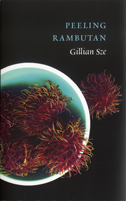
Peeling Rambutan - Gillian Sze (Gaspereau Press)

Today's book of poetry:
Peeling Rambutan.  Gillian Sze.  Gaspereau Press.  Kentville, Nova Scotia.
2014.


FOR SABERA

"sorrow becomes a friend if it hangs
around long enough"
                                --from East is the Sun Behind a Tree
                                           Gillian Sze

Back on October 14, 2014, Today's book of poetry (blog #257), I had the pleasure of writing about Gillian Sze's utterly illuminating second book, The Anatomy of Clay.  Peeling Rambutan feels and reads as though it were written by a different poet - but one of equally fascinating and obvious talent.

Whereas there was a lightness to The Anatomy of Clay, an almost casual brilliance - Peeling Rambutan has weight.  It is full of focused energy and power.  But it is never too heavy.  This balancing act takes game.

Once again, Gillian Sze is dazzling.

Come

and show me our various forms of leaving. By boat, by foot,
by the flash of our thumbs. By storm, by nightfall, by the
infant hours. Play me the heave of a train horn pushing
through the dark. Show me how a railway crossing rises as
easily and slowly as a dancer lifting one leg. Show me the
silent lightning, as if the sky surrendered, and we're waiting
for ash. Tell me that someone has already seen this and is
still looking up. Tell me how to prepare for the weather next
Saturday. tell me how to reduce stories to their simplest
parts. Tell me again our various forms of leaving. With the
engine running. With joy, avidity, stifled regret. Tell me how
the rooms fell silent. Faces looming in the back window.
The eye falling to the fence. Tell me about two-toned living.
The incompatibility of temper. the worlds you worked to
unite. the tumbling languages that refused to stay aloft. The
ground-bound postscripts. The plummeted paper planes.

...

Many of the poems in this third book of poetry by Sze are prose poems - and yet they flow easily enough, slide off of your tongue as though by design.

Contemplative is a good word to describe these precise poems of captured moments.  Like you are constantly walking into rooms of new discovery.  The edges are clear, reading them is like watching one of those old Polaroid photos come into focus in front of your eyes.

Garage Band

In Wen Chong Village, beneath a small light,
a group of old men settle on their plastic chairs.
Cradling their instruments,
they smoke cigarettes
and drink kung fu tea to defeat the dark.
Inside, their women fret over what to prepare
and pack for next day's lunch.
Outside, a weathered man stands to face his players
and wavers out a Canton opera,
spitting during the interludes,
and picking up at his cues.

...

Once again I have to mention Gary Dunfield & Andrew Steeves.  This book continues Gaspereau's tradition of making the most beautiful books of poetry that Today's book of poetry sees.  Looks shouldn't matter to poetry - but Gaspereau gives all other poetry presses something to aspire to.

How To Kill A Cockroach

Without qualm,
she peers at the bottom of her shoe and says,
Never let a cockroach see your hand's shadow.

...

Peeling Rambutan is a travelogue of sorts that takes you inside the minds and language of foreign people and places that you will most likely never see - and leaves you feeling like you've been there.

That's a great trick.  Bravo Gillian.

Gillian Sze

ABOUT THE AUTHOR
Gillian Sze is the author of two previous collections: The Anatomy of Clay (2011) and Fish Bones (2009). Her work has appeared in a number of national and international journals, and has received awards such as the University of Winnipeg Writers’ Circle Prize and the 2011 3Macs carte blanche Prize. Originally from Winnipeg, she now resides in Montreal.

BLURBS
Peeling Rambutan traces a young poet's journey into the interior of China, a place where "religion is a game of telephone and illumination," where epiphany is found in ancestral kitchens. Sze shows us a luminous, lyric landscape where old village vendors ride into Shanghai singing in rhyming couplets. What a beautiful, unforgettable trip reading this book is!
—MARY DI MICHELE, author of The Flower of Youth

Gillian Sze's Peeling Rambutan is an unforgettably vivid collection, combining her characteristic intimacy with subjects and a gut-punching instinct to get it across. Richly detailed with uncommon knowledge and observance, poised in articulation and always present. Gillian Sze is one of our most enchanting poets.
—DAVID MCGIMPSEY, author of L'il Bastard

Gillian Sze's voice is so assured and so clear. She sets out to explore where she is from, where "Here can't be found on a map," and then sends the images our way. She records, and then tattles in the best of ways: with curiosity and awe and humour. I felt at times that I was reading a novelist writing brilliant poetry. That is to say, these poems are busy with story. I loved them.
—DAVID BERGEN, author of The Age of Hope


Gillian Sze's sensuous, precisely-observed poems trace her identity across cultures, eras and continents, weaving together scraps of family lore, visits to changing landscapes, the smell of Malaysian fruits and Canadian snow. Her far-flung home, often in the air, often lonely and built from memory is of a sort many of us share. The poems in Peeling Rambutan enlarge our sense of who we are.
—JOHN STEFFLER, author of Lookout


Gillian Sze reads from The Anatomy of Clay\
video from ECW Press

gaspereaupress.com 

292

Poems cited here are assumed to be under copyright by the poet and/or publisher.  They are shown here for publicity and review purposes.  For any other kind of re-use of these poems, please contact the listed publishers for permission.
Posted by Today's book of poetry at 10:18 AM No comments:
Email ThisBlogThis!Share to XShare to FacebookShare to Pinterest
Labels: andrew steeves, david bergen, david mcgimpsey, gary dunfield, gaspereau press, gillian sze, john steffler, mary di michele, michael dennis, peeling rambutan, the anatomy of clay, today's book of poetry.

Sunday, January 11, 2015

Honey - Richard Carr (Gival Press)

Today's book of poetry:
Honey.  Richard Carr.  Gival Press.  Arlington, Virginia.  2008
(Winner of the Gival Press Poetry Award)


Whimsy and delight would suggest the wrong thing, but whimsy and delight are at the fore of Honey.

Richard Carr gives us a sequence of such silly joy that the reader spills with glee.  But there is enough seriousness in here to give you a heart attack, sweetly.

Intelligent and witty doesn't cut the mustard with Honey, but witty and intelligent are two of the first visceral responses to this tapestry.  This is some fine weaving.  Richard Carr is as sure footed as spider on its' own web.

IV

No amount of washing can divert the ashtray
from its purpose.
The Bearded Lady, clean shaven in the off season,
offers me a cigarette,

and we share a thin, gravelly smoke.
I want to be like her.
She is a mirror. when she stirs her coffee,
the whole restaurant stirs.

...

These poems rollick with frenzied imagination.  Richard Carr has limitless spark and endless horizon.
Each of these stunning short poems adds another colour to Carr's explosive palette.

IX

Design in the gothic city
a matter of assemblage,
I wear a massive clothing of stone monuments
and scaffolding.

The street a chaotic plaid of asphalt repairs,
I dent the pavement
where the work is still fresh,
hot.

The soles of my feet blacken my apartment--
walls, ceiling, all of it.

...

I usually require more of a narrative thread but found these tireless ditties endlessly fascinating.  It's like they came out of the barrel of a machine gun, each bullet as faultless as the other.

Carr would, I expect, be a marvelous dinner guest -- his imagination rolls out like a big sun that is constantly rising.

LXXXIII

I gather to my cheekbones
crabappled blossoms drenched in a cold drizzle.
I lick violets, kneeling obscenely,
and draw yellow dandelion heads into my mouth.

I want to taste what the bee tastes,
nectar and pollen, but more, her chemical imprint,
footprints on the petals,
to learn where she has been, what orchards and nurseries.

gardens, graves --
and if she ever blushes.

...

A blushing bee, footprints on petals.  I loved these.

Everyone here at Today's book of poetry chose three different poems for today's blog -- but I chose the three you read here.  It could just as easily been any three poems picked at random from this electric book.

Dazzling stuff, sweet like honey, and a little sticky.

Richard Carr

ABOUT THE AUTHOR
Richard Carr grew up in Blue Earth, Minnesota, and lives in Minneapolis. A former systems analyst, web designer, and tavern manager, he has taught writing and literature at several universities and community colleges. His other poetry collections are Ace (The Word Works, winner of the Washington Prize), Honey (Gival Press, winner of the Gival Press Poetry Award), and Mister Martini (University of North Texas Press, Winner of the Vassar Miller Prize). His chapbooks include Butterfly andNothingness (Mudlark) and Letters from North Prospect(Frank Cat Press, winner of the Frank Cat Press Poetry Chapbook Competition).

BLURBS
"Poet Richard Carr weaves together lovely and unlikely connections in his Gival Press Poetry Award winner, Honey (978-1-928589-45-7). Wrinkled plants, a goldfish and the poet drink water while outside, 'The clouds rain gasoline.' A Bearded Lady stirs coffee in a restaurant, birds listen to our voices on a telephone wire, and 'somewhere a dying child / wears a wig of [his] donated hair.' Lyrical, laced with longing, these 100 short poems create a world where 'The best stars slide across the sky in retrograde.'"
ForeWord Magazine, July 2009

"Honey is a tour de force. Comprised of 100 electrifying microsonnets, Richard Carr’s invention recalls Berryman’s Dreamsongs, for brilliance and wit, but is more readable. Open to any page: language and image startle and delight, like 'Einstein’s blown-fuse hairdo.' The whole sequence creates a narrative that becomes, like the Hapax Legomenon, a form that occurs only once in a literature."
—Barbara Louise Ungar, author of the award-winning collection The Origin of the Milky Way and final judge of the 2007 Gival Press Poetry Award

"This sequence of compact poems is musically subtle, visually surprising, and, at times, deeply moving. More than this, though, Honey is an ambitious, intricately unified book, part brilliant lyrical meditation and part surreal Bildungsroman. In it, Richard Carr creates a character whose search for truth and self (accompanied by the Bearded Lady, the Poet, the Boy, and the Hapax) is delightful and ambiguous. Honey is a poetry collection unlike any you’re likely to encounter. It is a wonderful, breathtaking achievement.
 —Kevin Prufer, editor of Pleiades: A Journal of New Writing

givalpress.com 

291

Poems cited here are assumed to be under copyright by the poet and/or publisher.  They are shown here for publicity and review purposes.  For any other kind of re-use of these poems, please contact the listed publishers for permission.


Posted by Today's book of poetry at 3:31 PM No comments:
Email ThisBlogThis!Share to XShare to FacebookShare to Pinterest
Labels: barbara louise ungar, foreword magazine, gival press, honey, kevin prufer, richard carr

Thursday, January 8, 2015

Time Out of Mind - Laurie Block (Oolichan Books)

Today's book of poetry:
Time Out of Mind.  Laurie Block.  Oolichan Books.  Lantzville, British Columbia.  2006.


There are an infinite number of tragedies in this modern world.  It is a smorgasbord of tears, an endless litany of horror.

But perhaps there is no pain quite so primal as the death of our mothers.

My mother, like Laurie Blocks', did not go gentle into that good night.  She went screaming, cursing her early demise until all reason abandoned her.  In the end she was a meat-puppet blathering at the diminishing light.

No sadness like it.

Slap

Even before I arrive on the ward and check in
with the nurse I know it's my mother by the sound
a relentless hammering as she slaps her knees
and the arms of her wheelchair punctuate
the lunatic corridor, a long day closing
with a dull thud and an open hand.

This is no case of nerves, the drumming
of a mind on edge or absent
as it taps a table or the crystal face
of a watch, fingers feeling their way
along the smooth hard surface of an agenda
toward cancelled appointments and imminent events.

Nor is it holy vacancy, autistic hands
rearranging the sacred furniture and music
of a deep deep world while waiting
for the call. There are no visible signs
of grace as she bangs against the mystery
of matter and the limits of medicine

only the wreckage of what she used to be
a vacant lot littered with orphaned shoes
and unwanted metal, the broken springs
of thought and language where all she knows is
to kick it into life, shake the machinery
until it starts to run like it did.

...

Laurie Block addresses the anguish of those left observing.  With a knowing eye he shares the grief of the witness.

These aren't easy poems to read -- but there is something reassuring about them.

These poems are that voice recording the steps towards the ultimate darkness with diligence.  Nothing is left out.

Lights Out

Your absence has grown
to the size of a grapefruit
floating beneath my skin
irreversible, neither self nor
other but an organ or a thought
without a home, a question
that won't fit and can never be
answered or forgiven.

Don't you go dying on me
again, bending one morning
to tie a shoelace or to open
your book, you lost your place
falling into silence, a hand
at my elbow, a voice
turning and returning.
What did you mean to say?

That this room will be a comfort
that the earth will continue
to amaze, whether or not
you are here cool and familiar
to the touch, darkness will contain
the loss, something to bump into
press against like a wall
or a dream you insist on
passing through, these words

only a membrane, a story
I can neither finish nor put down
stumbling between the beginning
and the end, feeling for the door.

...

This book won't cheer you up, that not a poets' job.

The job is to illuminate, startle, report, imagine and so on.  Laurie Block's Time Out of Mind does all those things and more.

He looks at what most of us try to turn away from.  Block ventures into those harried moments before death and tells us what he sees.

Smudge

Without love how would I be here
to see this day dying how would I notice
the golden light anointing airborne
wings, the holy outcry of ice
letting go and birds as they soar
and descend, returning to touch
the open water of ancestral lakes, the nests
that hold their deep blue history  and perfect
oval future. Once again I am here, in time
for the arrival of eagles and untold geese
more ducks than I can name: Mallards and Teal
Bufflehead and Goldeneye, each one
recognizing their home in creation, gifted
to read the opinion of the wind and call out
the complete story of up and down. Myself
I don't need to know why they fly or who
dictates the revolution of heaven and earth
it's enough to see the season turn, to hear
the hum of generation and witness how they govern
the green shifting territory between water and sand.
This country where I am always a guest, walking
along the edge, welcomed and cleansed
in the smudge of the setting sun.

...

Time Out of Mind is no fun, but it is very necessary.

Laurie Block

ABOUT THE AUTHOR
Laurie Block is a poet, playwright and storyteller. He was born in Winnipeg and now lives in Brandon, Manitoba. His previous work includes a chapbook of poetry, Governing Bodies, and a bilingual collection of poems, Foreign Graces/Bendiciones Ajenas, based on his experiences in South America. He is also the author of a full-length play,The Tomato King, produced by Theatre Projects of Manitoba in 1997, and a short piece, Pop! His short story, While the Librarian Sleeps, won the 2003 Prairie Fire fiction contest and, most recently, The National Magazine Award Gold Medal for fiction. Time Out of Mindis the winner of the inaugural Lansdowne Poetry Prize.

BLURB
"These poems, and the eloquent essay that precedes them, are bittersweet, outraged, heroic, surprised, witty, sensuous, occasionally surreal, generous, broken hearted. Poems of middle age, mourning the loss of a mother to slow dementia, fiercely resisting the downward spiral of amnesia. A beautiful book, a necessary book, a grand shout at the hubris of modern medicine, that claims to protect us from physical pain while multiplying the diseases of the spirit. The poems startle us into clarity, the discovery of pure love, 'coming into fullness at the end/of the season.'"
     --Di Brandt

oolichan.com 

290

Poems cited here are assumed to be under copyright by the poet and/or publisher.  They are shown here for publicity and review purposes.  For any other kind of re-use of these poems, please contact the listed publishers for permission.
Posted by Today's book of poetry at 10:12 AM No comments:
Email ThisBlogThis!Share to XShare to FacebookShare to Pinterest
Labels: amnesia, dementia, di brandt, laurie block, michael dennis, oolichan books, time out of mind

Tuesday, January 6, 2015

The Beauty of This World - Rosemary Zurlo-Cuva (Parallel Press)

Today's book of poetry:
The Beauty of This World.  Rosemary Zurlo-Cuva.  Parallel Press.  University of Wisconsin-Madison Libraries.  Madison, Wisconsin.  2014.


"A lifetime isn't long enough for the beauty of this world,
and the responsibilities of your life.

Scatter your flowers over the graves, and walk away."

                                                                   Mary Oliver
                                                                   from Flare 12

Rosemary Zurlo-Cuva starts her marvelous chapbook The Beauty of This World with this perfect Mary Oliver quote.

It is the exact right tone to set for these poems.

Zurlo-Cruz is subtle and slightly subversive.  These poems start you in one clear direction, a recognizable path and then Zurlo-Cruz effortlessly turns the world around under our feet.  It is an accomplished feat of engineering, an impressive skill to have.

We Have Always Known Grief

There were always the fireflies, rising
out of the grass at dusk, the call of crickets
at summer's end when the fat milk pods begged
to be split and their seeds to float like
questions on the wind

and the endlessly churning lake, impervious
to the cries of seagulls, changing color with each
passing cloud, smoothing bits of shattered
bottle glass and spitting them back
as jewels to be treasured and forgotten
in a small girl's pocket

the roar of the city bus after depositing
the cleaning ladies on our unimproved
suburban lanes as if aliens from
another planet, the immigrant grandmother
enthroned on a lime-green plastic
lawn chair, tugging her black sweater close
on the hottest summer afternoon.

...

Zurlo-Cuva's poem "Post Card to My Mother" rang so familiar to me that for a moment I thought I'd written it, which is faint praise for poor Ms. Zurlo-Cuva - but this poem paralleled my life experience in the most surrealistic way.

I had to share it with Today's book of poetry readers.

Post Card to My Mother
                            -Winchcombe, Gloucestershire

On the lane from Sudeley Castle, a shaded
stone bench beside a brook and a meadow. A horse
grazing far off in the corner seems not to notice
when I sit down to rest from the gravel dust
and a midday sun. "You've dreamed your whole
life about England," my mother said as I packed
to leave. "I worry the real thing might
disappoint you." It went unsaid
the number of real things that had come
to disappoint her.

I pull a post card and a pen out of my pack
and pause, listening to the rush
and slap of the brook over stones, the world
imperturbably green. I sit frozen long enough
that the horse comes to investigate, leaning
over the fence to blow a puff of hot breath
on my shoulder.

Years later, boxing my mother's things, cleaning
out her desk after the funeral, I find
among the other letters and cards, the one
picturing Sudeley Castle. On it I had written: Dear Mom,
I am not disappointed.

...

Well that teared me up real good.  Caused a tear for one or two of our interns as well. Handkerchief time.

There are no pyrotechnics or marvels of post-modernist construction in The Beauty of This World.  These poems are old-school, bell in the belfry, certain.  The ring with clarity.

My Mother's Bones

We buried her in pink Pumas -- her last
mail-order purchase -- and now I can't stop
picturing those sneakers cradling
the small, gnarled bones
of her feet. We ought to have dressed
her in woolens, a London Fog
for the damp, instead of the pale
summer dress she'd worn to parties
and teas, and matched
her vivid blue eyes -- so thoroughly
unsuitable for an eternity
in the ground.

...

Rosemary Zurlo-Cuva's solid poems are ones you could hang your hat on, come in, make yourself at home with.

Today's book of poetry staff all liked this book, solid as rock, subtle as a knowing whisper.

Rosemary Zurlo-Cuva

ABOUT THE AUTHOR
Rosemary Zurlo-Cuva grew up in Milwaukee, got her undergraduate degree at the University of Wisconsin-Madison, and has lived there ever since. She works as a journalist, editor, and writing teacher. Her novel, Travel for Agoraphobics was published as an e-book in 2011.

parallelpress.library.wisc.edu 

289

Poems cited here are assumed to be under copyright by the poet and/or publisher.  They are shown here for publicity and review purposes.  For any other kind of re-use of these poems, please contact the listed publishers for permission.


Posted by Today's book of poetry at 7:01 AM No comments:
Email ThisBlogThis!Share to XShare to FacebookShare to Pinterest
Labels: mary oliver, parallel press, rosemary zurlo-cuva, the beauty of this world, university of wisconsin-madison libraries

Sunday, January 4, 2015

Civil and Civic - Jonathan Bennett (Misfit/ECW Press)

Today's book of poetry:
Civil and Civic.  Jonathan Bennett.  Misfit/ECW Press. Toronto, Ontario.  2011.

Civil and Civic - ECW Press

Jonathan Bennett's Here is my street, this tree I planted (Misfit/ECW Press, 2004) starts with a quote from the great American painter Edward Hopper:

"I guess I am not very human.  I didn't just want to paint people posturing and grimacing; what I wanted to do was paint sunlight on the side of a house."

A simple enough declaration for both painter and poet - and Bennett followed through.  These very human and plain speaking poems, entirely unadulterated, yet always casting light certain to illuminate.

Civil and Civic, Bennett's second book of poetry, opens with Bennett painting once again.  Plain language where the words don't betray themselves but are clear, concise and with purpose.  These poems are canvases we can admire for the sunlight Bennett casts on the previously mundane.

The events in these poems, are for the most part, not extraordinary but for the patient reader they certainly are rewarding.

Back Roads

It is a beautiful car, it is a concession line.
Late light, amber and broken by the ashes

and cedar groves, streaks the dirt road now
and into the future. Three deer appear just

ahead, still as lawn ornaments, at the edge
of a field of farmed firs. Shots do no ring

out and the buck does not collapse forward
onto its knees, heavy head falling to its rest

on the wet grass, doe and fawn away into
the thick green. Instead, the motor purrs;

they stand their ground as we pass.
Shoot, see those deer? Where? Look.

At the crest of a hill is the house we love
to admire, way out here. The owners rake

at the edges of their lawn. It's a stone farm
house. They do not invite us in, of course.

We slow, their home in our sights. They do
not see us. Not really. The light sinks in

fast and pools of dark collect in the valleys
as we take the turns slower, resorting

to headlights. Silhouettes of barns cut dusk
exactly the shape of themselves and birch

march up hillsides, as if determined to escape
reflection by the river, or be caught by that

roadside painter who would sell the night sky
out her for big bucks back in the city.

...

Jonathan Bennett's poems always seem to dealing with some undercurrent of light, as though every secret in the universe is vulnerable to a particular strain of illumination.

In Civil and Civic Bennett's candlepower is focused on those small moments that give us all pause, those moments where our thoughts turn into decisions, the choices which determine what road we will be taking seem to become more obvious as the oblivious dark recedes and morning breaks, as Emily Dickinson would exclaim, "excellent and fair."

Civil and Civic

You talk across periods; I draw on arms
with blue pen, The Clash, et cetera.
With gall you hang posters, know the slogans.
You savour the word disobedience,
chew chocolate first thing in the morning,
as I follow you around, onto the bus,
ignore exposed hip skin winking love, love.
Trapped, wet in a tent, some bitch recites Brecht.
We play Hacky Sack.
                                    They open tear gas.
An act born from a crowd's seething will
I heave the blunt harm of a brick at helmets
and shields, a slow, magnificent arc.
My brick in flight is like a dove, you shriek.
A boy falls and is crushed. We are all filmed.
Two cars are torched in the square after dark.
Over there you haver at a statue's feet,
the bronze general dismounts and runs you through.

...

"Haver" is a Scottish work that means to talk nonsense.

Bennett's poems are both stuck between the pastoral certainty of the rural country and the less certain and frantic city - and a bridge between the two.  These poems are perched on a see-saw that goes up and down to the refrain of "private", bounce, "public."

These well lit snapshots are political one moment, worldly and personal high water marks the next.

And then there is the painting, and always, the light.

After Painting Wild Apple Trees

A mile east, the oxen steam, nose-blow clouds
into the grave chill, puff, shake soaked leather.
He heaves a mattock at a stubborn stump.
Through her still-young pout she sucks at damp hair.
After hewing pine, she suggests apples,
which he bites wide-mouthed, wincing with the sour.
Oxen huff. Let it rot, she says plainly.
He over-arms the core at underbrush.

Two hundred years of light drips this clearing.
No apple baubles: a post-fruitful palette
limns limbs, their osteoancient gestures
canvas a feral orchard, gouged, layered,
verdure and crowded, yet sky and white,
frame woolly chance as harvesting this delight.

...

Okay, sometimes Bennett's private prism is a little more articulate than just plain speech - but the resulting paintings/poems are ones that we here at Today's book of poetry admire.

We look forward to next show, a sometimes Illuminati, I bet when Bennett walks into a room he turns on every light.

Jonathan Bennett

ABOUT THE AUTHOR
Jonathan Bennett is the author of five books including the critically acclaimed novels Entitlementand After Battersea Park, two collections of poetry, and a collection of short stories, Verandah People, which was runner up for the Danuta Gleed Literary Award. He is a winner of the K.M. Hunter Artists' Award in Literature. Born in Vancouver, raised in Sydney, Australia, Jonathan lives in the village of Keene, near Peterborough, Ontario.

BLURB
“As accomplished as Jonathan Bennett is at using language, he’s never fussy or precious about it. With his exacting, contemporary voice, part colourful reporter, part reluctant witness, his lines gain their effect by serving experience in the most necessary way possible, via clear-eyed attention and vivid diction. The result is an immediacy often lacking in other poetry. Civil and Civic’s nimble narratives will crackle in your ear.”
     - David O'Meara, author of Noble Gas and  Penny Black


Jonathan Bennett reads from Civil and Civic

ecwpress.com 

288

Poems cited here are assumed to be under copyright by the poet and/or publisher.  They are shown here for publicity and review purposes.  For any other kind of re-use of these poems, please contact the listed publishers for permission.


Posted by Today's book of poetry at 4:09 AM No comments:
Email ThisBlogThis!Share to XShare to FacebookShare to Pinterest
Labels: civil and civic, david o'meara, ecw press, edward hopper, emily dickinson, jonathan bennett, michael dennis, misfit

Friday, January 2, 2015

Smoke Of Her Body - Stephanie Levin (Jacar Press)

Today's book of poetry:
Smoke Of Her Body.  Stephanie Levin.  Jacar Press.  Durham, North Carolina, 2011.


Winner of the Jacar Press Poetry Book Contest

Dorianne Laux has it right.  Ever actually been punched so hard in the stomach that all of the air in your body simply leaves?

It's like an instantaneous vacuum that leaves you on your knees sucking air.  At first you don't even realize it hurts.

It's only when you gasp, your throat in some raspy almost silent prayer.

Well, sit down on the floor so you'll have less far to fall.

Stephanie Levin just sucker punched Today's book of poetry.

Devotion

God was a beautiful man
who was deeply in love with me.

He said, I know you're only seven,
but you have an old soul.
He knew everything about me. He knew
what the backs of my knees smelled like.

I imagined all my past bodies cut out
and standing up in a row behind me
as he'd tug my T-shirt over my head.

...

Smoke Of Her Body goes to some harrowingly dark places.  I'll go you one further -- unless you've seen a certain type of evil, a particular shade of darkness and malice -- you may not recognize anything here.

These poems are the sound that might have come out of the silent maw of Edvard Munch's "The Scream".

I exclaimed, quite loudly, as frequent readers of Today's book of poetry may remember, after reading each of the first several pieces in Levin's Smoke Of Her Body.  I swore loudly, multiple times.

I swear for two reasons, the first is when poems are so bad I'm annoyed at their ability to have found a publisher.  The second reason is the exact opposite, when the poems are so good that I'm instantly transfixed.

The Teachings

Later, when I wanted to know about Hell--
if I would end up there--
she'd nod her chin for me to lie back down,
lift the tail of the sheet and lower it
so air rolled in waves beneath
and the cotton landed
cool on my knees, then pull
the quilt over me, place the end
in my fingers balled up beneath my chin,
and say, We're there already.

...

Well, these are that -- instantly game changing, welding me into place, so to speak.  

But now a third reason to swear -- along with excellence, Stephanie Levin has introduced fear as a criteria.  I was mortified and exhilarated as to where she would go next.

Not a roller-coaster thrill but definitely an amusement park, perhaps a fun-house, filled with monsters.

Second Anniversary of His Death

In the linen aisle of Target, I mouth the words
to Barry White in Muzak overhead,
and there's my brother in this movement:
chin bobbing to the left, neck moving

snakelike to the beat.
I see him driving, seat pushed back
like a La-Z-Boy, eyes bloodshot,
nodding to the music just like this.

A saleswoman approaches; I have to leave here.
I won't cry in a store like this.
But they make those aisles long
so you're sidetracked as you try to leave,

and I find something for him:
pizza plates in the shape of an extra large slice,
with pigs in chef hats, pepperonis flying.
The perfect gift for my brother, and he's dead.

...

Put on your seat-belt, turn off your phone.  "This is" to quote the toughest dame out there, "going to be a bumpy ride".

Stephanie Levin

ABOUT THE AUTHOR
Stephanie Levin received her MFA in Poetry from the University of Virginia. Her work has appeared in Green Mountains Review, Folio, River Styx, Prairie Schooner, and Shenandoah. Her collection, Smoke of Her Body, was chosen by Dorianne Laux as winner of the 2011 Jacar Press Poetry Book Prize. The mother of two, she teaches reading at Carrboro High School.

BLURBS
"This one just has that punch in the stomach, 'wow, who the &#!% wrote this' factor going for it. I like how the poems are strong, yet understated, loud and quiet at the same time."
     - Dorianne Laux, author of The Book of Men

"Unrelentingly harrowing."
     - Marie Howe, author of The Kingdom of Ordinary Time

jacarpress.com

287

Poems cited here are assumed to be under copyright by the poet and/or publisher.  They are shown here for publicity and review purposes.  For any other kind of re-use of these poems, please contact the listed publishers for permission.
Posted by Today's book of poetry at 3:57 AM No comments:
Email ThisBlogThis!Share to XShare to FacebookShare to Pinterest
Labels: dorianne laux, edvard munch, jacar press, jacar press poetry book contest, marie howe, michael dennis, smoke of her body, stephanie levin
Newer Posts Older Posts Home
Subscribe to: Posts (Atom)

Search This Blog

Popular Posts

  • Medallions Of Belief - Fred Wah
  • Infiltration - Ben Groh
  • The Sound The Sun Makes - Leanne McIntosh
  • X - Poems & Anti-Poems - Shane Rhodes
  • Meeting the Tormentors in Safeway - Alexandra Oliver

Blog Archive

  • ▼  2021 (1)
    • ▼  January (1)
      • Michael Dennis (September 1, 1956 - December 31, 2...
  • ►  2020 (16)
    • ►  April (1)
    • ►  March (6)
    • ►  February (5)
    • ►  January (4)
  • ►  2019 (68)
    • ►  December (2)
    • ►  November (1)
    • ►  October (5)
    • ►  September (9)
    • ►  August (6)
    • ►  July (7)
    • ►  June (8)
    • ►  May (7)
    • ►  April (6)
    • ►  March (6)
    • ►  February (7)
    • ►  January (4)
  • ►  2018 (84)
    • ►  November (2)
    • ►  October (9)
    • ►  September (1)
    • ►  August (8)
    • ►  July (8)
    • ►  June (7)
    • ►  May (11)
    • ►  April (10)
    • ►  March (11)
    • ►  February (10)
    • ►  January (7)
  • ►  2017 (109)
    • ►  December (11)
    • ►  November (12)
    • ►  October (8)
    • ►  September (11)
    • ►  August (11)
    • ►  July (4)
    • ►  June (9)
    • ►  May (4)
    • ►  April (9)
    • ►  March (10)
    • ►  February (11)
    • ►  January (9)
  • ►  2016 (116)
    • ►  December (7)
    • ►  November (11)
    • ►  October (11)
    • ►  September (8)
    • ►  August (8)
    • ►  July (8)
    • ►  June (9)
    • ►  May (10)
    • ►  April (11)
    • ►  March (11)
    • ►  February (12)
    • ►  January (10)
  • ►  2015 (139)
    • ►  December (8)
    • ►  November (13)
    • ►  October (14)
    • ►  September (9)
    • ►  August (10)
    • ►  July (13)
    • ►  June (10)
    • ►  May (13)
    • ►  April (12)
    • ►  March (11)
    • ►  February (12)
    • ►  January (14)
  • ►  2014 (148)
    • ►  December (19)
    • ►  November (10)
    • ►  October (10)
    • ►  September (9)
    • ►  August (13)
    • ►  July (14)
    • ►  June (11)
    • ►  May (12)
    • ►  April (14)
    • ►  March (14)
    • ►  February (10)
    • ►  January (12)
  • ►  2013 (140)
    • ►  December (14)
    • ►  November (11)
    • ►  October (9)
    • ►  September (8)
    • ►  August (11)
    • ►  July (14)
    • ►  June (15)
    • ►  May (15)
    • ►  April (14)
    • ►  March (29)
Awesome Inc. theme. Powered by Blogger.