Thursday, September 17, 2015

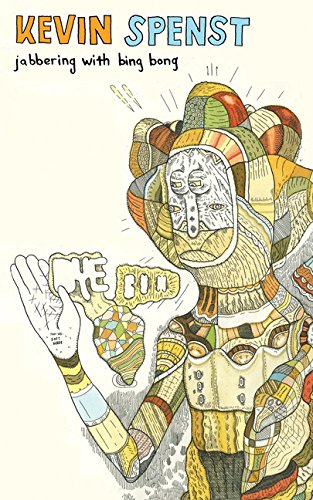
Jabbering with bing bong - Kevin Spenst (Anvil Press)

Today's book of poetry:
Jabbering with bing bong.  Kevin Spenst.  Anvil Press.  Vancouver, British Columbia.  2015.

Crystal Gayle is whisper-crooning the Tom Waits' classic "Take Me Home" and the lake is as quiet and still as bathwater in an bathtub. I've sent the entire staff off on a scavenger hunt into the woods with at least three impossible tasks.  I expect them to be gone for hours.

Most likely they will find a quiet spot, sit and smoke bobo, tell each other lies.

Kevin Spenst's Jabbering with bing bong is a little like Crystal Gayle singing Tom Waits.  A beautiful clash-turn-cascade of juxtaposing cultures.  Spenst has that distinct voice we recognize on first hearing, like Waits, like Gayle, unique and hauntingly familiar.

Pray Goodbye

At sixteen, I folded into prayer for the last back-
and-forth time in my basement bedroom with
one brick wall, and cheap wood siding
and a box-filled fireplace. It was midnight.
The cement floor, covered in carpet scraps,
was equally unseen and cold. The brick wall
stopped halfway, continuing as a ledge of its
lower self, a makeshift closet. An opening at
the end led you under musty clothes toward
a wooden door with a metal latch to a crawl
space under the stairs. A history of fear, of play.
Despite the darkness, my eyes were closed.
I can no longer believe in you, I prayed in bed,
If I'm wrong, I hope I find my way back.

...

These crisp missives chirp, chortle and chide and in no time at all Spenst has taken us around an unexpected corner.  Spenst has a strangle hold on contemporary culture and the reader tied in knots with these dense little sausages packed to bursting with poetic meat.  These poems have a great sense of wondrous play that disguise the shot to the brain Spenst has just knuckle-balled your way.  He gains quick and slick access to the part of our brains that love poetry.

Jabbering with bing bong, although laced with as much sadness and uncertainty as anyone need carry, brims with poems that will make your brain happy.  You are going to be pleased you paid the price of admission for this show.

A Brief History of Lust

Fenris Wolf Esquire beds little Red,
colonizes her limbs
in a cherry bowl motel room
rented by the century. Whispers,
is Red your real name? Whispers,
I only feel at home inside you.

...

Fenris Wolf drops in about half-way through Jabbering with bing bong.  He snorts and cockwalks through several excellent poems.  He caterwauls and smells like sex but he doesn't hang around for long.  Too bad.

If there were ever a sequel to Jabbering..., Today's book of poetry would like to hear more about the big, bad Wolf.

This reader is sad to see the Wolf go.

On we go into the back half of Jabbering with bing bong (which is a GREAT title), and it is delightful.  Spenst dances over these quirkily terrained poem scapes as though he had an extra set of legs.  These poems are so bursting full of ideas that you hardly have time to digest one train of thought before another comes screaming into the station.

Jabbering with bing bong is full of literary characters, you never know when John Berryman might drunkenly jump from a bridge, or Margaret Atwood opine robustly.  Wallace Stevens and Milton Acorn, Al Purdy and, well.  You catch the drift.  But Spenst doesn't just name drop, he uses the aura and glow from each of these giants to make them all welcome, necessary.

Pray/Goodbye

       for Rob

Even under the real mask of bipolar disorder
Halloween is a bad time to kill yourself: an
awkward costume, a shroud of ugly absence.
Earth holds more dead weight. Soggy cardboard
tombstones line the house next door. Anger
lurks behind ghouls at our front door. What we
must offer you is love. You hammered out
the personal into concave dusks, listening spaces
you opened with a tilted head for writing students
and friends. Your ex will go to San Francisco
for eleven days. I wish her warmth. We walk
with heaviness as if gravity has increased.
Saint Suicide, we pray that yours will be
the last. Suspend our disbelief forevermore.

...

Today's book of poetry is smart enough to trick his minions into the woods for the morning but not smart enough to adequately express the wonder and playfulness of these acid-etched songs.  Kevin Spenst has just made a place for himself at the table,  Jabbering with bing bong is first class jabbering of the highest order.  The best jabbering you'll see for a while.
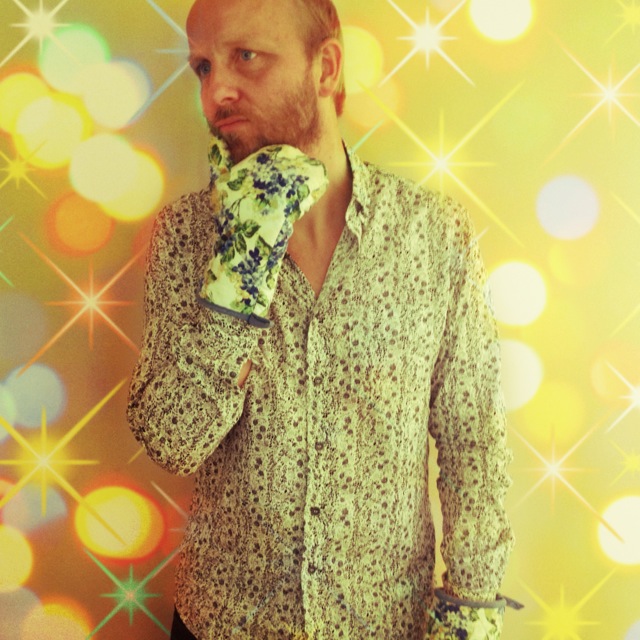
Kevin Spenst

ABOUT THE AUTHOR
In addition to the UK, the United States, Austria and India, Kevin Spenst’s poetry has appeared in over a dozen Canadian literary publications. In the spring of 2014 Kevin did a 100-venue reading tour of Canada in support of small poetry presses with his chapbooks Pray Goodbye; Retractable; Happy Hollow and the Surrey Suite; What the Frag Meant and Surrey Sonnets.


BLURBS
“Belief and disbelief rub up against each other in this startling and flawless debut collection. … These important poems do not redeem so much as allow the possibility of redemption.”
      —Jen Currin, author of The Inquisition Yours

“Fearless, attentively probing, and sonically sharp, he is a rare counter-theosophist rhapsodist. Spenst’s Jabbering…is the work of a remarkable shepherd.”
     —Sandra Ridley, author of The Counting House

“Kevin Spenst provides further proof that the best writing these days is in the practice of poetry. Hang on tight as you are winged deftly through the human strains…curiosity, sexuality, death, religion and striving—it’s all here.”
     —Dennis E. Bolen, author of Black Liquor

“Kevin Spenst’s muscular vocabulary, vigorous pace and nimble references to cultural details enliven his exploration of topics ranging from adolescence to God to Fenris wolf.”
     —Sarah Klassen, author of Journey to Yalta

Kevin Spenst
Reading at the Human Bean in Cobourg, Ontario
as part of his 100-Chapbook Tour across Canada
Video:  Wally Keeler


382
DISCLAIMERS

Poems cited here are assumed to be under copyright by the poet and/or publisher.  They are shown here for publicity and review purposes.  For any other kind of re-use of these poems, please contact the listed publishers for permission.

We here at TBOP are technically deficient and rely on our bashful Milo to fix everything.  We received notice from Google that we were using "cookies"
and that for our readers in Europe there had to be notification of the use of those "cookies.  Please be aware that TBOP may employ the use of some "cookies" (whatever they are) and you should take that into consideration.

Monday, September 14, 2015

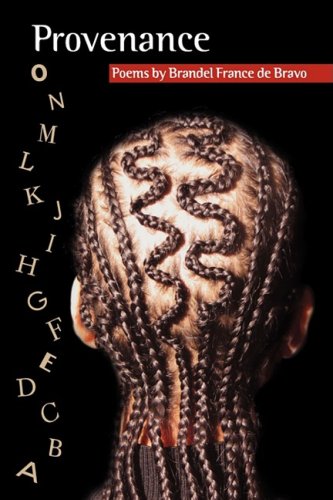
Provenance - Brandel France de Bravo (Washington Writer's Publishing House)

Today's book of poetry:
Provenance.  Brandel France de Bravo.  Washington Writer's Publishing House.  Washington, D.C.. 2008

Winner of the Washington Writer's Publishing House Poetry Prize


Today's book of poetry has taken our entire staff to a remote lake near Georgian Bay.  You can only get to this retreat by boat -- and you can't leave unless you are a Marilyn Bell type swimmer or you can wrest the boat keys from my cold dead hand.

We started the morning with French toast and bacon and then it was into the canoes.

Now the crew is muscle-sore and quiet.  It's how I like them best.  They are scattered over the furniture like exhausted rugs.  We are listening to Jan Garabeck blow the bejuses out of his saxophone while Ustad Fateh Ali Kahn's voice contemplates the universe one note at a time.

Today's assignment is Brendel France de Bravo's Provenance.  What an adventure.  France de Bravo's poetry is a carnival ride.  These poems range through a curio vision of the universe. Everything she sees is interesting -- or France de Bravo makes it so.

Apricot

A sarcastic Egyptian always speaks
of apricot season, which comes and vanishes
faster than dreams over morning coffee.
Oh sure, he'll take care of it -- in apricot season
which falls between manana and the cows coming home,
a time so fleeting, ephemeral,
it might as well be never
or what we cannot recover:
the buoyant forever when we held our noses
underwater where no one could see
and touched tongues for the first time;
the certainty that certain transgressions
meant no turning back.
It isn't innocence we miss
but the thrilling moment that we let go,
a stem splitting from the branch, fruit in free-fall.

Cecilia was the first among us to ripen,
breasts at eight, and shortly after
rendezvous with boys in the bushes.
No one called her "slut."
She floated above us
like Mary in a procession,
her wooden robes fluttering in the wind.
We supplicants longed for a guilty glimpse
of her panties, her early bloomers,
named for Amelia Jenks Bloomer,
who like Cecilia was ahead of her time.
While others fought for suffrage,
an end to slavery,
she dreamed of simpler underwear,
a garment so free, it might as well be nothing,
loose as an apricot,
that precocious apple,

Lolita of a peach.

...

France de Bravo provides an Abridged Etymologies and Related Words along with her Notes at the end of Provenance and this is helpful information but it is also a little like finding a sugary surprise as a treat.  Long before the time you reach the end of this book you realize Brandel France de Bravo is as nimble as Charlie Parker playing "Ko-ko", which conveniently enough is now blaring around the room.

I take my staff on holiday but they have to listen to MY music.  It drives poor Milo bonkers, his latest favourite band use hammers and spent ammunition.  I just played Yusef Lateef's "Don't Blame Me" and Milo wasn't amused at all.

France de Bravo would get the joke and make a good poem out of it.

Fornicate

Linguistic equivalent of latex gloves, the delicately intransitive
fornicate sounds sterile, scientific next to its censored Anglo-Saxon cousin,
which Shakespeare avoided but evoked with firk  -- to strike.

The Christian who's saved knows there's nothing highfalutin, exalted
about fornication, sensing perhaps its lowly origins in the vaulted
underground where Rome's dregs dwelled and trolled for sex.
Rather he hears in fornicate satanic seduction:
the way of the bifurcated tail, the hump of illicit union.

I believe in redemption, too, and in resurrection of the word

locked in its Latinate basement, outshined by its sensational
relation -- all penetration, fight and fist. I welcome
fornication -- crusty and soft as bread from a brick oven,
round as te amo and the whores of Pompeii. I listen for it
like a copulatory cry from the hotel room next to mine:
one column rising up
to meet another,
to make an arch.

...

These poems are each a small fable, a needed lesson, a deeper understanding of a corner that needed some light.  France de Bravo dances us outside of our usual perceptions, brings us to new ground, leads us by the hand.

Two of our interns have fallen asleep, we're now listening to Stanley Turrentine With The 3 Sounds playing "Since I Fell For You."  The interns have both fallen into that saxophone slumber that comes after canoeing across a big lake and back again and then having a big soft leather couch under you. And that's okay, they both told us what they thought of Provenance before drifting off.  Full consensus, even Milo nodded yes.

Oslo, Summer Solstice

That Norway night when day
held on -- a handshake
turned kiss --
I watched you sleep
because I couldn't.
How different we are.
In your country, the joke goes,
people say good-bye without leaving;
in mine they leave without good-byes.

In the half-empty, half-full
light, where darkness
and morning exchange vows,
I heard
the glass is love.

...

Today's book of poetry had a great deal of fun in Brandel France de Bravo world.  You will too. These poems are optimistic prayers full of hope and reason.  This is France de Bravo's first book of poetry, more recently she has published a second collection Mother, Loose.

Brandel France de Bravo
Photo: Stephen R. Brown

ABOUT THE AUTHOR
Brandel France de Bravo’s second collection of poems Mother, Loose won the Accents Publishing chapbook prize in 2014 and was published in 2015. Her first book, Provenance, won the Washington Writers’ Publishing House prize in 2008 and was a finalist for the ForeWord Book of the Year Awards that same year. Her poetry has appeared in Alaska Quarterly Review, Black Warrior Review, theCimarron Review, The Cincinnati Review, The Fairy Tale Review, Fugue, Gulf Coast, The Kenyon Review, and Poet Lore, as well as in various anthologies, including The Beacon Best of 1999, Creative Writing by Men and Women of All Colors. In 2009, the Washington, D.C. Commission on the Arts and Humanities awarded Brandel the Larry Neal Writers’ prize in poetry. She has also received an artist fellowship in poetry from the D.C. Commission on the Arts, and has been nominated for a Pushcart Prize three times. As a member of Washington Writers’ Publishing House, she has acted as senior poetry editor and organizer of the fundraising event, the Writers Ball. To read recently published poems, click here.

BLURBS
Sharp-eyed, sharp-tongued, sharply etched and sharply worded,Provenance is a book of alphabets and fables, of narrative precision and verbal passion. Across a host of exotic locales, and through the labyrinth of etymology, Brandel France de Bravo is a poet of restless travel and linguistic inquiry—what luck for the reader who accompanies her on the voyage!
     -  Campbell McGrath

In Provenance, Brandel France de Bravo writes with urgency of continuous displacement, an exile status rendering her exquisitely sensitive to the textures of daily life. She is forever a stranger among those who do not ask “where I’m from, but where I’ve just come from, / which country I left last.” At home in many cultures, at home in none, this gifted poet transforms a search for identity into a voyage through language, and finds her true roots in the alphabet letters that generate experience. This is a remarkable first book, and an important one in our time.
    -  Grace Schulman


381

DISCLAIMERS

Poems cited here are assumed to be under copyright by the poet and/or publisher.  They are shown here for publicity and review purposes.  For any other kind of re-use of these poems, please contact the listed publishers for permission.

We here at TBOP are technically deficient and rely on our bashful Milo to fix everything.  We received notice from Google that we were using "cookies"
and that for our readers in Europe there had to be notification of the use of those "cookies.  Please be aware that TBOP may employ the use of some "cookies" (whatever they are) and you should take that into consideration.


Tuesday, September 8, 2015

Miscellaneous Wreckage - Greg Simison (Thistledown Press)

Today's book of poetry:
Miscellaneous Wreckage.  Greg Simison.  Thistledown Press.  Saskatoon, Saskatchewan.  2014.


In Greg Simison's fourth collections of poetry, Miscellaneous Wreckage, he is letting all his ya-ya's out.  There are some absolutely hilarious divorce poems wafting around inside this madhouse of humour and stiff-upper-lip resolution.  Simison's poems sound like your favourite smart-ass uncle ruminating with educated candor.

There are no poetry tricks, gimmicks or hysterics.  These are salt of the earth, steady, sturdy poems.
Think of Raymond Souster with a couple of wise scotch into him.

Dreams of the Grand Banks

Amateur anthropologists, we sift
through rock mounds in the field looking
for artefacts: pounders, scrapers, awls
and spear points, gathered and tossed here,
broken and twisted beyond any use, alongside
all the miscellaneous wreckage of farm life.

And though no stone tools reveal
themselves, digging through the third pile
we soon expose the old, disjointed bones of
a man's life: a dozen Johnnie Walker bottles,
evidence of a love of whiskey; the rusted cans of
Repeater, his tobacco brand, and what we first take

to be an old shed roof, on closer
inspection, turns out to be the bleached
ribs of a homemade rowboat. So this strange
country delivers yet one more mystery:
a boat in the middle of a wheatfield. The closest
lake, three miles to the north, alkaline and lifeless

since the last ice age; the closest fish,
ten miles to the west, unless we count the
bony few swimming through rock fifty feet
beneath the ground where he himself now floats.
Of course, ever the romantic, I start reconstructing
a dreamer: a homesick fisherman, new immigrant

or hopeful maritimer with a one-way
ticket, swapping one sea for another, only to
find himself marooned, a landlocked homesteader
with no way back when the dream finally turned
to dust. And I imagine him out there late at
night, seated in the stranded boat, washed up on that

stone island, sipping whiskey and
drunkenly arguing with the indifferent
moon. Rolling one-handed smokes in the
dark, he lights the wooden matches with a
blackened thumbnail, creating sudden small stars,
but stars too brief and too late to steer an old sailor home.

...

Today's book of poetry thinks, as the poet has already confessed, that Simison is a hopeless romantic in slightly grumpy skin.  We took a poll around the office and eventually came to a consensus, we here at Today's book of poetry believe that Simison has a large gold ring in one of his ears in case he buys the farm on a foreign shore.

He is clearly a pirate.

The comedy and ease of these heartwarming poems disguise a specific moral code of conduct that Simison has built his voice around.  He doesn't waver and we like this voice.  It is smart, brash, bold and ultimately - very tender.

9C

After they took his leg to slow down the
cancer, I visited one evening and announced

he may as well have had a sex change
because from them on I'd be calling him Peggy.

He retaliated in a hoarse whisper
that despite the fact I was God's own fool,

he was still prepared to cut me
a deal on a barely worn right shoe,

but quickly changed the subject, knowing
within a month I'd have the pair for nothing.

...

If you are lucky you have a Greg Simison in your life.  A wise/wisecracking decoder, someone who tells the terrible truth with compassion.  These poems grow on you, they compound, and collectively they hum.

Simison has made no attempt to package these poems as a narrative, each poem stands alone, yet cumulatively coalesce into something important.  Miscellaneous Wreckage would make Simison's proper and prim mother proud, it is tea on the table.

Calls

My brother calls at 1 a.m.
to tell me the ambulance has
taken her to the Civic Hospital,

suggests it would be best
if I flew out as soon as possible.
I call my children with the news.

Book a ticket. Pack a suitcase.
With terrible practicality, learned
at her side, include a black suit, A tie.

And realize, on perhaps
this longest night of our lives,
we're all simply small children

who've only been outside
playing grownups until our
mothers call us home, one last time.

...

Reading Miscellaneous Wreckage was like meeting up with an old friend and hearing all their stories. Greg Simison writes with just the right amount of distrust and disdain to disguise how much his loves this world and all of us in it.

  Greg Simison

ABOUT THE AUTHOR
Greg Simison was born in Guildford, England, and came to Canada as a child. He is the author of four books of poetry. His latest collection, Miscellaneous Wreckage, was released by Thistledown Press in 2014. Simison spent eight years writing a weekly column for a small newspaper in B.C. , and was both scriptwriter and director for Organized Crimes, a theatre company that produced more than twenty-five Murder Mystery events throughout the Okanagan Valley. He currently resides in Moose Jaw.

BLURB
The poems in Miscellaneous Wreckage are always approachable, marked as they are by a sense of humour and a light touch, by surprising turns of phrase and clever twists of thought. Greg Simison is the kind of poet who knows that crows and ravens are 'properly dressed year round / for either death or dining out'. Simison, however, is firmly on the side of life, inheriting from an English mother the notion that troubles are best met by heating up the kettle and 'getting on with this living business'.
     -  Robert Currie, author of Running in Darkness and Witness
380
DISCLAIMERS

Poems cited here are assumed to be under copyright by the poet and/or publisher.  They are shown here for publicity and review purposes.  For any other kind of re-use of these poems, please contact the listed publishers for permission.

We here at TBOP are technically deficient and rely on our bashful Milo to fix everything.  We received notice from Google that we were using "cookies"
and that for our readers in Europe there had to be notification of the use of those "cookies.  Please be aware that TBOP may employ the use of some "cookies" (whatever they are) and you should take that into consideration.


Sunday, September 6, 2015

Trying Again to Stop Time - Jalal Barzanji (The University of Alberta Press)

Today's book of poetry:
Trying Again To Stop Time.  Jalal Barzanji.  The University of Alberta Press.  Robert Kroetsch Series.  Translated by Sabah A. Salih.  Edmonton, Alberta.  2015.


We all know how life is simply not fair, not for a second.  You only have to turn on the news to see the world in despair.  In this 21st century people are still being displaced from their homes for geopolitical/racial reasons.  What insanity is this?

Today's book of poetry believes that poetry connects us, makes us more human.

Today's book of poetry, Trying Again to Stop Time by Jalal Barzanji, is translated from the original Kurdish.  Barzanji has been part of an oppressed minority in his own country, an exile, a refugee and an immigrant.  Now living in Canada his voice broadens the scope with which we see the world and we are the better for it.  These poems, reprinted from Barzanji's previous collections and with the addition of three newer poems, chronicle his life and journey.

Jalal Barzanji's previous collections:  Trying Again to Stop Time (2009), I Want To Be Named Home (2007), In Memory of a Person Swept By the Wind (2006),  The Rain of Compassion (2002),  No Warmth (1985) and The Evening Snow Dance (1979).

Home in a Suitcase

Thanks to the sea,
the journey from Istanbul
to Edmonton
is a seventeen-hour flight.
A day earlier,
a thirteen-hour bus ride
brought us to Istanbul's Ataturk Airport.
It felt good to say goodbye to Sivas-
the city was too conservative for our taste.
The airport was teeming with refugees like us:
some sleeping,
some reflecting,
some looking up words
they thought they needed upon arrival in a foreign land,
some busying themselves with their hats,
some pondering the possibility of failure and disappointment,
some missing home,
some staring at their new lives in suitcases.

Some six months before,
we left Ankara for Sivas.
Nine months earlier,
in the midst of the Kurdish civil war,
I fled to Ankara,
where luck turned out to be on my side:
I was accepted by the U N as a refugee.
For six months
in the Ols district,
the hub of refugees from Southern Kurdistan,
I was Teza's tenant.
Every morning,
Sungul and I
climbed down 122 concrete steps
to go to the local bazaar:
Sungul sold ice water,
I reflected on what was to come.
I am not a storyteller,
though I do keep a lot in my heart.

In 1961,
at the start of the September Revolution,
Iraqi warplanes bombed our village.
For several weeks
the nearby caves were our home.
Mother missed her vegetable garden;
she knew it wouldn't survive under the rubble.
Father lost the few sheep he cared so much about.
And I lost a woollen ball I had made myself.

My first time flying
I was unafraid:
I had complete faith in my kite's wings.
The second time,
I flew from Ankara to Kiev
on a fake visa,
hoping to be smuggled to Sweden.
The venture failed;
I was caught
and sent back to Istanbul
on a half-empty flight.

My children weren't afraid of flying;
the plane going up and down was like a seesaw for them.
For my wife,
flying above the rain, the crowds, the city
was hard to believe.
In Amsterdam,
U N bags in hand,
we stood for six hours near the gate.
Getting lost was our biggest fear.
But I did manage to call Hawler.
I don't remember much else from Amsterdam.
Crossing the Atlantic
made me realize we were still without an address.

...

By illuminating his world of exile Barzanji shines a light on the whole world.  His poems are witness and journey.

Canada is home to many voices and there is plenty of room for more.  Jalal Barzanji's Trying Again to Stop Time is a Rahsaan Roland Kirk beautiful shriek.  These tender, searching poems are not jazz, that's not what I meant - they are heart bound echoes, human song, passionate and persuasive.  That was Kirk all day long.

Hello Exile

The women of my country
have become inseparable from the cemetery.
The keys were poisonous:
poison above,
poison below,
poison in the blood,
poison in the imagination.
We were small to begin with;
now we've become even smaller,
and more confused.

My country,
war has left you without gardens.
The young are jumping to their deaths.
The old are too old for walking sticks.
Your doors are always open,
but your windows are always shut.
There was a time when people grew wheat
built beautiful homes
went to the mountains
made music
organized festivals
and eliminated bad odours.

To exile,
we take with us
two eyes, one heart, and one soul.
When we return
we bring back thousands of eyes and thousands of hearts,
but we return with deeply troubled souls.
We plant trees in exile;
we socialize,
but only loneliness filters through our imagination.
Still, I must say hello to exile.

It was a divided nation;
too many wars,
too many tribes,
too many sects.
It was a divided land:
each day
losing a tree,
a spring,
a valley,
a cliff.
Neither its music,
nor its poetry
cared for dreams.

...

Barzanji has a surprisingly light touch considering the depths he is mining, it surprises the reader again and again.  The poems in Trying Again to Stop Time are connected to the natural world by a gossamer thread, there is a quiet solitude in Barzanji's exile but that doesn't translate into his being schtump.

Trying Again to Stop Time quieted things down in our office.  It creates its' own space for reflection.

Where Am I?
Fourteen years in this country,
in the same neighbourhood,
and I still don't know where I belong.
With my next door neighbour on the right,
I have yet to exchange a word;
with my other neighbour, I do talk,
but no more than three times a year.
If it's summer and the sun is out,
we say, "It's a nice day."
If it's winter,
while shovelling the snow,
we say: "It's snow again."
and then just before the year is over,
he leaving,
I returning,
we exchange a few more words.

...

Jalal Barzanji's story is a familiar one but it is not often shared, rendered into art.  These poems shine.

Jalal Barzanji

ABOUT THE AUTHOR
Jalal Barzanji is a highly respected Kurdish poet and journalist. He has published seven books of poetry and numerous critical columns. After his two-year imprisonment by Saddam Hussein’s regime in the late 1980s and further political repression into the 1990s, Barzanji and his family fled to Turkey. They remained there for eleven months, eventually immigrating to Canada.

BLURBS
“Like contemporary poets Taslima Nasrin, Adonis, Yehuda Amichai, and Shuntaro Tanikawa, Barzanji’s is a voice in which the native willingly mutates into the global.”
     — Sabah A. Salih, Translator

“The Kurdish question stands tall in our age as yet another emblematic paradigm of the violence enacted on a people in the name of the nation-state. Barzanji’s poetry is lovely, with frequent piercing tender moments and visions of the daily and the ordinary. The translation reads smoothly and naturally, highlighting the spoken quality of the poems, the loving and wounded quality of their speaker.”
     — Fady Joudah, translator of Ghassan Zaqtan's Like a Straw Bird It Follows Me, and Other                     Poems, winner of the 2013 International Griffin Poetry Prize


Jalal Barzanji
Edmonton Poetry Festival
Kurdish CBC Center Stage
April 24, 2015
video: Tymofiy Hawrysh


379

DISCLAIMERS

Poems cited here are assumed to be under copyright by the poet and/or publisher.  They are shown here for publicity and review purposes.  For any other kind of re-use of these poems, please contact the listed publishers for permission.

We here at TBOP are technically deficient and rely on our bashful Milo to fix everything.  We received notice from Google that we were using "cookies"
and that for our readers in Europe there had to be notification of the use of those "cookies.  Please be aware that TBOP may employ the use of some "cookies" (whatever they are) and you should take that into consideration.

Thursday, September 3, 2015

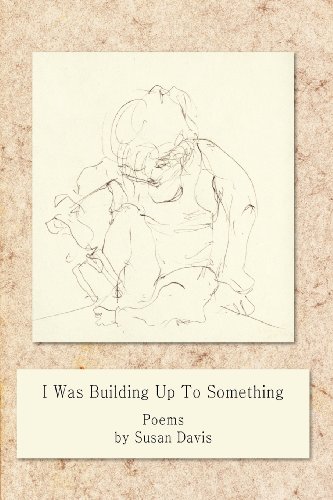
I Was Building Up To Something - Susan Davis (Moon Tide Press)

Today's book of poetry:
I Was Building Up To Something.  Susan Davis.  Moon Tide Press.  Irvine, California.  2011.


It happened again last night.  I was reading Susan Davis' splendid I Was Building Up To Something and I got to her poem "Undertaking" and I cracked through the silence, alarming Kirsty something fierce.  I whoooooped.  It hadn't been any sort of angry silence or unhappy silence, just the usual, late at night, both of us reading, toes touching, silence.  We'd talked our day over earlier, made our usual little complaints against the universe, solved some problems that weren't ours, laughed a little and then, as usual, read.

As I've said before, it takes a bad poem or a very good one for me to break the silence.

Then I usually read that bad or good poem to K.  She either scowls, laughs and goes back to her The Goldfinch by Donna Tartt or whatever other tome she is reading, or she puts down her book and takes my hand, shares the moment, and then goes back to her book.

K loved this poem.

Undertaking

She had to wash away
the black silt
worked into his pores, into
the wrinkles around his eyes
that made him look older
than his 47 years.
She walked his naked length
on the table at her waist
where she kneaded dough,
where she told the men to place him.
She had given them the children
and made them all leave.
She took her time.
By lantern-light, she washed each finger,
cleaning underneath the nail with
a splinter sheathed in cotton.
She started once to wrap him
in a blanket. He was so cold.
She found a mole on his hip
she never knew was there.
I thought he would have liked
to have her find the mole like this
when he was still alive.
I said to you
when the husband died,

The way it's done now,
they make her leave the room,
leave the body with a stranger
who zips it up in a plastic bag,
tags it like a specimen,
puts this warm sweet body
in a drawer.
They let a stranger handle you
that one last time.
They would have to drug me.
They would have to drag me away.

Remember how I told you that?

...

Today's book of poetry frequently falls victim to romantic shambles and Susan Davis has that voice honed, whet-sharp.  In her poem "Hindsight" when she intones the following I almost fell apart:

What do we want so badly
that we give up those we love to get it?

Lines like these haunt me like a ghost.  So I passed I Was Building Up To Something around the office, like we always do, and was surprised.  Milo read it last, as usual, but today when he finished reading he didn't scowl and throw the book back at me.  Instead he asked, almost politely, if he could keep it until after lunch.  He wanted to give it another go.

This is poetry that reminds the reader of what it is we really struggle with, the basic firmaments of our desire to be good.  Discovering basic goodness is a life long pursuit and Davis provides us with some very illuminating and instructional moments.

Davis writes serious poems that resonate in the reader's ear as though it were common knowledge we were being reminded of, that we are all this wise.  Davis is just reminding us.

Gravity

Ticking marks seconds players use to list words starting with a
  single letter.
It is the end of concentration and a style of thinking.

I have won before. And the smile of summer at table under trees.
Rugs looped on little metal spikes and sheets stiff from sun-drying.

O! the looping car sighs in the suburb summer.
The tire blimp is grinding over like a rainless thunderstorm.

Ten years ago its pilot grabbed a trailing rope to reattach the
  mooring
and it took him off into the small plane space just above the houses

but high enough. He was trying to save it. He was going up with
  the ship
and then he was falling away. What was he thinking? When did he
know

he had misjudged? At the gym we talk fat, muscle, bicep curl,
  lunge.
If he had been stronger. She says work to failure. Exhaust the
  muscle.

And I want to rest. I get tired of holding on. His body whipping
  along like a flag
over the woman strolling her baby and the boy cutting grass for
  his father.

People watching the towers burning and groaned as the bodies
  dropped
a very simple way. There's no help. Then falling is what's left to
  do.

...

Davis kept me riveted from beginning to end of I Was Building Up To Something.  These poems hum with all the right tension.  They are sometimes passion and sometimes pain but always right on target. By the time you get to the end of I Was Building Up To Something you feel completely invested in the poetry of Susan Davis.

I Was Building Up To Something is like a photo album full of strangers who look like you - it is a familiar.  Not because Davis knows you but because she know us  -  because the good stuff is universal.

Progeny

          My conclusions are often wrong, but I don't find out until it's
too late. Then again, who gets to say it's too late? I'm not dead yet.
          That sounds like my daughter. She thinks she'll never die. If
I were sixteen with such fierce grandmothers, I might feel the same.
They'll live to be a hundred. That's a conclusion.
          Endings got heavier with my father's death - the only son,
after my brother - the only son. Now my aunts and their sons are
dying, as if a plague had been designed to stamp out the family.
          I read about the Tutsis and the Hutus in Rwanda. In
Waimanalo, they wait for the day when the north part of Oahu will
be returned to the Kanaka Maoli. I don't know how my Great Aunt
Mattie's land was split up when she died. There are no natives left
to return it to. I don't think Ina Claire will keep up the practice of
stocking the pond and giving each grandchild for birthdays an acre
and a calf to raise.

...

Today's book of poetry simply liked the way Davis talked.  These plain speaking poems are all an open door, their geography welcoming, the weather unpredictable but always instructive.

Susan Davis

ABOUT THE AUTHOR
Susan Davis's poetry reflects a birth in Louisiana, a childhood in upstate New York and stints in the giant states of Texas and Alaska.  She now resides in California with her husband and directs under-graduate creative writing at University of California, Irvine.  Her poem "The Season Begins in a Waiting Room" was chosen for the 2010 Rebecca Lard Poetry Award, and the poem "Farm Days" was installed on wind screens at the Lake June transit station in Dallas in November of 2010.  She is the mother of two daughters.  I Was Building Up To Something is her first book.

BLURBS
There's an ancient Chinese sensibility to Susan Davis' poems, a compression of line and idea, but not of emotion, which I found profoundly moving. While trying to write these lines, I kept replaying her haunting music and rhythms. A first book with the wisdom of several, and I haven't even mentioned that she already owns her own stark, unflinching, original vision or our redoubtable, ever-mysterious world. It's a pleasure to help welcome a new and memorable voice to our literature.
      - Philip Schultz

Susan Davis' poems remind us what reverence is, its sources, why we might quiet ourselves down enough to remember and to hear what brings us to our knees, sometimes with pain, sometimes with joy. Allow the quiet. Kneel down in the garden.  Read these perfect, careful poems.
      - Michelle Latiolais

With an astounding clarity, I Was Building Up To Something looks at the world of family and faith, the vicissitudes of love and longing. The poems explore deeply the fundamental experiences all thinking, feeling people face in a world where spiritual longing is often met with terrifying silence, and the sensation of time passing is both a blessing and a curse. Plainspoken, fresh and unpredictable, they heighten the sense of human attachment. This is a beautiful book. It should be required reading for anyone wishing to live a serious life.
     - Alan Shapiro

Susan Davis' book has the indelible yet understated quality of certain great photographs. Sharp edges of narrative, clarity of emotion, distinct images in declarative sentences, the velvet, gradated shadows of loss, unpredictable rhythms of violence and tenderness in country life and family life: from the precisions of that exacting surface rise the mysteries of life itself, caught in the trigger-slices of these urgent, concentrated poems.
     - Robert Pinsky

Susan Davis
reading from I Was Building Up To Something
at the Muckenthaler Cultural Center
Fullerton, California
18.12.11
video: kmichaelobrien


378

DISCLAIMERS

Poems cited here are assumed to be under copyright by the poet and/or publisher.  They are shown here for publicity and review purposes.  For any other kind of re-use of these poems, please contact the listed publishers for permission.

We here at TBOP are technically deficient and rely on our bashful Milo to fix everything.  We received notice from Google that we were using "cookies"
and that for our readers in Europe there had to be notification of the use of those "cookies.  Please be aware that TBOP may employ the use of some "cookies" (whatever they are) and you should take that into consideration.